

Why Are Hundreds Dying in the Red Sea Migration Route?
By Darius Spearman (africanelements)
Support African Elements at patreon.com/africanelements and hear recent news in a single playlist. Additionally, you can gain early access to ad-free video content.
Tragedy off the Coast of Obock
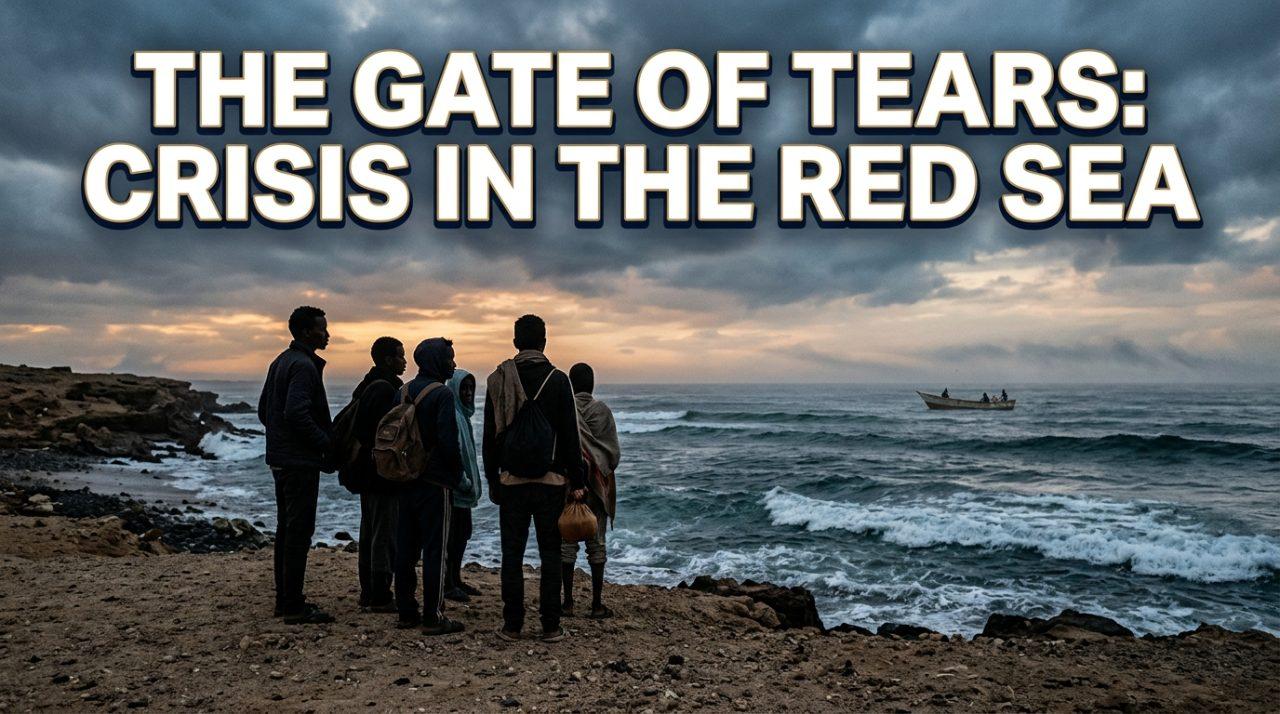
The dark waters off the coast of Djibouti hide unspeakable horrors. Late at night, an overcrowded boat carrying 305 migrants capsized near the small coastal community of Guhere (cbc.ca). Most aboard were young Ethiopians seeking economic survival across the sea (theeastafrican.co.ke, newsweek.com). Emergency search teams confirmed that at least 139 people drowned, including 15 children (theguardian.com, africanews.com). Rescuers pulled only 82 survivors alive from the suffocating surf, leaving dozens lost beneath the waves (cbc.ca, theguardian.com).
The vessel began taking on water almost immediately after launching into the darkness (theguardian.com). Overcrowding quickly destabilized the fragile wooden craft (the-independent.com). Alexandre Coissac, the Chief of Mission for the International Organization for Migration in Djibouti, reported that local resources were instantly overwhelmed by the scale of the disaster (theeastafrican.co.ke). As washed-up bodies lined the sand, workers dug mass graves in the desert earth (cbc.ca, theguardian.com). This catastrophe is not an isolated maritime accident. Instead, it is the predictable outcome of an entrenched global migrant corridor known as the Eastern Route (iom.int).
Casualties of the Obock Boat Disaster
The Ancient History of the Gate of Tears
The maritime channel separating the Horn of Africa from the Arabian Peninsula is the Bab-el-Mandeb Strait. In Arabic, this name translates directly to the “Gate of Tears.” Ancient mariners gave this 20-kilometer passage its grim title because of perilous navigation and treacherous rip tides. However, ancient folklore also speaks of tears shed during tectonic separations that split the continents apart. For millennia, this narrow passage served as a bustling commercial and migratory artery linking African kingdoms to Arabian commerce (iom.int).
Historical trading fleets navigated these waters carrying incense, gold, spices, and ivory as part of dynamic commercial exchanges that defined ancient African civilizations. Concurrently, regional empires engaged in cultural contact and religious pilgrimages toward Mecca. Yet, these historical routes also enabled the brutal Red Sea slave trade, transporting captive laborers northward. Consequently, deep connections have bridged the Horn of Africa and the Gulf for centuries. The contemporary pathway is not a modern invention, but rather an evolution of ancient maritime exchange.
The 1990s and the Rise of Smuggling Networks
Modern irregular migration along the Eastern Route consolidated rapidly during the early 1990s. The fall of the military Derg regime in Ethiopia in 1991 produced intense political realignments. At the same time, the state collapsed in neighboring Somalia, triggering severe cross-border displacement. Economic restructuring programs across East Africa eliminated millions of rural safety nets. Simultaneously, oil-producing nations in the Persian Gulf embarked on rapid urban construction projects, creating an endless appetite for cheap manual and domestic labor.
During this period, traditional dhow sailing operations transformed into criminal human trafficking rings. Local recruitment brokers, known locally as delalas, fanned out into remote Ethiopian villages. These brokers convinced rural youth that prosperity waited across the Red Sea for a modest transportation fee. Over the following three decades, the Eastern Route grew exponentially in volume. In multiple years, passenger counts along this waterway completely surpassed crossings in the Mediterranean Sea (iom.int). An ancient maritime crossroads had permanently become a commercialized corridor of human desperation.
Modern Drivers: Conflict and State Fragility
Today, more than 90 percent of people journeying through Obock are Ethiopian citizens (iom.int). Global observers often dismiss these travelers as purely economic migrants looking for higher wages. The underlying reality is far more complex and dangerous. The devastating 2020–2022 Tigray war destroyed civilian infrastructure and displaced millions of people across northern Ethiopia. Although formal peace accords ended large-scale fighting, violent clashes quickly erupted in neighboring territories like Amhara and Oromia.
Armed conflict reignited when the federal government attempted to dissolve regional paramilitary forces into the national military. Militias such as the Amhara Fano resisted this mandate, claiming the dissolution left local communities unprotected against surrounding forces. Additionally, the peace agreement failed to settle intense disputes over contested areas such as Western Tigray. Ethnic tensions across rural provinces continue to fracture farming regions. Many survivors of the recent shipwreck fled villages where gunfire, arbitrary detention, and military sweeps made daily life impossible.
Environmental Shocks and Economic Despair
Climate catastrophes compound the displacement created by political instability. The Horn of Africa recently experienced its worst historic drought in over four decades. Five consecutive rainy seasons failed, drying up staple crops and killing millions of livestock. These environmental disasters pushed vulnerable families to starvation. Desperate rural communities exhausted every traditional survival mechanism, forcing youth to abandon pastoral lands entirely.
Moreover, severe economic problems leave working-class youth without viable opportunities at home. Skyrocketing consumer inflation, deep currency devaluations, and stagnant rural wages make daily survival a constant struggle. These compounding financial pressures resemble historical debt crises that have long restricted African economic sovereignty. Under such conditions, paying a smuggler appears to be the only available lifeline. Desperate families pool their remaining savings to send a single young relative abroad to secure remittances.
Primary Motivations for Horn of Africa Migration
Why Legal Migration Remains Inaccessible
Many observers wonder why East African laborers choose irregular smuggling routes instead of boarding commercial flights with visas. The reality is that legal immigration mechanisms systematically exclude working-class Africans. Administrative costs for official recruitment programs regularly exceed several hundred dollars. For an impoverished farm worker, obtaining a passport, medical clearance certificates, and agency approval represents an impossible financial hurdle. Smugglers offer deferred, debt-financed transit that poor families can afford upfront.
Furthermore, destination states enforce restrictive visa regimes that exclude informal manual laborers. Asian countries have established durable bilateral labor agreements with Gulf employers over many decades. Conversely, East African governments have historically cycled through abrupt bilateral bans due to documented abuse of overseas domestic workers. These diplomatic suspensions routinely block legal pipelines. Because working-class laborers cannot secure formal entry permits, they are forced to use clandestine border networks.
The Multi-Stage Desert Gauntlet
The shipwreck off Obock is only one phase of an arduous journey. Before even reaching the water, migrants must survive a punishing desert trek. Travelers march for days through Djibouti’s Danakil desert, enduring temperatures above 45 degrees Celsius (113 degrees Fahrenheit). Dehydration, heat stroke, and exhaustion claim scores of lives along these paths every month (iom.int). Over 3,000 exhausted migrants were recently found stranded along Djibouti border roads without food or clean water (iom.int).
Upon reaching the coast, travelers find themselves trapped in unregulated transit staging camps. Smugglers charge extortionate fees while cramming hundreds of passengers into unseaworthy skiffs (the-independent.com). In recent weeks alone, regional authorities documented more than 20,000 border movements entering Djibouti from Ethiopia (iom.int). Smugglers routinely launch these overloaded vessels at night to evade maritime coast guards (theeastafrican.co.ke, theguardian.com). If rough currents strike the overloaded hull, the unseaworthy craft capsizes within minutes.
Annual Eastern Route Migrant Fatalities
Exploitation and Lethal Borders in the Gulf
For those who survive the maritime crossing, the ordeal only deepens in Yemen. The country remains fractured by more than a decade of civil war. Criminal gangs kidnap arriving migrants, holding them in clandestine detention camps to extort ransoms from their relatives. Survivors who make it to the northern frontier face heavily militarized border security forces. United Nations investigators and rights groups have documented horrific border violence, including the use of explosive weapons and point-blank gunfire against migrant groups.
Migrants who manage to slip through face systemic exploitation under the kafala sponsorship system. Under this legal framework, a worker’s legal status is tied directly to a single employer. This arrangement enables rampant abuses, such as confiscated passports, withheld wages, and forced confinement. Undocumented workers face apprehension, detention in unsanitary holding centers, and eventual deportation back to the Horn of Africa. The journey mirrors the historical hardships faced during mass migrations driven by racial hostility. Despite these severe risks, thousands continue to risk their lives across the Bab-el-Mandeb.
Humanitarian Response and the Path Ahead
The tragedy off Djibouti underlines how vulnerable emergency infrastructure is throughout the region. Djiboutian coast guards and rescue teams recovered bodies for multiple days as the death toll climbed (theeastafrican.co.ke, theguardian.com). Local morgues lacked the facilities to care for so many victims, forcing authorities to organize mass burials in the desert sands (cbc.ca, theguardian.com). Medical teams from the International Organization for Migration treated survivors for chemical burns caused by toxic mixtures of seawater and spilled boat fuel (theeastafrican.co.ke, theguardian.com).
International Organization for Migration Director General Amy Pope stressed that tragedies will continue without policy reform (iom.int). She declared that no one boards such unseaworthy vessels unless they believe no other option exists for survival (iom.int). Ending this loss of life requires addressing regional conflicts, expanding legal migration channels, and dismantling predatory trafficking syndicates (iom.int). Until African workers gain access to secure, dignified alternatives, the Bab-el-Mandeb Strait will continue to claim lives, preserving its tragic historical reputation as a Gate of Tears.
About the Author
Darius Spearman is a professor of Black Studies at San Diego City College, where he has been teaching for over 20 years. He is the founder of African Elements, a media platform dedicated to providing educational resources on the history and culture of the African diaspora. Through his work, Spearman aims to empower and educate by bringing historical context to contemporary issues affecting the Black community.
