


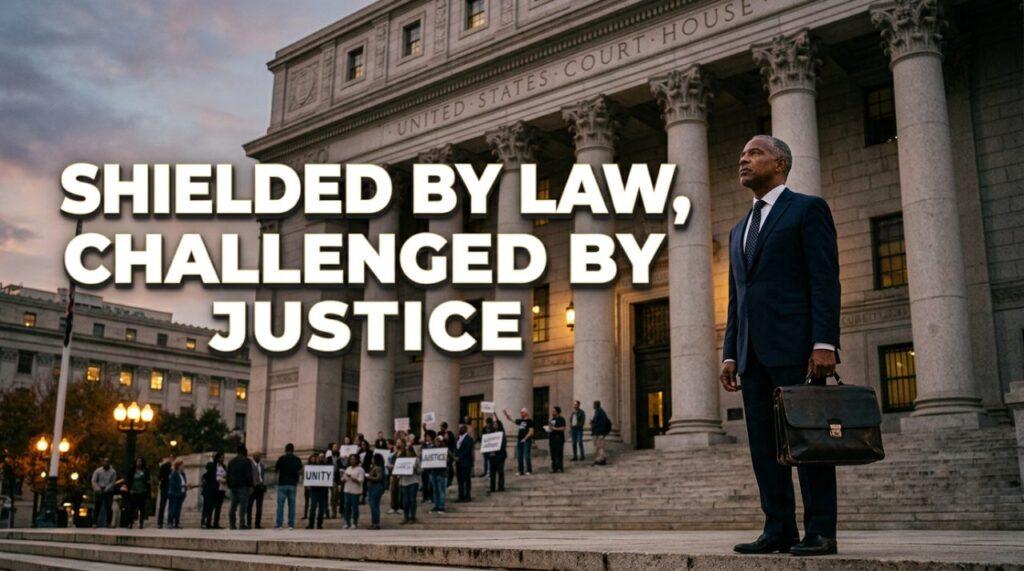
Why Police Qualified Immunity Faces a Reckoning in Court
By Darius Spearman (africanelements)
Support African Elements at patreon.com/africanelements and hear recent news in a single playlist. Additionally, you can gain early access to ad-free video content.
The Ledge and the Coma: The Reality of Black v. Weber
A routine traffic stop in Georgia escalated into a life-threatening disaster for an unarmed Black passenger named Angelo Black. Black was riding in a car when police initiated a stop (naacpldf.org, 11alive.com). Officers did not suspect him of any ongoing crime or violent action. Yet, an officer attempted to execute a physical pat-down search on him without a warrant or individual suspicion (naacpldf.org). Feeling threatened, Black stepped back, ran several paces, and vaulted over an elevated concrete ledge (naacpldf.org).
While Black was airborne over the drop, the pursuing officer fired a Taser directly into his body without giving any verbal warning (naacpldf.org). The electric probes triggered instant neuromuscular incapacitation. Because Black could not use his arms to brace for impact, he plummeted headfirst toward the pavement below. The violent fall produced catastrophic skull fractures and traumatic brain swelling (naacpldf.org, 11alive.com). Doctors placed Black into an extended medically induced coma to preserve his life (naacpldf.org).
Following this tragedy, the Legal Defense Fund intervened in the federal appeal known as Black v. Weber (naacpldf.org). Civil rights attorneys joined the case after a federal district judge denied qualified immunity to the officer (naacpldf.org). The officer appealed to the United States Court of Appeals for the Eleventh Circuit, claiming existing law did not clearly forbid tasing an airborne suspect (naacpldf.org). The outcome of this case now tests the outer boundaries of police accountability across the nation.
The Reconstruction Era and the Roots of Section 1983
To understand why police officers routinely claim immunity today, one must examine the bloody aftermath of the American Civil War. During Reconstruction, white supremacist groups waged a campaign of racial terror against newly freed Black citizens. White vigilantes and local sheriffs worked together to deny basic constitutional rights. Congress realized that state courts in the former Confederacy would never hold violent officials accountable.
Consequently, federal lawmakers passed the Ku Klux Klan Act of 1871 to enforce the Fourteenth Amendment. A core provision of that landmark statute survives today as Title 42, United States Code, Section 1983 (nd.edu). This law created a direct civil pathway for citizens to sue state and local officials who violate federal constitutional protections (nd.edu). It aimed to dismantle systems of involuntary servitude after emancipation by guaranteeing federal court access.
The original statutory text of Section 1983 was remarkably clear and uncompromising. It stated that any official who deprived an individual of constitutional rights “shall be liable to the party injured” (nd.edu). The Reconstruction Congress included zero carve-outs, defenses, or blanket protections for municipal actors (nd.edu). For nearly a century, the law stood as an absolute guarantee that public agents could not abuse their authority with legal impunity.
The Invention of Qualified Immunity: From Good Faith to Impunity
The modern barrier to police accountability did not originate from elected legislators. Instead, the Supreme Court created qualified immunity out of whole cloth during the Civil Rights Movement (nd.edu). In the 1967 case Pierson v. Ray, police arrested Black and white clergymen who were peacefully desegregating a Jackson, Mississippi bus terminal (nd.edu). The Supreme Court ruled that local officers could avoid financial liability if they acted in subjective “good faith” under laws they believed were valid (nd.edu).
Fifteen years later, the high court reshaped the doctrine into an aggressive defense. In Harlow v. Fitzgerald, the justices abandoned the inquiry into an officer’s subjective motives (nd.edu). The Court established an objective legal test: government officials are shielded from civil lawsuits unless their conduct violates “clearly established statutory or constitutional rights of which a reasonable person would have known” (nd.edu).
This standard became even more rigid after the 2009 ruling in Pearson v. Callahan (nd.edu). The Supreme Court allowed judges to dismiss lawsuits simply because no prior court had addressed an identical factual scenario (nd.edu, yalelawjournal.org). Under this procedural rule, judges regularly decline to decide whether an officer committed an unconstitutional act (yalelawjournal.org). Legal scholars refer to this dynamic as constitutional stasis, because new constitutional rights can never become clearly established when courts refuse to rule on them (yalelawjournal.org).
Civil Rights Judgment Payment Sources
The Illusion of Officer Liability: What the Data Reveals
Defenders of qualified immunity claim that the doctrine prevents law enforcement officers from facing personal financial ruin. However, empirical legal research completely disproves this persistent narrative. A landmark investigation conducted by Professor Joanna Schwartz examined dozens of law enforcement agencies across the country (cvpsd.org). The study revealed that individual police officers almost never pay civil rights settlements or judgments out of their own pockets (cvpsd.org).
In reality, municipal governments and insurance carriers pay more than 99.98 percent of all civil damages awarded to victims of police misconduct (cvpsd.org). Officers do not risk bankruptcy when citizens sue them for constitutional violations. Instead, local taxpayers shoulder the bill, while the individual officers routinely walk away without personal financial liability (cvpsd.org). Qualified immunity does not shield officer bank accounts; it simply denies injured plaintiffs their rightful day before an impartial civil jury.
Furthermore, appellate court data indicates that federal judges dismiss more than sixty percent of civil rights appeals on qualified immunity grounds. When defense attorneys file early motions to dismiss, lower courts frequently grant them before discovery even begins. This legal reality prevents victims from gathering internal police records, body camera footage, and departmental communications. The doctrine operates as a nearly impenetrable shield that silences civil rights claims before juries can hear the facts.
Electrified Weapons and Gravity: A Pattern of Deadly Force
Under the Fourth Amendment baseline established in Graham v. Connor, any use of police force must be objectively reasonable (daiglelawgroup.com). When departments first introduced conducted electrical weapons, administrators marketed them as harmless, intermediate control tools. Law enforcement officials claimed these shock devices would reduce physical injuries during street arrests. Yet, electroshock weapons deliver thousands of volts that cause instantaneous, total muscular paralysis.
When an officer fires a Taser at someone standing on high ground, gravity turns an intermediate stun device into potentially lethal force. The Fourth Circuit affirmed this principle in Armstrong v. Village of Pinehurst, warning against deploying electroshock weapons on vulnerable or non-violent subjects (daiglelawgroup.com). Other federal courts, including the Sixth Circuit in Phelps v. City of Saginaw, have reiterated that electrical weapons carry severe risks of death when applied recklessly (daiglelawgroup.com).
National investigative reporting indicates that more than 1,080 individuals have died in the United States following police Taser encounters since 2000 (capitalbnews.org). The human toll reveals stark, painful racial patterns. Black people represent only about 13.6 percent of the national population, but account for approximately 32 percent of all Taser-related fatalities (capitalbnews.org). Firing a weapon that induces total physical helplessness at an airborne individual violates basic safety guidelines and basic constitutional protections (naacpldf.org, 11alive.com).
Black Representation: Population vs Taser Deaths
Traffic Stops and Passenger Rights: The Shadow of Racial Profiling
The violent encounter in Angelo Black’s case started with a roadside vehicle stop (naacpldf.org). In American jurisprudence, traffic detentions are the single most frequent point of contact between civilians and law enforcement. In Terry v. Ohio (1968), the Supreme Court ruled that officers may only execute an investigatory stop and frisk when they possess reasonable suspicion of criminal activity (justia.com). Decades later, the Court established clear guidelines for passengers in Arizona v. Johnson (justia.com).
The unanimous ruling in Arizona v. Johnson made one point explicit: while officers may temporarily detain vehicle occupants, a physical pat-down requires independent reasonable suspicion that the passenger is armed and dangerous (justia.com). An officer cannot lawfully frisk a passenger simply because the driver committed a traffic violation (justia.com). Without specific, observable signs of an immediate physical threat, a hands-on search violates the Fourth Amendment (justia.com).
Nevertheless, police departments have long relied on pretextual stops to search Black motorists. Under the doctrine of Whren v. United States (1996), the Supreme Court permitted officers to use minor traffic infractions as cover to conduct unrelated investigatory stops. Black drivers and passengers face physical searches, verbal intimidation, and invasive questions at rates far exceeding their white counterparts. These aggressive practices reflect the enduring contradictions of early American legal traditions regarding personal freedom and equal treatment.
Sanctuary Under Pressure: Federal Immigration and Local Policing
While the Legal Defense Fund challenged qualified immunity in Georgia, it also mobilized against municipal policing abuses in New York City (naacpldf.org). The intersection between municipal authority and federal deportation agencies carries a deep legislative history. In 1996, the federal government passed the Illegal Immigration Reform and Immigrant Responsibility Act, creating Section 287(g) agreements. These pacts allowed local police to perform the functions of federal immigration agents.
In response, major cities developed sanctuary ordinances anchored in the Tenth Amendment’s anti-commandeering doctrine. Under Printz v. United States (1997), the Supreme Court ruled that the federal government cannot command local agencies to administer federal regulatory regimes. New York City established early protections through Mayor Edward Koch’s Executive Order 124 in 1989. Mayor Michael Bloomberg expanded those protections in 2003 through Executive Order 41, prohibiting city workers from disclosing immigration status (wikipedia.org).
City lawmakers reinforced these protections by enacting landmark detainer laws in 2011 and 2014 (wikipedia.org). These municipal statutes forbade the New York Police Department and the Department of Correction from honoring federal immigration detainers without a judicial warrant signed by a federal judge (wikipedia.org). This local framework demonstrated the complex dynamics of federalism that shape local policy. However, police cooperation with federal agents often continues beneath the surface.
Confrontation in the Bronx: The Spark at Marble Hill
Tensions over local police compliance reached a boiling point following a violent confrontation in the Marble Hill section of the Bronx (naacpldf.org). A federal Immigration and Customs Enforcement agent opened fire on a moving vehicle occupied by a Dominican national named Oscar Belgal (naacpldf.org, courthousenews.com). Belgal’s five-year-old child was sitting directly inside the targeted vehicle when the federal officer discharged the weapon (naacpldf.org).
The shooting sparked outrage throughout the surrounding working-class neighborhood. Community residents quickly gathered in the streets to protest the federal gunfire and demand safety for immigrant families (naacpldf.org, leftvoice.org). Rather than de-escalating the crisis or investigating the reckless federal discharge, the NYPD arrived in force (naacpldf.org, leftvoice.org). Municipal officers deployed aggressive crowd-control tactics and placed peaceful civilian demonstrators in handcuffs (naacpldf.org, lavocedinewyork.com, leftvoice.org).
Civil rights observers noted that local police were shielding federal agents who had just endangered an innocent child (naacpldf.org). The Legal Defense Fund swiftly sent a formal demand letter to New York City Mayor Zohran Mamdani (naacpldf.org). The civil rights organization demanded an immediate cessation of all municipal agency cooperation with federal deportation raids (naacpldf.org). The letter warned that local police assistance directly undermined municipal sanctuary promises.
Why the Legal Defense Fund Connects Police Reform and ICE
Some observers questioned why the Legal Defense Fund—an institution established by Thurgood Marshall to combat anti-Black discrimination—intervened against federal immigration enforcement (naacpldf.org). The answer lies in the shared machinery of systemic bias. In the United States, municipal traffic detentions and street interrogations operate as the front door to civil detention and federal deportation pipelines.
Research published by the Thurgood Marshall Institute demonstrates that Black immigrants experience profound disparities within the deportation system (naacpldf.org, tminstituteldf.org). While Black immigrants make up only about five to seven percent of the noncitizen population, they account for more than twenty percent of all noncitizens facing deportation on criminal grounds (naacpldf.org, tminstituteldf.org). Discriminatory police stops in Black neighborhoods expose these residents to immediate federal detention, even when local charges are dropped or dismissed (naacpldf.org).
Black Noncitizens: Population vs Criminal Deportations
Consequently, Fourth Amendment protections against unreasonable searches and Fourteenth Amendment guarantees of equal protection are deeply intertwined with municipal immigration policy (naacpldf.org, naacpldf.org). When local police share registry data or run joint operations with federal agents, they reproduce patterns of racial subordination. The struggle against unchecked law enforcement power spans both criminal courts and immigration detention centers.
Dismantling the Pipeline: The SRG, the CURB Act, and the NYC Trust Act
Civil rights coalitions in New York City have focused their legislative energy on three specific policy targets: the Strategic Response Group, the CURB Act, and the NYC Trust Act (naacpldf.org, nyclu.org). The NYPD formed the Strategic Response Group in 2015 as a dedicated, heavily armed counterterrorism division (nyclu.org). However, department leaders quickly reassigned this tactical unit to police First Amendment demonstrations across the city (nyclu.org).
Civil rights attorneys have documented that the unit routinely relies on violent crowd-control methods, including baton charges, chemical agents, and kettling (nyclu.org). To stop these tactics, advocates introduced the CURB Act into the City Council (naacpldf.org, nyclu.org). This proposed statute would prohibit rapid-response units from deploying to peaceful protests, stripping militarized divisions of their authority to suppress civilian demonstrations (nyclu.org).
Simultaneously, advocates are championing the NYC Trust Act to close administrative loopholes in existing sanctuary laws (naacpldf.org, immigrantdefenseproject.org). While past executive orders restricted cooperation, they lacked binding enforcement mechanisms. The Trust Act creates an explicit private right of action, granting wronged residents the power to sue municipal agencies that unlawfully share surveillance data or coordinate with federal immigration authorities (immigrantdefenseproject.org). This legislation gives real legal teeth to local protections.
A Converging Battle for Constitutional Dignity
The parallel fights in Georgia and New York City expose the structural flaws that undermine American constitutional rights. In Black v. Weber, government lawyers argued that an officer cannot face liability without an identical prior case on the books (naacpldf.org). Meanwhile, municipal agencies in New York continue cooperating with aggressive federal agents despite clear local sanctuary mandates (naacpldf.org). These parallel actions reflect persistent institutional resistance against public accountability.
Civil rights struggles cannot rely on minor bureaucratic adjustments or well-meaning executive promises alone. Challenging qualified immunity in the Eleventh Circuit strikes at the heart of judicial impunity that shields excessive force on the streets (naacpldf.org). Enacting the CURB Act and the NYC Trust Act dismantles the municipal infrastructure that feeds families into deportation cells (naacpldf.org). Both movements demand that the constitutional rights written on paper must protect human beings in daily life.
Whether resisting aggressive traffic stops or fighting digital deportation pipelines, Black and Brown communities continue to confront contemporary Black political dynamics with determination. The Legal Defense Fund’s dual intervention reminds the nation that civil rights cannot be divided into separate compartments. When law enforcement officers act without accountability, constitutional freedoms disappear for everyone. Real accountability demands a system where no badge, doctrine, or municipal policy stands above the fundamental law of human dignity.
About the Author
Darius Spearman is a professor of Black Studies at San Diego City College, where he has been teaching for over 20 years. He is the founder of African Elements, a media platform dedicated to providing educational resources on the history and culture of the African diaspora. Through his work, Spearman aims to empower and educate by bringing historical context to contemporary issues affecting the Black community.
