


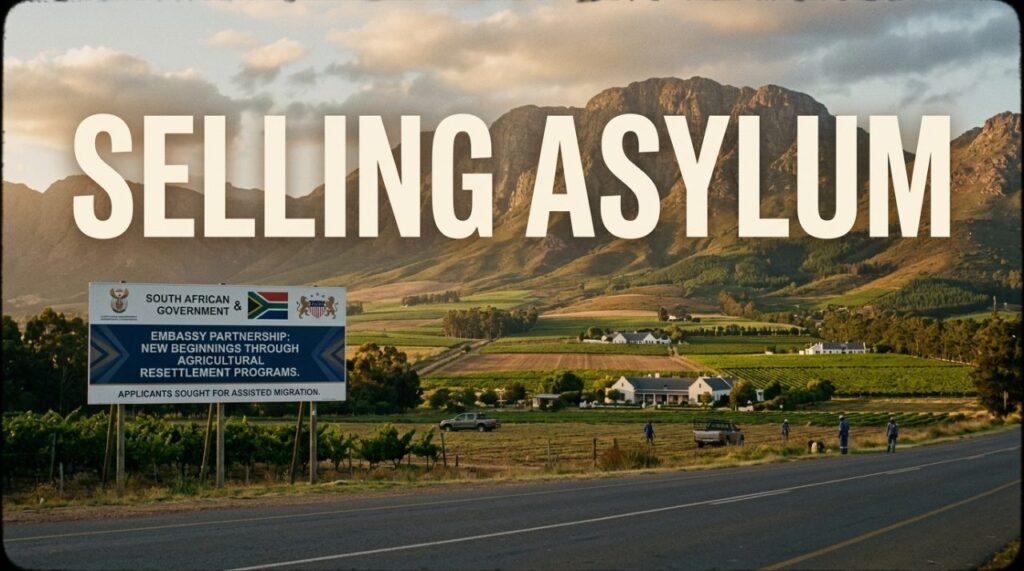
Why Is Washington Advertising Asylum to White South Africans?
By Darius Spearman (africanelements)
Support African Elements at patreon.com/africanelements and hear recent news in a single playlist. Additionally, you can gain early access to ad-free video content.
A Taxpayer Campaign to Recruit Reluctant Refugees
Federal immigration authorities are weighing a taxpayer-funded advertising project in South Africa. The proposed initiative carries a budget of roughly three hundred and thirty-five thousand dollars. Its primary objective is unusual for the United States government. Officials want to convince white Afrikaners to leave their homeland and resettle on American soil (apnews.com, pbs.org).
This initiative follows an aggressive overhaul of the United States Refugee Admissions Program. Under an initiative dubbed “Mission South Africa,” the administration allocated hundreds of millions of dollars to welcome white farmers. Yet federal figures show that very few people applied. Instead of evaluating the core assumptions of the program, officials decided to launch a public relations campaign to recruit candidates (apnews.com, cbsnews.com).
Colonial Conquest and the Roots of South African Inequality
The origins of modern South African land ownership began in the seventeenth century. In 1652, the Dutch East India Company established a permanent settlement at the Cape of Good Hope. European settlers steadily displaced indigenous Khoikhoi, San, Xhosa, and Zulu populations. Settler militias seized vast grazing lands and fertile valleys across several generations (wikipedia.org).
Colonial officials later codified this dispossession into national law through the Natives Land Act of 1913. This legislation prohibited Black citizens from purchasing or renting land across more than ninety percent of the country. That policy shattered indigenous self-sufficiency and created a captive labor reserve. Much like the failures of Reconstruction in the American South, colonial statutes denied Black families economic independence (wikipedia.org, cepr.net).
In 1948, the Afrikaner-dominated National Party consolidated this racial hierarchy under apartheid. The regime established comprehensive racial segregation. Over three million non-white citizens suffered forced removal from their ancestral homes. Meanwhile, the state transferred premier agricultural real estate directly into white hands. The apartheid apparatus secured immense agricultural and mineral wealth for a tiny white minority (wikipedia.org).
South Africa Land Ownership vs Population Share
The Unfinished Business of Democratic Land Reform
When multiracial democracy arrived in 1994, President Nelson Mandela promoted peaceful reconciliation. The African National Congress adopted a market-friendly model known as “willing-buyer, willing-seller.” The state purchased land only when white commercial owners agreed to sell at fair market value. Consequently, redistribution proceeded at an agonizingly slow pace (wikipedia.org, cepr.net).
Decades after the fall of apartheid, racial inequality remains stark. White South Africans make up less than eight percent of the population. Nevertheless, they own nearly three-quarters of all privately held commercial agricultural land. South Africa still ranks as one of the most economically unequal societies on earth (cepr.net, theguardian.com).
To address this stagnation, the South African parliament debated constitutional provisions to authorize lawful expropriation. Lawmakers eventually passed the Expropriation Act. The statute permits land acquisition under narrow, court-reviewed public interest standards. Despite strict constitutional limits, right-wing lobbies described these legal measures as unlawful confiscation and racial assault (wikipedia.org, apnews.com).
Language, Identity, and the South African Racial Mosaic
The racial lexicon of South Africa contains crucial distinctions that Americans often misunderstand. In the United States, “colored” is an archaic, offensive Jim Crow term historically used to demean Black Americans. In South Africa, however, “Coloured” represents a distinct and proud demographic group (wikipedia.org, harvard.edu).
South Africa’s Coloured community constitutes roughly eight percent of the national population. Their heritage combines indigenous Khoisan ancestry, enslaved people brought from East Africa and Southeast Asia, European settlers, and Bantu groups. Under the Population Registration Act of 1950, apartheid officials separated citizens into Black, White, Coloured, and Indian categories. Coloured families suffered targeted expulsions from historic neighborhoods like District Six in Cape Town (wikipedia.org).
Today, Statistics South Africa maintains this classification for official census and equity monitoring. Many of the most impoverished communities across the Western Cape belong to this multiracial group. The ongoing struggle of these workers in South Africa illustrates how economic marginalization crosses racial categories while remaining rooted in colonial exploitation (wikipedia.org, harvard.edu).
The Great Replacement Myth and Rural Crime
South Africa experiences severe violent crime due to extreme poverty, systemic unemployment, and underfunded police agencies. Rural farm attacks, known locally as plaasmoorde, occur within remote farming regions. These assaults target isolated homesteads that lack emergency services. Right-wing lobbying organizations, such as AfriForum, claim these incidents represent a calculated ethnic cleansing campaign against white people (wikipedia.org, newlinesmag.com).
In reality, empirical data from criminologists and the South African Police Service disproves this narrative. Farm homicides claim between forty and sixty lives each year nationwide. These victims include both white farm owners and Black agricultural laborers. Independent monitoring proves that white citizens account for less than two percent of total annual homicides in South Africa (cepr.net, theguardian.com).
Nevertheless, international far-right networks weaponized these farm attacks to popularize the “Great Replacement” conspiracy theory. Originally popularized by French writer Renaud Camus in 2011, this ideology claims that elites are intentionally replacing white populations with non-white populations. This toxic narrative motivated deadly domestic terrorist attacks in the United States, including the 2017 Charlottesville rally, the 2018 Pittsburgh synagogue massacre, the 2019 El Paso shooting, and the 2022 Buffalo supermarket massacre (harvard.edu, newlinesmag.com).
South Africa Annual Homicide Victim Demographics
Black American Activism Versus Apartheid Diplomacy
The preferential treatment of white South African applicants stands in sharp contrast to historical American solidarity movements. Decades ago, African American activists organized powerful coalitions against the apartheid government. Advocacy groups such as TransAfrica joined forces with the Congressional Black Caucus to challenge Washington’s cozy relationship with Pretoria (cepr.net, harvard.edu).
Black leaders staged massive demonstrations and organized economic boycotts. Their tireless efforts culminated in the passage of the Comprehensive Anti-Apartheid Act of 1986. That legislation passed over the veto of President Ronald Reagan, establishing mandatory sanctions against the white-minority regime. Black Americans championed human rights abroad while fighting for the elusive promise of freedom at home (cepr.net, harvard.edu).
In contrast, federal authorities have consistently excluded Black refugees escaping actual political violence. During the 1980s and 1990s, the United States Coast Guard intercepted thousands of Haitian refugees at sea. American officials detained them in squalid military camps at Guantanamo Bay. Asylum seekers from Sudan and Mauritania face staggering denial rates under the Refugee Act of 1980. That statutory framework requires proof of individualized, state-sponsored persecution (cepr.net, harvard.edu).
Dismantling Global Asylum for “Mission South Africa”
Beginning in early 2025, American immigration policy underwent a radical transformation. The federal administration slashed the global refugee ceiling from one hundred and twenty-five thousand down to under eight thousand slots. This decision froze processing for hundreds of thousands of vulnerable families escaping civil war in Sudan, Syria, and the Democratic Republic of Congo (apnews.com, pbs.org).
Simultaneously, the administration created an exclusive resettlement corridor for white South Africans. Officials allocated roughly five hundred million dollars to transport and support these prospective arrivals. Secretary of State Marco Rubio initiated severe diplomatic measures against Pretoria. In March 2025, the State Department expelled South African Ambassador Ebrahim Rasool after he described the policy as white grievance politics (apnews.com, pbs.org, cbsnews.com).
Tensions escalated further through targeted visa restrictions against South African lawmakers who supported land restitution laws. Washington transformed humanitarian assistance into a punitive instrument against a democratic partner. Even so, the anticipated rush of applicants never materialized (apnews.com, pbs.org).
U.S. Refugee Program Shift (2024 vs 2026 Caps)
The Paradox of Reluctance: Why Farmers Refuse to Leave
The failure of the resettlement push exposes a massive disconnect between Washington’s rhetoric and reality. By late summer 2026, roughly thirteen thousand South Africans had accepted American relocation. That total fell far below federal goals. The sluggish intake led officials to propose the three hundred and thirty-five thousand dollar marketing program (apnews.com, pbs.org).
White Afrikaners maintain powerful cultural roots in the African continent. Unlike early British administrators who returned to England, Afrikaners trace their identity entirely to African soil. The word “Afrikaner” translates directly to “African.” Leaving their farms means abandoning centuries of heritage and language (wikipedia.org, theguardian.com).
Furthermore, white landowners enjoy extraordinary domestic privileges. Wealthy citizens protect their communities through private security firms, perimeter fencing, private healthcare, and independent solar grids. Commercial agricultural associations, including AgriSA, openly rejected the American genocide narrative. They understand that claiming false refugee status would destroy domestic race relations and insult neighbors who endure far worse poverty (apnews.com, theguardian.com).
Ideology Over Humanitarian Protection
The plan to buy advertising to persuade wealthy landowners to claim refugee protection reveals a troubling shift in American policy. Washington has repurposed its humanitarian machinery to serve domestic racial grievance narratives. Genuine refugees fleeing documented violence remain locked outside American borders (cepr.net, apnews.com).
The resilience of marginalized communities around the world reminds observers of the resilience of African American families during historic trials. True refugee protection exists to save those without resources or shelter. Manufacturing an imaginary crisis to justify racial favoritism harms international diplomacy and betrays the universal principles of human rights (cepr.net, harvard.edu).
About the Author
Darius Spearman is a professor of Black Studies at San Diego City College, where he has been teaching for over 20 years. He is the founder of African Elements, a media platform dedicated to providing educational resources on the history and culture of the African diaspora. Through his work, Spearman aims to empower and educate by bringing historical context to contemporary issues affecting the Black community.
