


HBCU Online Degree Consortium Unlocks Historic Access
By Darius Spearman (africanelements)
Support African Elements at patreon.com/africanelements and hear recent news in a single playlist. Additionally, you can gain early access to ad-free video content.
A Bold Step Toward Digital Self-Reliance
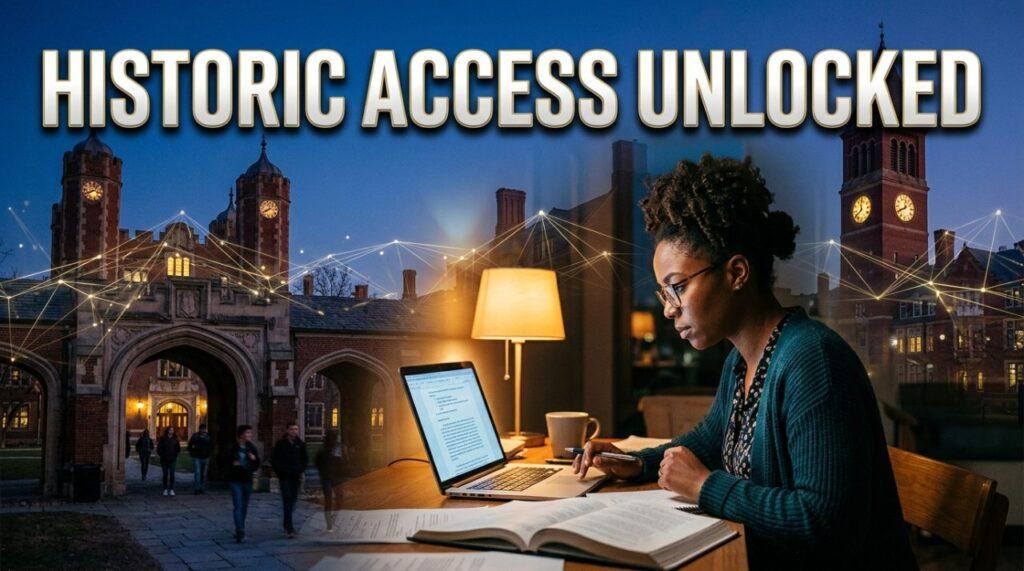
Six Historically Black Colleges and Universities have launched a unified digital education network called eHBCU (atlantadailyworld.com, ehbcu.edu). This alliance creates a shared virtual campus designed to eliminate long-standing barriers to degree completion (prnewswire.com, ehbcu.edu). Delaware State University anchors the collective effort alongside Alabama State University and the Pensole Lewis College of Business and Design (atlantadailyworld.com, ehbcu.edu). The partnership also includes three distinct campuses from the Southern University System in Baton Rouge, New Orleans, and Shreveport (atlantadailyworld.com, ehbcu.edu). Working adults and non-traditional scholars can now enroll through a single digital gateway (prnewswire.com, ehbcu.edu).
The coalition aims to serve working-class students who require flexibility to finish their academic journeys (prnewswire.com, ehbcu.edu). Backed by the Thurgood Marshall College Fund and philanthropic supporters like Blue Meridian Partners, this network pools institutional power (prnewswire.com, tmcf.org). Students can take accredited online classes across any of the partner colleges without administrative delays (prnewswire.com, ehbcu.edu). While the technology is modern, the collaborative philosophy draws directly from deep communal traditions of survival and collective advancement (pnpi.org, abhmuseum.org).
Roots in Resistance: Education After the Civil War
The origins of Black higher education began in a period of severe legal and racial repression (pnpi.org, abhmuseum.org). Before the Civil War, enslavement laws strictly prohibited Black literacy across the American South (pnpi.org, abhmuseum.org). A few pioneering institutions emerged in the North, such as Cheyney University in 1837 and Lincoln University in 1854 (pnpi.org, abhmuseum.org). Following the collapse of the Confederacy, newly freed people immediately organized independent schools in churches and abandoned military barracks (pnpi.org, abhmuseum.org). They understood that real emancipation required intellectual independence and economic self-sufficiency (abhmuseum.org).
Federal actions offered some initial assistance, but racial hostility quickly narrowed those early promises (pnpi.org, abhmuseum.org). Freedom did not bring immediate equality, as seen in widespread struggles after emancipation across the former plantation states. The First Morrill Land-Grant Act of 1862 had granted public lands to fund state colleges, but Southern legislatures blocked Black students (pnpi.org, tcf.org). In response, Congress passed the Second Morrill Land-Grant Act in 1890 (pnpi.org, tcf.org). This law forced states to either integrate existing land-grant universities or fund separate institutions for Black youth (pnpi.org, tcf.org). Rather than integrate, Southern governments created a segregated second tier of institutions (pnpi.org, tcf.org).
Unfunded State Promises to 1890 HBCUs
The Enduring Debt of State-Sanctioned Underfunding
The establishment of 1890 land-grant colleges did not guarantee financial fairness (tcf.org, ed.gov). State legislatures routinely withheld statutory matching funds from Black schools while pouring vast sums into white universities (tcf.org, ed.gov). A comprehensive federal study conducted in 2023 exposed the sheer magnitude of this historical theft (ed.gov). The Departments of Education and Agriculture found that sixteen states underfunded their 1890 land-grant HBCUs by over twelve billion dollars between 1993 and 2020 (ed.gov). This massive resource gap crippled campus facilities and limited digital upgrades (tcf.org, ed.gov).
Federal legislation attempted to correct these systemic deficits over the decades (pnpi.org, ed.gov). Title III of the Higher Education Act of 1965 formally recognized HBCUs as unique national assets (pnpi.org). It established specific grants to strengthen their academic programs and fiscal management (pnpi.org). Even with federal support, institutional endowments remained modest compared to wealthy predominantly white universities (pnpi.org, tcf.org). This historical undercapitalization forced Black colleges to operate with remarkable thrift (tcf.org, uncf.org). It also motivated modern educational leaders to build cooperative models instead of solitary, expensive computer systems (prnewswire.com, tmcf.org).
The Modern Completion Crisis and the Stopout Dilemma
Today, millions of students encounter severe obstacles on the road to a college degree (completecollege.org). More than forty-three million Americans have earned some college credit but left campus without completing a credential (completecollege.org). Within that national total, more than six million are Black learners who paused their education (completecollege.org). These students rarely leave school due to a lack of academic ability (completecollege.org, uncf.org). Instead, they leave because of financial distress, childcare demands, and inflexible work schedules (completecollege.org, uncf.org). Many individuals carry heavy student debt that mirrors broader patterns of systemic economic debt across marginalized communities.
The institutional capacity of smaller colleges can also unintentionally slow student momentum (completecollege.org). When a campus must cancel a low-enrollment class, students must wait a full term or more for that prerequisite to return (completecollege.org). A single missed course can push an adult learner completely out of the academic pipeline (completecollege.org). Historically, taking that needed class at another institution required endless paperwork, separate admissions fees, and credit evaluations (completecollege.org). Course-sharing platforms remove these administrative hurdles completely (prnewswire.com, sreb.org).
Student Financial Vulnerability Profiles
Inside eHBCU: Operational Mechanics and Shared Portals
The operational framework of the eHBCU consortium depends on practical collaboration through the Acadeum platform (prnewswire.com, ehbcu.edu). When students enroll in a course hosted by another campus, they remain fully matriculated at their home institution (prnewswire.com, ehbcu.edu). This design protects student financial aid packages, including federal Pell Grants and state awards (prnewswire.com, ehbcu.edu). Tuition billing stays simple and direct (ehbcu.edu). Students pay standard tuition directly to their home school, avoiding expensive out-of-state fees (ehbcu.edu).
Academic credits flow smoothly without complex transcript evaluations (prnewswire.com, ehbcu.edu). A student at Southern University at New Orleans can complete an advanced elective delivered by Delaware State University (prnewswire.com, ehbcu.edu). The earned grade posts automatically to the home transcript (ehbcu.edu). Furthermore, eHBCU pairs each learner with personal success coaches (prnewswire.com, ehbcu.edu). These advisors assist with time management, technology orientation, and degree mapping (prnewswire.com, ehbcu.edu). This hands-on structure reduces the isolation that frequently derails students in generic online learning programs (prnewswire.com, uncf.org).
Cultivating “The Virtual Yard” Across Digital Networks
Beyond course credits, HBCUs offer a distinct cultural sanctuary known colloquially as “The Yard” (uncf.org, uncf.org). The physical campus quad serves as a historic hub for fellowship, homecoming celebrations, and civic debate (uncf.org, uncf.org). It is a space where Divine Nine organizations perform and where faculty mentors nurture student leadership (uncf.org, uncf.org). Social scientists call this the institutional protective factor (uncf.org). It shields Black youth from the subtle racial hostility often experienced at majority institutions (uncf.org, uncf.org).
Consortium leaders now work deliberately to recreate that cultural warmth online (uncf.org, uncf.org). The network addresses historical distance learning barriers by designing digital classrooms that encourage active engagement (uncf.org, mmtconline.org). Synchronous virtual breakout sessions and regional networking groups help remote learners connect personally (uncf.org, uncf.org). Students interact directly with faculty who share their cultural references and understand their daily struggles (uncf.org, uncf.org). This shared belonging keeps scholars motivated when family and work duties threaten their academic progress (uncf.org, completecollege.org).
Outsized HBCU Academic Production
Navigating the Demographic Cliff with Collective Strength
American colleges face an impending demographic challenge known as the enrollment cliff (hbcutransformation.org). Birth rates dropped sharply during the 2008 recession, leading to a smaller pool of graduating high school seniors today (hbcutransformation.org). Many regional universities risk falling enrollments and program cancellations (hbcutransformation.org). For HBCUs, pooling online course rosters offers strong financial protection (prnewswire.com, hbcutransformation.org). Instead of shutting down specialized majors, schools can combine low-enrollment classes to keep programs fully solvent (prnewswire.com, hbcutransformation.org). This approach exercises practical Black institutional power to safeguard generational community assets.
Reaching adult learners across state borders also expands enrollment beyond small local regions (prnewswire.com, hbcutransformation.org). Member colleges can welcome thousands of adult scholars without financing expensive brick-and-mortar buildings (prnewswire.com, hbcutransformation.org). Delaware State University has already demonstrated this success by expanding its distance programs and partnering with regional colleges (desu.edu). The Southern University System brings century-old academic authority across three distinct Louisiana institutions (atlantadailyworld.com, ehbcu.edu). Meanwhile, the Pensole Lewis College of Business and Design contributes rare programs in industrial design and creative marketing (atlantadailyworld.com, ehbcu.edu). This creative sharing allows every member campus to thrive (prnewswire.com, hbcutransformation.org).
The Long Arc of Educational Liberation
The creation of eHBCU represents far more than a practical administrative compromise (atlantadailyworld.com, prnewswire.com). It represents the latest chapter in a long struggle for academic freedom and self-determination (pnpi.org, abhmuseum.org). When Reconstruction ended, Black educators held evening reading classes beneath brush arbors and in church basements (pnpi.org, abhmuseum.org). They used whatever tools were available to uplift their communities (abhmuseum.org). Today, cloud software and fiber optic cables serve that exact same liberatory purpose (prnewswire.com, mmtconline.org).
By connecting six historic schools into one coordinated network, the consortium honors its founding mission (atlantadailyworld.com, pnpi.org). It removes bureaucratic roadblocks and helps working scholars claim the credentials they have earned (prnewswire.com, completecollege.org). The platform ensures that working parents and full-time wage earners can access transformative instruction (prnewswire.com, ehbcu.edu). Through mutual aid, resilience, and digital cooperation, these storied institutions continue to open doors that prejudice once tried to keep closed (pnpi.org, uncf.org).
About the Author
Darius Spearman is a professor of Black Studies at San Diego City College, where he has been teaching for over 20 years. He is the founder of African Elements, a media platform dedicated to providing educational resources on the history and culture of the African diaspora. Through his work, Spearman aims to empower and educate by bringing historical context to contemporary issues affecting the Black community.
