


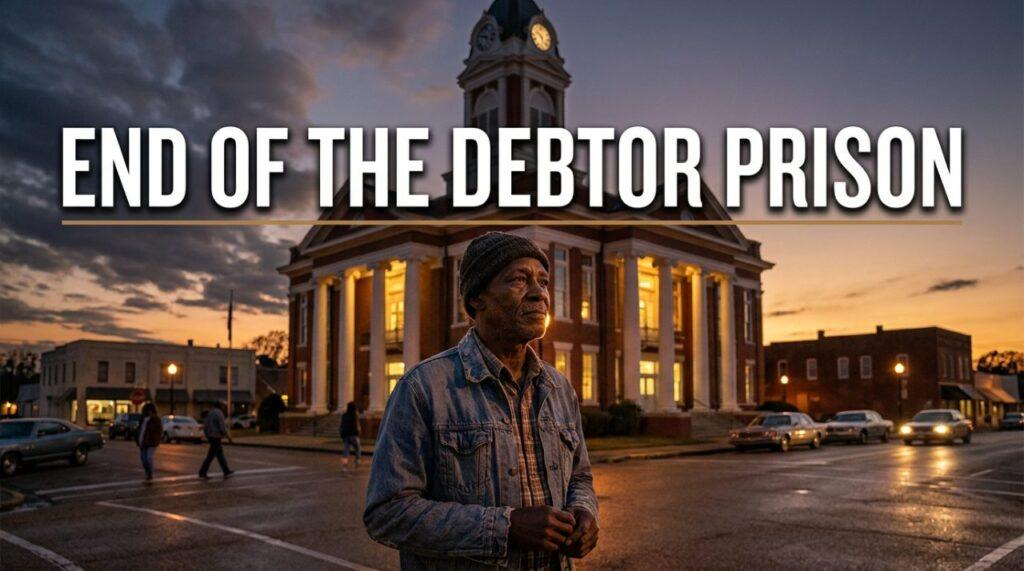
Lexington Police Overhaul: Inside a Mississippi Debtor Prison
By Darius Spearman (africanelements)
Support African Elements at patreon.com/africanelements and hear recent news in a single playlist. Additionally, you can gain early access to ad-free video content.
The small town of Lexington, Mississippi, sits quietly along the eastern edge of the fertile Mississippi Delta. It is a community of roughly 1,200 residents, where more than three out of every four citizens are Black (apnews.com, mississippifreepress.org). For years, local police officers turned the town streets into a predatory collection zone. Poor Black residents faced constant harassment, unlawful traffic stops, and crushing fines that they could not afford to pay (justice.gov, apnews.com). If they could not produce instant cash, officers placed them in handcuffs and locked them behind bars (apnews.com, finesandfeesjusticecenter.org).
Federal civil rights investigators eventually intervened to examine this modern revival of the debtor prison. In October 2026, the United States Department of Justice finalized a comprehensive out-of-court settlement agreement with the City of Lexington (justice.gov, apnews.com). This landmark agreement forces municipal officials to dismantle their abusive court fines and overhaul police operations (justice.gov, justice.gov). While regional news outlets like the Utica Phoenix documented the legal victory, the roots of this crisis stretch back more than a century (thepeoplespaperms.com). To comprehend how police officers transformed basic municipal law enforcement into armed extortion, one must examine the long racial history of Holmes County.
Annual Arrest Rate Comparison
The Legacy of Convict Leasing and Sharecropping
The economic subjugation of Black citizens in Holmes County did not start with traffic tickets. Following the Civil War and the collapse of Reconstruction, white plantation owners sought new ways to control agricultural labor. State leaders quickly devised Black Codes and harsh vagrancy statutes. These laws criminalized Black mobility and made joblessness an arrestable offense. Sheriffs swept through rural roads, arrested freedmen on flimsy pretenses, and assessed heavy judicial fines (mississippiencyclopedia.org).
Because newly emancipated families had no cash reserves, white landowners paid their legal fines in exchange for forced labor. Through involuntary servitude and the state-sanctioned convict lease system, Black men suffered brutal exploitation on plantations, levees, and railroads (mississippiencyclopedia.org). Sharecropping reinforced this cycle of poverty. Plantation bosses maintained manipulated accounting ledgers that ensured Black tenant farmers remained perpetually indebted. County law enforcement officers acted as the primary enforcers of this economic trap. Any laborer who attempted to flee an unpaid debt faced armed capture and immediate imprisonment.
This history established a dangerous tradition in Holmes County. Local government entities viewed Black residents as sources of compulsory labor and capital rather than citizens deserving constitutional protection. The criminal legal system became an apparatus for generating wealth and enforcing social boundaries. Over multiple generations, rural authorities learned that the threat of jail provided immense leverage over an impoverished populace.
Land, Autonomy, and Resistance in Holmes County
Despite heavy racial violence, Holmes County also became an epicenter of extraordinary Black resilience. During the Great Depression, the federal Farm Security Administration purchased foreclosed plantation land across the county. In the community of Mileston, the government divided nearly 10,000 acres into individual family farms (mississippiencyclopedia.org). Hundreds of Black tenant farmers purchased their own soil. This landmark program created an independent class of Black landowners who did not depend on white bosses for their daily bread.
Because they owned their fields, these independent farmers organized without fear of immediate eviction. During the early 1960s, local civil rights organizers turned Holmes County into a citadel of grassroots rebellion. On April 9, 1963, a courageous local farmer named Hartman Turnbow led thirteen other Black residents to the Holmes County Courthouse in Lexington (snccdigital.org, mississippiencyclopedia.org). They walked together to demand their constitutional right to register to vote. At the courthouse door, Deputy Sheriff Andrew P. Smith rested his hand on his holster and demanded to know who would dare step forward first (snccdigital.org). Turnbow looked the armed officer in the eye and stated plainly that he came there to die to vote (snccdigital.org).
White registrars failed all fourteen applicants on discriminatory literacy tests (snccdigital.org). Exactly one month later, white vigilantes firebombed Turnbow’s home while his family slept inside (snccdigital.org, mississippiencyclopedia.org). Turnbow grabbed his rifle and fired back into the darkness to protect his loved ones (snccdigital.org). Local law enforcement retaliated by arresting Turnbow himself, claiming he had firebombed his own residence (snccdigital.org). The Lexington courthouse remained a fortress of white legal supremacy. Yet the bravery of those farmers revealed that local police authority was fundamentally political, designed to crush Black self-determination.
Lexington Municipal Debt Burden
From Plantation Fields to Taxation by Citation
When legal segregation collapsed during the late twentieth century, rural power dynamics changed form. White flight eroded the property tax bases of Mississippi towns, while industrial farm mechanization wiped out traditional agricultural employment. In Holmes County, which became the second poorest county in the United States, municipal budgets fell into deep distress (reason.com, mississippifreepress.org). Local town halls faced declining revenues and decaying infrastructure.
Rather than addressing structural poverty, municipal authorities discovered that the criminal code could serve as an alternative revenue stream. This modern transition mirrored broader trends in mass incarceration across the United States. Police officers were no longer deployed merely to investigate serious crimes. Instead, town leadership pushed them to function as armed collection agents. Municipal courts assessed hundreds of dollars in fees for minor vehicular infractions, cracked windshields, and expired tags (justice.gov, reason.com).
This scheme created an extractive relationship between municipal governments and low-income Black communities. The town government balanced its books on the backs of citizens who survived on fixed incomes. Between 2021 and 2024, town leaders allowed ticket and court collections to surge by nearly 700 percent (justice.gov, reason.com). Armed officers parked outside grocery stores, churches, and high school football games to issue multiple citations to single motorists (justice.gov). The ancient practice of debt peonage was reborn under modern municipal codes.
Terror Under Badge and Gun
The aggression reached a breaking point under the tenure of former Police Chief Sam Dobbins, who took office in 2021 (apnews.com, mississippifreepress.org). Under his command, the Lexington Police Department intensified unconstitutional roadblocks and illegal searches throughout Black neighborhoods (justice.gov, clearinghouse.net). Officers routinely stopped pedestrians without reasonable suspicion and threw them against squad cars. Citizens reported pervasive verbal abuse, unnecessary physical violence, and sexual degradation (justice.gov, washingtonpost.com).
In July 2022, an audio recording of Chief Dobbins leaked to the public (apnews.com, mississippifreepress.org). On the tape, Dobbins used vile racial and homophobic slurs while boasting about his violent past (apnews.com, washingtonpost.com). He bragged about killing thirteen individuals in the line of duty and described shooting an unarmed Black man over one hundred times (apnews.com, washingtonpost.com). Furthermore, he explicitly declared that he did not care if his officers killed people in cold blood (apnews.com). The town aldermen voted to terminate him by a narrow 3–2 margin, but the abusive culture he created endured under subsequent departmental leadership (apnews.com, mississippifreepress.org).
Local citizens refused to submit quietly to this armed terror. Community members joined forces with civil rights attorney Jill Collen Jefferson and the civil rights organization JULIAN (julianfreedom.org, aclu-ms.org). They filed federal civil rights lawsuits to stop the unchecked harassment (clearinghouse.net, aclu-ms.org). In response, Lexington officers attempted to intimidate advocates. Police went so far as to arrest attorney Jefferson on municipal charges after she filmed an officer conducting a traffic stop on a public road (julianfreedom.org, aclu-ms.org). The arrest laid bare a department willing to violate fundamental First Amendment freedoms to conceal its conduct.
Modern Debtor Prisons and Bearden v. Georgia
The most devastating tool wielded by Lexington authorities was the systematic operation of an illegal debtor prison. In modern American jurisprudence, a debtor prison refers to the incarceration of indigent individuals simply because they cannot afford to pay municipal fines or court costs (finesandfeesjusticecenter.org, reason.com). The practice violates the fundamental core of the United States Constitution (justice.gov, justice.gov).
In the landmark 1983 ruling Bearden v. Georgia, the United States Supreme Court established strict protections for impoverished defendants. Under Bearden, the Fourteenth Amendment’s Due Process and Equal Protection Clauses prohibit courts from incarcerating an individual for nonpayment of legal financial debt without first holding an inquiry into whether the failure to pay was willful or caused by genuine poverty (finesandfeesjusticecenter.org, reason.com). A judge must determine on the record if a defendant intentionally refused to pay or genuinely lacked the economic means (finesandfeesjusticecenter.org). If the person cannot pay, the court must consider alternatives, such as payment adjustments or community service, before even considering jail (finesandfeesjusticecenter.org, reason.com).
Lexington municipal officials systematically discarded these constitutional mandates (justice.gov). Judges never conducted indigency hearings (justice.gov). Instead, the municipal court issued more than 650 arrest warrants against citizens for unpaid debt (apnews.com, reason.com). Officers arrested citizens at work or in their homes, forcing them into jail cells until family members produced cash (justice.gov, apnews.com). To make matters worse, the city assessed an arbitrary, mandatory $50 “processing fee” on every incarcerated debtor (justice.gov, finesandfeesjusticecenter.org). Individuals who could not pay this extra gatekeeping fee languished behind bars for weeks without seeing a judge (justice.gov, reason.com). The city converted human liberty into a commodity sold at the police station counter.
Fine & Fee Revenue Surge
The Federal Settlement and Enforcement Mechanisms
Following a comprehensive investigation launched under federal civil rights laws, the Department of Justice published a searing report in September 2024 confirming these systemic constitutional abuses (justice.gov, justice.gov). Faced with overwhelming evidence, municipal leaders entered into an out-of-court settlement agreement in late 2026 to avoid catastrophic federal litigation (justice.gov, apnews.com). This settlement fundamentally alters the governance of Lexington’s police and courts (justice.gov).
The agreement requires the city to cancel more than 650 active, fine-based arrest warrants and clear those records immediately (justice.gov, apnews.com). Furthermore, the municipal court cannot jail any individual for unpaid debts without formal ability-to-pay hearings (justice.gov). The city must eliminate arbitrary $50 booking fees and unconstitutional bail barriers (justice.gov). Crucially, the settlement prohibits ticket and arrest quotas, completely decoupling police funding from municipal citation revenues (justice.gov, apnews.com). Officers may no longer stop people without objective reasonable suspicion or retaliate against citizens who film police conduct (justice.gov).
Enforcement of this agreement relies on active oversight from the Department of Justice Civil Rights Division (justice.gov). Rather than paying a costly third-party monitor, the agreement institutes a strict three-year compliance monitoring schedule managed directly by federal attorneys (justice.gov, justice.gov). The City of Lexington must regularly submit operational logs, body-worn camera audits, and warrant records to federal officials (justice.gov). If city leaders fail to execute these reforms, the settlement contract allows federal prosecutors to file an immediate federal civil enforcement lawsuit to place the municipality under a court-ordered consent decree (justice.gov, justice.gov). This mechanism preserves federal power over local municipal behavior.
Rural Viability Without Extortion
Critics often argue that impoverished rural communities cannot survive without municipal fine revenue. However, the reliance on aggressive ticketing reveals an unsustainable economic illusion. In truth, running a debtor prison creates massive hidden costs that drain public coffers (finesandfeesjusticecenter.org, reason.com). Transporting, booking, and housing indigent citizens in regional county detention facilities costs thousands of taxpayer dollars every month. Valuable officer time is squandered hunting down unpaid traffic fines instead of addressing violent crimes.
To achieve financial stability after severing ties with predatory citations, rural municipalities must reshape their operational structures. Town leadership must right-size police departments to match real local needs instead of maintaining excessive forces for revenue generation. Small towns can also partner through interlocal agreements to share basic dispatch, emergency, and utility management costs. This operational streamlining eliminates the budget deficits once filled by citation extortion.
Furthermore, cleaning up municipal practices restores eligibility for legitimate intergovernmental assistance. Federal and state agencies distribute millions of dollars annually in community development block grants, infrastructure funds, and professional rural policing grants. However, programs frequently bar cities trapped in active civil rights scandals and ticket quota controversies. By ending systemic rights violations, Lexington opens the door to sustainable public funding and technical support. Fair local governance creates genuine economic safety.
The Long Walk for Freedom in the Delta
The crisis in Lexington proves that the battle for Black civil rights is far from complete. The transition from slavery to freedom was never a simple, straight road. From nineteenth-century convict camps to modern rural jail cells, white-dominated legal systems repeatedly adapted their tools to control Black movement and extract Black resources. The same courthouse square where Hartman Turnbow took his heroic stand against white supremacy in 1963 became the modern distribution point for unconstitutional arrest warrants.
Yet, the outcome in Lexington also demonstrates the undeniable power of community resistance. When local citizens stood united with civil rights lawyers, they forced the federal government to intervene against municipal abuses. The 2026 settlement framework provides an important legal blueprint for towns across the South that continue to finance themselves through racialized coercion. Dismantling modern debtor prisons honors the sacrifices of previous generations who refused to bow to armed injustice.
Real accountability, however, cannot exist solely on paper. The residents of Lexington know that enduring transformation requires constant community vigilance. As federal monitoring unfolds over the coming years, local citizens must remain organized to guarantee that police officers respect constitutional rights. The struggle for dignity in Holmes County reminds us that justice is not granted by municipal decrees. It is built and defended every single day by ordinary people demanding their freedom.
About the Author
Darius Spearman is a professor of Black Studies at San Diego City College, where he has been teaching for over 20 years. He is the founder of African Elements, a media platform dedicated to providing educational resources on the history and culture of the African diaspora. Through his work, Spearman aims to empower and educate by bringing historical context to contemporary issues affecting the Black community.
