

Cameroon Anti-Femicide Law: The Hidden Fight for Justice
By Darius Spearman (africanelements)
Support African Elements at patreon.com/africanelements and hear recent news in a single playlist. Additionally, you can gain early access to ad-free video content.
A National Reckoning in Central Africa
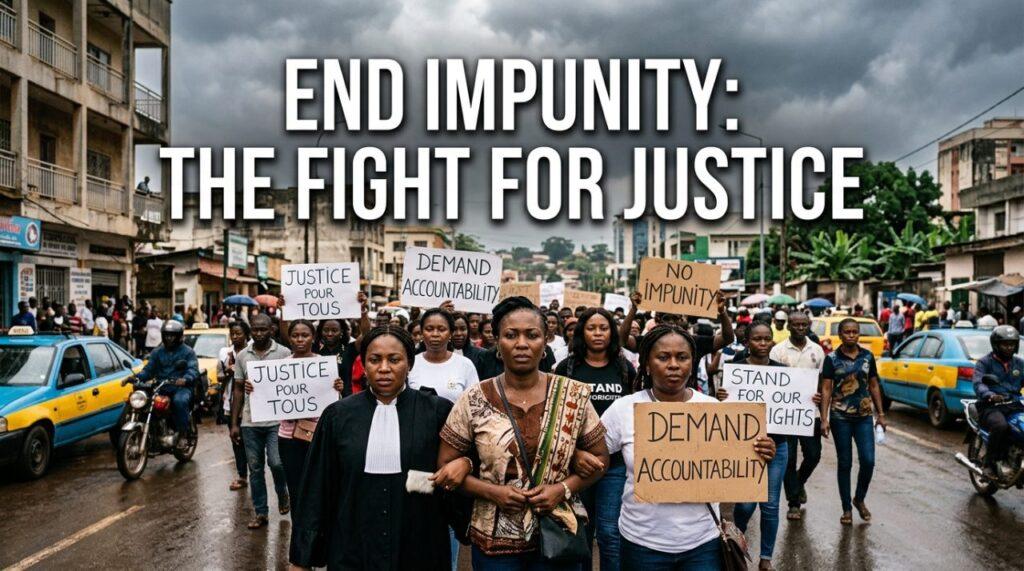
Across Cameroon, a powerful roar for accountability has shattered decades of institutional silence. In late 2026, thousands of citizens took to the avenues of Yaoundé and Douala to demand urgent legislative intervention (africanews.com, weafrica24.com). Women raised their voices against a lethal wave of gender-based brutality that claimed dozens of lives within months (africanews.com). Community leaders, legal advocates, and grassroots organizers joined together to demand an autonomous criminal statute designating femicide as a distinct felony (theguardianpostcameroon.com, cameroon-tribune.cm).
This national mobilization did not emerge in a vacuum. The immediate trigger was the brutal death of Geraldine Achiah, an elementary school teacher who died in Yaoundé shortly after her wedding (theguardianpostcameroon.com, thepostnpcameroon.com). Forensic documentation revealed severe physical trauma, yet local authorities initially sought to treat the incident as a private marital dispute (thepostnpcameroon.com). Her tragic loss became an unbearable breaking point for an exhausted public. Demonstrators marched through rain and police checkpoints, carrying banners that called for an immediate end to systemic impunity (africanews.com, weafrica24.com).
The tragedy resonated across the African diaspora. Rights organizations in neighboring West and Central African nations mobilized solidarity campaigns, shining an international spotlight on Cameroon (africanews.com, instagram.com). Historically, Black movements across the globe have shown that women leading grassroots struggles are central to securing real institutional change. Today, Cameroonian women are confronting state inertia and demanding that the legal system formally value female lives (theguardianpostcameroon.com, cameroon-tribune.cm).
The Legacy of Colonial Partition and Legal Pluralism
To understand the current crisis, one must examine the colonial architecture that shaped Cameroon. Following World War I, the League of Nations divided the former German protectorate between French and British administrative mandates (fjc.gov). This partition created a dual colonial structure across the territory. The French zone instituted a civil law framework, while the British sector established an English common law apparatus (fjc.gov, ijsshr.in).
Both colonial powers imposed their European codes over hundreds of indigenous legal traditions (fjc.gov). However, colonial authorities did not seek to protect African women through these imported statutes. Instead, colonial governors governed through local male elites to maintain social stability at minimal cost. They left domestic relations to uncodified customary traditions. This dual inheritance produced a complex legal pluralism that persisted long after national independence in 1960 and reunification in 1961 (fjc.gov, ijsshr.in).
When the post-colonial state unified administrative structures, it preserved these overlapping legal systems without reconciling them (fjc.gov). The central government adopted formal penal statutes for public order offenses. Yet, it continued to defer marital conflict to traditional patriarchs. By studying the history before foreign rule, one observes how colonial intervention altered traditional social balances. European rule entrenched patriarchal power, leaving domestic violence outside the protection of formal state courts (ijsshr.in).
The Trap of Customary Arbitration
Because post-colonial statutory law ignored domestic violence, intimate-partner abuse remained trapped in informal customary arbitration (ijsshr.in). Village elders, traditional chiefs, and family heads handled severe domestic assaults behind closed doors. The primary objective of these traditional councils was the preservation of family ties rather than individual safety. Customary authorities prioritized communal harmony and bride-price arrangements over punitive justice for physical violence (ijsshr.in).
Consequently, severe intimate-partner violence was routinely addressed through arrangements à l’amiable, or informal out-of-court settlements (ijsshr.in). Under this practice, an abusive partner paid a small fine, provided livestock, or performed a cleansing ceremony for the victim’s family. Once these traditional exchanges occurred, local police and magistrates considered the matter settled. Formal criminal investigations were dropped before charges could be filed (ijsshr.in).
This informal system created an environment of widespread legal neglect. Women who suffered ongoing brutality found little recourse within formal state institutions. Police officers frequently turned victims away at precinct doors, advising them to reconcile with their abusers at home. The persistent resilience of Black families has often been tested by such institutional neglect. In Cameroon, the absence of protective orders left women defenseless against escalating threats (ijsshr.in).
Documented Femicides in Cameroon (2023–2026)
International Treaties Versus Domestic Stagnation
On the international stage, Cameroon repeatedly affirmed its dedication to human rights and gender equality (upr-info.org). In 1994, the central government ratified the United Nations Convention on the Elimination of All Forms of Discrimination Against Women (upr-info.org). Later, in 2006, the state ratified the African Union Maputo Protocol, one of the most comprehensive human rights treaties for women in the world (upr-info.org). These international accords legally bound the state to enact protective legislation and punish gender-based violence (upr-info.org).
Yet, domestic implementation stalled for decades. International commitments were treated as ceremonial declarations rather than operational domestic statutes (upr-info.org). The Ministry of Women’s Empowerment and the Family, known as MINPROFF, drafted policy frameworks and public awareness brochures (theguardianpostcameroon.com, cameroon-tribune.cm). However, administrative guidelines lacked the authority of criminal law. They could not compel judicial magistrates to prosecute perpetrators or issue restraining orders (upr-info.org, bakermckenzie.com).
This profound disconnect between treaty obligations and domestic law generated deep frustration among legal scholars and civic activists (upr-info.org). State officials routinely celebrated international milestones while court prosecutors operated under antiquated statutory guidelines. Intimate-partner killings were prosecuted as standard homicides or non-intentional assault (bakermckenzie.com). Without explicit statutory recognition of gender crimes, the judicial system failed to identify patterns of control that routinely preceded fatal violence (upr-info.org, bakermckenzie.com).
The 2016 Penal Code Reform: A Partial Step
In July 2016, the National Assembly passed Law No. 2016/007, enacting the first major revision of the national Penal Code in half a century (bakermckenzie.com). Civic coalitions and legal advocacy networks welcomed the legislative window, hoping lawmakers would finally introduce comprehensive domestic violence protections (upr-info.org, bakermckenzie.com). The revised code did introduce historic penalties for specific gender violations, criminalizing female genital mutilation and the forced eviction of a spouse from the marital residence (bakermckenzie.com).
Despite these improvements, the 2016 overhaul stopped short of systemic transformation. Lawmakers failed to define gender-based violence as an autonomous category within the penal framework (bakermckenzie.com). Furthermore, the statute completely omitted any legal definition or aggravated punishment for femicide. Homicides committed by intimate partners remained prosecuted under Articles 275 and 276 of the general criminal code (bakermckenzie.com).
This structural omission carried devastating practical consequences for judicial proceedings (bakermckenzie.com). Defense attorneys regularly argued that intimate killings were crimes of passion resulting from emotional provocation. Magistrates frequently downgraded murder charges to involuntary manslaughter under Article 278, which punishes blows and injuries causing unintended death (bakermckenzie.com). Consequently, men convicted of beating their female partners to death received minor prison terms, leaving surviving families without justice.
Gender-Based Violence Rates in Cameroon
Armed Conflict and the Collapse of Legal Safeguards
The institutional vulnerability of women intensified dramatically with the eruption of regional conflicts (genocidewatch.com, hrw.org). In late 2016, deep discontent in the English-speaking Northwest and Southwest regions erupted into the Anglophone Crisis (hrw.org, hrw.org). Anglophone teachers and lawyers initially mounted peaceful strikes protesting the central government appointment of Francophone judges into common law courts (hrw.org). The violent state crackdown that followed quickly pushed the dispute into an armed separatist conflict (hrw.org, hrw.org).
Separatist violence and severe military operations crippled the formal judicial network across the Anglophone territories (hrw.org, hrw.org). Armed fighters routinely kidnapped court magistrates, assassinated court workers, and burned legal buildings (hrw.org). Courts of first instance closed across rural divisions, confining formal judicial hearings to heavily fortified regional capitals like Bamenda and Buea (hrw.org, hrw.org). The entire legal structure disintegrated, leaving hundreds of thousands of displaced civilians without basic institutional protection (hrw.org).
Simultaneously, ongoing Boko Haram incursions across the Far North created continuous regional insecurity (upr-info.org, state.gov). Armed groups throughout these conflict theaters weaponized sexual violence against rural populations (hrw.org, hrw.org). With local police stations abandoned and rural courts shuttered, domestic abusers operated with absolute freedom. Conflict-induced displacement shattered extended family safety nets, leaving women isolated and exposing them to lethal violence without any legal remedy (hrw.org).
Conflict Zone GBV Service Disruption
High-Profile Tragedies Ignite Public Rage
Public anger boiled over through a series of notorious cases that exposed the deep rot within the state legal apparatus (dailysabah.com). In July 2020, twenty-three-year-old university student Lydienne Taba was shot and killed by a regional sub-prefect in Lokoundjé (dailysabah.com). The government official claimed the firearm discharged accidentally during an argument (dailysabah.com). For years, administrative power shielded the perpetrator from criminal detention, sparking national protests across civil society (dailysabah.com).
The Association for the Fight against Violence against Women, known as ALVF, waged an exhausting legal campaign alongside Taba’s family (dailysabah.com). In March 2024, a military tribunal finally rejected claims of accidental death and convicted the administrator of murder (dailysabah.com). This historic verdict proved that sustained civic outrage could pierce elite political immunity (dailysabah.com). It energized legal activists, demonstrating that coordinated public pressure could successfully compel judicial accountability.
This activist momentum exploded in early 2024 during the public scandal surrounding Hervé Bopda, a well-connected socialite accused of systemic sexual abuse and intimidation (washingtonpost.com). Anonymous survivor testimonies published online documented horrific violence spanning over a decade (washingtonpost.com). Civil society figures like Kah Walla mobilized digital campaigns under the banner of #StopFemicide (washingtonpost.com). The coordinated public demonstrations forced federal prosecutors to arrest Bopda, transforming a digital outcry into a sustained movement for national legislative reform (washingtonpost.com).
The 2026 Mobilization for a Femicide Statute
By late 2026, the movement had shifted its direct focus to the national parliament in Yaoundé (africanews.com, theguardianpostcameroon.com). Minister Marie-Thérèse Abena Ondoa openly classified the rising wave of femicide as an intolerable national crisis (cameroon-tribune.cm). State figures revealed that recorded femicides had risen steadily, climbing from 50 confirmed cases in 2023 to more than 73 by late October 2026 (africanews.com, cameroon-tribune.cm). An alarming eight femicides occurred within eight days in August 2026 alone, highlighting the terrifying pace of fatal violence (africanews.com).
Parliamentary leaders responded to the public outcry. Following a private member bill introduced by the opposition Social Democratic Front in June 2026, the National Assembly slated a dedicated anti-femicide criminal bill for review during its November session (theguardianpostcameroon.com, cameroon-tribune.cm). Grassroots coalitions, including the Women’s International League for Peace and Freedom and the Mandela Center International, submitted detailed legislative recommendations to the parliamentary committee (africanews.com, theguardianpostcameroon.com). Their proposals insisted that statutory law must address systemic administrative failures alongside individual acts of violence.
Activists stressed that this bill must mandate severe penalties for police personnel who dismiss domestic abuse reports (theguardianpostcameroon.com, cameroon-tribune.cm). Furthermore, the proposed statute explicitly bans informal out-of-court settlements in cases of domestic battery (theguardianpostcameroon.com). Civic groups also demanded state funding for secure regional shelters and forensic medical examinations, which remain prohibitively expensive for working-class victims (theguardianpostcameroon.com, thepostnpcameroon.com). Modern activists have emphasized that <a href="https://www.africanelements.org/news/decolonizing-african-universities-a-roadmap-to-transformation/ must extend beyond academic spaces to reform our foundational judicial systems.
Transforming Positive Law and Judicial Practice
The core objective of the pending statute is the formal removal of judicial ambiguity in intimate partner killings (theguardianpostcameroon.com, bakermckenzie.com). Under current statutory guidelines, judges retain broad discretion to classify deadly domestic violence as minor altercations (bakermckenzie.com). The draft legislation closes this loophole by creating a distinct penal offense for femicide, establishing a mandatory minimum sentence that cannot be reduced through claims of emotional distress (theguardianpostcameroon.com). By legally recognizing the gender dynamics of lethal violence, the bill strips abusive partners of common legal shields (theguardianpostcameroon.com, bakermckenzie.com).
Equally important, the legislation establishes strict statutory evidentiary standards (theguardianpostcameroon.com). Prosecutors will be required to introduce prior restraining order violations, digital harassment, and domestic abuse histories as statutory aggravating factors during trial (theguardianpostcameroon.com). This evidentiary shift prevents defense attorneys from isolating a fatal attack from long-standing patterns of coercive control (theguardianpostcameroon.com, bakermckenzie.com). It treats lethal domestic assaults not as spontaneous domestic disputes, but as calculated crimes demanding the full punitive force of the state.
Additionally, the legislation establishes strict consequences for public officials who refuse to register complaints (theguardianpostcameroon.com). Historically, police desk officers demanded bribes or discouraged victims from filing official charges against abusive partners (thepostnpcameroon.com, ijsshr.in). Under the proposed legislation, deliberate administrative neglect becomes a punishable criminal offense (theguardianpostcameroon.com). This provision seeks to dismantle the wall of institutional indifference that has long left vulnerable women to fend for themselves (theguardianpostcameroon.com, thepostnpcameroon.com).
A Transnational Horizon for African Liberation
The legislative battle in Yaoundé carries profound implications for the broader African continent (africanews.com, instagram.com). Across West and Central Africa, grassroots feminist organizations are closely monitoring Cameroon’s parliamentary debate (africanews.com). Activists in Nigeria, Ghana, and the Democratic Republic of Congo face identical hurdles regarding legal pluralism, colonial remnants, and customary mediation (researchgate.net, tedu.edu.tr). Cameroon’s landmark statute could provide an influential legal blueprint for statutory gender justice across the entire region (africanews.com).
This struggle demonstrates that genuine liberation requires confronting uncomfortable social realities within our communities (africanews.com). For too long, post-colonial institutions treated violence against women as a minor private inconvenience rather than a grave human rights violation (ijsshr.in). Grassroots coalitions in Cameroon have effectively rejected this colonial mindset, reclaiming the public square to demand systemic dignity and legal protection (africanews.com, weafrica24.com). Their unwavering determination shows that true decolonization must guarantee safety, justice, and human rights for every individual.
As the National Assembly prepares its historic vote, the collective will of the Cameroonian people remains resolute (africanews.com, theguardianpostcameroon.com). A statutory victory will not eliminate gender-based violence overnight, but it will provide communities with vital legal weapons to demand accountability (theguardianpostcameroon.com, cameroon-tribune.cm). The ongoing fight proves that sustained grassroots advocacy can hold powerful institutions accountable to the people they serve (africanews.com). In Cameroon, the long march toward justice continues, transforming personal grief into lasting institutional liberation (africanews.com, theguardianpostcameroon.com).
About the Author
Darius Spearman is a professor of Black Studies at San Diego City College, where he has been teaching for over 20 years. He is the founder of African Elements, a media platform dedicated to providing educational resources on the history and culture of the African diaspora. Through his work, Spearman aims to empower and educate by bringing historical context to contemporary issues affecting the Black community.
