

Why Is Ebola Spreading in East Africa Again?
By Darius Spearman (africanelements)
Support African Elements at patreon.com/africanelements and hear recent news in a single playlist. Additionally, you can gain early access to ad-free video content.
A Dangerous Dual Outbreak Across Central and East Africa
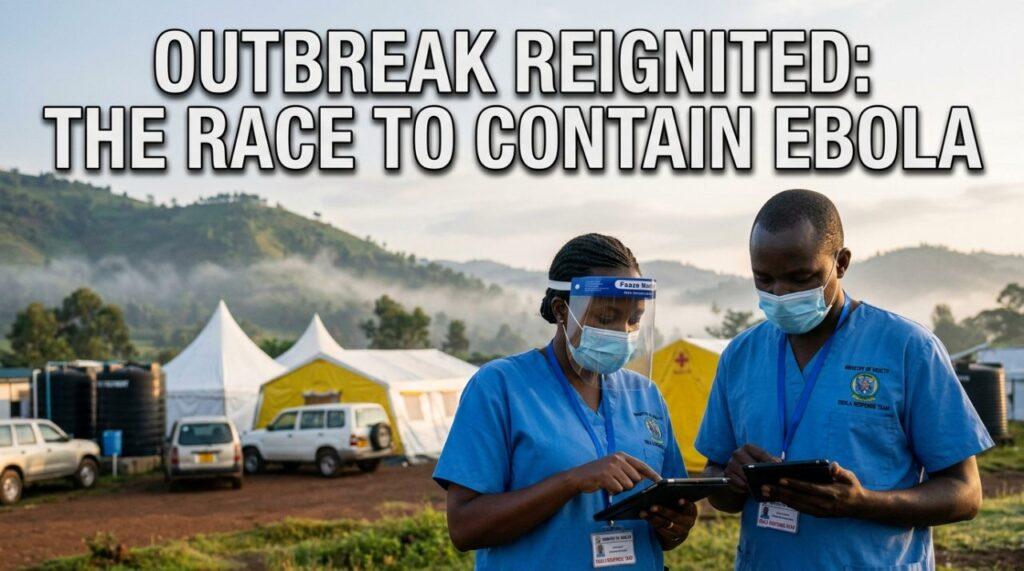
Health workers across Central and East Africa are facing a compounding medical emergency. In the Democratic Republic of the Congo, doctors are battling two simultaneous health catastrophes. A fast-moving Ebola outbreak has spread across seven provinces, while a massive cholera epidemic infects tens of thousands (apnews.com, un.org). International relief teams have expanded emergency water purification stations and cross-border screening points to protect communities (apnews.com, choleraalliance.org).
The Ebola epidemic has claimed over 4,400 lives and infected more than 9,100 people across 64 health zones (apnews.com, umn.edu). At the same time, cholera has sickened over 125,000 individuals nationwide since 2025 (un.org, choleraalliance.org). The emergency crossed international boundaries when Kenyan health officials confirmed a secondary Ebola case in Nairobi (channelnewsasia.com, ndtv.com). Regional travel links these neighboring economies closely. Consequently, public health officers in Kenya quickly traced 113 contacts and isolated 108 people in quarantine (nation.africa, the-star.co.ke).
Estimated Case Fatality Rates in Central Africa
The Discovery of Ebola and Viral Strain Realities
To understand the current crisis, one must return to 1976. In that year, scientists first identified Ebola virus disease in central Africa (cdc.gov, who.int). Two simultaneous outbreaks struck Nzara, South Sudan, and Yambuku in northern Zaire, which is now the DRC (cdc.gov). Congolese microbiologist Dr. Jean-Jacques Muyembe-Tamfum worked alongside international researchers to collect patient blood samples (cdc.gov, who.int). They named the deadly pathogen after the nearby Ebola River to protect local villages from stigma.
Different strains carry distinct biological behaviors. The current outbreak involves the Bundibugyo strain, first identified in western Uganda in 2007 (cdc.gov). This strain has historically caused a case fatality rate between 30 and 50 percent (cdc.gov). Unfortunately, modern vaccines like Ervebo protect only against the more common Zaire strain (umn.edu, cdc.gov). The surface glycoproteins of these two strains differ by nearly 45 percent. Therefore, frontline doctors cannot rely on pre-approved vaccines or monoclonal therapies for this specific Bundibugyo outbreak (umn.edu).
Colonial Extraction and the Legacy of Underdevelopment
The structural weakness of central African public health is rooted in colonial history. King Leopold II ruled the Congo Free State as personal property from 1885 to 1908. His regime engaged in forced labor, violent mutilation, and relentless rubber extraction. Later Belgian administrators maintained an extractive economic system rather than building domestic institutions. Colonial officials extracted mineral wealth and agricultural goods while spending little on African welfare.
When the nation achieved independence in 1960, the colonial power left behind massive institutional voids. The newly independent country had fewer than two dozen university graduates across its entire population. Furthermore, state planners built railways only to transport minerals to oceanic ports for export. They built almost no municipal sanitation systems, clean drinking networks, or regional clinics. This pattern of historical exploitation continues to shape how modern African nations navigate structural debt and infrastructure shortages.
DRC National Access to Basic Services
The 1994 Goma Precedent and Chronic Insecurity
Eastern Congo carries deep historical trauma tied directly to modern cholera outbreaks. In July 1994, the Rwandan genocide displaced over one million refugees into the border city of Goma (choleraalliance.org, doctorswithoutborders.org). Refugee settlements lacked clean water, adequate shelter, and basic latrines (choleraalliance.org). A catastrophic cholera explosion followed, killing roughly 50,000 displaced people within a single month (choleraalliance.org, doctorswithoutborders.org). That disaster proved that municipal collapse turns waterborne bacteria into an uncontrollable killer.
Subsequent proxy conflicts and regional wars destroyed the fragile infrastructure that remained in the eastern provinces. Today, over 120 distinct armed factions operate throughout North Kivu, South Kivu, and Ituri (apnews.com). Fighting by rebel groups constantly interrupts public health measures (apnews.com, doctorswithoutborders.org). Militias frequently loot isolation centers, displace aid staff, and ambush ambulances (apnews.com). Consequently, medical workers must suspend contact tracing whenever fighting erupts, allowing both cholera and Ebola to spread unchecked.
The Syndemic Burden on Eastern Communities
Epidemiologists refer to this intersecting crisis as a syndemic. Multiple ongoing epidemics interact to amplify human suffering and institutional stress. When Ebola cases surge, health ministries must divert their scarce ambulances, epidemiologists, and nurses away from other clinics. As a result, treatment centers for cholera, tuberculosis, and measles lose vital staff and emergency supplies. Routine immunizations slow down, leaving young children completely exposed to preventable bacterial infections.
Community mistrust also worsens disease transmission across the region. Armed conflict produces deep suspicion toward central government authorities and international medical interventions. Rumors spread rapidly through displacement camps. Many sick residents avoid isolation clinics because they fear catching Ebola inside medical wards. Instead, families care for relatives with acute watery diarrhea at home. Without early oral rehydration salts, patients often die within hours from severe cholera dehydration (choleraalliance.org).
Cross-Border Corridors and Kenya’s Fast Quarantine Action
The geography of the Great Lakes region links neighboring economies intimately. Active transport corridors connect eastern DRC with Uganda, Rwanda, Burundi, and Kenya (nation.africa, channelnewsasia.com). In September 2026, a 40-year-old Kenyan citizen fell ill inside the DRC (nation.africa, the-star.co.ke). He traveled through three Ebola-affected provinces before crossing into Uganda (nation.africa). He subsequently boarded a commercial flight to Nairobi, was admitted to a hospital, and died on October 5 (nation.africa, the-star.co.ke).
Kenyan disease surveillance teams responded immediately to the imported infection (nation.africa). Health authorities traced 128 potential contacts who crossed paths with the traveler (nation.africa, the-star.co.ke). On October 14, the Ministry of Health confirmed a second case in a 39-year-old male relative (channelnewsasia.com, ndtv.com). Because the man had already been placed under quarantine, workers quickly moved him into strict isolation (nation.africa, channelnewsasia.com). Officials placed 108 local contacts under 21-day observation while tracking five international travelers through global alert networks (nation.africa, the-star.co.ke).
Kenya Contact Tracing Progress (128 Total Contacts)
Market Failure and the Bundibugyo Vaccine Shortage
The lack of vaccines for the Bundibugyo strain reflects persistent imbalances in international biomedical research. Western pharmaceutical firms and defense agencies invested heavily in Zaire Ebola countermeasures after the 2014 West African epidemic. In contrast, researchers recorded only two small Bundibugyo outbreaks before the current crisis (cdc.gov). Global funding mechanisms deprioritized the strain because commercial drug developers saw little financial return in rural African markets.
This dynamic mirrors historic patterns of racial bias in medicine, where marginalized populations bear the risks while receiving few therapies. Commercial pharmaceutical companies rarely invest research capital without guaranteed commercial sales. Because Bundibugyo outbreaks occur intermittently, clinical researchers struggle to complete traditional Phase III clinical drug trials. As a consequence, doctors facing this outbreak have no licensed pharmaceutical treatments on clinic shelves.
Ring Vaccination and Field Ethics in Active Conflict
Health authorities are now planning emergency clinical trials using candidate vaccines (umn.edu). Epidemiologists rely on ring vaccination strategies first developed during smallpox eradication campaigns. Instead of vaccinating entire cities, teams locate primary contacts and secondary contacts of infected individuals. They vaccinate frontline clinicians and high-risk household members to build a protective biological barrier. This targeted deployment cuts off viral transmission pathways before infections expand across wider neighborhoods.
Deploying experimental medications in active war zones requires strict bioethical frameworks. Regulators utilize the Monitored Emergency Use of Unregistered and Investigational Interventions protocol (umn.edu). This framework allows patients to access experimental treatments when no licensed alternative exists. Congolese researchers ensure that local communities provide informed consent before receiving experimental candidate doses. Transparent communication helps build community trust, protecting medical teams from violence while delivering life-saving clinical oversight.
Building Self-Determination and Infrastructure for the Future
Emergency medical teams cannot permanently stop disease without lasting institutional investments. Clean drinking water, paved transit roads, and stable power grids remain the true frontline defenses against recurring epidemics. Cross-border temperature checks and airport quarantine wards serve as temporary protective shields (nation.africa). Yet, waterborne killers like cholera will return every rainy season until cities install piped water networks (un.org, choleraalliance.org). True biosecurity requires sustainable municipal development and peacebuilding.
Central African nations must also develop domestic vaccine manufacturing centers and sovereign medical supply chains. Genuine community safety depends on African institutions having structural political power to direct their own scientific priorities. When local universities and laboratories control pharmaceutical production, regional health systems will no longer wait on foreign pharmaceutical goodwill. Long-term public investment will ultimately transform eastern Congo from a site of emergency response into an enduring center of resilience.
About the Author
Darius Spearman is a professor of Black Studies at San Diego City College, where he has been teaching for over 20 years. He is the founder of African Elements, a media platform dedicated to providing educational resources on the history and culture of the African diaspora. Through his work, Spearman aims to empower and educate by bringing historical context to contemporary issues affecting the Black community.
