

South Africa U.S. Trade Pact Threatens Black Workers
By Darius Spearman (africanelements)
Support African Elements at patreon.com/africanelements and hear recent news in a single playlist. Additionally, you can gain early access to ad-free video content.
Ramaphosa’s Warning and the Looming Trade Cliff
South African President Cyril Ramaphosa recently delivered a sobering assessment regarding the future of his nation’s economy. Speaking before senior business leaders and journalists, the president warned that the country must brace itself for the possible loss of duty-free trade access to the United States (businessupturn.com, africanews.com). Ramaphosa made it clear that a sudden collapse of these trade privileges would unleash catastrophic damage across key industrial sectors and eliminate hundreds of thousands of jobs (businessupturn.com).
The core of this impending crisis centers on the African Growth and Opportunity Act, commonly known as AGOA (businessupturn.com, hsf.org.za). Although the United States Congress advanced legislation to extend the preferential program through 2028, individual country eligibility remains entirely at the discretion of the American executive branch (businessupturn.com). Ramaphosa openly acknowledged that while South Africa was kept in the legislative text, the White House holds the unilateral power to revoke access at any moment (businessupturn.com). Consequently, South African officials are preparing contingency plans for an abrupt exit (businessupturn.com).
South Africa Annual Exports to U.S. ($ Billions)
The Roots of AGOA: From Apartheid to Open Trade
To comprehend this current standoff, one must examine the optimism of the late twentieth century. In May 2000, American President Bill Clinton signed AGOA into federal law (ustr.gov). The statute emerged as a cornerstone of post-Cold War foreign policy. It promised to replace traditional foreign aid with direct commerce, enabling qualifying sub-Saharan African nations to export thousands of goods duty-free into the United States (ustr.gov).
For South Africa, the timing was profoundly symbolic. The nation was emerging from decades of international isolation under white minority rule. Under the leadership of Nelson Mandela, the new democratic government sought to rebuild a shattered economic structure. Apartheid had isolated South African businesses behind sanctions and trade embargoes. AGOA provided an avenue to reintegrate into global supply networks.
Unlike many continental peers who exported only raw minerals or basic textiles, South Africa possessed advanced industrial capacity. Global automobile companies like BMW, Mercedes-Benz, Ford, and Volkswagen expanded operations in the country (tips.org.za). These corporations utilized trade preferences to build world-class assembly plants, shipping finished passenger vehicles directly to American ports (tips.org.za, hsf.org.za). AGOA became an essential pillar of South Africa’s modern industrial base.
The Ghost of the 1913 Land Act and Redress
Today’s trade friction cannot be separated from South Africa’s deep domestic struggle for racial restitution. Under colonial rule and the formal apartheid regime, the white minority government used raw legislative power to dispossess Black Africans of their ancestral heritage. The notorious 1913 Natives Land Act legally prohibited the Black majority, who made up over 80 percent of the populace, from owning or renting land across 87 percent of the territory.
Subsequent measures like the Group Areas Act of 1950 and the Bantu Education Act systematically stripped generations of Black families of commercial assets, residential stability, and technical education. When democracy arrived in 1994, South Africa inherited the most racially skewed wealth distribution on earth. Decades of systemic oppression had locked Black people out of capital ownership and managerial authority.
To heal these structural wounds, the post-apartheid government turned to constitutional transformation. Section 9(2) of the 1996 South African Constitution explicitly mandated affirmative measures to uplift individuals harmed by unfair discrimination. This provision anchored national land restitution initiatives and the Broad-Based Black Economic Empowerment Act of 2003, commonly known as B-BBEE. These laws were designed to redress systemic dispossession rather than serve as arbitrary state market interference.
When Redress Clashes with American Trade Law
Despite its moral and constitutional imperative, South Africa’s domestic transformation agenda directly collides with American trade mechanisms. Section 104 of AGOA requires beneficiary nations to make continuous progress toward establishing a market-based economy, protecting private property rights, and eliminating barriers to United States trade (ustr.gov). The Office of the United States Trade Representative routinely classifies South African equity policies as non-tariff trade barriers (ustr.gov).
In official trade reports, Washington has singled out B-BBEE ownership targets and state procurement preferences as unfair market restrictions on American multinational firms (ustr.gov). Right-wing political groups and agricultural lobbyists have exploited these statutory clauses to challenge South African policies. Organizations such as AfriForum have lobbied lawmakers in Washington, claiming that South African land reform and affirmative action programs represent state-sanctioned racial discrimination.
This dynamic reveals a fundamental clash between two divergent legal philosophies. The American trade establishment defines fairness through the lens of non-interventionist market neutrality, rejecting any regulatory mandate that favors local demographics. Conversely, South Africa operates on a constitutional mandate of substantive equality, recognizing that true economic fairness requires proactive state intervention to reverse generational harm. These ideological contradictions mirror past external economic exploitation experienced throughout the African diaspora.
South Africa Official Unemployment by Race (%)
The 2015 Chicken Wars: Precedent for Coercion
This is not the first time Washington has used AGOA access as geopolitical leverage over Pretoria. A major dispute unfolded between 2014 and 2016 during the Obama administration. Seeking to protect its domestic poultry industry from predatory dumping, South Africa had placed anti-dumping duties on bone-in chicken imports from the United States. In response, powerful American farm lobbies mobilized key lawmakers in Washington to force a confrontation.
United States trade negotiators issued a stern ultimatum to the South African government. If Pretoria refused to drop its barriers to American poultry, South Africa would face immediate expulsion from AGOA. That action would have instantly stripped duty-free protections from South Africa’s automotive, wine, and fruit exports. The threat proved devastating to South African negotiators.
Faced with the destruction of its high-value manufacturing sector, the South African government capitulated in early 2016. Pretoria agreed to an annual duty-free quota of 65,000 metric tons for American poultry imports. This episode proved that the trade agreement was never an equal partnership. Rather, it functioned as an instrument of trade coercion that the United States could wield whenever domestic interests felt threatened.
The Modern Geopolitical Rift Over Foreign Policy
While economic issues remain contentious, current tensions are aggravated by deep geopolitical disputes. Following the outbreak of the Russia-Ukraine war, South Africa maintained an official stance of non-alignment, choosing to abstain from United Nations votes condemning Moscow. Tensions exploded in 2023 over allegations that a sanctioned Russian cargo vessel, the *Lady R*, had loaded weapons at a South African naval base. Diplomatic ties suffered further strain when Pretoria hosted joint naval exercises with Russia and China.
Friction deepened considerably in late 2023 when South Africa filed a landmark case at the International Court of Justice, accusing Israel of genocide in the Gaza Strip. The legal challenge drew intense anger from United States lawmakers on Capitol Hill. Bipartisan members of the House of Representatives introduced the U.S.–South Africa Bilateral Relations Review Act, mandating a formal review of whether South African diplomacy undermined American national security interests.
These disputes demonstrate how conditional trade pacts leave developing nations vulnerable to political retaliation. Trade preferences intended to alleviate poverty have become tied to foreign policy compliance. South Africa asserts its sovereign right to forge an independent path on the global stage. Yet, that sovereign posture now threatens the livelihoods of domestic industrial workers who depend on the American market.
Vulnerable Employment Sectors (Workers)
The Human Toll on the Black Working Class
Should the United States terminate South Africa’s preferential access, the economic pain will fall directly on the country’s Black working class. South Africa remains one of the most unequal societies on earth, with a Gini coefficient hovering near 0.67. Official government statistics show that Black African unemployment exceeds 36 percent, while white unemployment stands at roughly 8 percent. Millions of Black families depend entirely on wages earned by a single household breadwinner.
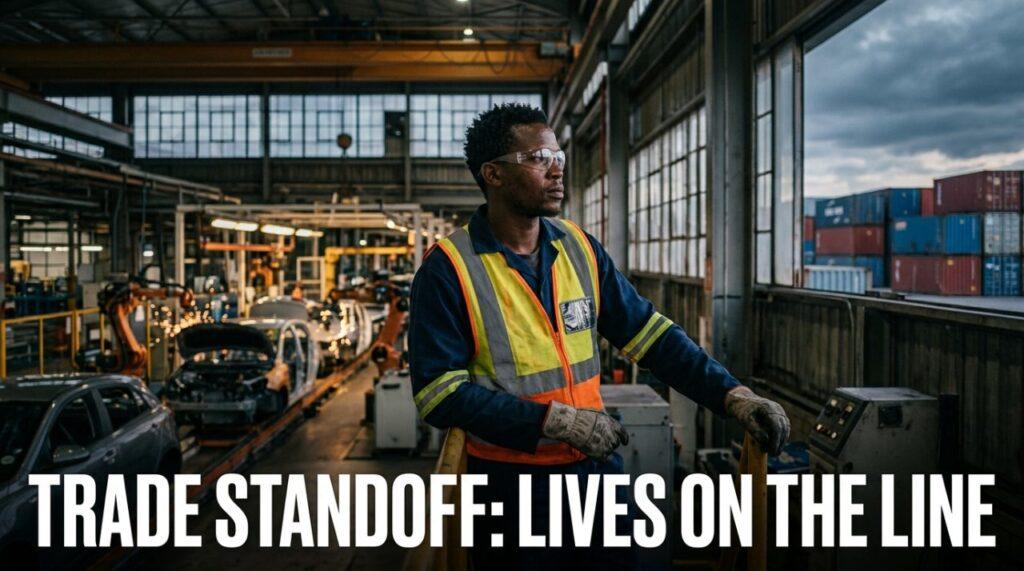
The manufacturing hubs most exposed to trade sanctions are home to extensive unionized labor. Automotive assembly plants located in the Eastern Cape, Gauteng, and KwaZulu-Natal support over 125,000 direct and value-chain workers (tips.org.za). The Eastern Cape cities of Gqeberha and East London already suffer from widespread joblessness. Losing access to American dealerships would crush auto component makers and devastate families, echoing long-standing industrial labor movements where workers faced sudden economic devastation.
Commercial agriculture faces similar catastrophe. Agricultural exports to the United States grew fivefold under the trade pact, with citrus and wine producers generating critical export revenue (usda.gov, wesgro.co.za). In rural regions where alternative employment does not exist, an unexpected tariff shock would displace tens of thousands of farm laborers. Furthermore, multinational corporations forced to downsize would cut ties with Black-owned supplier businesses established through empowerment legislation. Removing trade preferences would widen the racial wealth gap.
Pivoting East: Can BRICS and AfCFTA Fill the Void?
Recognizing the danger ahead, the Ramaphosa administration is actively looking to diversify its trading partnerships. Officials have sent high-level delegations to Asian capitals, seeking deeper ties with Beijing and New Delhi. South African leaders hope to capitalize on China’s recent tariff-free framework for African imports. Concurrently, Pretoria is pushing to fast-track integration under the African Continental Free Trade Area to absorb domestic production surpluses.
However, practical obstacles complicate these strategic ambitions. China and India predominantly purchase raw mineral commodities from South Africa, such as iron ore, coal, and platinum. Neither country represents an equivalent consumer market for high-value finished passenger cars or processed agricultural goods. The machinery and auto components assembled in South African plants are built specifically to satisfy Western consumer demands (tips.org.za, hsf.org.za).
Furthermore, agricultural producers have spent two decades obtaining United States sanitary approvals and building specialized cold-storage supply chains (usda.gov, agrisa.org.za). Rerouting these goods into Asian markets will require years of regulatory negotiations. Abandoning the American market would also slash dollar-denominated export revenues, putting severe downward pressure on the South African rand. History demonstrates that South African workers inevitably pay the highest price when global trade pacts fracture.
About the Author
Darius Spearman is a professor of Black Studies at San Diego City College, where he has been teaching for over 20 years. He is the founder of African Elements, a media platform dedicated to providing educational resources on the history and culture of the African diaspora. Through his work, Spearman aims to empower and educate by bringing historical context to contemporary issues affecting the Black community.
