

Why Haiti Gang Suppression Force Faced Deadly Ambush
By Darius Spearman (africanelements)
Support African Elements at patreon.com/africanelements and hear recent news in a single playlist. Additionally, you can gain early access to ad-free video content.
A Violent Flashpoint in Croix-des-Bouquets
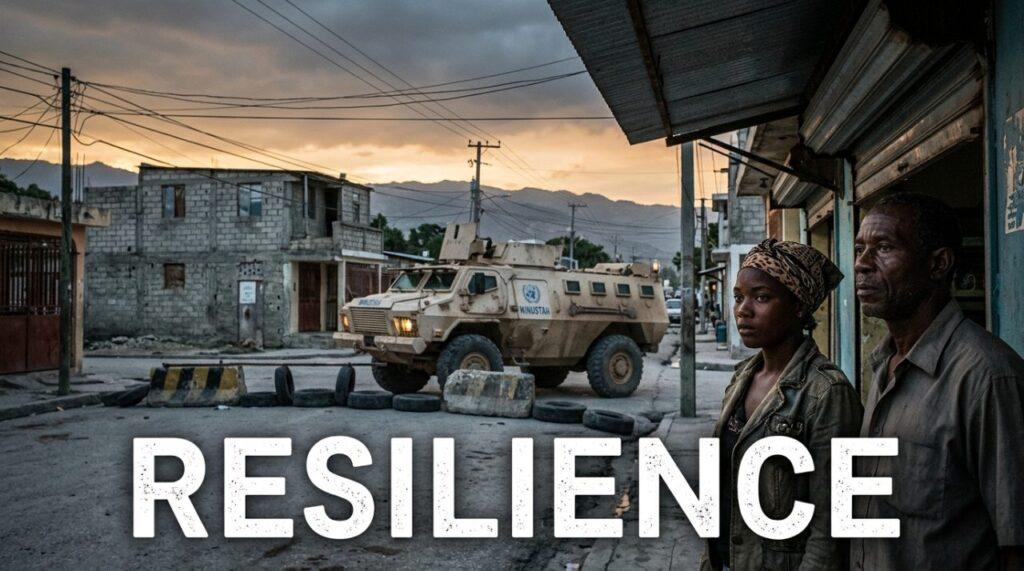
A heavily fortified armored convoy rumbled down the scarred streets of Croix-des-Bouquets, located northeast of Port-au-Prince (wsls.com). Suddenly, a coordinated ring of fire erupted from nearby rooftops and fortified barricades. Improvised explosive devices shattered the road, disabling an armored transport vehicle belonging to the United Nations-backed Gang Suppression Force (wsls.com, military.com). As flames consumed the vehicle, crew members were forced to flee for their lives amidst intense sniper fire (wsls.com). Four military aviation technicians from El Salvador disappeared during the chaotic retreat (military.com, apnews.com).
Rescue helicopters rushed toward the combat zone to evacuate wounded personnel (wsls.com). However, heavy sustained ground fire from gang positions forced the aircraft to abort their mission and turn back (wsls.com, military.com). At the United Nations Security Council, United States Ambassador Mike Waltz sharply condemned the brazen assault (military.com). Waltz stated that international forces would not back down before criminal intimidation (military.com). Meanwhile, special representative Jack Christofides described the battle as a direct test of the international mission (apnews.com).
Two Centuries of Debt and Extraction
The violence engulfing Port-au-Prince is rooted in two centuries of economic exploitation and foreign intervention (cfr.org, wikipedia.org). The remarkable legacy of the Haitian revolution shook European colonial powers to their core. In response, global empires imposed punishing economic isolation to crush the first free Black republic. In 1825, French warships encircled Haiti and demanded an exorbitant indemnity of 150 million gold francs to compensate former enslavers (wikipedia.org). This staggering debt forced the young nation into predatory loans with French banks (wikipedia.org).
Debt service consumed up to eighty percent of national tax revenues for generations (wikipedia.org). Consequently, the Haitian state was systematically starved of capital needed for public infrastructure, clean water, and civic security. Modern demands for reparations frequently emphasize how this financial extortion drained national treasuries across the Black diaspora. When imperial powers extracted wealth from Caribbean soil, they created structural deficits that persist in modern urban neighborhoods.
Haitian State Revenue Allocation (Late 19th Century)
The Legacy of Military Occupation and Disbandment
Foreign meddling deepened significantly during the United States military occupation of Haiti from 1915 to 1934 (wikipedia.org). United States Marines seized the Haitian national gold reserves and transported them to Wall Street vaults (wikipedia.org). The occupation authorities disbanded the national legislature and forced through legal changes allowing foreign ownership of domestic land (wikipedia.org). Furthermore, occupying forces established a centralized military structure that routinely repressed domestic dissent instead of protecting civilian welfare (wikipedia.org).
Decades later, the authoritarian regimes of François Duvalier and his son Jean-Claude Duvalier built a parallel armed militia (cfr.org, wikipedia.org). Known as the Tonton Macoutes, this brutal group violently suppressed the populace and operated outside ordinary legal constraints (cfr.org). In 1995, after returning from a military coup, President Jean-Bertrand Aristide fully disbanded the Armed Forces of Haiti (cfr.org, wikipedia.org). The state formed the Haitian National Police to maintain order, but the force lacked adequate resources and staffing (cfr.org).
To defend impoverished urban strongholds like Cité Soleil, political leaders organized armed neighborhood defense units known as chimères. Over time, prominent politicians and business elites supplied these groups with weapons to manipulate elections and control economic crossroads. By the late 2010s, these armed groups broke free from their wealthy patrons. They transformed into independent criminal cartels fueled by kidnapping profits, systemic extortion, and territorial dominance (cfr.org).
The American Pipeline Arming Haitian Cartels
The high-powered rifles carried by street fighters in Croix-des-Bouquets did not originate in Haitian factories. Instead, an illicit iron pipeline funnels weapons directly from the United States into Port-au-Prince harbors (unodc.org, unodc.org). Transnational criminal rings deploy straw purchasers across southern states like Florida, Georgia, and Texas (unodc.org, justice.gov). Because these states maintain permissive gun purchase laws, buyers acquire military-grade weapons with minimal regulatory scrutiny (unodc.org, justice.gov).
Traffickers purchase AR-15 assault rifles, Galil rifles, and .50-caliber sniper rifles capable of piercing heavy armor (unodc.org, unodc.org). These lethal weapons are dismantled and packed inside routine commercial shipments along the Miami River and Port Everglades (unodc.org, justice.gov). Contraband is concealed inside vehicle dashboards, washing machines, and bulk food containers (unodc.org, justice.gov). Federal export inspections in the United States focus primarily on incoming narcotics rather than outgoing maritime freight (unodc.org, unodc.org).
When cargo ships arrive in Haiti, interdiction systems break down entirely (unodc.org, unodc.org). Haitian customs agencies suffer from broken cargo scanners, understaffed docks, and pervasive bribery schemes (unodc.org, unodc.org). Furthermore, armed gang coalitions control the primary highway exits surrounding maritime shipping hubs (cfr.org, unodc.org). Straw purchasers resell rifles in Port-au-Prince at markups reaching twenty times their retail price, generating colossal profits for illicit syndicates (unodc.org).
Port-au-Prince Metropolitan Control (2026)
The Moïse Vacuum and the Rise of Viv Ansanm
The contemporary collapse accelerated rapidly following the July 2021 assassination of President Jovenel Moïse inside his private residence (cfr.org). His death opened an immense political void across the country (cfr.org). Parliamentary elections had expired, the supreme court remained depleted, and Prime Minister Ariel Henry ruled without constitutional standing (cfr.org). State institutions completely lost their capacity to project basic authority across urban neighborhoods (cfr.org).
Historically, capital gangs engaged in violent turf wars against each other (cfr.org). Jimmy “Barbecue” Chérizier commanded the G9 Family and Allies coalition, which fought bitterly against the G-Pèp alliance (cfr.org). However, in late 2023, these rival factions established a historic non-aggression pact named Viv Ansanm, meaning “Living Together” (apnews.com, cfr.org). By early 2024, Viv Ansanm launched coordinated offensives across the capital (apnews.com, apnews.com).
The coalition assaulted two central prisons, freeing over 4,500 incarcerated individuals, including experienced cartel commanders (apnews.com). Gang snipers attacked police stations, public utilities, and the international airport (apnews.com). Their siege prevented Prime Minister Henry from returning home from international travels, forcing his eventual resignation (apnews.com, apnews.com). Consequently, the United States designated Viv Ansanm and regional allies like the Gran Grif gang as Foreign Terrorist Organizations (usembassy.gov, treasury.gov).
A Fragile Government: The Transitional Presidential Council
To bridge the governance vacuum, international mediators established the Transitional Presidential Council in April 2024 (apnews.com, apnews.com). Brokered through the Caribbean Community, the council holds presidential authority until general elections can take place (apnews.com, apnews.com). It includes nine members: seven voting delegates representing political coalitions and civic groups, plus two non-voting observers from religious and civil sectors (apnews.com, apnews.com). Its primary mandate involves selecting cabinet ministers and organizing general elections (apnews.com, apnews.com).
Despite this design, the council faces profound legitimacy crises across the country (apnews.com). Broad civil society organizations view the body with deep skepticism. Critics point to persistent political infighting, corruption allegations, and the fact that leaders took office by decree rather than popular vote (apnews.com, lenouvelliste.com). The average Haitian citizen sees familiar political elites competing for patronage while street violence worsens daily (apnews.com, lenouvelliste.com).
Simultaneously, the armed cartels openly reject the council as an illegitimate creation of foreign diplomats (apnews.com, apnews.com). Having forced Henry out, cartel leaders demanded direct participation in national governance talks. When authorities excluded them from political discussions, Viv Ansanm vowed to destroy the council entirely (apnews.com). The ongoing urban attacks represent an aggressive attempt to bring down the transitional government and dictate state policies.
From the Kenya Mission to the Gang Suppression Force
International security efforts have repeatedly struggled to match the firepower and coordination of Haitian cartels (cfr.org, apnews.com). In October 2023, the United Nations Security Council passed Resolution 2699 authorizing a Multinational Security Support mission (military.com, cfr.org). Led by Kenyan police, this force arrived in Port-au-Prince in June 2024 (military.com, cfr.org). However, the mission suffered from chronic personnel shortages and inadequate funding (military.com, apnews.com).
Planners envisioned a deployment of 2,500 officers, but troop-contributing nations rarely kept more than 1,000 personnel on the ground (military.com). Moreover, the initial mission relied entirely on voluntary financial contributions from donor nations (military.com, apnews.com). Kenyan personnel held a restrictive mandate focused on joint patrols and static defense, lacking independent arrest authority (military.com, apnews.com). Street gangs quickly realized that the foreign force lacked the resources to hold territory permanently (apnews.com).
Recognizing these severe limitations, the United Nations Security Council transformed the mission into the expanded Gang Suppression Force (military.com, un.org). The new force carries an authorized strength of 5,550 personnel, supported by the United Nations Support Office in Haiti for logistics and air mobility (military.com, un.org). Troop contingents arrived from El Salvador, Chad, and other partner nations (military.com). Unlike the prior mission, this force holds an aggressive mandate to conduct kinetic clearing operations and detain cartel leaders (military.com).
International Force Strength Comparison
The Asymmetrical Realities of Modern Urban Warfare
The ambush in Croix-des-Bouquets revealed the tactical sophistication of Haiti’s criminal confederations (wsls.com). Croix-des-Bouquets serves as a vital strategic gate connecting Port-au-Prince to the Dominican border (unodc.org). It is the primary territory of the 400 Mawozo gang and borders zones held by the Kraze Barye group (treasury.gov, unodc.org). The assault was not a brief hit-and-run encounter. Instead, the fighters executed a coordinated encirclement using roadblocks and explosive traps (wsls.com, military.com).
Moreover, driving off international military evacuation helicopters demonstrated dangerous anti-aircraft capabilities (wsls.com). Suppressive small-arms fire from elevated urban structures can easily down low-flying rotary aircraft (wsls.com). Many community activists who study struggles against foreign intervention observe how asymmetrical guerrilla methods regularly stall conventional military operations. The cartels use tight neighborhood alleys and civilian populations as human shields, making conventional armor ineffective.
The human cost of this continuous urban warfare is catastrophic (un.org, apnews.com). Cartel networks control nearly ninety percent of the metropolitan capital (apnews.com, apnews.com). Over 1.4 million civilians have fled their homes, living in makeshift camps without sanitation or clean drinking water (apnews.com, apnews.com). United Nations reports indicate that six million Haitians face acute food insecurity, while thousands endure famine-level conditions (un.org). Meanwhile, fewer than 10,000 national police officers remain active in a nation of twelve million people (cfr.org).
Historical Skepticism and the Question of Sovereignty
Public reaction to foreign military boots on Haitian soil remains conflicted (cfr.org). Memories of past international missions remain painful for many residents. Between 2004 and 2017, the United Nations Stabilization Mission in Haiti, known as MINUSTAH, attempted to pacify urban sectors (cfr.org, wikipedia.org). However, peacekeepers accidentally introduced cholera to the Artibonite River, killing over 10,000 Haitians and sickening hundreds of thousands (wikipedia.org). Unaddressed sexual exploitation scandals further damaged public trust in international forces (wikipedia.org).
Consequently, many community leaders view outside forces with deep skepticism (cfr.org). They question whether foreign troops arrive to protect ordinary citizens or simply preserve an unpopular political elite (cfr.org, lenouvelliste.com). The ambush against Salvadoran personnel exposes the immense dangers of attempting military pacification without accountable domestic institutions (wsls.com, military.com). A military vehicle can clear an intersection, but it cannot restore public hospitals, reopen closed schools, or build legitimate courts.
The battle in Croix-des-Bouquets signals that Haiti stands at an unprecedented crossroads (wsls.com). The Gang Suppression Force faces an enemy equipped with high-powered weaponry from Florida ports and absolute control over capital transit routes (wsls.com, unodc.org). Until the international community curbs illicit gun pipelines and addresses past economic exploitation, security deployments will encounter determined urban resistance. Restoring lasting stability requires genuine Haitian self-determination, accountable governance, and an end to foreign extraction.
About the Author
Darius Spearman is a professor of Black Studies at San Diego City College, where he has been teaching for over 20 years. He is the founder of African Elements, a media platform dedicated to providing educational resources on the history and culture of the African diaspora. Through his work, Spearman aims to empower and educate by bringing historical context to contemporary issues affecting the Black community.
