


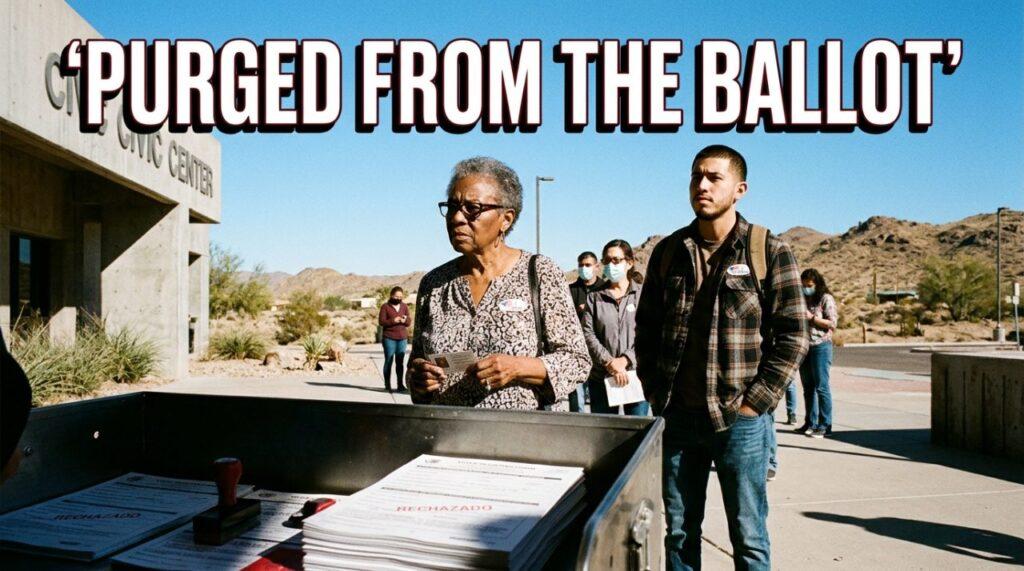
Arizona Voter Purges: Who Loses the Right to Vote?
By Darius Spearman (africanelements)
Support African Elements at patreon.com/africanelements and hear recent news in a single playlist. Additionally, you can gain early access to ad-free video content.
As early voting expands across the United States, civil rights organizations have taken an urgent fight to the nation’s highest court. Voting rights legal teams recently submitted an emergency amicus curiae brief to the Supreme Court of the United States. The filing challenges aggressive voter registration restrictions and systematic list purges in Arizona. These measures threaten to disenfranchise thousands of eligible citizens, with a heavy burden falling on Black, Latino, and naturalized voters (naacpldf.org, advancingjustice-aajc.org).
The coalition includes the NAACP Legal Defense and Educational Fund, the Advancement Project, and the League of Women Voters. They argue that Arizona’s statutes violate core federal protections designed to guarantee equal access to the ballot box. While defenders describe these rules as administrative updates, the current conflict is rooted in a much older tradition. The battle exposes how procedural hurdles have long served to narrow the American electorate (naacpldf.org, lwv.org).
The Legal Showdown in Republican National Committee v. Mi Familia Vota
The legal clash centers on two measures enacted by the Arizona Legislature in 2022: House Bill 2492 and House Bill 2243. House Bill 2492 demands that voters provide documentary proof of citizenship to vote in presidential elections or cast a ballot by mail. House Bill 2243 mandates regular list comparisons against state and federal databases. It directs county recorders to cancel registrations whenever officials believe a voter might lack citizenship papers (naacpldf.org, campaignlegal.org).
Federal district and appellate courts initially blocked key parts of these laws. Federal judges determined that the statutes conflicted with the National Voter Registration Act of 1993. That federal law created a standard federal mail registration form that requires an applicant to swear citizenship under penalty of perjury. However, political intervenors appealed to the Supreme Court. In August 2024, the high court allowed Arizona to enforce proof mandates for state forms while leaving federal form registrants temporarily protected (supremecourt.gov, votebeat.org).
In response, voting rights organizations filed their emergency brief to warn of immediate harm during early voting. The groups argue that systematic removals violate the 90-day quiet period established by federal law. Under the National Voter Registration Act, states cannot conduct mass automated purges within 90 days of a federal election. Congress built this buffer because last-minute bureaucratic purges leave citizens no time to correct government paperwork mistakes before Election Day (naacpldf.org, brennancenter.org).
Citizens Lacking Ready Citizenship Papers
National survey data on voting-age American citizens (Brennan Center / CDCE)
The Jim Crow Origins of Periodic Purges and Voter Caging
The practice of purging registered voters from government rolls did not begin in modern Arizona. It traces directly to the post-Civil War era. Following the ratification of the Fifteenth Amendment, Black Americans registered to vote in historic numbers across the South and West. In response, white-dominated state legislatures enacted purity laws and periodic re-registration mandates to dismantle multiracial political power (naacpldf.org, brennancenter.org).
Under these historic statutes, registrars erased entire registration books on a scheduled basis. Citizens had to appear in person to prove their qualifications anew. Local white registrars enjoyed broad discretion to accept or reject applicants on arbitrary grounds. Officials used minor handwriting variations or missing middle initials to deny Black citizens their registration certificates (brennancenter.org, cornell.edu).
These practices gave rise to the tactic known as voter caging. In a caging operation, partisan groups send non-forwardable mailings to voters residing in targeted minority neighborhoods. When letters return as undeliverable due to postal issues or minor clerical typos, operatives compile challenge lists. Operatives then demand the immediate purge of those individuals from the registration books without verifying their true eligibility. Consequently, administrative machinery served as a silent barrier to democratic participation (brennancenter.org).
Born Without Papers: How Medical Segregation Created a Modern Document Gap
Modern documentary proof requirements assume that every American citizen possesses a certified birth certificate or passport. That assumption ignores the painful history of racial segregation in American healthcare. Before the Civil Rights Act of 1964, racial segregation barred Black mothers from white hospitals across several regions. As a result, hundreds of thousands of Black babies were delivered at home by traditional community midwives (naacpldf.org, aclufl.org).
Local vital statistics offices, operated by white officials, regularly neglected to record these home births. Some counties refused to send clerks into rural Black communities altogether. Other jurisdictions charged exorbitant registration fees that impoverished families could not afford. Due to this official negligence, an entire generation of Black Americans grew up without official birth documentation issued at birth (aclufl.org, facetofacegermantown.org).
Today, strict documentation laws place heavy burdens on elderly Black voters. Obtaining a delayed birth certificate decades later requires archival school transcripts, census entries, and affidavits from deceased witnesses. Many citizens cannot afford the filing fees or navigate the bureaucratic maze. Research shows that roughly 21.3 million voting-age Americans lack easy access to citizenship documents. An estimated 3.8 million citizens possess no proof documents at all (brennancenter.org, brennancenter.org).
Arizona Federal-Only Voters by Age
Demographic concentration of voters registered without state paper proof
Operation Eagle Eye and Arizona’s Covered Past
Arizona possesses its own long history of ballot restrictions directed at communities of color. When Arizona achieved statehood in 1912, the first legislature enacted a mandatory English literacy test. The statute targeted Spanish-speaking Mexican Americans and Indigenous populations across the territory. Decades later, party operatives expanded these barriers into organized challenger campaigns at the voting booth (wikipedia.org, votebeat.org).
Between 1958 and 1964, conservative political organizers ran Operation Eagle Eye in Phoenix. Challengers converged on voting precincts populated by Black, Mexican American, and Navajo voters. Operatives confronted citizens waiting in line, demanded that they read sections of the Constitution aloud, and questioned their citizenship status. William H. Rehnquist, who later became Chief Justice of the United States Supreme Court, served as a key attorney directing these challenges (wikipedia.org).
Because of persistent discrimination against language minorities and communities of color, Congress intervened. In 1975, federal lawmakers expanded the Voting Rights Act of 1965. The amendments placed Arizona under Section 5 preclearance oversight. For nearly four decades, Arizona could not change any voting procedure without prior approval from the federal government (naacpldf.org, wikipedia.org).
From Shelby County to State Mandates: Dismantling the Preclearance Shield
Federal oversight remained a critical safeguard for marginalized voters until the Supreme Court intervened in 2013. In Shelby County v. Holder, the Court struck down the coverage formula in Section 4(b) of the Voting Rights Act. Chief Justice John Roberts wrote that conditions had changed dramatically since 1965. This decision effectively eliminated the enforcement of Section 5 preclearance nationwide (wikipedia.org, brennancenter.org).
The elimination of preclearance transformed the legal landscape for voting rights. States that previously required federal approval could now pass sweeping changes without advance scrutiny. This development directly accelerated the broader history of black voter disenfranchisement across the country. Arizona lawmakers moved swiftly, passing aggressive statutes that would have faced severe scrutiny under Section 5 (naacpldf.org, brennancenter.org).
Without federal preclearance, the Arizona Legislature passed House Bill 2492 and House Bill 2243 in 2022. These laws resurrected demands that federal courts had repeatedly limited. Civil rights attorneys could no longer rely on federal administrative reviews to block discriminatory statutes. Instead, communities of color had to shoulder the massive financial cost of filing post-enactment lawsuits after the harms were already underway (naacpldf.org, campaignlegal.org).
The 2024 Glitch: How List Purges Threaten Eligible Citizens
Proponents of aggressive list cleaning claim that automated database checks guarantee error-free election rolls. However, real-world administration reveals how easily state record systems malfunction. In September 2024, Arizona election administrators discovered a catastrophic computer coding error that had persisted undetected for decades between state databases (votebeat.org, votebeat.org).
Due to a software glitch between the Motor Vehicle Division and election systems, approximately 218,000 registered voters were misclassified. These citizens received standard driver’s licenses prior to October 1996, before Arizona began collecting physical proof of citizenship for road credentials. The computer system erroneously marked them as having verified citizenship documents on file (votebeat.org, ap.org).
If county recorders had implemented immediate purge statutes under House Bill 2243, more than 200,000 eligible citizens would have lost their full ballots weeks before an election. The affected population spanned every political affiliation across the state. Fortunately, the Arizona Supreme Court intervened on an emergency basis. The justices ruled that voters could not be disenfranchised due to a bookkeeping failure by the state government (votebeat.org, azsos.gov).
The 2024 Arizona Database Glitch
Voters placed at risk of ballot purges by state data recordkeeping errors
Bureaucratic Traps and the Civil Rights Act Materiality Provision
The amicus brief emphasizes another vital federal protection: the Materiality Provision of the Civil Rights Act of 1964. Codified at 52 U.S.C. § 10101(a)(2)(B), this rule forbids states from disqualifying voters over minor clerical mistakes. An error on a registration application cannot disenfranchise an applicant if the error does not determine their actual qualifications, such as age or residence (naacpldf.org, justice.gov).
In addition, cross-checking state databases against federal sources frequently misidentifies newly naturalized citizens. Federal systems such as the SAVE database track immigration status, but they frequently lag by weeks or months in updating naturalization records. A newly naturalized Black or Latino immigrant might present valid citizenship papers at a naturalization ceremony yet appear as a non-citizen in an outdated federal registry. When automated sweeps cross-reference these records, lawful citizens face immediate cancellation notices (naacpldf.org, advancingjustice-aajc.org).
These legal protections intersect directly with historic equal protection battles before the judicial branch. When states impose procedural barriers that fall disproportionately on racial minorities, they run counter to the Reconstruction Amendments. Stripping a citizen of registration based on outdated administrative lists resurrects the very abuses Congress sought to abolish decades ago (naacpldf.org, brennancenter.org).
Constitutional Clashes: State Power Versus Federal Protections
The Supreme Court must weigh two competing views of American elections. Intervenors argue that the Qualifications Clause of Article II grants state legislatures sweeping authority to establish voter eligibility rules. They assert that proof mandates protect public trust in the integrity of election outcomes. Proponents argue that states must possess the freedom to remove ineligible individuals whenever doubts arise (supremecourt.gov, alec.org).
Civil rights attorneys present a contrasting constitutional vision. They point to the Elections Clause in Article I, which grants Congress supreme authority to set the times, places, and manner of federal elections. Furthermore, the Fourteenth and Fifteenth Amendments give federal lawmakers explicit power to protect equal access to the ballot. The coalition warns that allowing individual states to ignore federal rules destroys national uniformity (naacpldf.org, supremecourt.gov).
| Legal Issue | RNC & State Legislative Position | Civil Rights Coalition Position |
|---|---|---|
| Federal Registration Form | States may reject forms lacking physical citizenship documents. | The NVRA preempts states from adding documentation mandates. |
| 90-Day Quiet Period | States may remove suspect names at any point before an election. | The NVRA bars mass, automated database purges within 90 days. |
| Burden of Documentation | Proof documents are standard and accessible to all eligible voters. | Over 21 million citizens lack ready papers, burdening minorities. |
| Constitutional Authority | State qualifications authority under Article II overrides federal acts. | Congressional power under the Elections Clause remains supreme. |
In a tightly divided electoral environment, these legal determinations carry immense weight. In Arizona, the 2020 presidential contest was decided by merely 10,457 votes. The 2022 race for governor was resolved by 17,117 ballots. Because more than 40,000 citizens currently rely on federal-only registration status, sweeping state purges can easily shift political outcomes by removing eligible voters from the electorate (votebeat.org, ballotpedia.org).
The Continuing Struggle for Access to the Ballot
The emergency amicus brief filed before the Supreme Court is not an isolated legal dispute. It represents the newest chapter in a generational struggle over American democracy. From post-Reconstruction list purges to mid-century challenge squads, procedural technicalities have repeatedly been used to keep marginalized citizens away from the ballot box. Each generation must defend the basic principle that voting is a fundamental civil right (naacpldf.org, brennancenter.org).
As the Supreme Court considers these emergency motions, the questions reach far beyond Arizona. Decisions made in this case will influence whether other states adopt similar database sweeps and aggressive documentation barriers. The outcome will decide whether the promise of the franchise remains secure for every citizen, regardless of wealth, race, or origin (naacpldf.org, lwv.org).
About the Author
Darius Spearman is a professor of Black Studies at San Diego City College, where he has been teaching for over 20 years. He is the founder of African Elements, a media platform dedicated to providing educational resources on the history and culture of the African diaspora. Through his work, Spearman aims to empower and educate by bringing historical context to contemporary issues affecting the Black community.
