

Why Did Burkina Faso Restore Capital Punishment?
By Darius Spearman (africanelements)
Support African Elements at patreon.com/africanelements and hear recent news in a single playlist. Additionally, you can gain early access to ad-free video content.
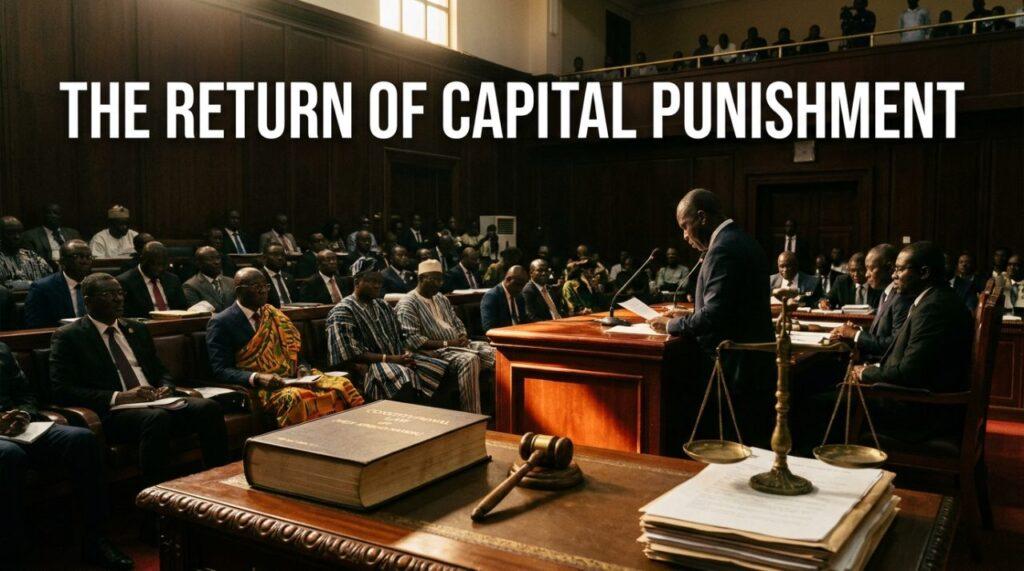
In October 2026, the transitional parliament of Burkina Faso voted unanimously to bring back the death penalty (kfgo.com, democrata.es). The measure forms the center of an overhaul of the national penal code under the military junta led by Captain Ibrahim Traoré (sfgate.com, modernghana.com). Transitional authorities insist that capital punishment is an essential deterrent against armed insurgents who threaten the sovereignty of the nation (ktvb.com, africanews.com). However, human rights organizations and legal experts warn that the broad statutes will be used to crush civil society (hrw.org, amnesty.org).
This dramatic legislative reversal does not exist in a vacuum. It represents the latest chapter in a long, turbulent history of judicial power, military intervention, and political upheaval in West Africa. Understanding why Burkina Faso reinstated capital punishment requires examining the legacy of colonial penal laws, the revolutionary trials of the 1980s, and the gradual statutory abolition achieved under civilian rule (wikipedia.org, pgaction.org). It also requires looking closely at how wartime crises can transform legal systems into instruments of domestic control (hrw.org, hrw.org).
The Legislative Reversal in Ouagadougou
The revised penal code passed through Burkina Faso’s 71-member Transitional Legislative Assembly without a single dissenting vote (sfgate.com, democrata.es). The sweeping reform contains 933 articles that reshape criminal liability and state authority (democrata.es). Justice and Human Rights Minister Edasso Rodrigue Bayala presented the legislation to lawmakers as an urgent national defense requirement (ktvb.com, modernghana.com). Bayala argued that past statutory reforms had weakened the state against violent extremist groups operating across the Sahel (africanews.com, modernghana.com).
The new penal provisions reintroduce capital punishment for high treason, espionage, and armed terrorism (sfgate.com, kfgo.com). The statutes also extend capital sentences to parricide, as well as the commercial distribution of adulterated goods and counterfeit pharmaceuticals that result in fatalities (ktvb.com, democrata.es). Captain Ibrahim Traoré declared publicly that the era of leniency had ended for anyone who undermines national security (kfgo.com, modernghana.com). Yet, independent legal observers note that the official definitions of treason and subversion remain dangerously vague (hrw.org, jurist.org).
Legislative Action and Territorial Crisis
Colonial Legacies and Revolutionary People’s Tribunals
Modern Burkinabè jurisprudence began under French colonial domination, when the territory was known as Upper Volta (wikipedia.org). The French colonial administration imposed criminal codes that reserved the death penalty for armed rebellion, violent insurrections, and homicides (wikipedia.org). Following independence in 1960, successive military and civilian governments retained these statutes without substantial reform. The legal apparatus remained centralized, elite-driven, and disconnected from the everyday lives of ordinary citizens (wikipedia.org, justiceinitiative.org).
When Captain Thomas Sankara led the Democratic and Popular Revolution in August 1983, his administration attempted to break from colonial justice systems (wikipedia.org, thomassankara.net). Sankara established the Popular Revolutionary Tribunals, known as the TPRs, in October 1983 (thomassankara.net). These open-air public hearings were staffed by magistrates, military officers, and neighborhood representatives (thomassankara.net). They tried former politicians, senior civil servants, and commercial traders for embezzlement, corruption, and neocolonial exploitation (thomassankara.net). The sessions were broadcast live across national radio to demonstrate popular accountability (thomassankara.net).
Although the TPRs were designed to curb elite impunity, they suffered from structural weaknesses (thomassankara.net). Defendants were frequently denied professional defense counsel, and proceedings sometimes descended into personal score-settling (thomassankara.net). Sankara himself publicly acknowledged these judicial abuses before his death and sought to restrain tribunal overreach (thomassankara.net). This historical tension between popular accountability and arbitrary state power continues to echo across West African history, much like the revolutionary nationalism debates that gripped liberation movements across the Black diaspora.
The 1988 Precedent and the Thirty-Year Moratorium
The assassination of Thomas Sankara in October 1987 ushered in the autocratic rule of Captain Blaise Compaoré (wikipedia.org). In 1988, the Compaoré government carried out executions of several military officers and political figures accused of plotting against the regime (amnesty.org, wikipedia.org). Those executions marked the last time the state carried out a formal judicial execution in Burkina Faso (sfgate.com, amnesty.org). For the remainder of Compaoré’s twenty-seven-year rule, capital punishment existed in the penal code, but the state observed a de facto moratorium (amnesty.org, wikipedia.org).
Under this administrative moratorium, Burkinabè judges continued to hand down capital sentences for severe criminal offenses (amnesty.org). However, heads of state deliberately declined to sign the necessary execution warrants (amnesty.org). This executive restraint allowed Burkina Faso to maintain diplomatic relationships with international donor institutions and European partners (wikipedia.org, iris-france.org). It also reflected a broader post-Cold War recognition across the African continent that state executions carried toxic political liability and undermined institutional legitimacy (amnestyusa.org, wikipedia.org).
The 2018 Statutory Abolition Under Civilian Rule
A massive popular uprising in October 2014 forced Blaise Compaoré from power after he attempted to amend the constitution to extend his rule (wikipedia.org, amaniafrica-et.org). The democratic transition led to the 2015 election of President Roch Marc Christian Kaboré (wikipedia.org). Under the Kaboré administration, civil society organizations, jurists, and human rights advocates pressed for a systematic modern overhaul of the national justice system (amnesty.org, pgaction.org).
On May 31, 2018, the National Assembly of Burkina Faso voted to adopt a revised penal code that formally abolished capital punishment for ordinary crimes (amnesty.org, amnesty.org). Lawmakers replaced execution with life imprisonment, earning international praise from the United Nations and regional rights coalitions (amnesty.org, amnestyusa.org). The move positioned Burkina Faso alongside regional neighbors, including Benin, Côte d’Ivoire, Guinea, Senegal, and Togo, which had removed the death penalty from their statute books (amnestyusa.org, wikipedia.org). The reform marked a major high point for civilian governance and legal modernization (pgaction.org).
Timeline of Modern Capital Punishment
The Sahel Security Crisis and the Deterrence Myth
The political stability required to sustain legal reforms collapsed under the weight of regional security crises (amaniafrica-et.org, iris-france.org). The armed violence consuming Burkina Faso originated with the 2011 NATO military intervention in Libya (amaniafrica-et.org). That campaign dismantled the Libyan state, releasing massive stockpiles of advanced weaponry into the Sahara Desert (amaniafrica-et.org). The influx of arms energized separatist and Islamist insurgencies in northern Mali in 2012, which spilled across the Burkinabè border by 2015 (amaniafrica-et.org, iris-france.org).
Today, violent extremist factions like Jama’at Nasr al-Islam wal-Muslimin (JNIM) and the Islamic State in the Greater Sahara control an estimated 40 to 50 percent of Burkinabè territory (hrw.org, hrw.org). More than two million civilians are internally displaced, and Burkina Faso has repeatedly ranked at the top of the Global Terrorism Index for conflict casualties (hrw.org, hrw.org). Despite claims by the military administration, counterterrorism research shows that capital punishment fails to deter ideologically driven fighters (amnesty.org, amnesty.org). Militant doctrines celebrate death as martyrdom, meaning state executions often serve as propaganda tools that drive recruitment rather than deter attacks (amnesty.org, amnestyusa.org).
Weaponizing State Security Against Domestic Dissent
Human rights watchdogs document that the reintroduction of the death penalty occurs alongside a coordinated dismantling of democratic protections (hrw.org, hrw.org). Since seizing power in September 2022, Captain Traoré’s government has suspended political parties, curtailed trade union activities, and expelled critical foreign journalists (hrw.org, jurist.org). Domestic media outlets face direct censorship, and the military administration has used emergency mobilization decrees to silence critics (hrw.org, hrw.org). Independent lawyers, investigative journalists, and opposition leaders who challenge government policy have been forcibly conscripted into frontline combat units (hrw.org, hrw.org).
This dynamic mirrors historic patterns where regimes exploit national crises to justify the targeting of political dissidents. Legal scholars note that the Specialized Judicial Unit Against Terrorism suffers from severe evidentiary backlogs and procedural deficiencies (hrw.org, justiceinitiative.org). Human Rights Watch revealed that judges frequently hold suspects in prolonged arbitrary detention out of fear that soldiers will execute them extrajudicially upon release (hrw.org). Reintroducing capital punishment into an intimidated judicial system creates high risks of state-sanctioned judicial murder against political opponents (hrw.org, jurist.org).
Documented Civilian Casualties (2023-2025)
Severing Supranational Oversight: The ECOWAS Rupture
The domestic legal crisis is intensified by Burkina Faso’s diplomatic withdrawal from regional bodies (amaniafrica-et.org). In early 2024, Burkina Faso, Mali, and Niger announced their immediate departure from the Economic Community of West African States, forming the Alliance of Sahel States (amaniafrica-et.org). This withdrawal severed the jurisdiction of the ECOWAS Community Court of Justice over Burkinabè affairs (amaniafrica-et.org, justiceinitiative.org). Established under a 2005 supplementary protocol, the ECOWAS Court had served as an essential supranational judicial forum where citizens could challenge human rights abuses without first exhausting compromised domestic appeals (justiceinitiative.org).
Without access to the ECOWAS Court, Burkinabè citizens possess no regional judicial remedy against arbitrary state violence (amaniafrica-et.org, justiceinitiative.org). The military government also expelled representatives of the United Nations High Commissioner for Human Rights, removing critical international observers from the country (hrw.org). By severing ties with regional judicial structures and international bodies, the transitional government removed the final external checks that once restrained executive power (hrw.org, amaniafrica-et.org). The newly enacted capital punishment statutes now operate in a closed legal environment dominated by executive decree (jurist.org).
Sankarist Symbolism Versus Military Authoritarianism
Captain Ibrahim Traoré has consistently utilized the memory, speeches, and public image of Thomas Sankara to build popular support (thomassankara.net, iris-france.org). The military junta frames its policies as an anti-imperialist campaign to recover national sovereignty from Western interference (amaniafrica-et.org, iris-france.org). Yet historical analysts point out stark differences between Sankara’s revolutionary mass mobilization and Traoré’s concentration of military authority (thomassankara.net, iris-france.org). Sankara sought to redistribute wealth, expand literacy, and empower local peasant councils, while Traoré has centralized control within the armed forces (thomassankara.net, hrw.org).
By reinstating capital punishment, the current administration departs from the long struggle to protect human dignity against state excess (amnesty.org, amnesty.org). The move echoes past historical moments during the era of mass incarceration, when conservative legal policies expanded state power under the banner of law and order. While Sankara’s tribunals were public forums that exposed elite corruption, the junta’s new capital provisions create a legal foundation to prosecute journalists, whistleblowers, and political organizers behind closed doors (hrw.org, jurist.org).
The Struggle for Judicial Accountability
The restoration of capital punishment in Burkina Faso exposes the fragility of democratic institutions facing protracted asymmetrical warfare (amaniafrica-et.org, iris-france.org). When national security threats become existential, governments frequently roll back constitutional protections and expand state violence (hrw.org, hrw.org). The unanimous parliamentary vote highlights how thoroughly wartime emergency measures can sweep away decades of hard-fought legal progress (sfgate.com, pgaction.org). It transforms the penal code from a system of civil justice into an instrument of military defense (modernghana.com, jurist.org).
For Pan-African scholars and civil society advocates, the developments in Ouagadougou offer a sobering reminder that national liberation cannot be separated from human rights (amnesty.org, justiceinitiative.org). A state that claims absolute authority over the lives of its citizens risks establishing permanent legal exceptionalism (hrw.org, jurist.org). As Burkina Faso confronts deep security threats and geopolitical realignment, the reinstatement of the death penalty stands as a cautionary sign of how wartime authoritarianism can undermine the rule of law (hrw.org, hrw.org).
About the Author
Darius Spearman is a professor of Black Studies at San Diego City College, where he has been teaching for over 20 years. He is the founder of African Elements, a media platform dedicated to providing educational resources on the history and culture of the African diaspora. Through his work, Spearman aims to empower and educate by bringing historical context to contemporary issues affecting the Black community.
