

Why Are Sudan and Haiti Collapsing at the Same Time?
By Darius Spearman (africanelements)
Support African Elements at patreon.com/africanelements and hear recent news in a single playlist. Additionally, you can gain early access to ad-free video content.
The United Nations Security Council recently held urgent sessions to address severe breakdowns of human life in Sudan and Haiti (securitycouncilreport.org, un.org). Diplomats listened to terrifying accounts of civilian suffering in both nations (un.org, securitycouncilreport.org). Heavily armed street coalitions in Port-au-Prince have shut down hospitals, stormed major prisons, and displaced over half a million residents (un.org, indiatimes.com). Meanwhile, across Sudan, open urban warfare and ethnic cleansing have created the largest human displacement catastrophe on earth (iom.int, unocha.org).
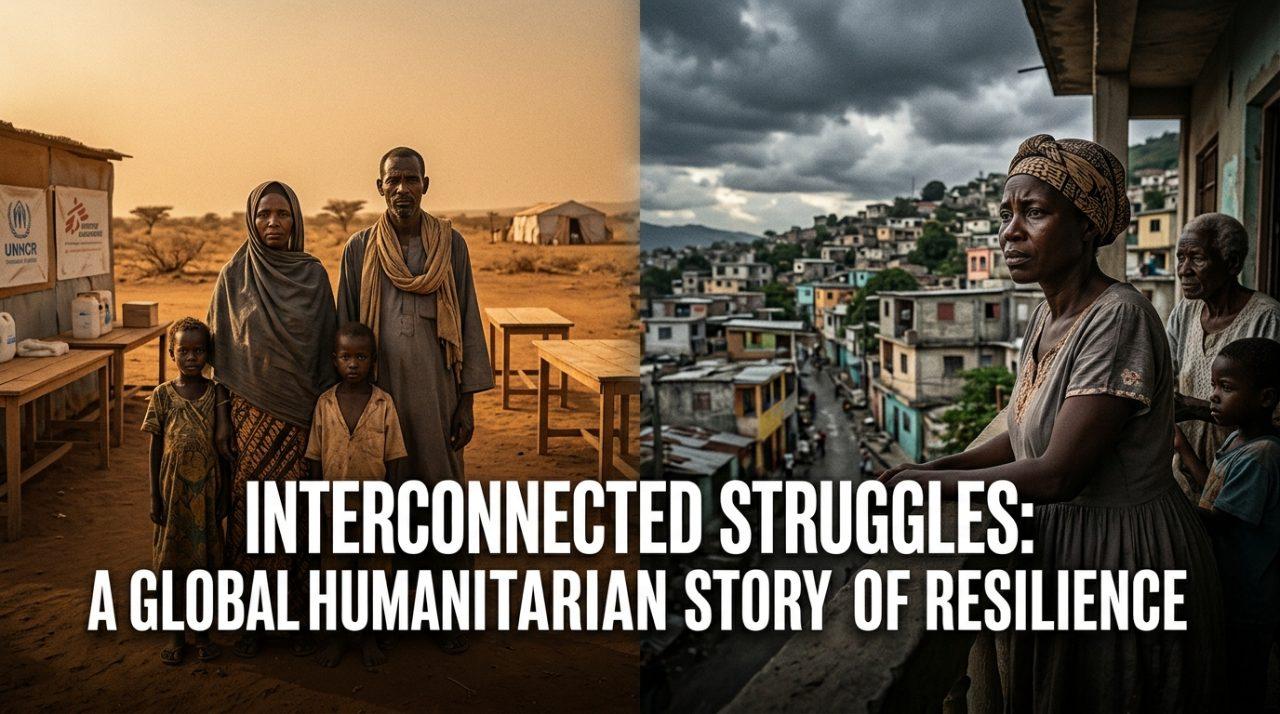
At first glance, these crises seem unrelated. Sudan faces a conventional civil war in Northeast Africa, while Haiti confronts criminal gangs across a Caribbean capital. However, both emergencies share an identical structural disease. Ruling elites in both countries weaponized armed non-state proxies to retain power. Decades of institutional hollow-out, colonial interventions, and total impunity transformed those proxies into uncontrollable monsters. The current tragedies before the Security Council are the direct harvest of that history (securitycouncilreport.org, un.org).
Colonial Divide and Rule in Sudan
The conflict in Sudan did not begin with rival generals fighting in 2023. Instead, it is rooted in centuries of institutionalized inequality. Historically, domestic slave-trading cast darker-skinned, non-Arabized indigenous populations as targets for forced labor. This practice established an ideological caste dynamic where Arab identity held political freedom, while indigenous African identity, often called Zurqa, occupied a lower status. This social division persisted despite a shared Islamic faith.
British colonial administrators deepened these divisions through the Anglo-Egyptian condominium between 1899 and 1956. Colonial officials concentrated development funds, civil-service positions, and modern schooling along the Nile riverine center. They favored northern riverine tribes whom they labeled civilized Arabs. Meanwhile, British authorities governed western and southern peripheries under closed-district ordinances. This policy isolated indigenous African farming communities in Darfur, including the Fur, Masalit, and Zaghawa. When Sudan achieved independence, the riverine elite inherited state power and maintained this racial hierarchy.
From Janjaweed Militias to the Rapid Support Forces
In 1989, Brigadier General Omar al-Bashir took power through an Islamist military coup. Confronted with a 2003 rebellion by indigenous African groups in Darfur, the Bashir government refused to rely only on regular soldiers. Instead, the regime armed nomadic Arab pastoralist fighters known as the Janjaweed (securitycouncilreport.org). These horse-mounted fighters executed scorched-earth campaigns against sedentary African communities. They burned villages, carried out systematic sexual assaults, and stole ancestral farmlands to alter local demographics (www.gov.uk, usmission.gov).
Rather than disarming these fighters, Bashir formalized them in 2013 under a presidential decree (securitycouncilreport.org). He created the Rapid Support Forces, placing commander Mohamed Hamdan Dagalo, known as Hemedti, in charge. Bashir used the paramilitary unit as a praetorian guard against regular army mutinies. The paramilitary group seized Darfur gold mines and earned millions by sending mercenary fighters to foreign conflicts. In April 2023, disputes over integrating this force into the regular army exploded into open warfare across Khartoum and Darfur (usmission.gov, securitycouncilreport.org).
Humanitarian Need and Displacement (2024)
The Historical Debt and Subjugation of Haiti
The contemporary political collapse of Haiti cannot be understood without examining foreign imperial suppression. Enslaved Africans liberated themselves during the heroic Haitian Revolution, founding the first independent Black republic in 1804. Western slave-holding empires immediately cut off trade and diplomatic contact. In 1825, French warships threatened war unless Haiti agreed to pay an astronomical indemnity of 150 million francs to compensate former enslavers.
Repaying this crushing debt required enormous loans from French and American banking firms. The payments drained the national treasury for over a century, which left the island without funds for schools or civic infrastructure. In 1915, the United States military invaded and occupied Haiti for nineteen years. American authorities dissolved the parliament, rewrote the national constitution, and crushed rural resistance movements. This prolonged occupation centralized wealth in Port-au-Prince and weakened local governing bodies across the provinces.
Duvalier’s Blueprints and Gang Patronage
Modern gang networks in Haiti operate from a political blueprint created by dictatorship. François Duvalier governed Haiti from 1957 to 1971 through terror. Distrusting the regular army, he organized a personal paramilitary force known as the Tonton Macoutes. This militia assassinated political rivals, collected unlawful taxes, and operated without judicial restraint. This practice showed political rulers that private armed groups could secure state power.
Decades later, rival political parties and business magnates repeated this strategy. Wealthy patrons armed disenfranchised youth living in Port-au-Prince slums to control voting districts, intimidate opponents, and protect contraband shipments. Following the 2021 assassination of President Jovenel Moïse, central authority dissolved. Realizing their collective strength, criminal groups stopped answering to political masters. Former police officer Jimmy Chérizier unified rival factions under the Viv Ansanm alliance in 2024 to wage war on state infrastructure (un.org, thenewhumanitarian.org).
Port-au-Prince Territorial Control (2024)
The Florida Pipeline Arming Haitian Gangs
Haiti does not manufacture commercial rifles, handguns, or heavy munitions (unodc.org). Despite this reality, gang fighters patrol urban streets carrying higher firepower than local police units (unodc.org). Reports from the United Nations Office on Drugs and Crime show that these military-grade firearms originate inside the United States (unodc.org). Weak firearm sales regulations across southern states allow criminal networks to acquire high-capacity rifles without triggering administrative alarms (unodc.org).
Traffickers employ straw buyers to purchase assault rifles, submachine guns, and .50-caliber sniper rifles at gun shops and trade shows in Florida, Georgia, and Texas (unodc.org). Brokers pack these weapons into shipping crates hidden beneath used clothing, home appliances, and vehicle engine blocks. American port authorities historically inspect incoming cargo for narcotics, leaving outbound maritime cargo largely uninspected. Because Haitian customs facilities lack cargo scanners and maritime patrol boats, these weapons flow into Port-au-Prince with minimal resistance (unodc.org, unodc.org).
Outsourcing Peace Through the Kenyan Mission
The deployment of police officers from Kenya through United Nations Security Council Resolution 2699 surprised many observers (un.org, stimson.org). Western powers chose not to organize a standard United Nations peacekeeping mission. The international body faced intense local hostility due to the previous MINUSTAH mission, which operated from 2004 until 2017. That mission introduced a catastrophic cholera epidemic that killed nearly ten thousand Haitians and sparked deep public outrage. Additionally, council members China and Russia threatened to veto funding for an open-ended peacekeeping force (stimson.org).
American officials avoided sending United States troops to avoid comparisons with past military interventions. Instead, the United States financed and supplied a multinational mission led by Kenyan personnel (usembassy.gov, usmission.gov). This strategy generated fierce criticism from civil rights organizations and legal monitors. Watchdogs argued that the plan outsourced dangerous policing to Black foreign forces. Critics also noted that Kenyan police face domestic scrutiny for brutal protest responses and do not speak Haitian Creole, which limits their operational success against embedded street networks (indiatimes.com, thenewhumanitarian.org).
Starvation as a Deliberate Weapon of War
Humanitarian agencies in Sudan and Haiti report that hunger is being used as an intentional military weapon (unocha.org, un.org). In North Darfur, the Rapid Support Forces surrounded the city of El Fasher, trapping over one million civilians (reliefweb.int, aljazeera.com). United Nations monitors confirmed Phase 5 famine conditions inside the nearby Zamzam displacement camp (unocha.org, unocha.org). Paramilitary forces intercepted emergency food trucks, destroyed rural grain silos, and demanded exorbitant bribes at roadway checkpoints to deny food to African populations (unocha.org, un.org).
A similar strategy of artificial scarcity plays out across Port-au-Prince. Gang coalitions blocked National Route 1 and National Route 2, cutting off the capital from food-producing valleys in the Artibonite department. Criminal leaders also seized seaports and fuel distribution facilities, preventing humanitarian deliveries to starving families. Historically, marginalized people have shown incredible strength and resilience during structural crises. Yet, deliberate food blockades present life-threatening challenges that community endurance alone cannot overcome (unocha.org, un.org).
Acute Food Insecurity Levels (IPC Phase 3+)
The Cycle of Impunity and Global Paralysis
International Criminal Court Prosecutor Karim Khan warned the Security Council that Darfur atrocities continue because past perpetrators never faced trial (securitycouncilreport.org). Two decades ago, the international community documented mass executions in western Sudan. International warrants targeted high-level leaders, yet foreign powers failed to arrest them. Consequently, military commanders guilty of past massacres retained power, rebranded their troops, and committed identical atrocities in El Geneina and Ardamata without fear of legal consequences (www.gov.uk, aljazeera.com).
Haitian gang commanders operate with identical expectations of legal immunity. Corrupt officials never prosecuted the organizers of the 2018 La Saline massacre, in which armed groups slaughtered dozens of community members. Jimmy Chérizier, then an active police officer, faced no domestic trial. When judicial systems fail to punish violence, armed groups realize violence brings political influence instead of prison sentences. This ongoing absence of accountability undermines the broader global quest for reparations and historic justice across the Black diaspora.
Breaking the Cycle of Armed Proxies
The emergency briefings at the United Nations showcase two distinct societies confronting the same historic failure (securitycouncilreport.org, un.org). Ruling authorities dismantled civic systems and relied on irregular militias to suppress local populations. When those proxies turned on their patrons, central governments collapsed completely. The people of Port-au-Prince and North Darfur bear the terrible consequences of this political strategy (iom.int, apnews.com).
Diplomatic statements alone cannot solve these structural crises. Halting this downward spiral requires ending illicit weapons shipments leaving American harbors and stopping foreign proxy funding flowing to African paramilitaries (unodc.org). The United Nations Security Council must look past emergency responses and confront historical causes (un.org). Sustainable peace requires dismantling corrupt patronage networks and establishing genuine legal accountability for wartime atrocities (securitycouncilreport.org).
About the Author
Darius Spearman is a professor of Black Studies at San Diego City College, where he has been teaching for over 20 years. He is the founder of African Elements, a media platform dedicated to providing educational resources on the history and culture of the African diaspora. Through his work, Spearman aims to empower and educate by bringing historical context to contemporary issues affecting the Black community.
