

ICE 287g Program Surge: Why Local Police Pacts Face Backlash
By Darius Spearman (africanelements)
Support African Elements at patreon.com/africanelements and hear recent news in a single playlist. Additionally, you can gain early access to ad-free video content.
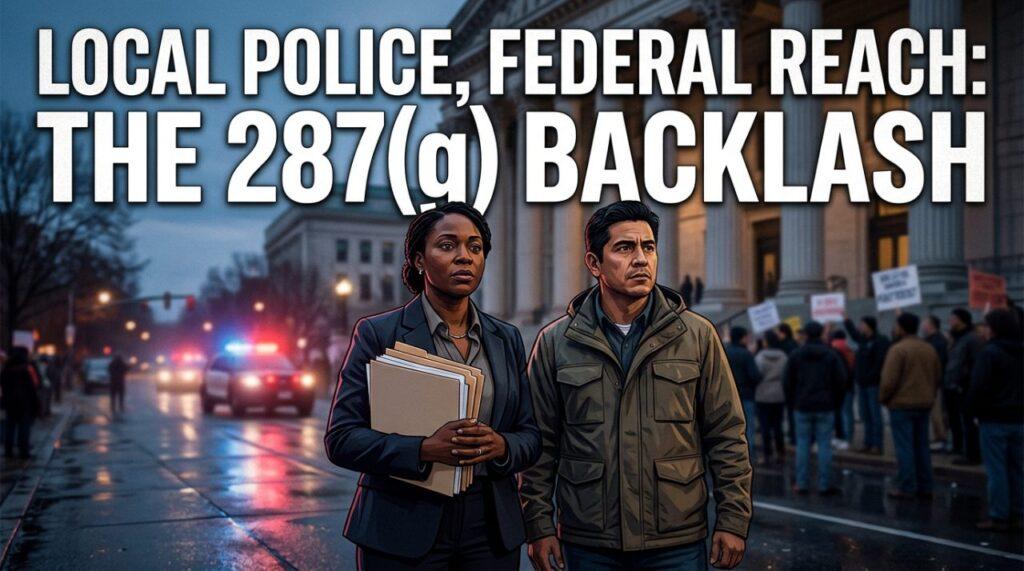
A sweeping national expansion of operational compacts between municipal law enforcement and Immigration and Customs Enforcement has mobilized legal observers and civil rights coalitions across the country. Through the formal ICE 287g program, federal authorities have delegated civil immigration enforcement powers to thousands of local sheriff deputies and municipal police officers (aclu.org, fwd.us). These cooperative arrangements transform routine encounters, such as traffic citations or broken taillight stops, into direct pathways to federal deportation facilities (americanimmigrationcouncil.org, ilrc.org).
Federal officials describe these compacts as necessary tools to maximize enforcement resources and maintain public safety (ice.gov, ice.gov). However, civil rights organizations, including the American Civil Liberties Union and the NAACP Legal Defense Fund, report that the policy expansion fuels systemic bias (aclu.org, naacpldf.org). The delegation of federal authority encourages aggressive policing practices in Black immigrant and Latino neighborhoods (tminstituteldf.org, capitalbnews.org). To evaluate the stakes of this conflict, one must examine the legal and legislative precedents that reshaped American policing over the past three decades.
Enforcement Personnel: Deputized Police vs. ICE Staff
The 1996 Roots and History of 287g Program
The formal statutory framework for deputizing municipal officers originated during the federal legislative overhaul of the mid-1990s. In 1996, President Bill Clinton signed the Illegal Immigration Reform and Immigrant Responsibility Act, known as IIRIRA (americanimmigrationcouncil.org, albanylaw.edu). Section 133 of that legislation amended the Immigration and Nationality Act by creating Section 287(g) (americanimmigrationcouncil.org). This provision authorized the federal government to enter into voluntary Memoranda of Agreement with state and local agencies (americanimmigrationcouncil.org, cis.org).
This legislative era fundamentally transformed both immigration law and domestic criminal justice. Alongside the Antiterrorism and Effective Death Penalty Act of 1996, Congress expanded the definition of deportable offenses (americanimmigrationcouncil.org). Lawmakers reclassified nonviolent infractions as aggravated felonies, eliminated judicial discretion for immigration judges, and mandated detention for minor criminal histories (americanimmigrationcouncil.org, albanylaw.edu). Legal scholars describe this synthesis of criminal statutes and civil removal as crimmigration (americanimmigrationcouncil.org, georgetown.edu). This historical shift mirrored wider political developments, including the political shift from civil rights to mass incarceration, which institutionalized punitive enforcement across communities of color.
Despite the passage of Section 287(g) in 1996, the statute remained unused for several years (americanimmigrationcouncil.org). State and local jurisdictions showed little interest in assuming federal immigration duties without dedicated funding or operational necessity (americanimmigrationcouncil.org, cis.org). The statutory framework existed on paper, but the federal government lacked an administrative mechanism to drive local participation until a national crisis redefined domestic security priorities (americanimmigrationcouncil.org).
Post-9/11 Expansion and the Resurgent 287g Task Force Model
The terrorist attacks of September 11, 2001, triggered an unprecedented realignment of domestic law enforcement priorities (americanimmigrationcouncil.org). Federal agencies sought force multipliers to monitor noncitizen populations, leading to the activation of the dormant 1996 statute (americanimmigrationcouncil.org, cis.org). In 2002, the State of Florida executed the first formal 287(g) agreement, establishing specialized regional enforcement units (americanimmigrationcouncil.org). Within four years, county sheriffs across the South and Southwest entered into similar agreements to expand their local jurisdiction (americanimmigrationcouncil.org).
Under the operational framework known as the 287g task force model, deputized patrol officers possessed street-level authority to enforce federal civil immigration rules (aclu.org, americanimmigrationcouncil.org). Officers interrogated motorists, checked DHS databases from patrol vehicles, and arrested individuals during ordinary field operations (americanimmigrationcouncil.org, ilrc.org). The most prominent deployment of this model occurred in Maricopa County, Arizona, under Sheriff Joe Arpaio (aclu.org, americanimmigrationcouncil.org). Maricopa County deputies launched sweeping neighborhood checkpoints and directed traffic operations toward Latino residents (aclu.org).
Federal scrutiny soon followed these aggressive enforcement tactics. In 2011, a Department of Justice Civil Rights Division investigation concluded that the Maricopa County Sheriff’s Office engaged in systemic racial profiling and unlawful Fourth Amendment seizures (aclu.org, americanimmigrationcouncil.org). The Justice Department uncovered similar unconstitutional patterns under Sheriff Terry Johnson in Alamance County, North Carolina (aclu.org). Facing mounting federal civil liability, the Obama administration formally eliminated the street patrol task force model in December 2012, redirecting resources toward correctional facilities (americanimmigrationcouncil.org).
Inside the Machinery: The Jail Enforcement Model and Administrative Detainers
Following the termination of street-level compacts, the federal government concentrated on institutional settings through the jail enforcement model (americanimmigrationcouncil.org, ilrc.org). Under this framework, designated detention officers interview individuals booked into county jails on state or local charges (americanimmigrationcouncil.org, ilrc.org). Officers query Homeland Security databases, issue administrative detainers, and initiate deportation proceedings directly from the jail intake desk (ice.gov, americanimmigrationcouncil.org). In 2019, federal authorities introduced the Warrant Service Officer model, which allows correctional officers to serve administrative arrest warrants within local facilities (ice.gov, americanimmigrationcouncil.org).
These practices rely heavily on Form I-247A, an administrative ICE detainer policy instrument (immigrantjustice.org, ilrc.org). Civil rights attorneys emphasize that an administrative detainer is not a judicial warrant (immigrantjustice.org, ilrc.org). A judicial warrant requires an independent magistrate to evaluate sworn evidence of a criminal violation (immigrantjustice.org). Conversely, an ICE detainer is an internal agency document signed by an immigration officer alleging a civil immigration violation (immigrantjustice.org, ilrc.org). Holding individuals past their scheduled criminal release date without judicial review violates Fourth Amendment protections against unreasonable seizure (immigrantjustice.org, ilrc.org).
Federal appellate rulings, including Morales v. Chadbourne, confirmed that local agencies face severe constitutional liabilities when honoring warrantless immigration detainers (immigrantjustice.org). In response, many counties enacted local ordinances prohibiting compliance with non-judicial requests (immigrantjustice.org, ilrc.org). This friction highlights constitutional tensions between centralized authority and local sovereignty, echoing long-standing historical debates on state versus nation centered power in American governance.
Documented Violations Among 287(g) Partner Agencies
Overpolicing and Black Immigrant Deportation Disparities
The expansion of municipal immigration pacts creates acute consequences across the African diaspora. National legal audits demonstrate extreme Black immigrant deportation disparities within deportation proceedings (naacpldf.org, tminstituteldf.org). Immigrants from Caribbean nations such as Haiti, Jamaica, and the Dominican Republic, alongside African nations including Nigeria, Ghana, and Somalia, face disproportionate removal rates (naacpldf.org, justiceroundtable.org). Although Black noncitizens account for roughly seven percent of the total United States noncitizen population, they make up more than twenty percent of immigrants facing deportation on criminal grounds (naacpldf.org, tminstituteldf.org).
This wide statistical gap does not stem from higher rates of criminal conduct (naacpldf.org). Instead, it reflects systemic domestic overpolicing in metropolitan areas (naacpldf.org, tminstituteldf.org). Black immigrants live in heavily surveilled urban neighborhoods subject to aggressive traffic enforcement and drug interdiction (naacpldf.org, capitalbnews.org). When local officers operate under federal immigration pacts, standard policing tactics instantly funnel Black motorists into deportation queues (naacpldf.org, tminstituteldf.org). This pipeline extends a historical lineage where criminal statutes functioned as instruments of racial labor control, visible since the post-Civil War era and the birth of convict leasing.
Furthermore, structural disadvantages within the legal system compound these outcomes (naacpldf.org, tminstituteldf.org). Indigent Black noncitizens routinely navigate criminal proceedings without adequate defense advisals under Padilla v. Kentucky, entering guilty pleas that trigger automatic deportation (naacpldf.org). In immigration courtrooms, Black immigrants receive lower rates of legal representation, face higher bond amounts, and experience higher rates of asylum denial than other demographics (naacpldf.org, tminstituteldf.org).
Black Immigrant Representation Disparity
Civil Rights Battles Over Police Immigration Racial Profiling
Legal challenges to joint compacts focus heavily on documented records of police immigration racial profiling (aclu.org). A comprehensive evaluation by the American Civil Liberties Union revealed systemic problems across partner jurisdictions (aclu.org). Researchers found that sixty-five percent of participating agencies had documented histories of racial profiling and unconstitutional practices (aclu.org). Over fifty-nine percent of participating sheriffs had recorded histories of public anti-immigrant statements, while seventy-seven percent operated correctional facilities cited for inhumane conditions (aclu.org).
Law enforcement executives also express institutional concerns regarding neighborhood stability (americanimmigrationcouncil.org, ilrc.org). The Police Executive Research Forum found that deputizing local police to enforce civil immigration codes damages community cooperation (americanimmigrationcouncil.org). When immigrant residents fear that calling the police leads to family separation, crime reports decline and witnesses avoid investigators (americanimmigrationcouncil.org, ilrc.org). The resulting silence leaves immigrant neighborhoods vulnerable to exploitation and undermines public safety for all residents (americanimmigrationcouncil.org).
These documented concerns have prompted legal pushback from state lawmakers seeking to protect immigrant rights civil liberties (immigrantjustice.org, ilrc.org). Legislative bodies in states such as New York introduced measures like the Local Cops, Local Crimes Act to bar local participation in federal deportation compacts (theguardian.com). In response, several conservative county sheriffs filed lawsuits to defend their partnerships, establishing high-stakes courtroom conflicts over local resources and equal protection guarantees (theguardian.com).
The Modern Scale of Local Police ICE Partnerships
Despite sustained constitutional litigation, recent investigative data confirms a dramatic resurgence in local police ICE partnerships (aclu.org, fwd.us). Between late 2024 and early 2026, the number of participating law enforcement agencies expanded rapidly from fewer than 140 departments to more than 1,850 agencies (fwd.us). Official records show more than 2,200 active agreements across nearly forty states (fwd.us). This rapid expansion represents the largest mobilization of domestic law enforcement for immigration duties in American history (aclu.org, fwd.us).
This operational surge created an auxiliary enforcement network of over 29,000 deputized state and local officers (fwd.us). By comparison, ICE employs approximately 11,600 federal Enforcement and Removal Operations agents (fwd.us). Municipal officers outnumber federal deportation agents by more than two to one (fwd.us). Substantial federal resources support this expansion through specialized grant allocations, surplus equipment transfers, and State Criminal Alien Assistance Program reimbursements (gbpi.org, immresearch.org).
The revival of street-level operations shifts federal strategy away from visible regional raids toward daily vehicular stops and neighborhood patrols (aclu.org, fwd.us). As local police assume federal enforcement powers, civil rights organizations continue to document constitutional violations (aclu.org, naacpldf.org). The thirty-year trajectory of Section 287(g) illustrates how statutory changes from the 1990s continue to shape racial profiling, local sovereignty, and equal protection within the modern justice system (aclu.org, americanimmigrationcouncil.org).
About the Author
Darius Spearman is a professor of Black Studies at San Diego City College, where he has been teaching for over 20 years. He is the founder of African Elements, a media platform dedicated to providing educational resources on the history and culture of the African diaspora. Through his work, Spearman aims to empower and educate by bringing historical context to contemporary issues affecting the Black community.
