


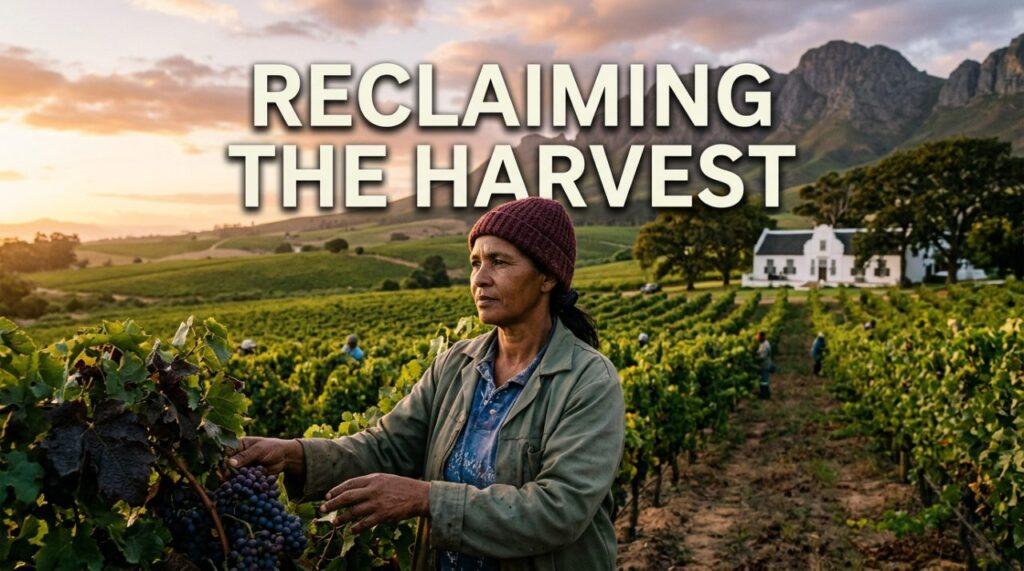
Cape Winelands Slavery: Descendants Reclaim Vineyard History
By Darius Spearman (africanelements)
Support African Elements at patreon.com/africanelements and hear recent news in a single playlist. Additionally, you can gain early access to ad-free video content.
The scenic valleys of Stellenbosch, Franschhoek, and Constantia attract millions of international tourists each year. Visitors admire the whitewashed Cape Dutch gables, rolling vineyard hills, and award-winning wines (theguardian.com, wosa.co.za). Behind this lucrative commercial landscape lies an uncomfortable historical reality. The foundational wealth of the Western Cape emerged from nearly two centuries of chattel slavery and indigenous subjugation (wikipedia.org, sahistory.org.za). Long before modern tourism, enslaved people cleared granite soils, planted vines, and built the historic cellars by hand (griotmag.com, capetownmuseum.org.za).
Today, a growing grassroots movement of farmworkers and community activists is challenging the traditional narrative of the South African wine industry history (theguardian.com, dailymaverick.co.za). Descendants of enslaved laborers are demanding formal historical recognition, living wages, and structural land justice (opendemocracy.net, theguardian.com). Commercial vineyards generate more than fifty-six billion rand annually for the national economy (wosa.co.za). Yet the working-class families living on these agricultural estates remain trapped in generational poverty (theguardian.com, iol.co.za). Activists argue that genuine vineyard labor restitution South Africa requires confronting the enduring legacy of Cape Winelands slavery directly (opendemocracy.net, iol.co.za).
Dutch East India Company Slavery and the Vineyard Economy
The agricultural development of the Western Cape began with commercial maritime colonization. In 1652, the Dutch East India Company, known as the VOC, established a permanent replenishment station at the Cape of Good Hope (wikipedia.org, sahistory.org.za). Dutch commanders intended to supply passing merchant vessels with fresh meat, water, and produce (sahistory.org.za). Commander Jan van Riebeeck planted the first European grapevines in 1655, pressing the colony’s first domestic wine four years later (wosa.co.za, wosa.co.za). Viticulture quickly expanded into a primary commercial industry across the fertile valleys (aehnetwork.org, uu.nl).
To cultivate these estates, the VOC imported captive laborers from across the Indian Ocean trading basin rather than purchasing enslaved people through the trans-Atlantic trade (wikipedia.org, iziko.org.za). Dutch East India Company slavery relied on regional slave routes connecting Madagascar, Mozambique, the Indonesian archipelago, and the Indian subcontinent (sahistory.org.za, iziko.org.za). Between 1658 and the formal abolition of the oceanic slave trade in 1807, colonial authorities transported more than sixty-three thousand captive people to the Cape (wikipedia.org, capetownmuseum.org.za). These workers cleared heavy rock, dug irrigation channels, and tended the vines under strict physical discipline (capetownmuseum.org.za, capeherstorian.co.za).
The institutional structure of Dutch colonial slavery shaped property and labor relations for generations. Enslaved populations frequently outnumbered European settlers in rural districts throughout the eighteenth century (wikipedia.org, aehnetwork.org). Settler families accumulated capital through the unpaid physical labor of captive workers who possessed no legal autonomy or property rights (sahistory.org.za, aehnetwork.org). Like before colonial expansion disrupted local governance, regional African societies were systematically excluded from economic sovereignty as agricultural estates expanded across the territory (sahistory.org.za, culturalsurvival.org).
Origins of Cape Enslaved Labor
Estimated regional distribution of imports (1658–1807)
Khoisan Land Dispossession and Indentured Farm Labor
The rise of the Cape agricultural economy did not occur on empty ground. Pastoralist Khoekhoe communities and San hunter-gatherers lived in the southwestern Cape for millennia prior to Dutch arrival (sahistory.org.za, culturalsurvival.org). As commercial settlers received extensive land grants in Stellenbosch and Drakenstein, colonial officials seized vital grazing territories and freshwater springs (sahistory.org.za, stellenboschheritage.co.za). Khoisan land dispossession accelerated through military conflict, livestock theft, and introduced infectious diseases (sahistory.org.za, capetownmuseum.org.za). The devastating smallpox epidemic of 1713 decimated indigenous social cohesion, allowing European farmers to consolidate control over prime agricultural soils (sahistory.org.za, aehnetwork.org).
Deprived of their ancestral herds and grazing corridors, surviving Khoisan individuals faced severe legal and economic restrictions (sahistory.org.za, culturalsurvival.org). Colonial statutes banned indigenous nomadism and forced dispossessed pastoralists into coercive farm labor contracts (sahistory.org.za). Over several generations, the intermarriage of indigenous Khoisan populations, imported enslaved people, and freed laborers created the demographic foundation of the rural working class (wikipedia.org, sahistory.org.za). Understanding Coloured identity Western Cape requires recognizing this specific history (sahistory.org.za). In South Africa, “Coloured” is a distinct, constitutional multiracial identity rather than a derogatory American term (sahistory.org.za, capetownmuseum.org.za).
Under colonial governance, this population was deliberately retained as a subordinate rural labor force (opendemocracy.net, sahistory.org.za). The apartheid regime later formalized this stratification through the Population Registration Act of 1950, which legally categorized citizens into racial hierarchies (sahistory.org.za). Today, Coloured people make up nearly half of the Western Cape provincial population (sahistory.org.za). Generational farmworkers continue to work the same soil their dispossessed ancestors cultivated centuries earlier (theguardian.com, opendemocracy.net). Their contemporary landlessness stems directly from colonial policies of territorial confiscation (sahistory.org.za, thetricontinental.org).
Groot Constantia Slave History and Estate Memorialization
The intersection of colonial power, viticulture, and bondage is clearest at the oldest agricultural properties in Southern Africa. In 1685, VOC Commissioner Hendrik Adriaan van Rheede tot Drakenstein granted hundreds of hectares to Cape Governor Simon van der Stel (grootconstantia.co.za, grootconstantia.co.za). Van der Stel developed the property into Groot Constantia, establishing South Africa’s oldest commercial wine estate (grootconstantia.co.za). The celebrated sweet wines of Constantia found international acclaim across European royal courts during the eighteenth and nineteenth centuries (grootconstantia.co.za, grootconstantia.co.za). However, colonial marketing omitted the enslaved workers who produced every vintage (griotmag.com, capetownmuseum.org.za).
Archival records reveal that Groot Constantia slave history depended upon dozens of enslaved men, women, and children at any given time (grootconstantia.co.za, grootconstantia.co.za). Captive laborers worked seven days a week during harvest, treading grapes in open vats and maintaining estate buildings (capetownmuseum.org.za, grootconstantia.co.za). In recent years, public reckoning forced historic estates to alter their museum exhibits (griotmag.com, iziko.org.za). Iziko Museums of South Africa established permanent slavery exhibitions at Groot Constantia, installing commemorative plaques listing the documented names and geographic origins of enslaved workers (grootconstantia.co.za, iziko.org.za). Similar initiatives emerged at the Museum van de Caab in Franschhoek, which displays two hundred memorial stones honoring named individuals who lived in bondage on the property (griotmag.com, creativecitysouth.net).
Memorial plaques and museum exhibits are an important first step, but they cannot replace economic justice for families who remain landless on the farms their ancestors built.
Cape Colony Slave Emancipation and the Illusion of Freedom
The British Imperial Parliament passed the Slavery Abolition Act in August 1833, implementing the measure across the Cape Colony on December 1, 1834 (wikipedia.org, econrsa.org). Yet emancipation did not bring economic independence. The colonial administration imposed a mandatory four-year “apprenticeship” program that prohibited freed workers from abandoning their former owners until December 1838 (wikipedia.org, sahistory.org.za). Furthermore, the imperial government allocated twenty million pounds sterling to compensate slave owners across the empire (wikipedia.org, econrsa.org). In the Cape, officials appraised more than thirty-eight thousand enslaved people, awarding approximately 1.24 million pounds directly to white masters (wikipedia.org, econrsa.org).
The formerly enslaved population received zero financial compensation, zero land grants, and zero housing rights (sahistory.org.za, econrsa.org). Stripped of assets, freed families utilized specific survival strategies among enslaved workers to navigate post-emancipation vagrancy laws and coercive Master and Servant statutes (sahistory.org.za). Landless rural laborers had few options other than remaining on white-owned wine and wheat estates as low-wage tenant workers (opendemocracy.net, sahistory.org.za). Cape Colony slave emancipation compensated the perpetrators of human bondage while permanently institutionalizing the landlessness of the emancipated population (sahistory.org.za, econrsa.org).
1834 Emancipation Compensation
British imperial payout distribution in the Cape Colony
The Dop System in South Africa and Intergenerational Poverty
To retain control over newly emancipated farmworkers, vineyard owners entrenched a coercive paternalistic labor regime (theguardian.com, sahistory.org.za). Central to this system was the dop system in South Africa, which involved paying laborers partially in daily measures of cheap wine (theguardian.com, capetownmuseum.org.za). Farm managers dispensed wine rations multiple times each day, beginning early in the morning and concluding at the end of physical shifts (theguardian.com, sahistory.org.za). This intentional practice produced chemical dependency, severe malnutrition, and chronic subservience across generational communities (theguardian.com, capetownmuseum.org.za).
The practice persisted for centuries because it maintained an inexpensive, dependent agricultural labor pool (theguardian.com, sahistory.org.za). While regional legislation restricted the practice over time, democratic authorities explicitly criminalized it under the Liquor Act of 2003 (theguardian.com, dailymaverick.co.za). Nevertheless, public health researchers note that the Western Cape continues to record some of the highest global rates of fetal alcohol spectrum disorders (theguardian.com, time.com). The physiological and economic damage of this institutional practice continues to burden working-class families across the region (theguardian.com, opendemocracy.net).
Apartheid spatial engineering compounded this historic dispossession during the mid-twentieth century (sahistory.org.za, dailymaverick.co.za). Under the Group Areas Act of 1950, the white minority government declared affluent viticultural enclaves like Constantia and Stellenbosch exclusively white (sahistory.org.za). Municipal authorities forcibly evicted thousands of Coloured residents, bulldozing established family cottages and trucking residents to desolate townships on the Cape Flats (sahistory.org.za, dailymaverick.co.za). These displacements broke community land claims and reinforced patterns of debt and structural inequality that endure today (sahistory.org.za, thetricontinental.org).
South Africa Land Restitution Cutoff and the Battle for Vineyard Equity
When democratic elections ended formal apartheid in 1994, rural communities expected structural agrarian reform (thetricontinental.org, dailymaverick.co.za). However, constitutional compromises placed severe limitations on historical justice (thetricontinental.org). Section 25 of the 1996 Constitution and the Restitution of Land Rights Act of 1994 established a strict South Africa land restitution cutoff date of June 19, 1913 (thetricontinental.org, culturalsurvival.org). This cutoff mirrors the date of the colonial Natives Land Act, barring legal claims for any territorial dispossession that took place prior to 1913 (thetricontinental.org, africacheck.org).
Because Cape Winelands slavery, Dutch colonial land grants, and Khoisan dispossession occurred between 1652 and the late nineteenth century, farmworker descendants cannot lodge constitutional restitution claims on historic wine farms (thetricontinental.org, culturalsurvival.org). Furthermore, market-assisted “willing-buyer, willing-seller” redistribution policies failed in the Western Cape (thetricontinental.org). Prime vineyard acreage commands exorbitant speculative real estate prices, making state-funded farm purchases nearly impossible on public budgets (thetricontinental.org, usda.gov). Nationwide, white South Africans continue to own approximately seventy-two percent of privately held commercial agricultural land (africacheck.org).
Commercial Agricultural Land Ownership
Distribution of privately owned farmland in South Africa
State-subsidized farm equity-sharing schemes have similarly struggled to deliver structural empowerment (dailymaverick.co.za, econrsa.org). In these joint ventures, farmworkers purchase minority equity stakes, typically between five and twenty-five percent, using public development grants (econrsa.org). However, operational management and financial authority remain concentrated with the original white estate owners (dailymaverick.co.za, econrsa.org). High operational debts and capital reinvestment requirements frequently leave worker trusts without annual dividends, keeping wages stagnant while workers remain without secure land title (dailymaverick.co.za, econrsa.org).
In response to these systemic failures, farmworker rights organizations like the Women on Farms Project and the Commercial, Stevedoring, Agricultural and Allied Workers Union, or CSAAWU, are mobilizing communities (theguardian.com, opendemocracy.net). Paralleling independent labor movements in South Africa, rural workers are connecting daily workplace battles to the historical continuum of chattel slavery (opendemocracy.net, dailymaverick.co.za). Organizers stage annual December 1 Emancipation Walks, retracing historical slave routes and occupying historic public squares in Stellenbosch (opendemocracy.net, iol.co.za).
Community advocates demand concrete structural reforms rather than ceremonial apologies (theguardian.com, opendemocracy.net). These demands include:
- Legislative amendments to protect farm dwellers from judicial evictions under the Extension of Security of Tenure Act (opendemocracy.net, dailymaverick.co.za).
- Direct land redistribution and state water allocation for independent, worker-owned agricultural cooperatives (opendemocracy.net, thetricontinental.org).
- Statutory heritage requirements mandating that all commercial wine estates document and display their enslaved labor lineage (griotmag.com, iol.co.za).
The mobilizations across the Cape Winelands demonstrate that the unresolved legacy of colonial enslavement cannot be separated from modern agricultural economics (theguardian.com, opendemocracy.net). Descendants of the enslaved are dismantling romanticized colonial marketing narratives to reclaim their documented history (griotmag.com, theguardian.com). By demanding land justice, tenure security, and fair economic distribution, grassroots movements are forcing South Africa to confront the uncompensated labor that built its most celebrated industry (opendemocracy.net, iol.co.za).
About the Author
Darius Spearman is a professor of Black Studies at San Diego City College, where he has been teaching for over 20 years. He is the founder of African Elements, a media platform dedicated to providing educational resources on the history and culture of the African diaspora. Through his work, Spearman aims to empower and educate by bringing historical context to contemporary issues affecting the Black community.
