

Voter Deterrence: How Modern Poll Intimidation Evolved
By Darius Spearman (africanelements)
Support African Elements at patreon.com/africanelements and hear recent news in a single playlist. Additionally, you can gain early access to ad-free video content.
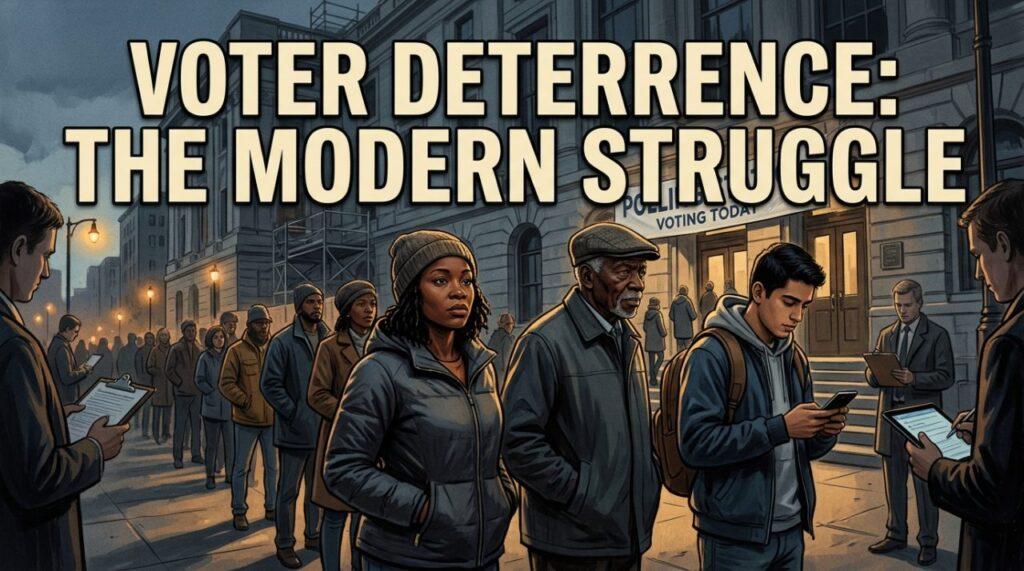
Recent evaluations by nonpartisan democratic integrity organizations and civil rights watchdogs have issued urgent warnings regarding the safety of the ballot box. Reports from groups such as the Brennan Center for Justice and Protect Democracy show that eligible voters face elevated obstacles across the nation (brennancenter.org, protectdemocracy.org). Communities of color, college students, and urban voters encounter targeted friction designed to suppress turnout. This friction operates through a coordinated framework: aggressive poll monitoring, visible law enforcement near precincts, and automated challenges to voter eligibility lists (brennancenter.org, brennancenter.org).
Many observers treat these developments as sudden reactions to recent election denial rhetoric. However, current practices represent the modern evolution of century-old voter deterrence techniques. Political actors have repeatedly mobilized private challengers and state power to target Black and brown voters whenever democratic participation has expanded (wikipedia.org, nypl.org). Understanding modern voter intimidation laws and administrative hurdles requires examining the historical continuum from Reconstruction to the present day.
Reconstruction, Intimidation, and Operation Eagle Eye 1964
The practice of confronting minority citizens at voting locations has deep roots in the post-Civil War era. Following the ratification of the Fifteenth Amendment in 1870, newly emancipated African Americans registered to vote in historic numbers across the South. White supremacist groups, working closely with local sheriffs, organized armed patrols to physically block polling places and break up political gatherings (wikipedia.org). Much like the systemic labor restrictions detailed in the history of struggles that followed the Civil War, political disenfranchisement served to preserve racial hierarchy.
To curb this violence, the federal government stepped in. Congress passed the Enforcement Acts of 1870 and 1871, which included the Ku Klux Klan Act of 1871 (wikipedia.org). These statutes created federal criminal penalties for private conspiracies that aimed to intimidate or deter citizens from exercising their constitutional voting rights (wikipedia.org). When federal troops withdrew after 1877, southern states enacted Jim Crow laws, replacing overt street violence with institutional barriers such as poll taxes, literacy tests, and grandfather clauses (nypl.org).
By the mid-twentieth century, as civil rights organizing regained momentum, organized challenger operations resurfaced in major northern and western cities. During the 1964 presidential campaign between Lyndon B. Johnson and Barry Goldwater, national party strategists launched a coordinated initiative known as Operation Eagle Eye 1964 (wikipedia.org). The campaign sent thousands of trained partisan observers into predominantly Black and Hispanic precincts in cities like Phoenix, Cleveland, and Chicago (wikipedia.org).
These observers slowed voting lines by questioning registration cards, demanding proof of literacy, and warning voters about penalties for clerical errors (wikipedia.org). William Rehnquist, who later became Chief Justice of the United States Supreme Court, faced intense questioning during his Senate confirmation hearings regarding allegations that he served as an observer during Operation Eagle Eye in Phoenix (wikipedia.org). The project demonstrated that coordinated challenge operations could suppress voting speed and deter turnout without relying on explicit Jim Crow statutes.
Ballot Security Fronts and RNC Consent Decree History
The tactics tested in 1964 expanded during the 1981 New Jersey gubernatorial election. The Republican National Committee and the state party created an organization named the National Ballot Security Task Force (wikipedia.org). The task force hired off-duty police officers who wore firearms and official-looking armbands while patrolling precincts in Black and Latino neighborhoods in Newark, Camden, and Trenton (wikipedia.org). Operatives posted large signs warning against voter fraud, offered monetary bounties for arrests, and took photographs of prospective voters waiting in line (wikipedia.org).
The Democratic National Committee filed a federal civil rights lawsuit alleging violations of the Voting Rights Act and the Civil Rights Act (wikipedia.org). The litigation produced the landmark 1982 federal consent decree that shaped RNC Consent Decree History for nearly four decades (wikipedia.org). Under the court order, the national party was prohibited from engaging in any ballot security programs or stationing observers in minority precincts without prior approval from a federal judge (wikipedia.org). This judicial oversight curtailed large-scale, coordinated party operations targeted at minority precincts.
While the national party faced judicial restrictions, political campaigns pivoted toward Voter Caging Operations (wikipedia.org). Operatives sent non-forwardable mass mailings to voters living in targeted minority neighborhoods. When letters returned as undeliverable because of postal errors or apartment changes, operatives used the returned envelopes as pretextual evidence to file bulk eligibility challenges. In 1990, the Jesse Helms Senate campaign in North Carolina mailed over 125,000 intimidating postcards to predominantly Black households, falsely threatening recipients with five years in federal prison for voting errors (wikipedia.org). The Department of Justice intervened after finding that ninety-seven percent of the targeted voters were Black (wikipedia.org).
The legal landscape shifted dramatically in January 2018 when a federal judge allowed the 1982 consent decree to expire (wikipedia.org). The court ruled that plaintiffs had not shown recent willful violations by the national organization (wikipedia.org). The termination of the decree reopened the door for nationwide party apparatuses to recruit, train, and fund thousands of poll observers ahead of modern electoral contests (wikipedia.org, brennancenter.org).
Growth in National Voter Roll Removals
Federal election data tracks the total volume of registered voters purged from active rolls across two-year reporting cycles (brennancenter.org).
The Devastating Shelby County v Holder Impact
The elimination of the consent decree intersected with an even broader rollback of federal oversight. For nearly half a century, Section 5 of the Voting Rights Act of 1965 required jurisdictions with documented histories of discriminatory election practices to submit any proposed voting rule change to the federal government for preclearance (brennancenter.org). Under this system, states such as Georgia, Alabama, and Texas had to prove that proposed adjustments would not dilute the voting strength of minority communities before those laws could take effect (brennancenter.org).
That balance collapsed in 2013 when the Supreme Court issued its landmark ruling in Shelby County v. Holder (brennancenter.org). The court invalidated Section 4(b), the statutory coverage formula that determined which jurisdictions were subject to Section 5 preclearance (brennancenter.org). The majority ruled that the formula was outdated, effectively immobilizing the preclearance apparatus across the country (brennancenter.org). This legal shift reflects broader historical tensions of state versus federal power, where local officials gained autonomy to reshape electoral mechanisms without advance federal review.
The Shelby County v Holder Impact shifted the entire legal burden onto disenfranchised voters and civil rights organizations (brennancenter.org). Rather than states proving their laws were nondiscriminatory before implementation, affected citizens now must file complex, costly lawsuits under Section 2 after discriminatory laws take effect (brennancenter.org). These lawsuits frequently take years to litigate, allowing suppression tactics to influence multiple election cycles while cases crawl through the judicial system (brennancenter.org).
Freed from federal pre-approval requirements, states moved swiftly to enact restrictive statutes. In 2021, Georgia enacted Senate Bill 202, an omnibus package that curbed drop boxes in densely populated urban centers, shortened runoff windows, and criminalized providing food or water to voters waiting in long lines (brennancenter.org). Most notably, the statute granted private citizens the legal authority to challenge an unlimited number of registered voters within their counties (brennancenter.org). Under the preclearance regime of the Voting Rights Act, such radical procedural changes would have faced intense federal scrutiny; in the post-Shelby landscape, the law took immediate effect across Georgia (brennancenter.org, brennancenter.org).
Algorithmic Purges and Mass Voter Challenges
The authority granted by state statutes like Georgia SB 202 Voter Challenges has merged with modern digital technology. Conservative organizations have designed specialized software platforms, such as True the Vote’s IV3 application and the EagleAI NETwork, to automate Mass Voter Challenges (votebeat.org). These platforms scrape county voter registries and cross-reference them with external records, including the National Change of Address database and municipal property tax records (votebeat.org). Users can generate bulk challenge files and transmit thousands of disputed names to county election offices with a single click (votebeat.org).
These automated operations carry devastating consequences for vulnerable populations. List-matching algorithms regularly fail on non-standard addresses, college campus housing, military installations, and high-density apartment complexes (votebeat.org). The programs produce high rates of false positives among Black and Latino voters who frequently share common surnames (votebeat.org). A tiny cohort of activists can overwhelm local administrative offices. In Georgia during the 2022 election cycle, just six individuals submitted nearly 89,000 eligibility challenges targeting voters in suburban Atlanta (brennancenter.org).
Algorithmic challenges place an immense administrative burden directly on the targeted voter (protectdemocracy.org, votebeat.org). Once an election board accepts a challenge filing, the voter often receives little or no formal advance notice through the mail (votebeat.org). To defend their registration, citizens must navigate opaque administrative bureaucracies, take unpaid time off from work, and attend formal hearings before county boards (protectdemocracy.org, votebeat.org). If a challenge remains unresolved on Election Day, the citizen cannot cast a regular ballot (protectdemocracy.org).
When relegated to a provisional ballot, voters must produce secondary identification documents within strict statutory cure deadlines, often within forty-eight to seventy-two hours following the election (protectdemocracy.org). Because few working people can satisfy these emergency hurdles, unverified software flags convert directly into practical disenfranchisement (protectdemocracy.org, votebeat.org). These mass challenge operations also conflict with federal voter protection mandates. The National Voter Registration Act of 1993 strictly prohibits states from executing systematic voter roll removals within ninety days of a federal election (votebeat.org). Private challenge networks bypass this statutory quiet period by filing tens of thousands of individual petitions right before voting begins (votebeat.org).
Mass Voter Eligibility Challenges
Documented individual voter registration challenges submitted by private activist networks during recent election cycles (brennancenter.org, brennancenter.org).
Enforcement Units and Police Presence at Polls
Along with algorithmic challenges, state-sanctioned enforcement measures have increased. Throughout American history, the presence of armed monitors or uniformed officers has produced an immediate chilling effect in communities that have fraught relationships with law enforcement (wikipedia.org). In recent years, several state legislatures have established dedicated investigative bodies tasked with prosecuting election crimes (apnews.com, cbc.ca).
The clearest example of this state-sponsored deterrence occurred in Florida. In 2018, more than sixty-four percent of Florida voters approved Amendment 4, a constitutional initiative designed to restore voting rights to returning citizens convicted of nonviolent felonies (newsfromthestates.com, ucla.edu). The measure aimed to dismantle a century-old disenfranchisement policy that barred more than twenty percent of Florida’s Black voting-age population from participating in elections (newsfromthestates.com). In 2019, however, the state legislature passed Senate Bill 7066, mandating that returning citizens satisfy all court fines, fees, and restitution before regaining their voting rights (newsfromthestates.com, ucla.edu).
This mandate functioned as a modern financial barrier, made worse because the state maintained no centralized database where citizens could verify their legal financial obligations (newsfromthestates.com, ucla.edu). Local election supervisors accepted registrations and issued official voter identification cards to returning citizens who believed their obligations were fulfilled (apnews.com, cbc.ca). In 2022, Florida’s newly created Office of Election Crimes and Security staged highly publicized, body-camera-recorded arrests of twenty individuals (apnews.com, cbc.ca). The majority of those arrested were Black returning citizens who had registered in good faith (apnews.com, newsfromthestates.com). The video footage circulated widely on national television, creating fear and confusion that deterred eligible returning citizens across Florida from casting ballots (apnews.com, ucla.edu).
Civilian groups have also introduced an armed Police Presence at Polls without official authority. During the 2022 midterm elections in Arizona, armed individuals wearing tactical uniforms, ballistic vests, and face masks stationed themselves outside twenty-four-hour ballot drop boxes (theguardian.com). They photographed prospective voters, recorded vehicle license plates, and shouted questions at citizens (theguardian.com). A federal judge issued a preliminary injunction under the Voting Rights Act and the Ku Klux Klan Act to push armed civilian monitors away from drop box locations (theguardian.com). Similar patterns of civilian surveillance and voter intimidation laws echo the armed patrols of the nineteenth century (wikipedia.org).
The Modern Mobilization of Partisan Poll Watchers
Following the expiration of the federal consent decree, political party organizations committed tens of millions of dollars toward recruiting and mobilizing Partisan Poll Watchers (wikipedia.org, brennancenter.org). While nonpartisan election observation is a fundamental pillar of democratic transparency, recent initiatives have encouraged partisan observers to view their responsibilities as confrontational missions (brennancenter.org, brennancenter.org). Training seminars have urged observers to treat routine clerical friction in urban precincts as proof of organized fraud (brennancenter.org).
Civil rights observers have documented aggressive conduct by partisan watchers across the country. In multiple jurisdictions, observers have hovered directly behind poll workers, attempted to view private ballot markings, photographed voters in processing lines, and challenged election judges over standard counting procedures (brennancenter.org, brennancenter.org). Much like the strategic debates seen during earlier civil rights movements, the battle over democratic power continues to center on community defense against outside disruption.
This aggressive posturing has created unprecedented strain on municipal election administrators. Comprehensive surveys conducted by the Brennan Center for Justice reveal deep institutional distress among local officials (brennancenter.org, brennancenter.org). More than one-third of election administrators reported experiencing threats, verbal harassment, or abuse while carrying out their official duties (brennancenter.org). Nearly a quarter expressed fear of physical assault at their workplaces or homes (brennancenter.org). Crucially, election administrators working in predominantly minority jurisdictions reported significantly higher rates of hostility than those serving in majority-white communities (brennancenter.org, brennancenter.org).
Pressure on Local Election Administrators
Survey data from local election officials documenting threats and workplace safety concerns (brennancenter.org, brennancenter.org).
The contemporary headlines warning of voter deterrence are not isolated phenomena. They mark the modern stage of a long historical contest over democratic inclusion. From the armed militias that targeted Black voters during Reconstruction to the poll challengers of Operation Eagle Eye, political factions have repeatedly weaponized procedural challenges and precinct surveillance (wikipedia.org). The dismantling of the 1982 consent decree and the gutting of Section 5 preclearance under Shelby County v. Holder removed critical guardrails that held these strategies in check (wikipedia.org, brennancenter.org).
Today, algorithmic software and specialized state police units have updated mid-century caging and intimidation methods (apnews.com, votebeat.org). These technologies increase bureaucratic friction and shift the burden of proof onto historically marginalized citizens. Recognizing this lineage shows that preserving the right to vote requires systemic solutions. Protecting democratic integrity demands rebuilding federal statutory guardrails, enforcing civil rights laws, and safeguarding the local administrators who ensure every citizen can access the ballot without fear.
About the Author
Darius Spearman is a professor of Black Studies at San Diego City College, where he has been teaching for over 20 years. He is the founder of African Elements, a media platform dedicated to providing educational resources on the history and culture of the African diaspora. Through his work, Spearman aims to empower and educate by bringing historical context to contemporary issues affecting the Black community.
