

Sudan Drone Strikes: Why RSF Targets Critical Power Grids
By Darius Spearman (africanelements)
Support African Elements at patreon.com/africanelements and hear recent news in a single playlist. Additionally, you can gain early access to ad-free video content.
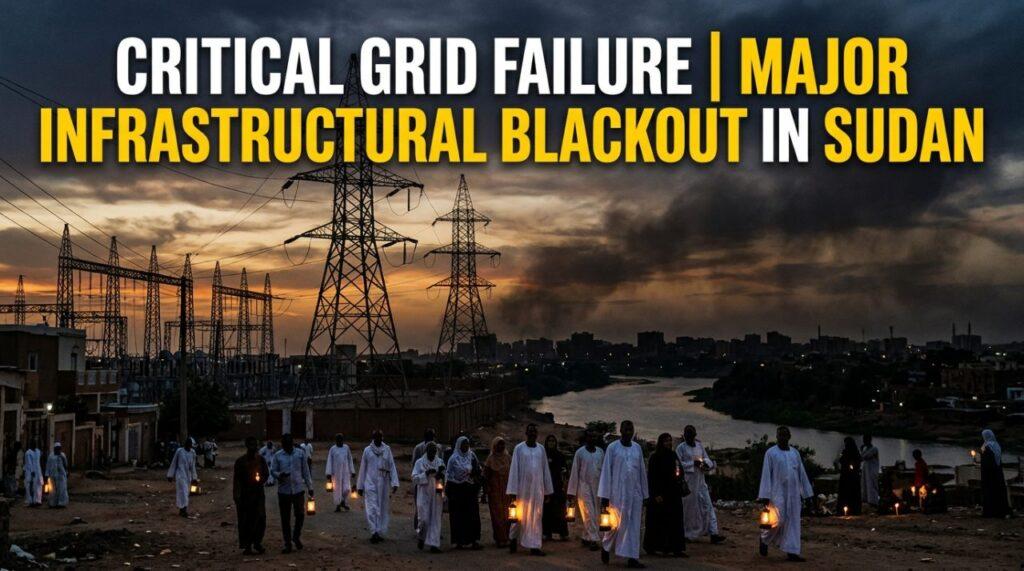
Coordinated waves of kamikaze unmanned aerial vehicles struck major power installations and fuel depots across Sudan in late October. The remote bombardments severed electricity lines, halted water utilities, and paralyzed emergency hospital care in multiple states. Suspicion immediately fell upon the Rapid Support Forces, a powerful paramilitary group locked in combat with the regular military (sudantribune.com, sudantribune.com). These operations signal a major transformation in the conflict. Unmanned systems now strike deep behind frontline combat areas.
The intensifying RSF drone campaign has extracted a brutal toll on civilian populations. United Nations monitors reported that Sudan drone strikes killed more than 300 civilians in the first three weeks of October alone (aa.com.tr, arabnews.com). As energy infrastructure burns from Khartoum to the Red Sea, millions of residents face sudden blackouts and clean water shortages. Understanding this shift requires examining the deep political economy of the Sudanese state. The roots of this crisis stretch back through decades of state-sponsored militia recruitment, resource extraction, and military fragmentation.
Sudan Power Station Attacks and the Strategy of Economic Denial
The recent aerial campaign marks an intentional pivot toward economic interdiction. In northwestern Omdurman, explosive drones struck the vital Al-Markhiyat electrical substation (sudantribune.com). The facility suffered devastating structural damage. The resulting electrical failure knocked out roughly 60 percent of the total power supply for Khartoum State (sudantribune.com). This Khartoum blackout promptly shut down municipal water treatment plants along the Nile, cutting off drinking water for hundreds of thousands of urban residents (sudantribune.com, sudantribune.com).
Simultaneous attacks occurred across central and eastern regions. Drones targeted the primary power distribution facility in Al Managil, located within Gezira State (sudantribune.com). Other strikes hit petroleum transport trucks and oil storage terminals, causing major fires (sudantribune.com). Farther east, strikes disabled regional substations in Singa, Al-Faw, Al-Hawata, Mashkour, and El Geneid (sudantribune.com). By striking five regional nodes simultaneously, the campaign caused a cascading electrical grid collapse across southeastern Sudan (sudantribune.com).
The Sudanese Armed Forces hold administrative control over these targeted eastern territories. By hitting facilities far behind active front lines, the RSF seeks to render army-held zones ungovernable (sudantribune.com). Strikes also reached the Um Alila fuel depot near Wad Madani, setting major petroleum reserves ablaze (sudantribune.com). These fuel reserves power regional transport, civilian bakeries, and agricultural irrigation pumps (sudantribune.com). The Sudan power station attacks systematically dismantle civilian systems essential for basic community survival.
Direct Civilian & Energy Impact Metrics
Rapid Support Forces Origins: Darfur and State-Sanctioned Militias
The contemporary paramilitary group carrying out these operations emerged directly from the Darfur conflict history of the early 2000s. Under former autocrat Omar al-Bashir, the central government in Khartoum sought to suppress insurgencies among non-Arab agrarian populations in western Sudan (theguardian.com). Instead of deploying regular troops exclusively, Bashir mobilized nomadic Arab pastoralist fighters. These proxy units gained global notoriety under the title Janjaweed (theguardian.com). They carried out brutal counterinsurgency campaigns marked by scorched-earth tactics, village burnings, and mass murder (theguardian.com).
In 2013, the regime restructured these informal armed groups into a formal paramilitary entity. This moment marks the true Rapid Support Forces origins. General Mohamed Hamdan Dagalo, universally known as Hemedti, assumed direct operational command. Bashir elevated Hemedti as a counterweight against coup-minded officers in the regular army. The ruler affectionately called the commander Himayti, translating directly to “my protector.” The Sudanese state granted the new force official status, weapons, and vast operational autonomy (theguardian.com).
This institutionalization laid the groundwork for severe ethnic hierarchies. State patronage empowered the group to seize commercial gold mines across Darfur and northern Sudan. Hemedti expanded his family corporate empire, capturing valuable mineral trade routes and financing private military expansion. These dynamics reflect historical patterns of systemic extraction that have long plagued African regional governance. Rather than functioning as a standard military wing, the RSF became an autonomous corporation backed by weapons (theguardian.com).
Sudan Civil War Escalation: The Rupture of the Military Coalition
The alliance between regular army leadership and the paramilitary hierarchy proved inherently fragile. Nationwide civilian street demonstrations ousted Omar al-Bashir in April 2019. Army chief General Abdel Fattah al-Burhan and Hemedti initially formed a governing partnership with civilian political leaders. However, in October 2021, the two commanders collaborated in a joint military coup. The takeover ousted civilian Prime Minister Abdalla Hamdok and crushed democratic reforms.
The military partnership collapsed during subsequent negotiations over democratic restoration. The primary friction involved Security Sector Reform. General Burhan demanded that the RSF submit to standard military oversight and fully integrate into the army within two years. Conversely, Hemedti demanded a ten-year integration schedule that preserved his independent command structure. The debate focused fundamentally on who would hold ultimate centralized national control over state security assets.
On April 15, 2023, simmering command disputes exploded into heavy urban fighting across Khartoum (theguardian.com). Paramilitary fighters deployed rapidly across the capital, seizing ministries, airports, and major intersections. The regular military responded with artillery barrages and jet aircraft strikes. This eruption initiated the catastrophic Sudan civil war escalation that now threatens regional stability across East Africa (theguardian.com).
Early combat operations centered on traditional infantry engagements and close-quarters fighting. The paramilitary fighters relied on fast-moving four-wheel-drive pickup trucks fitted with heavy machine guns. Conversely, the Sudanese Armed Forces leveraged conventional Russian-made fighter jets and attack helicopters. As the army reclaimed parts of Omdurman and stabilized defensive perimeters in eastern states, ground battles ground to an exhausting stalemate. Both factions subsequently turned toward unmanned aerial systems to break the deadlock (sudantribune.com, aa.com.tr).
Key Infrastructure Targets Struck
Sudan Energy Infrastructure Collapse: The Weaponization of Utilities
The deliberate targeting of civilian municipal power facilities creates severe legal and humanitarian consequences. Electrical transformers, fuel depots, and regional pumping stations represent dual-use infrastructure. While military units may draw power from municipal grids, these facilities primarily sustain civilian survival. Striking them triggers an immediate Sudan energy infrastructure collapse that endangers vulnerable civilian populations (sudantribune.com, sudantribune.com).
International Humanitarian Law establishes explicit protections for essential civilian networks. Article 54 of Additional Protocol I to the Geneva Conventions strictly forbids attacking, destroying, or rendering useless objects indispensable to the survival of the civilian population. Prohibited targets explicitly include drinking water installations, agricultural irrigation systems, and power plants required to run them. The law classifies attacks causing disproportionate civilian suffering as war crimes.
The physical consequences of these strikes are immediate and severe. When drone strikes knocked out the Al-Markhiyat plant, municipal water treatment systems along the Nile stopped operating (sudantribune.com). Millions of families lost access to treated pipe water, forcing households to collect untreated water directly from rivers. This breakdown triggered sudden spikes in acute cholera and bacterial dysentery across Khartoum and adjacent river communities.
Hospitals suffered immediate operational failure following the regional grid collapse. Medical facilities across Gezira and Gedaref lost continuous refrigeration, causing blood supplies, vaccines, and insulin stocks to spoil rapidly (sudantribune.com). Surgical wards and neonatal intensive care units were forced to shut down during prolonged blackout periods. Furthermore, destroying fuel storage at Um Alila halted diesel delivery for tractors and grain harvesters across Gezira (sudantribune.com). This destruction directly crippled food distribution in Sudan’s primary agricultural breadbasket (sudantribune.com).
Foreign Drone Supply Sudan: External Networks Arming the Skies
The sudden expansion of deep-strike drone capabilities reflects significant foreign intervention. The RSF historically operated as a light desert infantry force lacking aeronautical hardware. Today, the paramilitary group flies precision kamikaze loitering munitions and modified commercial reconnaissance drones hundreds of kilometers behind army front lines (sudantribune.com, aa.com.tr). This rapid technological upgrade stems directly from external logistical pipelines.
United Nations panels of experts have documented illicit supply networks sustaining the conflict. Official investigations point toward cargo flights landing at Amdjarass Airport in eastern Chad as a major conduit for foreign drone supply Sudan (hornreview.org). These flights, frequently labeled as humanitarian cargo shipments, transport weapons, communication gear, and unmanned aerial platforms directly into RSF control (hornreview.org). Commercial front companies operating in regional financial hubs help convert smuggled Sudanese gold into military hardware.
The regular military maintains its own international procurement networks. The Sudanese Armed Forces have deployed Iranian-manufactured combat drones and Turkish systems to offset infantry losses. Consequently, the skies over Sudan have evolved into a test ground for rival international defense technology. These foreign interventions reflect historical patterns seen in shared struggles against oppression across the Global South, where external interests routinely exacerbate regional crises.
Both combatants now employ remote drone technology without regard for civilian density. While RSF drones systematically dismantle public utility nodes, military drone operators have launched retaliatory strikes on public markets. Army drone strikes on the Amiet border market and a crowded transit hub in Nyala produced massive civilian casualties (kvue.com, aa.com.tr). Remote aerial warfare allows commanders to strike targets indiscriminately, eroding international norms of distinction and proportionality.
Humanitarian Toll Comparisons
Sudan Humanitarian Crisis: Attrition, Famine, and the Diaspora
The compounding destruction of utilities has produced an acute Sudan humanitarian crisis. International monitoring agencies describe the situation as the world’s most severe displacement emergency. More than fourteen million citizens have fled their homes to escape ground assaults and aerial bombardments (theguardian.com). Over two million people have crossed international borders into Chad, Egypt, and South Sudan, placing immense pressure on neighboring economies.
Direct conflict fatalities have exceeded 200,000 deaths according to international healthcare tallies. Furthermore, the Integrated Food Security Phase Classification alerts that over twenty million Sudanese experience emergency starvation conditions. Famine conditions already grip displacement camps in North Darfur, such as Zamzam. The systematic destruction of agricultural fuel supplies and irrigation stations threatens to lock the entire country into structural starvation.
For the African diaspora, Sudan’s devastation represents a catastrophic continuation of historical instability driven by militarism and resource extraction. The systematic destruction of power and water infrastructure guarantees that reconstruction will require decades of sustained capital investment. As remote aerial warfare continues unchecked, ordinary Sudanese civilians shoulder the entire cost of a destructive conflict fought for military dominance.
About the Author
Darius Spearman is a professor of Black Studies at San Diego City College, where he has been teaching for over 20 years. He is the founder of African Elements, a media platform dedicated to providing educational resources on the history and culture of the African diaspora. Through his work, Spearman aims to empower and educate by bringing historical context to contemporary issues affecting the Black community.
