


Texas Anti-DEI Lawsuit: Federal Battle Over School Arts
By Darius Spearman (africanelements)
Support African Elements at patreon.com/africanelements and hear recent news in a single playlist. Additionally, you can gain early access to ad-free video content.
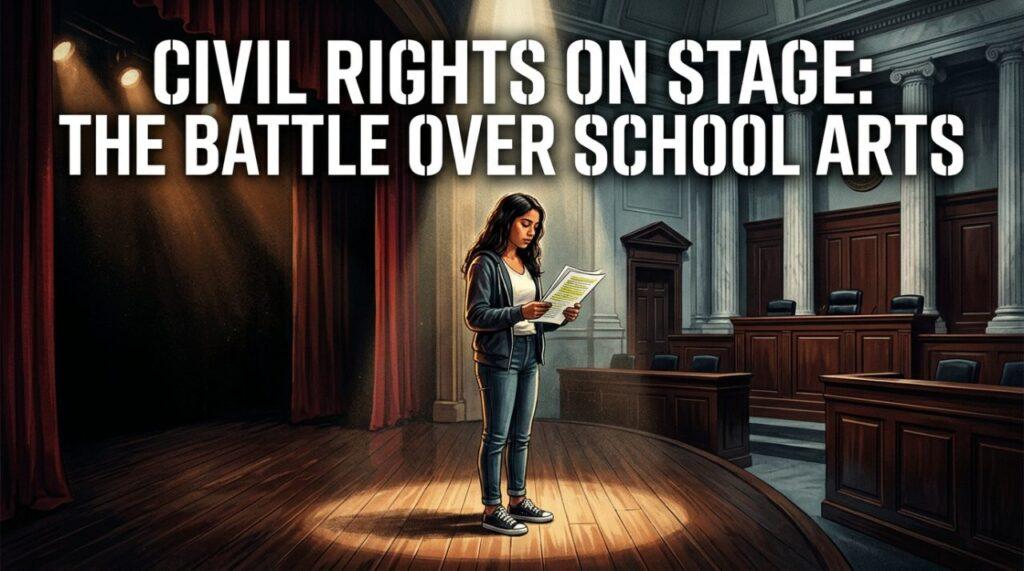
In late October 2026, a federal courtroom in North Texas became the latest battleground over civil rights in public schools (broadwayworld.com, lawyerscommittee.org). Civil rights attorneys filed a major federal complaint, titled Jimenez-Mota v Grand Prairie ISD, on behalf of a seventeen-year-old high school senior named Ana Mota (wfaa.com, lawyerscommittee.org). The student had earned the lead male role of Seymour in South Grand Prairie High School’s production of Little Shop of Horrors (broadwayworld.com, wfaa.com). Days into rehearsals, school administrators stepped in and barred her from performing the part because of her sex (wfaa.com, wfaa.com). When she declined an alternate role, district leadership canceled the entire musical and selected another show (broadwayworld.com, fox4news.com).
District administrators cited state restrictions, pointing toward compliance mandates governing diversity programs and gender policies in K–12 schools (wfaa.com, lawyerscommittee.org). What began as a high school audition has escalated into a landmark Texas anti-DEI lawsuit with national implications (lawyerscommittee.org). The cross gender casting lawsuit tests whether state restrictions can override foundational federal civil rights protections (lawyerscommittee.org). This legal clash reflects a long historical cycle in American education, where local resistance repeatedly collides with federal civil rights guarantees established across decades of struggle (lawyerscommittee.org).
Title VI Civil Rights Act: The Blueprint for Educational Equity
To understand the legal foundation of the Texas public school civil rights challenge, one must examine the Civil Rights Act of 1964 (lawyerscommittee.org). For generations after the collapse of post-Civil War Reconstruction, southern states maintained segregated public school systems that deliberately underfunded Black children (lawyerscommittee.org). Even after the Supreme Court outlawed legal school segregation in the landmark 1954 decision Brown v. Board of Education, state and local officials organized systemic resistance (lawyerscommittee.org). In response, Congress enacted Title VI of the Civil Rights Act of 1964 to establish federal authority over publicly funded education (lawyerscommittee.org).
Title VI established a simple but transformative rule: no institution that receives federal financial assistance may discriminate against individuals based on race, color, or national origin (lawyerscommittee.org). By linking federal funding to civil rights compliance, Congress created an enforcement mechanism that forced recalcitrant school boards to open their doors (lawyerscommittee.org). This architecture became the structural blueprint for modern educational equity laws (lawyerscommittee.org). Decades later, federal civil rights investigators still rely on Title VI authority to investigate hostile school environments, such as federal inquiries into persistent racial harassment in Texas school districts like Carroll ISD (texastribune.org, texastribune.org).
The principle behind Title VI confirmed that states cannot accept federal tax dollars while setting aside federal non-discrimination mandates (lawyerscommittee.org). When state laws seek to restrict educational programs or penalize institutional inclusion, federal statutory protections serve as the legal barrier preventing a return to unchecked local exclusion (lawyerscommittee.org). The Title VI Civil Rights Act statutory design remains the core model through which marginalized students demand equal protection under federal law (lawyerscommittee.org).
Title IX Participation Growth
High School Girls Extracurricular & Athletic Participation (nfhs.org)
Title IX Sex Discrimination in Classrooms and Creative Arts
When lawmakers sought to eliminate barriers facing women in educational institutions, they mirrored the text of Title VI (lawyerscommittee.org). Passed as part of the Education Amendments of 1972, Title IX established that no person shall face exclusion from any federally supported educational activity on the basis of sex (lawyerscommittee.org). The legislation was co-authored by Representatives Patsy Mink and Edith Green, drawing on civil rights organizing led by figures like Bernice Sandler and women in the civil rights movement who fought exclusionary academic hiring and admissions (lawyerscommittee.org).
Although Title IX is best known for expanding competitive athletic programs for girls, its statutory mandate covers all extracurricular programs (lawyerscommittee.org, nfhs.org). The law protects students participating in academic clubs, forensics, band, and theatrical productions (lawyerscommittee.org). The Supreme Court affirmed in Tinker v. Des Moines that students do not leave their constitutional rights at the schoolhouse gate (lawyerscommittee.org). In theater, cross-gender casting has existed for centuries, from classical Shakespearean stages to modern scholastic competitions (broadwayworld.com, lawyerscommittee.org). Script licensors routinely allow gender-neutral casting to accommodate school audition numbers (broadwayworld.com, lawyerscommittee.org).
The Grand Prairie controversy directly invokes Title IX sex discrimination protections (lawyerscommittee.org). Attorneys argue that South Grand Prairie High School officials denied Ana Mota an educational opportunity because she is female (wfaa.com, lawyerscommittee.org). The theater director cast her because she gave the best audition (wfaa.com, wfaa.com). Removing her solely due to her biological sex directly conflicts with federal sex discrimination laws, regardless of local interpretations of state statutes (lawyerscommittee.org).
The Political Arc of Anti-DEI Education Laws
The current legal friction is part of a larger historical reaction against institutional equity initiatives (lawyerscommittee.org, texastribune.org). Diversity, Equity, and Inclusion (DEI) offices grew out of affirmative action policies and federal compliance mechanisms developed in the 1970s and 1980s (lawyerscommittee.org). Institutions initially designed these programs to recruit and support Black, Hispanic, and female scholars who faced historic exclusion (lawyerscommittee.org). Over the following decades, universities and K–12 schools expanded these frameworks to include student affinity groups, culturally responsive literature, and anti-bullying guidelines (lawyerscommittee.org, txstudentsfordei.com).
Following nationwide racial justice demonstrations in 2020, conservative activists and state legislators launched an organized political campaign against racial and social equity curricula (lawyerscommittee.org). Political strategists used rhetorical panics surrounding Critical Race Theory to restrict lessons on institutional racism (lawyerscommittee.org). In Texas, lawmakers passed House Bill 3979 and Senate Bill 3 to limit how teachers could discuss slavery and racial discrimination in history classrooms (lawyerscommittee.org, texastribune.org). Once these curriculum bans took hold, legislative efforts moved to dismantle institutional diversity offices entirely (texastribune.org, texastribune.org).
By 2023, the campaign expanded to higher education through Texas Senate Bill 17, which eliminated diversity offices and diversity statements at state universities (texastribune.org, texastribune.org). Soon after, state lawmakers carried these prohibitions into the K–12 system through new anti-DEI education laws (lawyerscommittee.org). This campaign mirrors past political shifts after the civil rights era, where rhetoric around local control served to curtail educational civil rights gains (lawyerscommittee.org).
Legislative & Staff Reductions
State Anti-DEI Bills and Texas Campus Layoffs (challengergray.com)
Social Transitioning School Policy and the Grand Prairie Stage
The controversy in Grand Prairie highlights how school administrators conflate distinct legal and educational concepts (wfaa.com, lawyerscommittee.org). In educational guidance, social transitioning refers to non-medical personal steps an individual takes to affirm their gender identity in daily life (lawyerscommittee.org). These steps include adopting an alternative name, using different personal pronouns, or wearing clothing aligned with one’s gender identity rather than one’s biological sex assigned at birth (lawyerscommittee.org). Conservative state legislation targeted these administrative accommodations, barring teachers from honoring pronoun requests without parental consent (lawyerscommittee.org).
However, Grand Prairie administrators extended these rules to an artistic theatrical production (wfaa.com, lawyerscommittee.org). When school leaders barred Ana Mota from playing Seymour, they treated theatrical performance as an act of personal gender transition (wfaa.com, lawyerscommittee.org). Playing a scripted fictional character on stage does not alter a student’s administrative gender or personal identity (wfaa.com, lawyerscommittee.org). High schools nationwide regularly cast female students in male roles to balance audition turnouts, a convention accepted throughout theater history (broadwayworld.com, apnews.com).
This incident follows a documented pattern across North Texas school districts (apnews.com). In November 2023, Sherman High School administrators removed Max Hightower, a transgender male student, from a production of Oklahoma!, along with female students cast in male roles (12newsnow.com, apnews.com). The district instituted a rule requiring actors to match the sex on their birth certificates (12newsnow.com, apnews.com). Following community pushback, the Sherman school board rescinded the policy and reinstated the cast (12newsnow.com, apnews.com). Similarly, officials in Keller ISD canceled The Laramie Project before public outcry forced a reversal (theguardian.com, newsisout.com). The conflation of performance with a social transitioning school policy reflects administrative overreach designed to avoid political controversy (lawyerscommittee.org, fox4news.com).
Texas Senate Bill 12 and the Chilling of Student Expression
The administrative actions in Grand Prairie were driven by statutory anxiety surrounding Texas Senate Bill 12 (wfaa.com, lawyerscommittee.org). Texas Senate Bill 12 was drafted to regulate content related to gender and sexuality in public institutions, placing strict compliance liabilities on local school districts (lawyerscommittee.org, aclu.org). The law carries severe administrative consequences, including state investigations, funding freezes, and lawsuits from private citizens (lawyerscommittee.org, aclu.org). Because the statutory text uses broad language, administrators increasingly practice preemptive compliance to shield their institutions (lawyerscommittee.org).
Audio recordings submitted in the Grand Prairie federal court filings revealed that district leadership feared protests from conservative political groups (wfaa.com, fox4news.com). Administrators worried that allowing a female student to portray a male character in the Little Shop of Horrors Texas controversy would bring regulatory penalties under state statutes (wfaa.com, wfaa.com). Instead of defending artistic discretion, district officials removed the student and ultimately shut down the entire production (broadwayworld.com, wfaa.com). This institutional response shows how state laws create a chilling effect on student expression (lawyerscommittee.org).
This statutory pressure echoes earlier periods in American history when authorities weaponized social anxieties to police expressive culture and academic freedom in educational institutions (lawyerscommittee.org). When statutes use ambiguous terms, risk-averse administrators frequently interpret the rules in the most restrictive manner possible (lawyerscommittee.org). The result is the censorship of standard curricular materials, extracurricular clubs, and stage performances across public schools (lawyerscommittee.org, newsisout.com).
Campus Climate Survey Findings
Surveyed Texas Students and Post-Statute Instructional Impacts (equalitytexas.org, usc.edu)
Grand Prairie ISD Lawsuit: A Constitutional Collision Course
The Grand Prairie ISD lawsuit represents a direct constitutional test between state legislative power and federal civil rights protections (lawyerscommittee.org). Under the Supremacy Clause of the United States Constitution (Article VI, Clause 2), valid federal laws take precedence over conflicting state legislation (lawyerscommittee.org). When Congress passed Title IX under its constitutional spending powers and enforcement authorities, it established an enforceable civil rights floor for every school district accepting federal funds (lawyerscommittee.org). School districts cannot cite state laws to excuse actions that violate federal civil rights statutes (lawyerscommittee.org).
The legal complaint filed in federal court demonstrates how local administrative decisions create serious civil rights liabilities (wfaa.com, lawyerscommittee.org). Grand Prairie Independent School District receives millions of dollars in federal funding annually, which requires full adherence to Title IX (lawyerscommittee.org). By excluding a qualified female student from an established theater role based on gender stereotypes, the district engaged in unlawful discrimination under federal standards (lawyerscommittee.org). The lawsuit asks the federal court to issue an injunction preventing the district from enforcing sex-based casting bans and to award damages for the denial of equal educational opportunities (wfaa.com, lawyerscommittee.org).
The outcome of Jimenez-Mota v Grand Prairie ISD will shape school administration far beyond North Texas (lawyerscommittee.org). If school districts are permitted to use state anti-DEI mandates to justify sex-based restrictions, decades of Title IX precedent will be weakened (lawyerscommittee.org). Conversely, if the federal courts reaffirm that federal non-discrimination statutes supersede state-level restrictions, school boards will face clear boundaries against over-compliance (lawyerscommittee.org). As this case moves through federal court, it serves as a critical test of whether the civil rights frameworks won in the twentieth century can withstand modern legislative retrenchment (lawyerscommittee.org).
About the Author
Darius Spearman is a professor of Black Studies at San Diego City College, where he has been teaching for over 20 years. He is the founder of African Elements, a media platform dedicated to providing educational resources on the history and culture of the African diaspora. Through his work, Spearman aims to empower and educate by bringing historical context to contemporary issues affecting the Black community.
