

Displaced Women and Children: AU Demands Urgent Legal Rights
By Darius Spearman (africanelements)
Support African Elements at patreon.com/africanelements and hear recent news in a single playlist. Additionally, you can gain early access to ad-free video content.
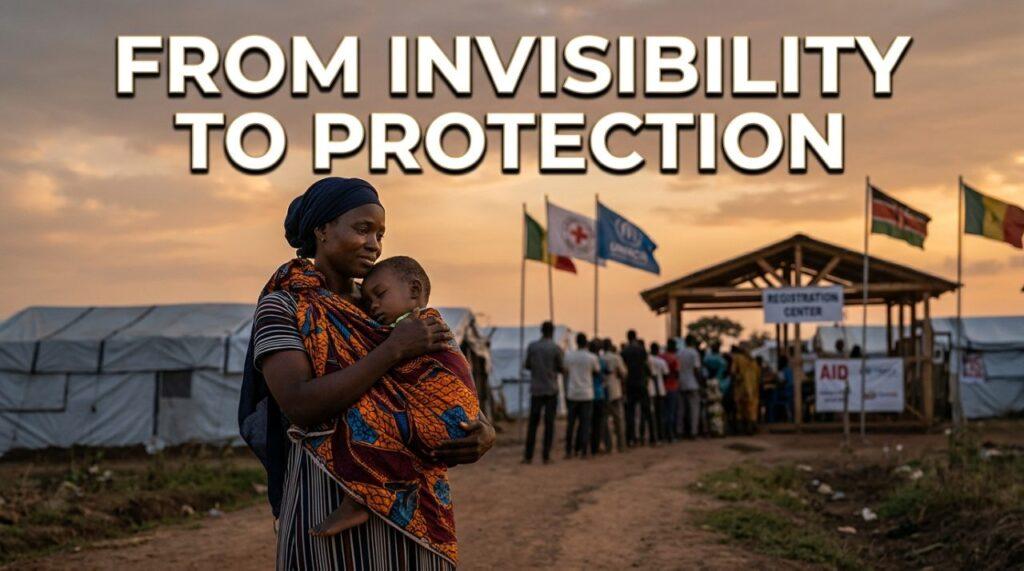
Across the globe, armed conflicts tear families from their homes and destroy entire communities. When villages burn and families flee, they leave behind land, livelihoods, and possessions. Yet one of the most devastating losses remains invisible to the naked eye. In the chaos of flight, millions of people lose the paper records that prove who they are (peaceau.org, unhcr.org).
Without birth certificates, identity cards, or nationality records, displaced persons face administrative erasure. They cannot vote, attend accredited schools, access state hospitals, or cross borders lawfully. In late October 2026, the African Union Commission brought this hidden emergency to the global stage. Continental leaders gathered in New York to demand immediate action for displaced women and children (peaceau.org).
UN Resolution 1325 anniversary and the AU Policy Dialogue
The high-level policy dialogue took place at the African Union Permanent Observer Mission in New York. The gathering coincided with the UN Resolution 1325 anniversary week (peaceau.org). In October 2000, the United Nations Security Council adopted Resolution 1325 to demand equal rights and physical protection for women in war zones (wikipedia.org). More than two decades later, African leaders argued that protection remains impossible without legal documentation (peaceau.org).
The dialogue was organized by the AU Special Envoy on Women, Peace and Security and the AU Special Envoy for Children Affected by Armed Conflict (peaceau.org). Continental diplomats, legal scholars, and civil society partners met to present a united front. Their title set the agenda: “From Legal Invisibility to Protection: Strengthening Legal Identity and Protection for Women and Children Affected by Armed Conflict” (peaceau.org).
For decades, international agencies treated the Women, Peace, and Security agenda separately from child protection frameworks. AU representatives declared that this bureaucratic divide must end immediately (peaceau.org). Displaced mothers and their dependent children face identical dangers when fleeing military violence. If an undocumented mother cannot establish her legal standing, her children face automatic exclusion from humanitarian services and school enrollment (unicef.org, child-identity.org).
Grassroots organizers in conflict zones often maintain civilian safety through enduring kinship ties and community mediation. AU delegates demanded that international relief agencies direct funding to these local groups. Displaced families rely on these local mutual aid groups when official state administration collapses (peaceau.org).
The internally displaced persons crisis Across the African Continent
The scale of the modern displacement emergency across Africa is staggering. More than 45 million individuals are currently displaced or stateless across Eastern, Southern, Central, and Western Africa (unhcr.org, unhcr.org). Armed confrontations in Sudan, the eastern Democratic Republic of the Congo, and the Central Sahel continue to force millions into survival camps (unhcr.org, unhcr.org).
Sudan alone accounts for roughly 13 million forcibly uprooted people, representing the largest displacement crisis on earth (unhcr.org). Across these conflict settings, women and children constitute up to 80 percent of the affected population (unhcr.org). When fighting erupts, mothers shoulder the burden of guiding young dependents across front lines and barren borders (peaceau.org).
Vulnerability in African Displacement Zones
Today, approximately 49 million children are displaced by violence around the globe (unicef.org). In Sub-Saharan Africa, roughly 100 million children under age five have never had their births formally registered (unicef.org, unicef.org). Over 120 million children across the continent lack a physical birth certificate (unicef.org, unicef.org). One in three unregistered African children lives in just three nations: the Democratic Republic of the Congo, Ethiopia, and Tanzania (unicef.org, unicef.org).
This demographic reality turns an administrative gap into a profound human rights catastrophe. When children lack records, authorities cannot verify their age or legal parentage (unicef.org, child-identity.org). Human traffickers, illegal labor cartels, and rebel commanders target these undocumented youths with total impunity (unicef.org). Without state paperwork, families cannot prove that their abducted children are minors under the law (child-identity.org).
Colonial Roots and civil registration in Africa
Current administrative failures have direct roots in the colonial occupation of the African continent. European powers established civil registration in Africa during the late nineteenth century. However, colonial regimes did not create civil registries to extend universal human rights to African populations (nih.gov, unicef.org). Instead, European administrators designed these systems to enforce labor extraction, collect poll taxes, and control movement (nih.gov).
Colonial administrators limited comprehensive record keeping to European settlers and urban coastal elites. Rural populations, pastoralist communities, and interior regions remained completely unrecorded by central bureaucracies. The machinery of governance relied on paper ledgers kept in centralized municipal headquarters. These ledgers were poorly protected and completely inaccessible to ordinary rural families (unicef.org, nih.gov).
When African nations won independence in the mid-twentieth century, they inherited these fragile civil frameworks. Just as activists fought to overcome post-war reconstruction policies that denied institutional protection to Black Americans, independent African states faced institutional neglect. Nascent governments lacked the funding to build universal digital records across vast geographic expanses (nih.gov).
Whenever post-colonial military conflicts broke out, paper registries collapsed almost immediately. Rebel factions and combatants targeted municipal town halls, courthouses, and church archives (peaceau.org). Burning these repositories eliminated land ownership records, birth registries, and census rolls. The destruction of administrative buildings stripped whole generations of legal existence overnight (peaceau.org, nih.gov).
From the OAU to ACRWC: legal identity human rights
African legal thinkers have spent decades fighting to protect displaced and vulnerable communities. In 1969, the Organization of African Unity adopted the OAU Refugee Convention (wikipedia.org). This treaty expanded the 1951 United Nations definition of a refugee. It included individuals fleeing foreign aggression, foreign domination, and public disorder (wikipedia.org). While revolutionary, the 1969 convention only protected people who crossed international boundaries, leaving internally displaced individuals unprotected (wikipedia.org, brookings.edu).
Continental jurists soon realized that children required explicit, binding legal guarantees. In 1990, the OAU adopted the African Charter on the Rights and Welfare of the Child (refworld.org). Article 6 of the Children’s Charter established that every African child has an inherent right to a name, a nationality, and immediate birth registration (refworld.org). This treaty moved legal identity human rights from administrative favors into non-negotiable legal protections (refworld.org, child-identity.org).
Unregistered Children Under Age 5
The African Union is pushing to classify legal identity as a non-derogable human right (peaceau.org). In international jurisprudence, a non-derogable right can never be suspended or restricted. Even during full-scale wars or states of emergency, governments cannot cancel these rights (iihl.org). Under Article 4 of the International Covenant on Civil and Political Rights, the right to recognition as a person before the law remains permanent (refworld.org).
Furthermore, the African Charter on Human and Peoples’ Rights contains no general emergency suspension clause. The African Commission on Human and Peoples’ Rights has consistently ruled that war does not justify denying basic legal identity (ulii.org, iihl.org). States bear a mandatory obligation to register individuals, issue credentials, and preserve civil status during armed conflicts (peaceau.org, iihl.org).
Maputo Protocol protections and Colonial Nationality Laws
African institutions took another major step forward in 2003 with the adoption of the Maputo Protocol (afronomicslaw.org). Article 11 explicitly orders state parties to protect women in armed conflicts (afronomicslaw.org). The treaty provides special measures for displaced mothers, single heads of households, and female refugees (afronomicslaw.org). Maputo Protocol protections remain among the most progressive gender frameworks on earth (afronomicslaw.org, equalnationalityrights.org).
Yet statutory inequality still blocks many women from securing citizenship for their offspring. Seven African countries deny mothers equal rights to confer citizenship to their children: Burundi, Eswatini, Liberia, Libya, Mauritania, Somalia, and Togo (equalnationalityrights.org, equalnationalityrights.org). Roughly 40 percent of African states prevent mothers from passing nationality to foreign husbands (equalnationalityrights.org). In these nations, citizenship passes almost entirely through fathers (equalnationalityrights.org, equalnationalityrights.org).
These gender restrictions are direct legacies of European legal codes. Colonial regimes exported patriarchal doctrines like English common law and the 1804 French Napoleonic Code across the continent (equalnationalityrights.org). Under these statutes, married women lacked independent civic status. European law subjected women to marital power and male guardianship (equalnationalityrights.org). Today, scholars working on colonial administrative legacies point out how these foreign statutes dismantled older African customs of female authority and kinship lineage.
When war erupts, these imported patriarchal laws create stateless generations. If fathers are killed in battle or separated during flight, mothers cannot register newborn infants alone (equalnationalityrights.org, equalnationalityrights.org). Without paternal documentation, the state refuses to issue papers. In West and Central Africa, more than one million individuals are currently stateless or at immediate risk of statelessness due to these structural exclusions (unhcr.org, unhcr.org).
Kampala Convention Article 13 and Operational Gaps
In 2009, the African Union made history in Uganda by adopting the Kampala Convention (reliefweb.int, brookings.edu). It was the world’s first legally binding continental treaty designed specifically to protect internally displaced persons (brookings.edu). The convention forbids arbitrary displacement, regulates camps, and demands safe return for uprooted families (reliefweb.int, refworld.org).
Kampala Convention Article 13 specifically addresses civil documentation. It obligates state parties to issue displaced persons the records required to claim their rights (refworld.org). Governments must replace lost or ruined identity cards and birth certificates without imposing impossible barriers (refworld.org). The treaty forbids states from forcing displaced individuals to journey back into active war zones simply to request paperwork (brookings.edu, refworld.org).
Kampala Convention Implementation Gap
Despite its historic adoption, the convention suffers from a severe implementation gap across the continent. Over 30 member nations have ratified the agreement, yet only a handful have passed domestic enabling laws (reliefweb.int, brookings.edu). Most African states operate under dualist legal frameworks (brookings.edu). An international treaty cannot be enforced in local courts until parliaments write it into national statutory law (brookings.edu).
Administrative capacity presents another major roadblock. Civil registration departments suffer from budget cuts and a lack of field equipment (nih.gov, unicef.org). When mass flight occurs, local offices cannot dispatch mobile units to remote displacement settlements (peaceau.org, nih.gov). Many regional governments also exhibit political hesitation. Officials worry that issuing identity papers gives displaced ethnic groups permanent claims to local voting districts and native land (brookings.edu, citizenshiprightsafrica.org).
Humanitarian aid groups have compounded this exclusion by adopting biometric verification. International programs require iris scans or digital fingerprints to distribute food aid and cash subsidies (peaceau.org). Without identity documents, displaced mothers cannot register for emergency food aid. To survive, vulnerable women often fall prey to predatory brokers and sexual exploitation (peaceau.org).
The historical resilience of family structures demonstrates that communities survive crises through organized solidarity. But survival requires institutional standing under the law. The African Union Commission has stated its position plainly in New York: legal identity is a non-negotiable gateway to physical safety, legal justice, and human dignity (peaceau.org).
About the Author
Darius Spearman is a professor of Black Studies at San Diego City College, where he has been teaching for over 20 years. He is the founder of African Elements, a media platform dedicated to providing educational resources on the history and culture of the African diaspora. Through his work, Spearman aims to empower and educate by bringing historical context to contemporary issues affecting the Black community.
