

Data Center Environmental Racism: NAACP’s Ballot Battle
By Darius Spearman (africanelements)
Support African Elements at patreon.com/africanelements and hear recent news in a single playlist. Additionally, you can gain early access to ad-free video content.
The NAACP Climate Voting Tool Exposes Digital Sacrifice Zones
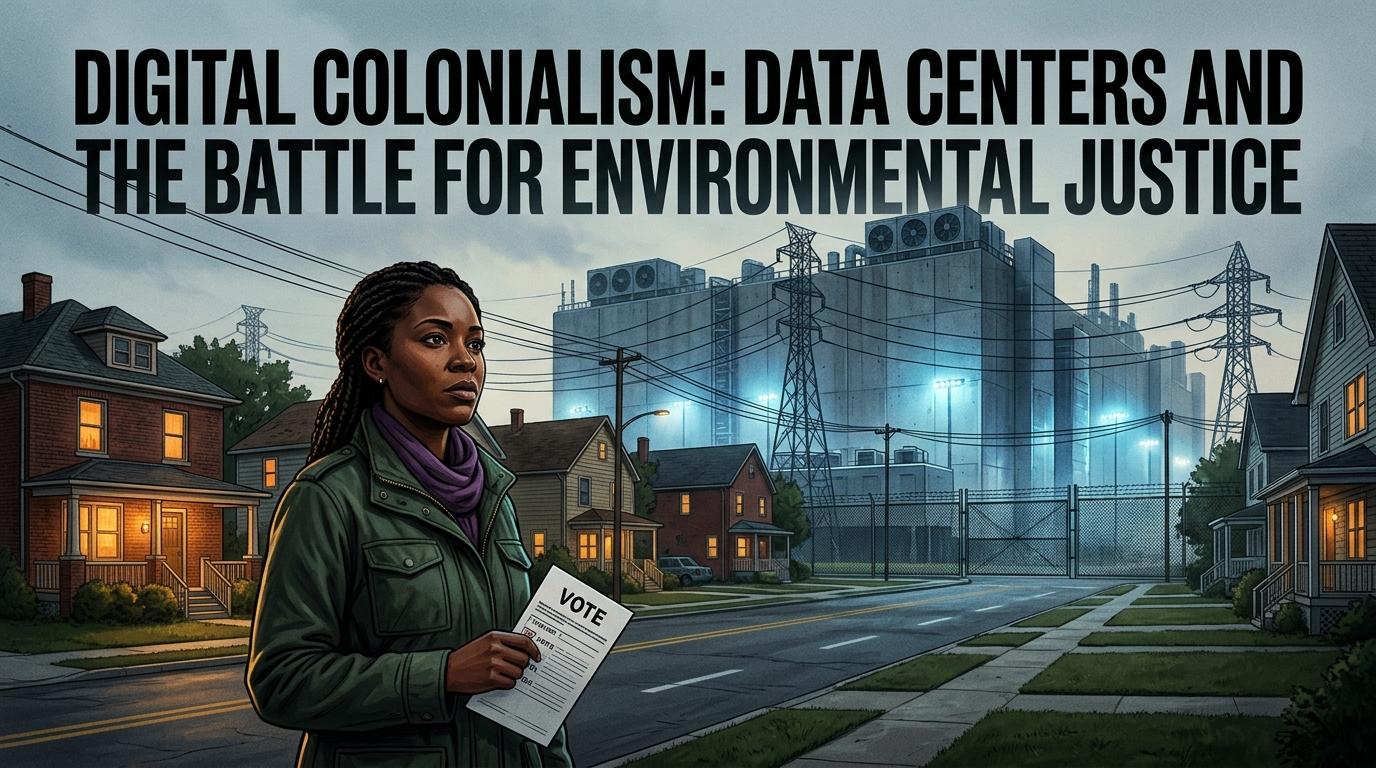
Civil rights leaders are drawing a firm line between the rapid growth of artificial intelligence and community health. In late October 2026, the National Association for the Advancement of Colored People joined with the environmental advocacy group Young, Gifted & Green to launch a national voter education dashboard (capitalbnews.org, wordinblack.com). Titled “Climate on Your Ballot,” the digital platform tracks the nationwide construction of massive industrial server campuses. The platform reveals how data center environmental racism directly threatens public health and household economic survival across the country (capitalbnews.org).
The interactive system catalogues 1,728 active commercial data centers alongside 1,042 facilities that are proposed or currently under construction (capitalbnews.org). Covering 17 targeted states, the dashboard allows voters to enter their home addresses to examine local corporate projects (wordinblack.com). Citizens can track the regulatory actions of elected officials, evaluate legislative records, and challenge candidates on energy equity before casting ballots. NAACP President Derrick Johnson and Environmental Justice Director Abre’ Conner argue that Big Tech digital sacrifice zones follow the exact predatory blueprints used by past industrial polluters (capitalbnews.org, naacp.org).
Data Centers Monitored on Voting Dashboard
The state and federal power dynamics surrounding this technology demonstrate how corporate interests capture regulatory bodies. Hyperscale server farms require continuous baseload electric power, millions of gallons of water, and thousands of acres of land (earthjustice.org, epri.com). Instead of building in wealthy enclaves, developers consistently select Black, brown, and lower-income rural towns (capitalbnews.org). Through the NAACP climate voting tool, organizers seek to turn hidden municipal agreements into public accountability during local elections (wordinblack.com).
The Deep History of Environmental Racism from Warren County to Now
Modern battles over computational infrastructure are rooted in more than four decades of civil rights resistance. The conceptual origin of this struggle emerged during the landmark 1982 Warren County PCB protests in North Carolina (apha.org, usccr.gov). State officials chose Afton, a rural town where 69 percent of the population was Black, to house a toxic chemical landfill (usccr.gov). The site held 6,000 truckloads of soil laced with highly toxic polychlorinated biphenyls that had been illegally dumped along state highways (usccr.gov, edizionicafoscari.it).
Residents refused to accept the dangerous dumping operation quietly. More than 500 protestors marched, lay down in front of heavy dump trucks, and suffered arrest alongside national civil rights leaders (apha.org, usccr.gov). During these intense street demonstrations, Reverend Dr. Benjamin Chavis coined the term environmental racism (apha.org, edizionicafoscari.it). Chavis defined the practice as racial discrimination in environmental policy making, selective regulatory enforcement, and the intentional placement of hazardous facilities in communities of color (apha.org).
Empirical evidence soon confirmed what grassroots organizers knew through lived experience. Dr. Robert D. Bullard, widely recognized as the father of environmental justice, conducted landmark sociological studies in Houston, Texas (jbhe.com, binghamton.edu). His research revealed that municipal authorities consistently directed toxic waste sites, municipal incinerators, and landfills into Black neighborhoods (binghamton.edu). In 1987, the United Church of Christ Commission for Racial Justice issued a groundbreaking national report (usccr.gov). That study documented that race was the single most prominent statistical factor in predicting commercial hazardous waste facility placement nationwide (usccr.gov, binghamton.edu). The history of environmental racism shows that industrial developers have long treated Black neighborhoods as paths of least political resistance (binghamton.edu).
How Redlining and Industrial Zoning Shaped Modern Data Center Corridors
The modern placement of digital server complexes is directly tied to twentieth-century housing discrimination. During the 1930s, the federal Home Owners’ Loan Corporation produced color-coded neighborhood assessment maps (escholarship.org). Neighborhoods where Black families lived were outlined in red ink, categorized as hazardous, and denied standard home loans (escholarship.org). Following this practice, municipal zoning boards systematically layered heavy manufacturing classifications over redlined residential streets (escholarship.org).
These historic zoning maps created industrial corridors that commercial tech developers target today. Municipal economic development boards sign non-disclosure agreements with shell corporations representing technology conglomerates (capitalbnews.org, naacp.org). Officials frequently claim these communities are pre-approved industrial lands, deliberately ignoring the families who live adjacent to the fence lines (capitalbnews.org). This institutional pattern reflects persistent anti-Black politics that prioritizes corporate balance sheets over community welfare.
This dynamic unfolded sharply in South Memphis, Tennessee, and neighboring Southaven, Mississippi (capitalbnews.org, earthjustice.org). In 2024, Elon Musk’s artificial intelligence enterprise, xAI, established its “Colossus” supercomputer facility at a former manufacturing complex in South Memphis (capitalbnews.org, futurism.com). Decades of industrial chemical exposure had already driven the neighborhood cancer risk in nearby Boxtown to four times the national average (capitalbnews.org). To operate the compute cluster without waiting for regular utility grid connections, xAI deployed 27 unpermitted methane gas combustion turbines (capitalbnews.org, earthjustice.org).
The unauthorized power plant had a capacity of 495 megawatts (capitalbnews.org, earthjustice.org). It generated hundreds of tons of hazardous nitrogen oxides, fine particulate soot, and carcinogenic formaldehyde adjacent to residential neighborhoods (capitalbnews.org, earthjustice.org). By late 2026, corporate operatives began offering financial buyouts to acquire 418 single-family homes in the adjacent Colonial Hills neighborhood (capitalbnews.org). The purchase contracts required homeowners to surrender future legal nuisance claims regarding industrial noise and air pollution (capitalbnews.org). Redlining and industrial zoning continue to serve as structural conduits for physical displacement and environmental injustice (capitalbnews.org, escholarship.org).
Surging AI Data Center Power Demand Strains the Electrical Grid
The nationwide rush to deploy generative artificial intelligence requires staggering amounts of electricity. Standard web search inquiries use minimal computational energy, but generative algorithms require four to five times more electrical energy per individual query (epri.com). Consequently, hyperscale facilities draw continuous baseload power on a scale equivalent to medium-sized cities (epri.com, energy.gov). This rapid growth has reversed decades of flat national power demand (epri.com).
Industry research highlights the rapid pace of this energy expansion. According to technical reports from the Electric Power Research Institute, commercial data centers consumed roughly 4 to 5 percent of total national electricity generation in 2024 (epri.com). Projections show that server facilities will consume between 9 and 17 percent of total United States electricity generation by 2030 (epri.com). In regional epicenters like Virginia, data center consumption is expected to absorb up to 57 percent of the state power supply (epri.com).
Data Center Share of U.S. Electricity
To satisfy this immense load, regulated utility companies are altering their long-term clean energy plans. Regulated power providers like the Tennessee Valley Authority and Georgia Power have delayed previously announced retirements of aging coal plants (selc.org, selc.org). Utilities are also investing heavily in new fossil-gas peaker units and high-voltage transmission lines (selc.org). The explosive AI data center power demand threatens to undermine national climate commitments while prolonging severe health hazards in surrounding residential communities (capitalbnews.org, selc.org).
Why Surging Residential Utility Bills Fall Heavily on Captive Ratepayers
The construction of private computational centers imposes steep financial costs upon everyday working families. When monopoly power companies build transmission lines, substations, and natural gas plants, they do not pay for these capital assets alone (selc.org, canarymedia.com). Instead, public utilities utilize a financial accounting process known as rate basing (selc.org, canarymedia.com). Under this regulatory formula, utilities incorporate capital expenditures into their authorized asset base, earning a guaranteed return approved by state regulators (selc.org).
Because retail electricity markets operate as state-granted territorial monopolies, residential families cannot switch to competing providers (publicpower.org, canarymedia.com). Everyday energy users remain captive ratepayers who are legally forced to fund grid upgrades built to serve corporate technology centers (selc.org, canarymedia.com). This financial transfer worsens an already severe energy affordability divide across the country (aceee.org, aceee.org).
Household Income Spent on Electricity
Data compiled by the American Council for an Energy-Efficient Economy illustrates this structural burden. The typical American household spends roughly 3.2 percent of its annual income on home energy expenses (aceee.org, aceee.org). In contrast, majority-Black census tracts spend an average of 5.1 to 6.0 percent of income on utilities, with lower-income brackets exceeding 15 percent (aceee.org, aceee.org). Decades of loan discrimination left older residential housing stocks without modern thermal insulation or energy-efficient appliances (aceee.org, aceee.org). Consequently, surging residential utility bills caused by data center construction fall most severely on working-class families with tight monthly budgets (capitalbnews.org, aceee.org).
How Public Service Commission Elections Decide Energy Justice
State regulatory panels hold the legal power to approve or reject massive technology utility buildouts. Known as Public Service Commissions or Public Utility Commissions, these governing bodies review corporate Integrated Resource Plans (selc.org). They decide whether monopolies can construct expensive methane gas turbines, establish high-voltage transmission projects, or pass capital charges onto domestic consumers (selc.org, canarymedia.com). Despite this massive authority, these regulatory bodies frequently escape voter scrutiny (tba.org, selc.org).
The method used to elect utility commissioners has deep historical links to political disenfranchisement. In states where utility regulators are elected rather than appointed, states have historically implemented at-large voting mechanisms (tba.org). In the federal lawsuit Rose v. Raffensperger, civil rights plaintiffs successfully demonstrated that Georgia’s statewide at-large voting framework violated Section 2 of the Voting Rights Act of 1965 (tba.org). The legal challenge proved that at-large elections submerged Black voters, preventing communities of color from electing regulators who represent their economic interests (tba.org).
Public service commission elections directly determine whether corporate utilities can force consumers to subsidize tech campuses. When regulatory benches lack democratic representation, utility monopolies routinely win approval for rate hikes without meaningful public pushback (tba.org, selc.org). Grassroots legal organizations and civil rights coalitions now view down-ballot utility elections as crucial democratic battlegrounds for economic equity (wordinblack.com, tba.org).
“Decisions about who pays for massive energy infrastructure are made at the ballot box through utility commissions and local zoning boards,” civil rights advocates note. “Voters must hold these regulatory agencies accountable before costs are locked in.”
history of environmental racism: Community Benefit Agreements and Frontline Democratic Resistance
Grassroots coalitions are refusing to accept corporate energy extraction as an inevitable cost of technological advancement. Drawing upon strategies developed during historic urban renewal campaigns, civil rights organizers demand legally binding Community Benefit Agreements (naacp.org). Pioneered during late-twentieth-century industrial fights like the Los Angeles Figueroa Corridor pact and the 2008 Pittsburgh Hill District agreement, these contracts give local coalitions independent legal standing in court (naacp.org).
Voluntary corporate philanthropy and non-binding press announcements fail to protect public health. The NAACP Frontline Framework sets explicit standards for local negotiations (naacp.org):
- Enforceable contracts that mandate dedicated local minority hiring and living wage guarantees (naacp.org).
- Total bans on municipal non-disclosure agreements that conceal public resource negotiations from taxpayers (naacp.org).
- Requirements that tech companies pay 100 percent of electrical transmission and sub-station infrastructure upgrades (naacp.org).
- Strict prohibitions against unpermitted fossil-fuel generators and gas combustion peaker units near neighborhoods (earthjustice.org, naacp.org).
- Mandatory limits on industrial water consumption from municipal drinking supplies and underground aquifers (capitalbnews.org, naacp.org).
These legal protections provide frontline neighborhoods with tools to confront corporate overreach directly. Understanding the broader historical debates regarding voting and representation clarifies why electoral transparency remains so urgent. The NAACP platform ensures that voters enter election booths with documented facts regarding local corporate concessions, industrial zoning votes, and utility rate hikes (capitalbnews.org, wordinblack.com). By linking the digital economy to civil rights principles, communities continue the long work of environmental justice that began decades ago (capitalbnews.org, apha.org).
About the Author
Darius Spearman is a professor of Black Studies at San Diego City College, where he has been teaching for over 20 years. He is the founder of African Elements, a media platform dedicated to providing educational resources on the history and culture of the African diaspora. Through his work, Spearman aims to empower and educate by bringing historical context to contemporary issues affecting the Black community.
