


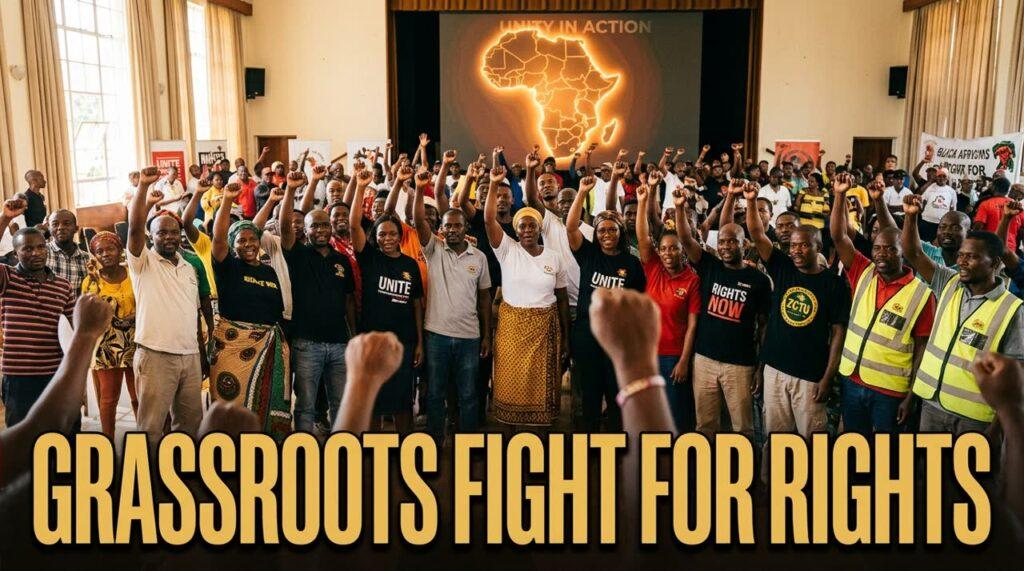
All-African Movements Assembly: Grassroots Fight for Rights
By Darius Spearman (africanelements)
Support African Elements at patreon.com/africanelements and hear recent news in a single playlist. Additionally, you can gain early access to ad-free video content.
Hundreds of frontline civil rights organizers, trade unionists, and journalists gathered in Maputo, Mozambique, for the 3rd All-African Movements Assembly (thisisafrica.me, afropolitain.com). The three-day summit brought together activists confronting a surge in state repression across the continent (thisisafrica.me). Convened under the title “United Africa: The Future We Want,” the meeting addressed closing civic spaces, military coups, and internet blackouts (thisisafrica.me, blanknewsonline.com). The Africans Rising movement organized this gathering to build civic power from the bottom up (africansrising.org, influencewatch.org).
The Maputo civil society assembly took place during a critical period for African democracy (thisisafrica.me). Across the region, modern regimes use telecommunications blocks, police violence, and restrictive statutes against peaceful demonstrators (civicus.org, accessnow.org). By convening in Mozambique, the assembly built bridges across linguistic divides, linking Anglophone, Francophone, and Lusophone organizers in shared struggle (thisisafrica.me). The current crisis in African civic space repression does not exist in a vacuum. It is the outcome of decades of political compromises, structural economic interventions, and ongoing struggles for popular democracy (wikipedia.org, africansrising.org).
The Split in Grassroots Pan-Africanism History
Modern Pan-African organizing has deep roots in 20th-century anti-colonial struggles (wikipedia.org). Early leaders such as Kwame Nkrumah, Julius Nyerere, and Gamal Abdel Nasser sought continental unity to dismantle European colonial rule (wikipedia.org). When these leaders founded the Organisation of African Unity in 1963, continental diplomacy shifted toward state structures (wikipedia.org). Over subsequent decades, the organization prioritized territorial integrity and regime preservation over civilian human rights (wikipedia.org). Grassroots critics often characterized the body as an elite pact designed to protect heads of state from accountability (wikipedia.org).
This state-centered model created a wide rift within grassroots Pan-Africanism history (wikipedia.org). While diplomatic summits took place in capital cities, ordinary citizens contended with authoritarian governance, one-party states, and military rule (wikipedia.org, ibrahim.foundation). Similar ideological divisions appeared in the Western diaspora, where debates over political self-determination and state power mirrored the conflicting elements of Black Nationalism during the mid-20th century. By the 1990s, the transition of the Organisation of African Unity into the African Union in 2002 offered renewed promises of regional integration (wikipedia.org). Yet the institution remained largely inaccessible to frontline labor organizers, rural farmers, and urban working-class communities (wikipedia.org, africansrising.org).
The early 2010s brought the corporate narrative of “Africa Rising” (africansrising.org). International finance institutions pointed to expanding telecommunications markets and gross domestic product growth (africansrising.org). However, that economic growth failed to improve living conditions for the majority of the population (africansrising.org). Foreign corporate extraction and local patronage networks consolidated wealth among a narrow ruling class (africansrising.org). Grassroots organizers recognized that established nongovernmental organizations had become reliant on Western donor funding, which often restricted radical advocacy (africansrising.org, influencewatch.org). A return to decentralized, mass-based organizing became necessary to demand democratic governance (wikipedia.org, africansrising.org).
Kilimanjaro Declaration Origins and People’s Power
The structural limitations of institutional advocacy led civic leaders to launch continent-wide consultations in 2015 (wikipedia.org, influencewatch.org). In August 2016, 272 delegates representing 40 African nations and the global diaspora met at the MS Training Centre for Development Cooperation in Arusha, Tanzania (wikipedia.org, influencewatch.org). Activists including Kumi Naidoo and trade union leader Jay Naidoo guided these sessions (wikipedia.org). The delegates sought to unify fragmented social movements into a single horizontal platform (wikipedia.org, africansrising.org).
On August 24, 2016, the conference adopted its foundational charter, marking the Kilimanjaro Declaration origins (wikipedia.org, africansrising.org). This manifesto rejected the elite-driven economic framing of the continent and asserted that authentic liberation requires peace, social justice, and dignity (africansrising.org). The charter anchored its commitments in the philosophy of Ubuntu, environmental defense, and full equality for women and youth (africansrising.org). This focus reflected a long historical continuum seen in the diaspora, where Black women organizing for freedom formed the backbone of community defense against entrenched oppression. The movement officially launched on African Liberation Day, May 25, 2017 (wikipedia.org).
The assembly model evolved through successive gatherings (africansrising.org, africansrising.org). The 1st All-African Movements Assembly convened in Arusha in August 2022, gathering more than 1,000 delegates to adopt the Kilimanjaro Declaration 2.0 (africansrising.org, africansrising.org). That update incorporated responses to digital surveillance and post-pandemic civic restrictions (africansrising.org). The 2nd Assembly convened in Accra, Ghana, in August 2024 (africansrising.org). That summit paired strategic sessions with delegations to Cape Coast Castle and Elmina Castle, positioning the legacy of the transatlantic slave trade at the center of modern reparatory justice campaigns (africansrising.org).
Civic Space Status in Sub-Saharan Africa
How Structural Adjustment Programs Africa Crippled States
To understand the current governance failures discussed in Maputo, one must examine international economic policies from the late 20th century (africansrising.org, ibrahim.foundation). During the 1980s and 1990s, the International Monetary Fund and the World Bank imposed Structural Adjustment Programs Africa across heavily indebted states. These loan packages required recipient governments to slash public expenditures, privatize state-owned utilities, devalue domestic currencies, and dismantle agricultural price supports.
These conditionalities gutted essential infrastructure throughout the continent. Governments had to introduce user fees for basic primary education and local medical clinics. Public sector hiring freezes left hospitals without personnel and schools without teachers. This institutional degradation triggered an immense brain drain of doctors, professors, and engineers to Western nations. The resulting loss of public capacity forced the cost of basic survival directly onto working families.
Furthermore, structural adjustment destroyed domestic manufacturing by forcing open local markets to foreign goods. This model prioritized raw mineral and agricultural exports over domestic food security and internal industrial production. By subordinating national budgets to external financial managers rather than elected parliaments, these programs severed the accountability between post-colonial governments and their citizens. The long-term deprivation established the conditions for recurring economic crises and public protests across African societies today (africansrising.org, ibrahim.foundation).
Confronting Digital Authoritarianism in Africa Today
Civil society faces modern surveillance regimes that build upon older methods of state control (adf-magazine.com, accessnow.org). Across the continent, digital authoritarianism in Africa has become a preferred instrument for suppressing political dissent (adf-magazine.com, accessnow.org). Over the past decade, human rights organizations have documented roughly 200 state-sponsored internet shutdowns across the continent (accessnow.org). Governments frequently cut off data access during elections, general strikes, and public protests (accessnow.org, accessnow.org).
During 2025 alone, monitoring coalitions recorded between 30 and 36 coordinated internet disruptions across 15 African nations (accessnow.org, accessnow.org). Rulers deploy these blackouts to prevent demonstrators from coordinating marches and to restrict the documentation of human rights abuses (adf-magazine.com, accessnow.org). This technological interference mirrors older patterns of state surveillance of civil rights activists, where security agencies weaponized surveillance tools to disrupt civil rights coalitions. Contemporary autocratic regimes also jam satellite internet systems and introduce cybercrime laws that penalize critical reporting online (adf-magazine.com, accessnow.org).
Delegates in Maputo approached digital communication access as a fundamental civil right (thisisafrica.me). Activists coordinated strategies to distribute offline mesh networking applications, secure circumvention proxies, and document abuses during total blackouts (thisisafrica.me, accessnow.org). Participants noted that telecommunications shutdowns often serve as a prelude to direct violence by police units (thisisafrica.me, adf-magazine.com). Securing digital communication is therefore critical to safeguarding human life during contested political elections (thisisafrica.me, accessnow.org).
Annual State Internet Shutdown Incidents
How the Africans Rising Movement Organizes in Maputo
At the gathering in Mozambique, the Africans Rising movement articulated a response to deteriorating political institutions (thisisafrica.me, africansrising.org). The 2026 Ibrahim Index of African Governance recorded that overall governance performance declined across nearly half of the continent over the preceding decade (ibrahim.foundation). Democratic participation measures dropped by an average of 18.6 points, alongside a 36.3-point decline in democratic elections (ibrahim.foundation). During the same window, political violence targeting civilians more than doubled (ibrahim.foundation).
Assembly leaders linked this institutional decay directly to military interventions in West and Central Africa (thisisafrica.me, africansrising.org). Military juntas have capitalized on widespread public anger regarding fraudulent ballots and economic stagnation (thisisafrica.me). Co-Chair Lucky Nimsiima addressed this dilemma during the assembly opening:
“An injury to one African is an injury to us all, and our march towards a fully integrated, borderless continent free from colonial barriers is unstoppable. Africa is navigating a deeply difficult moment where corrupt systems, rigged elections, and internet shutdowns are systematically weaponized to silence the will of her citizens. True authority belongs to the people.” (thisisafrica.me)
A central pillar of the Maputo agenda was the Borderless Africa campaign (thisisafrica.me, africansrising.org). Africa’s internal borders originated at the 1884–1885 Berlin Conference, where 14 European powers partitioned the land without African consent. Those colonial lines divided over 170 distinct ethnic and linguistic communities. In 1964, the Organisation of African Unity passed Resolution AHG/Res. 16(1) in Cairo, choosing to preserve inherited borders under the principle of uti possidetis juris to avert border wars. However, assembly delegates noted that these boundaries now restrict travel and trade while allowing authoritarian states to isolate local resistance (thisisafrica.me, africansrising.org). The assembly called for the immediate ratification of the African Union Protocol on Free Movement of Persons (africansrising.org).
Ten-Year Continental Governance Declines
Diaspora Reparatory Justice and Global Black Solidarity
The Maputo gathering reinforced links between continental activists and the global African diaspora (thisisafrica.me, africansrising.org). Article 4 of the Kilimanjaro Declaration formally establishes that people of African descent living across the Americas, the Caribbean, and Europe are equal stakeholders in the future of the continent (africansrising.org). Africans Rising coordinates direct joint campaigns with groups such as the Movement for Black Lives in the United States (africansrising.org, africansrising.org). These programs unite organizing efforts against racial capitalism, mass criminalization, and resource exploitation (africansrising.org, influencewatch.org).
The shared platform for diaspora reparatory justice moves beyond requests for financial remuneration (africansrising.org, africansrising.org). The framework aligns with demands advanced by the National African American Reparations Commission and United States legislative proposals such as H.R. 40. Organizers define reparations as systemic transformation: halting illicit financial flows, eliminating sovereign debt burdens, returning stolen ancestral artworks, and restructuring trade partnerships (africansrising.org, africansrising.org). This perspective links modern financial extraction to the long history of post-slavery economic subjugation, where emancipation lacked institutional redistribution, leaving communities economically vulnerable.
African youth governance movements are building alternatives to established political systems (thisisafrica.me, blanknewsonline.com). In Kenya, Nigeria, Senegal, and Mozambique, youthful populations are demanding genuine accountability (thisisafrica.me, theguardian.com). The 3rd All-African Movements Assembly underscored that piecemeal electoral reforms cannot address deep structural crises (thisisafrica.me, africansrising.org). By combining digital rights defense, economic resistance, and international solidarity, grassroots movements are reclaiming Pan-Africanism as an instrument of civilian liberation (thisisafrica.me, wikipedia.org).
About the Author
Darius Spearman is a professor of Black Studies at San Diego City College, where he has been teaching for over 20 years. He is the founder of African Elements, a media platform dedicated to providing educational resources on the history and culture of the African diaspora. Through his work, Spearman aims to empower and educate by bringing historical context to contemporary issues affecting the Black community.
