

RSF Arbitrary Detentions: Inside the West Darfur Crackdown
By Darius Spearman (africanelements)
Support African Elements at patreon.com/africanelements and hear recent news in a single playlist. Additionally, you can gain early access to ad-free video content.
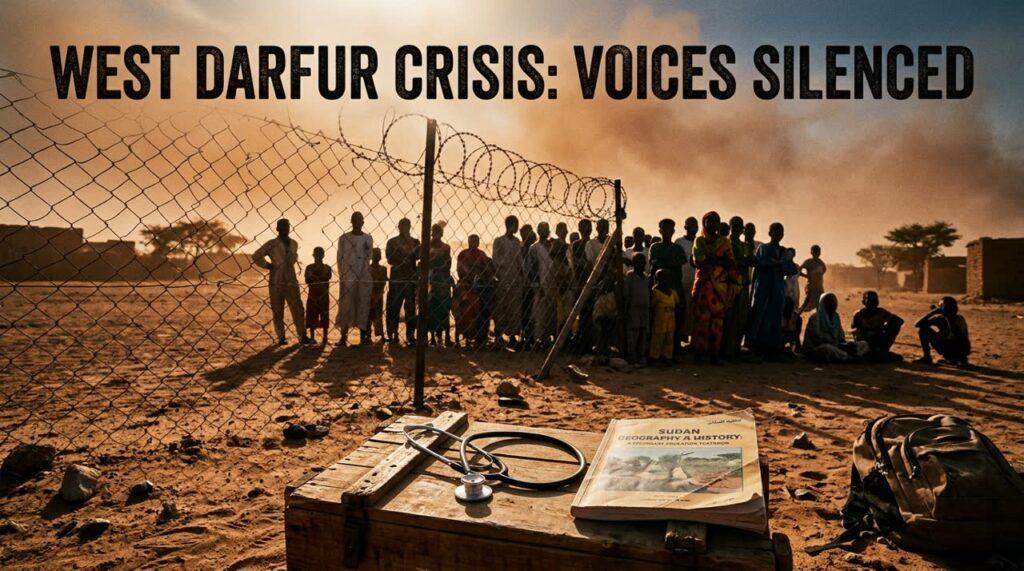
Human rights monitors and civil society groups in Sudan have raised an urgent alarm across West Darfur. The paramilitary Rapid Support Forces, known as the RSF, have instituted a wide campaign of arrests across the regional capital of El Geneina. These sweeps do not focus only on armed combatants. Instead, paramilitary squads are seizing community leaders, doctors, nurses, and classroom educators from their homes and workplaces (sudantribune.com).
For observers within the African diaspora, this tragic unraveling reflects long-standing historical patterns. Oppressive regimes frequently attempt to silence community memory by locking away civic leaders, a dynamic observed throughout the era of mass incarceration. In West Darfur, the suppression of educated professionals marks a calculated effort to weaken civic resistance and obscure ongoing abuses from the international community (dabangasudan.org).
Sudan Doctors Network Reports on Vanishing Professionals
Emergency documentation from human rights advocates details a severe wave of targeted abductions. Recent Sudan Doctors Network reports confirm that the RSF has arbitrarily detained at least 135 medical professionals and educational leaders in El Geneina (sudantribune.com). This count includes 47 healthcare professionals, such as specialized surgeons, general practitioners, lab technicians, and clinic nurses. Alongside them sit 88 teachers, school administrators, and university lecturers (sudantribune.com).
These arrests serve a clear military and administrative purpose. Human rights groups point out that healthcare workers are detained because they witness and document the human cost of armed assaults (dabangasudan.org). When wounded civilians arrive at local facilities, doctors treat physical trauma from shelling, gunshots, and sexual violence. Silencing these medical workers eliminates crucial eyewitnesses who can provide documented evidence of war crimes to external investigators (dabangasudan.org).
Furthermore, the detention of teachers and professors strikes at the intellectual core of the community. In periods of extreme crisis, educators often organize local relief networks and distribute humanitarian aid. Removing them destabilizes grassroots mutual aid groups. The loss of these professionals also leaves ordinary families without medical support and instruction, accelerating the complete breakdown of everyday urban life (protectingeducation.org).
Detained Professionals in West Darfur
Documented arbitrary detentions of civic personnel in El Geneina
Inside El Geneina Detention Facilities and Repurposed Bases
The arrest of civic workers is part of an extensive holding operation throughout the city. Independent monitoring groups estimate that more than 6,500 people are currently held within makeshift El Geneina detention facilities (sudantribune.com). These prisoners include captured Sudanese Armed Forces soldiers, civilian administrators, young men taken from neighborhood checkpoints, at least 709 women, and approximately 500 children (sudantribune.com).
To hold this large captive population, the RSF converted civilian and international infrastructure into interrogation camps. Paramilitary commanders occupied the former United Nations and African Union Mission in Darfur headquarters (sudantribune.com). A base constructed under an international mandate to safeguard local civilians now functions as a detention depot where people endure physical abuse without judicial review (sudantribune.com, redress.org).
Conditions within these sites are perilous. Detainees contend with extreme overcrowding, contaminated well water, and severe food shortages (sudantribune.com). Medical supplies are deliberately withheld, creating a health catastrophe behind barbed wire. Observers report that daily death rates continue to climb inside the Ardamata prison compound and nearby storage depots as preventable illnesses spread without treatment (sudantribune.com, dabangasudan.org).
The Darfur Hakura Land Conflict and Colonial Roots of Division
The contemporary violence across Darfur stems directly from unresolved colonial policies and land disputes. Long before modern borders were drawn, land access operated through the customary *hakura* system under the historical Darfur and Masalit Sultanates (wikipedia.org). Under this framework, tribal leaders held collective land titles called *hawakir*, granting specific geographic zones to sedentary farming populations, including the Masalit and Fur peoples (wikipedia.org).
When British colonial administrators took control of the region, they maintained this indirect rule structure. British officials codified customary boundaries while failing to provide land tenure protections for nomadic pastoralist communities (wikipedia.org). This colonial administrative framework laid the groundwork for future structural inequalities. It excluded pastoralist groups from administrative power and created sharp ethnic divisions over water access and grazing corridors (wikipedia.org).
During the 1970s and 1980s, persistent droughts and expanding desertification pushed northern nomadic herds south onto agricultural farmlands (wikipedia.org). Rather than reforming land administration equitably, authoritarian leaders in Khartoum manipulated these ecological tensions. Successive central governments encouraged political coalitions like the *Tajammu al-Arabi*, or Arab Gathering, to counter non-Arab political representation. This state strategy turned the historical Darfur Hakura land conflict into an ethnic struggle over territorial control and political dominance (wikipedia.org).
Conflict Zone Healthcare Breakdown
Operational status of health facilities in active war areas
Janjaweed to RSF Evolution and the Machinery of Impunity
The force carrying out mass detentions today grew directly from state-sponsored militias formed decades ago. In 2003, when African rebel groups rose up against the Khartoum regime over chronic regional underdevelopment, President Omar al-Bashir responded with counter-insurgency warfare (wikipedia.org). The state armed nomadic horsemen, known popularly as the Janjaweed, granting them legal immunity to burn villages, destroy wells, and displace indigenous populations (wikipedia.org).
By 2013, the central government formalized this arrangement. The state transformed irregular militia bands into a recognized paramilitary unit under commander Mohamed Hamdan Dagalo, known as Hemedti (wikipedia.org). This marked the formal Janjaweed to RSF evolution. The state recognized the paramilitary force by statute, giving its leaders access to official weaponry, state budgets, and independent commercial assets (wikipedia.org, idea.int).
Through gold mining in Darfur and foreign military deployments, the RSF accumulated wealth and operational autonomy (wikipedia.org). Following the popular revolution that unseated Bashir in 2019, the paramilitary leadership consolidated its position within the transitional authority. Over time, RSF fighters gained control over wide territories without accountability. This independence allowed the group to set up administrative networks and detentions outside the control of legal authorities (idea.int).
SAF and RSF Rivalry and the Desertion of West Darfur
The current nationwide conflict erupted directly from political infighting among Sudan’s armed leaders. In October 2021, regular army chief Abdel Fattah al-Burhan and RSF leader Hemedti united to stage a military coup, halting Sudan’s transition toward civilian democracy. However, unity between the commanders quickly collapsed over plans to merge the RSF into the regular army (idea.int).
International negotiations required security sector reform as a condition for civilian governance. Disagreements quickly mounted over the integration timetable. The army demanded complete absorption within two years, while the RSF pushed for a ten-year timeline under civilian oversight. On April 15, 2023, the intense SAF and RSF rivalry exploded into combat across Khartoum, quickly spreading into Darfur (wikipedia.org, idea.int).
In West Darfur, the regular army withdrew into defensive positions, leaving civilian communities unprotected. Stationed at the Ardamata military base, the 15th Infantry Division remained behind fortified perimeters while RSF fighters raided neighboring communities (washingtonpost.com). Army units prioritized their survival, and some soldiers eventually retreated into Chad. This military departure exposed local residents to armed takeovers, mirroring earlier historical moments when unfulfilled protection promises left vulnerable communities undefended (thecontinent.org, washingtonpost.com).
El Geneina Masalit Targeting and Intellectual Decapitation
With regular army forces barricaded inside their compounds, paramilitary fighters carried out a systematic campaign across the city. Between April and June 2023, paramilitary units launched an intense phase of El Geneina Masalit targeting, systematically attacking residential neighborhoods and displacement camps (wikipedia.org, washingtonpost.com). United Nations investigators estimate that between 10,000 and 15,000 people were killed in these assaults (www.gov.uk, wikipedia.org).
The violence deliberately targeted community leaders. In June 2023, West Darfur Governor Khamis Abdullah Abakar publicly condemned the RSF’s actions as genocidal during an international television broadcast (wikipedia.org). Hours later, paramilitary fighters abducted and killed him (wikipedia.org). Similar operations targeted lawyers from the Darfur Bar Association, local judges, and tribal elders who possessed administrative authority (dabangasudan.org).
Today, the mass detention of teachers, physicians, and lecturers represents an administrative continuation of those earlier killings. By removing educated community members, paramilitary authorities eliminate those capable of organizing civilian networks or reporting conditions to the outside world (dabangasudan.org, protectingeducation.org). Detained medical staff are also subjected to involuntary servitude, forced to treat wounded fighters while local clinics run out of basic supplies (sudantribune.com, doctorswithoutborders.org).
Total Detainees in El Geneina Facilities
Documented demographic composition across military sites and camps
The current detentions in West Darfur show how historical patterns of state-sponsored violence and land expropriation continue in the present day. When international peacekeeping missions departed in 2021, they left behind an institutional void that armed groups quickly filled. The ongoing detention of medical and academic personnel is not an accidental outcome of combat. It remains a sustained administrative campaign to suppress independent reporting and break civic organization across the region (sudantribune.com, dabangasudan.org).
About the Author
Darius Spearman is a professor of Black Studies at San Diego City College, where he has been teaching for over 20 years. He is the founder of African Elements, a media platform dedicated to providing educational resources on the history and culture of the African diaspora. Through his work, Spearman aims to empower and educate by bringing historical context to contemporary issues affecting the Black community.
