
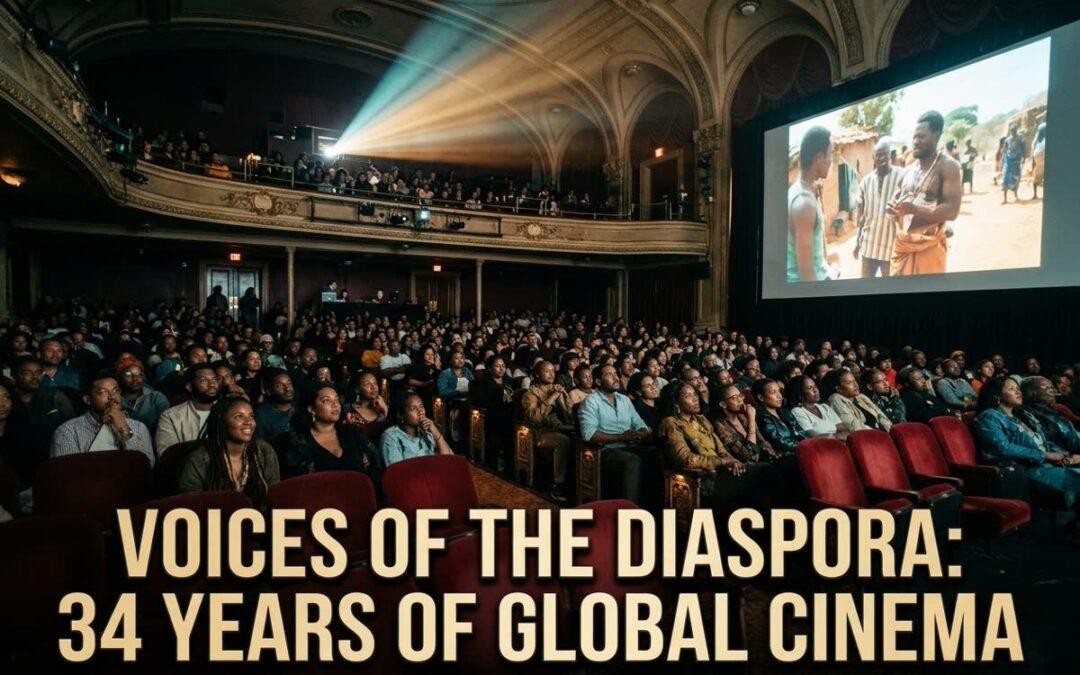


African Diaspora Film Festival: Inside the 34th Lineup
By Darius Spearman (africanelements)
Support African Elements at patreon.com/africanelements and hear recent news in a single playlist. Additionally, you can gain early access to ad-free video content.
On November 9, organizers in New York City announced the official program for the 34th annual African Diaspora International Film Festival (einpresswire.com). Running from late November through mid-December, this extensive gathering showcases dozens of contemporary works centered on human rights, economic transformation, and social resilience (einpresswire.com, nyadiff.org). The annual event draws global attention to cinematic narratives from across Africa, the Americas, Europe, and the Caribbean (filmfreeway.com, nyadiff.org). Among the headline presentations are official Academy Award submissions from Rwanda and Morocco (einpresswire.com). While modern multiplexes frequently overlook independent foreign cinema, this annual festival continues to expand access to international productions (africanamericanreports.com).
The contemporary headlines surrounding the festival spotlight international awards, diplomatic screenings, and digital streaming platforms (einpresswire.com). However, the roots of this annual event extend deep into the cultural politics of the twentieth century. The festival emerged from grassroots community organizing in Upper Manhattan during the early 1990s (africultures.com, nyadiff.org). It answered decades of structural exclusion within the American commercial film industry (africanamericanreports.com). Understanding the modern slate requires examining how independent distribution networks, Pan-African ideology, and educational activism converged to create this cultural institution (columbia.edu, columbia.edu).
ArtMattan Productions Harlem Origins and Grassroots Vision
The festival began in November 1993 through the initiative of Dr. Reinaldo Barroso-Spech and Diarah N’Daw-Spech (nyadiff.org). Dr. Barroso-Spech was a Cuban-born scholar of Haitian and Jamaican descent who completed doctoral studies at Teachers College, Columbia University (columbia.edu, nyadiff.org). Diarah N’Daw-Spech was a French-Malian financial consultant holding a business degree from Columbia Business School (columbia.edu, nyadiff.org). After relocating from Paris to New York City during the 1980s, the couple observed a severe absence of diverse Black narratives in mainstream commercial movie houses (africanamericanreports.com). Foreign language art houses rarely screened works created by African or Afro-descendant directors (africultures.com).
To confront this exclusion, the founders established ArtMattan Productions in Harlem as a specialized cultural distributor (africultures.com, nyadiff.org). Dr. Barroso-Spech originally utilized foreign-language films to instruct public school and university students in linguistics and literature (columbia.edu). He soon recognized that adult audiences possessed an intense desire for complex international cinema (africanamericanreports.com). Grounding their institutional philosophy in progressive pedagogy, the founders viewed motion pictures as primary educational instruments capable of dismantling racial stereotypes and building cross-cultural empathy (columbia.edu, columbia.edu). Their work reflected the foundational principles of academic Black studies by validating the lived experiences of global Black communities (columbia.edu).
Teachers College at Columbia University provided an early institutional home for academic symposia and public screenings (columbia.edu, columbia.edu). The inaugural 1993 edition presented approximately twenty-five films across seven days (nyadiff.org). Community members attended discussions analyzing structural racism, colonial legacies, and migratory labor (columbia.edu, africanamericanreports.com). That modest neighborhood initiative soon developed into an internationally recognized cinema institution (filmfreeway.com, nyadiff.org). Through decades of institutional independence, ArtMattan expanded its programming to satellite festivals in Washington, D.C., Chicago, and Paris (washingtonian.com, africultures.com, nyadiff.org).
ADIFF Festival Growth: 1993 vs 34th Edition
Black Independent Cinema History and the Fight for Distribution
The creation of the festival in Harlem followed a long historical tradition of cinematic self-reliance (africanamericanreports.com). In the early twentieth century, major Hollywood studios established rigid monopolies over production and theater exhibition (wikipedia.org). Studio productions routinely relied on demeaning caricatures of Black citizens (africanamericanreports.com). In response, independent directors established the race film industry (wikipedia.org). Oscar Micheaux emerged as a pivotal pioneer within this independent movement during the silent and early sound eras (wikipedia.org). Micheaux personally financed his productions, booked private auditoriums, and drove prints across the United States to reach urban audiences (wikipedia.org).
Decades later, Black filmmakers renewed this confrontation against institutional barriers during the 1970s and 1980s (africanamericanreports.com). A group of independent directors studying at the University of California, Los Angeles formed the L.A. Rebellion movement (africanamericanreports.com). Directors such as Charles Burnett and Haile Gerima rejected commercial narrative formulas (africanamericanreports.com). They developed an anti-colonial visual language that prioritized community organizing, historical reckoning, and working-class realities (africanamericanreports.com). These directors avoided studio interference by circulating prints through universities, union halls, and municipal community centers (columbia.edu, africanamericanreports.com).
Despite these critical achievements, commercial distributors throughout the late twentieth century continued to treat global Black cinema as commercially unviable (africanamericanreports.com). Studio executives claimed that foreign films featuring Black casts lacked domestic market appeal (africanamericanreports.com). ADIFF systematically shattered that industry myth starting in 1993 (nyadiff.org, africanamericanreports.com). By securing exhibition spaces at independent venues like Greenwich Village’s Cinema Village, the festival established a sustainable pipeline for independent films (nyadiff.org, cinemavillage.com). This alternative exhibition circuit directly connected international directors with engaged theater audiences (filmfreeway.com, cinemavillage.com).
The Pan-African Cinema Movement and Global Solidarity
From its inception, the festival adopted an expansive definition of the African diaspora (filmfreeway.com, nyadiff.org). Rather than restricting programming to an African American framework, the organizers embraced a polycentric Pan-African model (einpresswire.com, nyadiff.org). Pan-Africanism represents the political and cultural philosophy asserting that African people worldwide share common historical interests and a collective destiny (africanamericanreports.com). This framework examines historical dispersions resulting from the transatlantic, trans-Saharan, and Indian Ocean slave trades (einpresswire.com, africanamericanreports.com). It also addresses modern economic migrations driven by global financial inequality (einpresswire.com, afropop.org).
The festival deliberately includes North African and Indigenous Afro-descendant populations within its core curatorial structure (einpresswire.com, nyadiff.org). This deliberate curatorial choice challenges colonial cartographies that historically split North Africa from sub-Saharan regions (einpresswire.com). International forums like the Organization of African Unity and the modern African Union historically included nations like Algeria, Egypt, and Morocco to forge unified anti-colonial fronts (einpresswire.com). By presenting Indigenous Amazigh, Tuareg, and Afro-Latinx narratives, the festival questions monolithic definitions of racial identity (einpresswire.com, latinamedia.co). These complex narratives reveal ongoing expressions of cultural resilience across divergent linguistic traditions (einpresswire.com, africanamericanreports.com).
This global perspective builds an ideological bridge linking foreign anti-colonial struggles with domestic civil rights movements (africanamericanreports.com). Historical leaders like W.E.B. Du Bois, Malcolm X, and Martin Luther King Jr. consistently connected domestic disenfranchisement to international imperialist extraction (africanamericanreports.com). Post-screening panel discussions at ADIFF reinforce this historical continuity (columbia.edu, nyadiff.org). Audiences analyze systemic issues like police brutality, forced displacement, and resource exploitation as structural echoes of worldwide colonial dominance (einpresswire.com, africanamericanreports.com). The programming illustrates how cultural expression and political mobilization remain interlocked across the African continent and its worldwide diaspora (afropop.org, africanamericanreports.com).
Lineup Geographic Representation (34th Edition)
ADIFF New York Lineup: Spotlight on Justice and Resilience
The 34th annual festival schedule presents 74 films representing 39 nations over 17 days (einpresswire.com). In-person screenings take place across Manhattan at Teachers College, The Forum at Columbia University, and Cinema Village (einpresswire.com, cinemavillage.com). A nationwide virtual program accompanies these theatrical presentations to accommodate audiences across North America (einpresswire.com, nyadiff.org). The 2026 schedule prioritizes contemporary examinations of democratic access, state accountability, and community preservation (einpresswire.com). These programmatic selections demonstrate how international filmmakers utilize narrative and documentary formats to record human rights struggles (einpresswire.com, africanamericanreports.com).
Over half of the programmed selections represent regional, national, or world premieres (einpresswire.com, filmfreeway.com). This selection provides critical American theatrical exposure to non-commercial productions that lack corporate marketing backing (africanamericanreports.com). Many titles explicitly interrogate the generational impact of state violence and colonial extraction (einpresswire.com). By presenting these accounts in major urban centers, the festival directly contributes to modern discussions surrounding the international reparations movement and historical reconciliation (einpresswire.com, africanamericanreports.com).
The festival programming also navigates internal political debates over representation and cultural autonomy (africanamericanreports.com). Tensions between artistic self-determination and political messaging echo historic debates over cultural nationalism within the global Black liberation struggle (africanamericanreports.com). Rather than promoting uniform narratives, the festival curates contradictory perspectives on modern governance and social change (einpresswire.com, afropop.org). Audiences encounter varied perspectives regarding how communities sustain solidarity across geographic and cultural divisions (einpresswire.com, africanamericanreports.com).
Oscar Submissions Rwanda Morocco Challenge Mainstream Canons
Prominent on the 34th annual slate are official Academy Award submissions representing Rwanda and Morocco (einpresswire.com). These titles illustrate how sovereign nations utilize cinematic storytelling to project national histories onto international stages (einpresswire.com, africanamericanreports.com). Morocco submitted Strawberries (La Más Dulce), directed by Laïla Marrakchi (einpresswire.com). The film examines modern domestic realities, migratory pressures, and social dynamics within North Africa (einpresswire.com). The festival also screens Goundafa, the Cursed Song, a Moroccan production examining the cultural tensions between traditional Amazigh heritage and institutional religious conservatism (einpresswire.com).
Rwanda’s official submission, Ben’Imana, anchors the festival’s Justice and Democracy programming track (einpresswire.com). The narrative confronts the deep psychological and social scars remaining in post-genocide society (einpresswire.com). By focusing on reconciliation, institutional justice, and community survival, the film moves past simplistic western depictions of continental conflict (einpresswire.com, africanamericanreports.com). It portrays citizens actively negotiating collective memory, legal restitution, and personal survival in an evolving sovereign state (einpresswire.com). Complementing these feature films is the documentary She Had a Dream from Tunisia and France (einpresswire.com). This non-fiction work tracks the political campaign of Ghofrane Binous, a young Black Tunisian woman confronting institutional marginalization and colorism within North African political structures (einpresswire.com).
These entries highlight how African cinema has achieved technical excellence while preserving political urgency (einpresswire.com, afropop.org). Historically, African productions faced patronizing distribution policies from western film distributors (africanamericanreports.com). Mainstream distribution systems routinely treated continental cinema as ethnographic documentation rather than high-caliber artistic work (africanamericanreports.com). By placing these official Oscar contenders alongside independent documentaries, the festival validates these productions within elite artistic circuits (einpresswire.com, filmfreeway.com). The screenings confirm that African filmmakers operate at the leading edge of global cinema aesthetics (einpresswire.com, afropop.org).
Key Programming Metrics (34th Edition)
Women of Color Filmmakers Take Center Stage
A central pillar of the 34th annual festival is its deliberate platforming of female directors (einpresswire.com). International film festivals have faced sustained criticism for excluding women, particularly women of color, from competition slates and financing forums (africanamericanreports.com). In response, ADIFF established the Public Award for Best Film Directed by a Woman of Color (einpresswire.com). This formal competitive award honors cinematic innovation while providing measurable professional visibility to underfunded directors (einpresswire.com, nyadiff.org). It ensures that critical industry gatekeepers recognize the directorial vision of women across Africa, the Caribbean, and Latin America (einpresswire.com, latinamedia.co).
By centering women behind the camera, the festival expands discussions of gender, state power, and economic autonomy (einpresswire.com). Films directed by women within the lineup confront corporate exploitation, patriarchal family structures, and wartime sexual violence (einpresswire.com, africanamericanreports.com). These cinematic accounts do not present women merely as passive victims of historical crises (africanamericanreports.com). Instead, they highlight female protagonists organizing labor strikes, preserving ancestral memory, and challenging military authority (einpresswire.com, africanamericanreports.com). These perspectives broaden the global Black cinematic canon by introducing essential intersectional analyses (columbia.edu, africanamericanreports.com).
To prevent these films from vanishing after their festival runs, ArtMattan maintains permanent distribution infrastructure (nyadiff.org, africanamericanreports.com). Through its distribution wing, ArtMattan Films, and its video-on-demand service, ArtMattanTV, the organization licenses and streams independent productions year-round (nyadiff.org). This distribution model protects non-commercial films from algorithmic neglect on commercial streaming services (africanamericanreports.com). Over 100,000 attendees have engaged with the festival’s screenings and university workshops since 1993 (filmfreeway.com, nyadiff.org). As the 34th edition demonstrates, this Harlem-born organization remains an indispensable global institution for independent cinema and historical education (einpresswire.com, nyadiff.org).
About the Author
Darius Spearman is a professor of Black Studies at San Diego City College, where he has been teaching for over 20 years. He is the founder of African Elements, a media platform dedicated to providing educational resources on the history and culture of the African diaspora. Through his work, Spearman aims to empower and educate by bringing historical context to contemporary issues affecting the Black community.
