
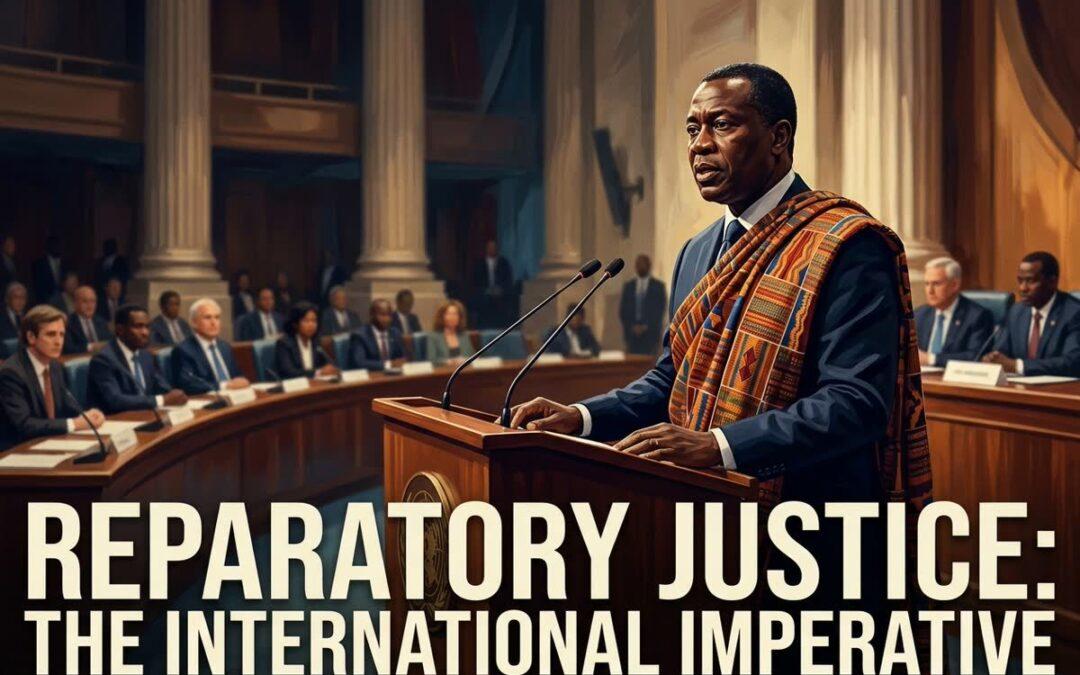


Slave Trade Reparations: Why Ghana Is Challenging the UK
By Darius Spearman (africanelements)
Support African Elements at patreon.com/africanelements and hear recent news in a single playlist. Additionally, you can gain early access to ad-free video content.
In late 2026, British Foreign Secretary Ed Miliband publicly dismissed financial reparations for the transatlantic slave trade as “not feasible” (theguardian.com, theguardian.com). This statement reflected a familiar diplomatic stance across Western capitals. European leaders often frame reparatory justice as an impractical, bankrupting cash transfer from modern taxpayers to individuals (theguardian.com).
Ghanaian President John Dramani Mahama rejected that narrow definition (presidency.gov.gh, citinewsroom.com). Serving as the African Union Champion on Reparations, Mahama announced the operationalization of three international working panels (presidency.gov.gh, news.cn). These panels are designing practical frameworks for reparatory justice (presidency.gov.gh, africanews.com). Their strategy looks beyond cash payouts to address debt cancellation, institutional investment, cultural repatriation, and legal accountability under international law (presidency.gov.gh, mfa.gov.gh).
UK Slave Trade Reparations: The Feasibility Debate and Modern Pushback
Western governments have long restricted their responses to expressions of regret (theguardian.com, theguardian.com). Ahead of the Commonwealth Heads of Government Meeting in Antigua and Barbuda, British officials indicated openness to a formal state apology (theguardian.com). However, British diplomats drew a hard line against financial liability (theguardian.com). They argued that calculating damages across centuries is impossible and economically destabilizing (historyreclaimed.co.uk, historyreclaimed.co.uk).
President Mahama and African legal scholars argue that this defense ignores economic reality (presidency.gov.gh, mfa.gov.gh). Modern economic research demonstrates that the transatlantic trade created systemic wealth disparities that persist today (brattle.com, brattle.com). A landmark 2023 study published by the Brattle Group calculated the global reparations liability for transatlantic chattel slavery between $100 trillion and $131 trillion (brattle.com, brattle.com). The report, co-authored by international jurists, assessed the United Kingdom’s specific obligation at $24 trillion, or roughly £18.6 trillion (brattle.com, theguardian.com).
These calculations cover unpaid labor, human suffering, and ongoing institutional harm (brattle.com, brattle.com). When European officials dismiss reparations as unrealistic, they overlook how their own economies were constructed (openedition.org, cadtm.org). Transatlantic slavery provided the capital accumulation that funded British industrial expansion, maritime infrastructure, and commercial banking (ed.ac.uk, cadtm.org).
Assessed Slave Trade Reparations Liabilities
Economic assessment by the Brattle Group for historic transatlantic enslavement
The 1833 Slavery Abolition Act: Financing Enslavers Over the Enslaved
The argument that state-backed financial restitution is impossible contradicts Britain’s own legal history (ed.ac.uk, cadtm.org). When the British Parliament passed the 1833 Slavery Abolition Act, it did not leave emancipation to market forces (ed.ac.uk, wikipedia.org). Instead, the British government executed the largest state bailout in its imperial history (wikipedia.org, cadtm.org).
Parliament authorized £20 million to compensate roughly 46,000 enslavers for the loss of their human property (ed.ac.uk, wikipedia.org). That payout represented approximately 40 percent of the annual expenditure of the British Treasury (wikipedia.org, cadtm.org). To finance the package, the government took out a massive loan from commercial financiers (ed.ac.uk, cadtm.org). British taxpayers continued paying off the interest and principal on that debt until 2015 (ed.ac.uk). Consequently, modern citizens of African descent living in the UK paid taxes to amortize the compensation awarded to slave owners (ed.ac.uk, cadtm.org).
Meanwhile, the formerly enslaved received zero financial restitution (ed.ac.uk, wikipedia.org). They were denied land, capital, and civil protection (ed.ac.uk, caricom.org). Parliament subjected them to mandatory unpaid labor, termed “apprenticeships,” which lasted up to six years after abolition (ed.ac.uk, wikipedia.org). Similar colonial patterns occurred elsewhere. Following the Haitian Revolution, France forced Haiti to pay a crushing 150-million-franc indemnity to former French planters, crippling the nation’s treasury for over a century (cadtm.org).
The 1833 British Indemnity Balance Sheet
Direct state payouts distributed under the 1833 Slavery Abolition Act
The Pan-African Reparations Movement: From Abuja to the Caribbean Coalition
Ghana’s diplomatic stance builds upon a century of Pan-African legal and economic organizing (up.ac.za, balanta.org). From the 1900 Pan-African Conference organized by Henry Sylvester Williams and W.E.B. Du Bois to the administration of Ghana’s first president, Kwame Nkrumah, activists linked continental independence directly to economic emancipation (balanta.org). Nkrumah argued that African sovereignty remained incomplete while colonial economic structures governed trade and resource extraction (balanta.org).
Modern institutional efforts gained momentum at the First Pan-African Conference on Reparations held in Abuja, Nigeria, in 1993 (up.ac.za, balanta.org). Chaired by Chief Moshood Abiola and supported by the Organization of African Unity, delegates produced the Abuja Proclamation (up.ac.za). The document characterized chattel slavery and colonial exploitation as an unprecedented moral and economic debt (up.ac.za). It called for a comprehensive “Middle Passage Plan” that mirrored the post-World War II Marshall Plan (up.ac.za, balanta.org).
Caribbean nations advanced this framework in 2014 through the CARICOM Reparations Commission (reparationscomm.org, caricom.org). Chaired by Sir Hilary Beckles, the commission created a 10-Point Reparation Plan (reparationscomm.org, reparationscomm.org). The program moved beyond direct payments, focusing on public health infrastructure, education, debt cancellation, and cultural preservation (reparationscomm.org, caricom.org). The current diplomatic alliance unites the African Union and CARICOM into a coordinated negotiating bloc (africanews.com, mfa.gov.gh).
Ghana Reparations Panels: A Three-Track Strategy for Systemic Redress
President Mahama established three distinct working panels to convert political declarations into concrete action (presidency.gov.gh, presidency.gov.gh). Instead of treating reparations as a single abstract discussion, the Ghanaian administration separated the work into operational, cultural, and legal tracks (presidency.gov.gh, citinewsroom.com). This structure allows diplomats, curators, and jurists to address distinct aspects of colonial harm simultaneously (presidency.gov.gh, africanews.com).
- The Global Advisory Panel on Reparatory Justice: Composed of current and former heads of state, continental diplomats, and institutional leaders from the African Union and CARICOM (presidency.gov.gh, presidency.gov.gh). This panel manages intergovernmental negotiations, trade frameworks, and sovereign debt relief initiatives (presidency.gov.gh, mfa.gov.gh).
- The Expert Panel on Cultural Restitution: Staffed by museum directors, archaeologists, and historians (presidency.gov.gh, citinewsroom.com). This group coordinates the unconditional legal and physical repatriation of sacred regalia, royal treasures, and administrative records plundered during colonial rule (presidency.gov.gh, africanews.com).
- The Global Legal Panel on Reparatory Justice: Staffed by international jurists and human rights lawyers (presidency.gov.gh, citinewsroom.com). This body develops legal doctrines to present before international courts, countering Western defenses centered on statutes of limitations and non-retroactivity (presidency.gov.gh, verfassungsblog.de).
This initiative responds directly to United Nations General Assembly Resolution A/RES/80/250, adopted in March 2026 (news.cn, mfa.gov.gh). Sponsored by Ghana, the resolution classified the transatlantic trafficking of Africans as a severe crime against humanity (news.cn, mfa.gov.gh). The measure passed with 123 votes in favor, 3 against, and 52 abstentions, giving African states a clear mandate for multilateral advocacy (news.cn, ghanabusinessnews.com).
UN Resolution A/RES/80/250 Vote Outcome
Classifying transatlantic slavery as a crime against humanity (March 2026)
Sovereign Debt Relief Reparations: Transforming Post-Colonial Economics
Modern sovereign debt in post-colonial nations functions as an ongoing mechanism of economic extraction (cadtm.org). Newly independent African and Caribbean states inherited economies built entirely around the export of primary raw materials (balanta.org, cadtm.org). Without domestic capital reserves, these countries were forced to borrow heavily from Western banks and international lending institutions to build public infrastructure (cadtm.org).
As interest rates fluctuated and international terms of trade worsened, debt servicing consumed large shares of national revenues (cadtm.org). African states frequently spend more annual revenue servicing foreign loans than funding domestic healthcare and education systems combined (up.ac.za, cadtm.org). The Global Advisory Panel argues that sovereign debt cancellation represents direct restitution for historical extraction (presidency.gov.gh, cadtm.org).
Canceling this debt would halt the transfer of capital from the Global South back to Western commercial centers (up.ac.za, cadtm.org). This approach aligns with ongoing municipal and state task forces across the United States, including state commission models that target structural disparities rather than isolated payments. Framing debt relief as restitution challenges the idea that post-colonial economic challenges stem solely from domestic mismanagement (cadtm.org).
International Law Slavery Reparations: Dismantling the Defense of Time
Western legal teams have historically relied on the principle of intertemporal law (verfassungsblog.de, asil.org). This rule holds that actions must be judged by the laws in place when they were committed, rather than by modern legal standards (verfassungsblog.de, asil.org). European governments contend that chattel slavery was lawful under domestic and international law during the seventeenth and eighteenth centuries, barring claims today (verfassungsblog.de, asil.org).
Ghana’s Global Legal Panel challenges this defense using two legal doctrines (presidency.gov.gh, verfassungsblog.de). First, jurists argue that prohibitions against slavery, human trafficking, and racial subjugation represent peremptory norms, known as jus cogens (verfassungsblog.de, asil.org). These universal standards override conventional statutes of limitations (verfassungsblog.de, asil.org). Second, legal scholars apply the doctrine of continuing violations (verfassungsblog.de). Under this rule, a wrongful act that creates ongoing deprivations generates an active legal duty for successor states to provide redress (verfassungsblog.de, asil.org).
International human rights bodies have supported this interpretation (verfassungsblog.de, asil.org). The UN Committee on the Elimination of Racial Discrimination has noted that modern conventions require states to eliminate the structural consequences of historical racial enslavement (verfassungsblog.de). This global strategy supports ongoing restitution battles pursued by diaspora communities, establishing legal precedents in international tribunals that reinforce domestic claims (africanews.com, asil.org).
Ghana’s three working panels represent a strategic shift in the global reparations campaign (presidency.gov.gh, presidency.gov.gh). By moving beyond simple cash demands and challenging European legal defenses, the African Union and its allies are treating reparatory justice as a comprehensive program for structural reform (presidency.gov.gh, mfa.gov.gh). This initiative connects historic coastal fortresses directly to contemporary debates over global trade, cultural property, and international law (africanews.com, presidency.gov.gh).
About the Author
Darius Spearman is a professor of Black Studies at San Diego City College, where he has been teaching for over 20 years. He is the founder of African Elements, a media platform dedicated to providing educational resources on the history and culture of the African diaspora. Through his work, Spearman aims to empower and educate by bringing historical context to contemporary issues affecting the Black community.
