

COP31 Climate Finance: Why Africa Demands Reparations Now
By Darius Spearman (africanelements)
Support African Elements at patreon.com/africanelements and hear recent news in a single playlist. Additionally, you can gain early access to ad-free video content.
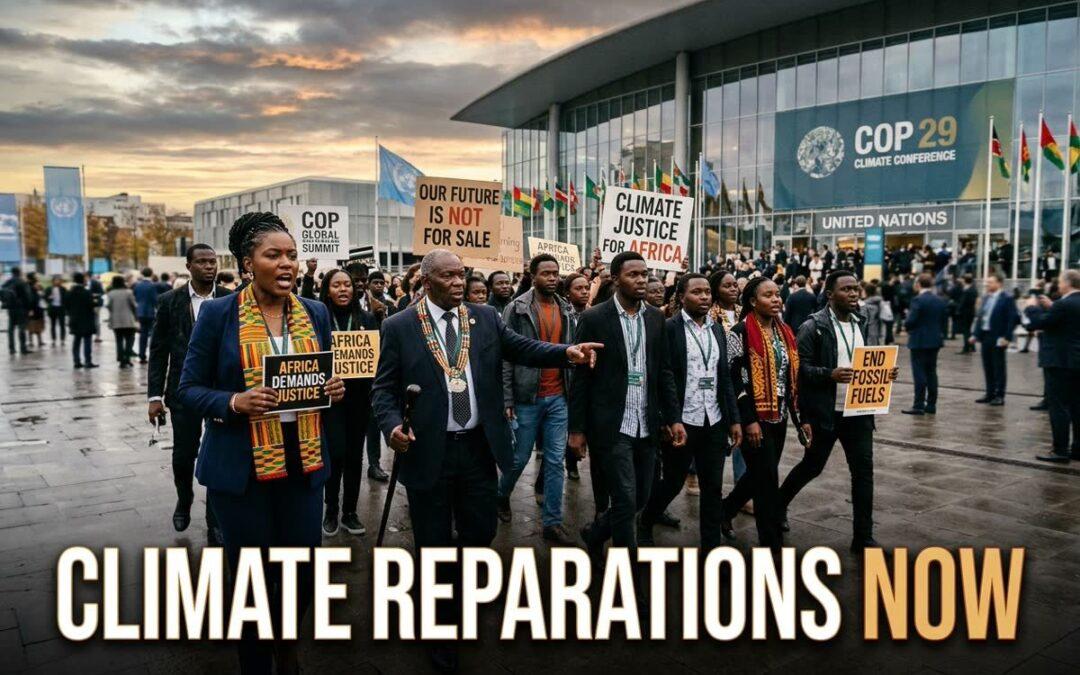
Thousands of demonstrators gathered outside the Expo Center in Antalya, Turkey, during the thirty-first United Nations Climate Change Conference (wikipedia.org, 350.org). African civil society leaders, grassroots coalitions, and youth activists marched through the conference grounds with clear demands (pacja.org, powershiftafrica.org). They insisted that world leaders replace empty rhetoric with dedicated, reparatory climate finance (afalab.org, thecommonsense.co.za). The banners held along the coastal venue connected contemporary environmental disasters directly to centuries of colonial resource extraction (afripoli.org, dailymaverick.co.za).
For decades, international summits treated environmental assistance as charitable aid from industrialized benefactors (afalab.org). Protesters at Antalya rejected this charity framework entirely (newarab.com). They argued that African nations suffer catastrophic droughts, floods, and infrastructure collapse despite producing less than four percent of global greenhouse gas emissions (earth.org, afdb.org). Demonstrators demanded that the United Nations climate framework recognize historical liability (thecommonsense.co.za). The mobilization at the conference reflects a long struggle to balance international power and secure economic independence for the Global South (pacja.org, afripoli.org).
Antalya COP31 Negotiations and the Breaking Point
The Antalya COP31 negotiations brought simmering geopolitical tensions to the surface (wikipedia.org). Turkey hosted the diplomatic gathering while Australia oversaw the presidency proceedings under an unusual joint partnership (wikipedia.org, youtube.com). Inside the plenary rooms, African negotiators pushed wealthy countries to honor financial obligations under the New Collective Quantified Goal (carbon-pulse.com, africaclimateinsights.org). Developing states argued that the prior target of three hundred billion dollars annually by 2035 fell far short of actual survival costs across the African continent (theguardian.com, carbon-pulse.com).
Civil society groups outside the negotiating halls amplified these diplomatic arguments with direct public actions (350.org, powershiftafrica.org). Demonstrators staged die-ins and rallies to remind delegates of recurring climate shocks in the Horn of Africa and southern regions (pacja.org, dailymaverick.co.za). Negotiators from the African Group of Negotiators highlighted that high borrowing costs prevent African governments from funding domestic resilience projects (afdb.org, climatepolicyinitiative.org). Activists declared that without immediate public grants, the UNFCCC COP31 Antalya summit would merely repeat past failures of international diplomacy (pacja.org, newarab.com).
Community organizers from rural agricultural zones joined international delegations to challenge corporate presence at the summit (powershiftafrica.org, newarab.com). Protesters demanded an end to market-based carbon offsets, which allow industrial polluters to purchase land rights while continuing domestic emissions (thecommonsense.co.za, afripoli.org). Civil society advocates insisted that discussions about Africa renewable energy funding must focus on public utilities and energy access for six hundred million people living without electricity (afdb.org, infrastructurenews.co.za). The demonstrations demonstrated that frontline populations will no longer accept delayed action or voluntary pledges from wealthy governments (350.org, dailymaverick.co.za).
The Origins of Common But Differentiated Responsibilities
The philosophical foundation of modern climate negotiations began at the 1992 Earth Summit held in Rio de Janeiro (wikipedia.org, researchgate.net). Delegates established the United Nations Framework Convention on Climate Change to prevent dangerous human interference with the global atmosphere (wikipedia.org). Developing nations insisted that the legal framework acknowledge historical accountability for atmospheric damage (afalab.org, researchgate.net). This demand produced the foundational doctrine known as Common But Differentiated Responsibilities and Respective Capabilities (researchgate.net).

African History Series • Volume II • Anti-Colonial Resistance & Sovereignty
Africa Reclaimed: Overcoming the Legacies of the Colonial Machine
By Professor A. Darius Spearman • 353 Pages • ISBN: 979-8-9924836-4-2
Colonialism in Africa was never passively endured—and its extractive machinery did not simply vanish when independence flags were raised. Professor A. Darius Spearman traces the unbroken arc of African political power from 19th-century indigenous statecraft and mid-20th-century liberation wars to contemporary battles against neo-colonial debt and resource imperialism.
Under this principle, industrialized nations accepted responsibility for the accumulation of carbon emissions generated since the Industrial Revolution (afalab.org). These historical polluters possessed superior financial resources and advanced technological capacity (researchgate.net). Consequently, international law required them to reduce domestic pollution while supplying capital to the Global South (wikipedia.org, researchgate.net). Developing states needed financial headroom to eradicate poverty without adopting carbon-intensive infrastructure (afalab.org, afdb.org).
Over the following three decades, wealthy nations attempted to weaken this legal distinction (afalab.org, carbon-pulse.com). Negotiators from the Global North frequently argued that emerging economies should accept identical emission-reduction mandates (afalab.org, theguardian.com). African delegates resisted these efforts systematically (pacja.org). They pointed to atmospheric data proving that the industrialized world consumed the majority of the global carbon budget (earth.org, researchgate.net). The principle of Common But Differentiated Responsibilities remains an essential legal shield protecting developing nations from unfair economic burdens during international negotiations (afalab.org, researchgate.net).
Emissions Contribution vs Global Vulnerability
Decades of Struggle: Loss and Damage Fund History
The diplomatic push for financial restitution began long before the recent demonstrations in Antalya (wikipedia.org, afalab.org). In 1991, the Alliance of Small Island States introduced the earliest proposal for climate redress during initial international climate negotiations (afalab.org). Led by the island nation of Vanuatu, vulnerable states requested an international insurance pool to remediate the destruction caused by rising ocean waters (afalab.org). High-income nations rejected the proposal because they feared open-ended financial liability for industrial pollution (afalab.org, researchgate.net).
For more than three decades, the Loss and Damage Fund history reflects persistent obstruction by wealthy governments (afalab.org, theguardian.com). At COP19 in 2013, delegates established the Warsaw International Mechanism to evaluate severe climate impacts (afalab.org). However, the agreement provided no dedicated financing mechanism for frontline communities (afalab.org). Two years later, during negotiations for the 2015 Paris Agreement, developed states insisted on adding paragraph 51 to the formal decision text (afalab.org). This provision explicitly stated that Article 8 did not involve or provide a basis for legal liability or compensation (afalab.org).
A breakthrough occurred at COP27 in Sharm El-Sheikh when developing nations coordinated their negotiating strategy (afalab.org, earth.org). The African Group of Negotiators joined forces with island states to force the creation of a specialized fund for climate harm (afalab.org). Despite this milestone, initial contributions totaled less than one billion dollars worldwide (afalab.org, earth.org). African leaders pointed out that a single tropical cyclone often inflicts multiple billions of dollars in structural destruction across Mozambique, Zimbabwe, and Malawi (earth.org, dailymaverick.co.za). Activists at Antalya emphasized that the fund remains an empty promise until industrialized nations commit predictable, mandatory resources (pacja.org, thecommonsense.co.za).
Broken Pledges and Mounting Climate Debt in Africa
In 2009, wealthy countries met at the COP15 conference in Copenhagen and made a public commitment (wikipedia.org, afalab.org). They promised to mobilize one hundred billion dollars each year by 2020 to support clean energy and adaptation in developing territories (afalab.org, theguardian.com). Developed nations missed this deadline completely, only claiming compliance several years late through controversial accounting procedures (afalab.org, climatepolicyinitiative.org). Independent evaluations revealed that donor states counted existing humanitarian aid, non-concessional commercial loans, and administrative overhead as international climate finance (afalab.org, climatepolicyinitiative.org).
This accounting maneuver fueled a crushing cycle of climate debt in Africa (afripoli.org, afdb.org). Rather than providing non-repayable grants to address ecological devastation, international financial institutions distributed seventy-one percent of public climate finance as debt instruments (afdb.org, climatepolicyinitiative.org). African nations now borrow money at elevated interest rates to rebuild bridges, roads, and electric grids destroyed by weather extremes (dailymaverick.co.za, afdb.org). Many sovereign states spend more money servicing foreign debt obligations than funding public health, education, and climate protection combined (afripoli.org, afdb.org). These harsh conditions mirror rising debt burdens that have limited self-determination across the continent for generations.
The structural shortfall between capital requirements and actual financial delivery remains wide (afdb.org, climatepolicyinitiative.org). African nations require approximately two hundred seventy-seven billion dollars every year through 2030 to fulfill their Nationally Determined Contributions under the Paris Agreement (afdb.org, climatepolicyinitiative.org). Current international allocations cover less than twenty-three percent of those documented adaptation and mitigation requirements (afdb.org, climatepolicyinitiative.org). African governments face severe sovereign risk penalties on international markets, which makes basic clean infrastructure projects significantly more expensive than identical installations built in Europe or North America (afdb.org, infrastructurenews.co.za).
Public Climate Finance to Africa: Structure
The Threat of Green Colonialism Critical Minerals Extraction
As the international community transitions away from fossil fuels, African civil society groups warn against another era of resource exploitation (thecommonsense.co.za, afripoli.org). The phenomenon known as green colonialism critical minerals mining replicates historic colonial trade dynamics (thecommonsense.co.za, afripoli.org). During the late nineteenth-century Scramble for Africa, European empires divided the continent to extract agricultural products, timber, and base metals to fuel domestic factories (thecommonsense.co.za). Today, international corporations enter the Congo Basin to extract lithium, cobalt, manganese, and copper for electric vehicles and renewable power grids (thecommonsense.co.za, afripoli.org).
The Democratic Republic of the Congo produces more than seventy percent of the world’s mined cobalt (thecommonsense.co.za). Yet the communities living near these extraction concessions endure heavy toxic pollution, forced eviction, and hazardous working conditions (thecommonsense.co.za, dailymaverick.co.za). International processing firms ship unrefined minerals abroad, capturing high-margin manufacturing profits in East Asia, Europe, and North America (thecommonsense.co.za, afripoli.org). Grassroots labor movements continue to organize against economic arrangements that enrich foreign investors while local residents remain in deep energy poverty (thecommonsense.co.za, dailymaverick.co.za).
Resource extraction projects regularly disregard the international standard of Free, Prior, and Informed Consent for rural populations (thecommonsense.co.za). Mining concessions contaminate local waterways, deplete regional water tables, and displace smallholder agricultural cooperatives (thecommonsense.co.za, dailymaverick.co.za). African civil society leaders at Antalya warned that climate policies must not sacrifice African sovereignty under the guise of global ecological urgency (pacja.org, thecommonsense.co.za). They demanded that international trade agreements require in-country mineral processing, technology transfer, and direct equity ownership for domestic communities (thecommonsense.co.za, afripoli.org). This clean transformation requires decolonizing institutional models so that African researchers and engineers lead local energy development (afripoli.org, afripoli.org).
African Climate Justice Demands and Legal Reparations
The demonstrations in Antalya crystallized unified African climate justice demands into concrete diplomatic and legal actions (350.org, pacja.org). First, African delegates demanded non-repayable grants to finance their Nationally Determined Contributions (pacja.org, afdb.org). Developing nations divide their national climate plans into unconditional domestic goals and conditional actions that require external financial resources (afdb.org, climatepolicyinitiative.org). Forcing nations to borrow commercial capital for conditional goals worsens insolvency across low-income states (afdb.org). Activists insisted that rich nations provide debt-free transfers to satisfy Article 9 commitments under the Paris Agreement (afalab.org, afdb.org).
Second, activists and legal scholars reframed financial delivery as an enforceable legal obligation rather than discretionary charity (afalab.org, thecommonsense.co.za). Under customary international law and the doctrine of state responsibility, causing transboundary environmental harm requires full restitution and compensation (afalab.org). International lawyers presented arguments before the International Court of Justice establishing that environmental stabilization represents an erga omnes obligation owed to the entire international community (afalab.org). Because wealthy nations appropriated far beyond their per-capita share of the global carbon budget, they carry an unpaid ecological debt to the African continent (afalab.org, thecommonsense.co.za).
Finally, civil society coalitions demanded structural reform of international funding channels (pacja.org, powershiftafrica.org). Traditional institutions such as the Green Climate Fund rely on complex bureaucratic procedures that take years to approve and disburse funds (pacja.org). Protesters urged direct funding models that deliver resources directly to local women, Indigenous councils, and smallholder farmers on the frontlines of drought (pacja.org, powershiftafrica.org). UN leaders acknowledged calls for mandatory windfall taxes on fossil fuel corporate profits to supply predictable resources (youtube.com, theguardian.com). African civil society demonstrated that true climate stability requires justice, legal accountability, and complete economic sovereignty (350.org, pacja.org).
Solar Potential vs Clean Investment Inflow
About the Author
Darius Spearman is a professor of Black Studies at San Diego City College, where he has been teaching for over 20 years. He is the founder of African Elements, a media platform dedicated to providing educational resources on the history and culture of the African diaspora. Through his work, Spearman aims to empower and educate by bringing historical context to contemporary issues affecting the Black community.
