
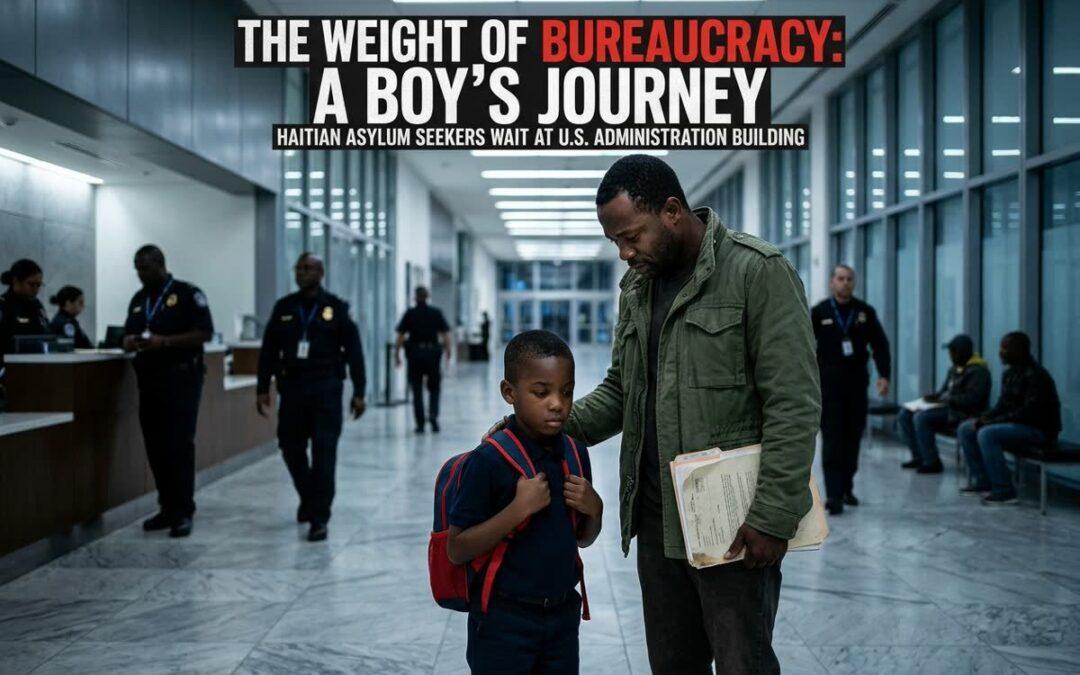


ICE Detains Haitian Boy at San Diego Check-In, Sparking Outcry
By Darius Spearman (africanelements)
Support African Elements at patreon.com/africanelements and hear recent news in a single playlist. Additionally, you can gain early access to ad-free video content.
When federal immigration authorities took custody of a young student in Southern California, the action sent shockwaves through local classrooms and immigrant communities. On November 5, immigration officers placed an eight-year-old child into federal custody during an administrative appointment in downtown San Diego (latimes.com, latimes.com). The incident occurred when federal agents executed an apprehension during what the family expected to be an ordinary reporting appointment. The boy arrived accompanied by his uncle, who had served as his primary caregiver after the federal government deported the child’s father (latimes.com, kpbs.org).
The arrest immediately drew widespread national attention. Video footage captured the separation inside a federal building, prompting condemnation from public officials, school administrators, and legal organizations such as the Haitian Bridge Alliance (latimes.com, ctninfo.com). While federal authorities stated that their officers acted to follow child welfare laws, immigrant rights advocates characterized the incident as the weaponization of bureaucratic appointments (latimes.com, kpbs.org). When ICE detains Haitian boy community members during scheduled reviews, the event reflects deeper, historical patterns of administrative deterrence and racial disparities within federal immigration enforcement.
The Reality of a San Diego ICE Check-In
The physical encounter occurred at the Edward J. Schwartz Federal Building in downtown San Diego (latimes.com, latimes.com). The eight-year-old boy, an elementary school student, accompanied his uncle to an interior check-in with Immigration and Customs Enforcement (ICE) (latimes.com, kpbs.org). Observers from Detention Resistance, a community group that monitors federal facilities, witnessed the event. A volunteer recorded video showing federal officers separating the third-grader from his uncle before taking the child into secure custody (latimes.com, kpbs.org).
The Department of Homeland Security defended the detention by pointing to federal anti-trafficking statutes (latimes.com, kpbs.org). Federal officials asserted that the uncle did not possess formal, state-issued guardianship documents establishing legal custody (latimes.com, kpbs.org). Consequently, authorities classified the student as an unaccompanied minor under the William Wilberforce Trafficking Victims Protection Reauthorization Act of 2008 (latimes.com, gao.gov). Agency representatives maintained that agents acted out of caution to guarantee the child’s safety, transferring the student into unaccompanied minor ORR custody overseen by the Department of Health and Human Services (latimes.com, acf.gov).

African Elements Press • Sociology & Black Family Studies
Legacy of Survival: The Dynamics of the Black Family
By Professor A. Darius Spearman • 284 Pages • ISBN: 979-8-9924836-0-4
For decades, mainstream sociology framed the Black family as a crisis to be diagnosed rather than a resilient institution to be understood. Legacy of Survival dismantles those deficit narratives—tracing the extended kinship networks, matriarchal anchors, paternal struggles, and psychological survival strategies that carried Black households from the transatlantic rupture to the modern era.
The decision to separate the pair transformed an administrative appointment into a forced division of a family unit. The uncle had managed the child’s daily care, shelter, and educational needs since federal agents previously removed the boy’s father from the United States (latimes.com, latimes.com). Although the uncle was released from the building without being detained himself, the government removed the young boy to an institutional shelter hundreds of miles away (latimes.com, kpbs.org). The sudden enforcement action during a standard San Diego ICE check-in highlighted the risks that immigrant families navigate when complying with federal reporting requirements.
Fay Elementary School Response and Community Shock
The enforcement action reverberated directly into the public education system. The eight-year-old boy attended Fay Elementary School, located in the City Heights neighborhood of San Diego (latimes.com, kpbs.org). School district records recognized the uncle as the child’s designated emergency contact and caregiver, an arrangement accepted by California school enrollment protocols (latimes.com, sandiegounified.org). The unexpected detention left an empty desk in a third-grade classroom, disrupting the educational environment.
In response, the San Diego Unified School District mobilized administrative and psychological support. The district deployed crisis counselors and trauma intervention staff to Fay Elementary to support young students and teachers dealing with the sudden absence of their peer (latimes.com, sandiegounified.org). District leaders quickly pushed back against federal authorities, seeking formal explanations from federal agencies regarding the separation of an enrolled pupil during an administrative interview (latimes.com, latimes.com). School Board Trustee Cody Petterson publicly condemned the enforcement tactic, stating that federal agencies used technical definitions under child welfare legislation to carry out actions that undermined community stability (latimes.com, latimes.com).
The institutional Fay Elementary school response reflected broader legal principles established by the Supreme Court of the United States. Under the 1982 landmark decision *Plyler v. Doe*, public school districts cannot deny educational access to children based on their immigration status (latimes.com, sandiegounified.org). Although immigration officers did not enter campus grounds directly, detaining a child who had left home for an administrative review undermined the perceived safety of public education (sandiegounified.org). The event highlighted the precarious nature of informal kinship care networks, which Black and immigrant communities have historically relied upon to protect dependent children during times of displacement and state separation.
Surge in Minor-Days in Federal Custody
Administrative Traps in Orders of Supervision Check-Ins
To understand how a child could be apprehended during an administrative visit, one must examine the mechanics of Orders of Supervision (Form I-220B) and Alternatives to Detention (ATD) (ecfr.gov, songlawfirm.com). Under federal statutes codified in 8 U.S.C. § 1231(a)(3) and 8 C.F.R. § 241.5, noncitizens who are subject to final orders of removal but cannot be immediately deported receive conditional release orders (ecfr.gov). These administrative orders require periodic in-person reporting, address confirmation, travel restrictions, and biometric processing (ecfr.gov, songlawfirm.com). Failure to report for an appointment constitutes an actionable immigration violation that triggers immediate arrest (ecfr.gov, forumtogether.org).
Under these monitoring programs, every noncitizen, including minor children, carries an individual Alien Registration Number and an administrative file (ecfr.gov, forumtogether.org). When broader humanitarian programs lapse or derivative familial relief changes, immigration officers schedule mandatory in-person appointments to verify physical custody (ecfr.gov, songlawfirm.com). Over decades, immigrants viewed compliance with these check-ins as a reliable path to avoid detention (acaciajustice.org, immigrantjustice.org). However, civil rights attorneys have documented how field offices increasingly utilize these mandatory appearances as controlled locations to interrogate legal guardianship, execute arrests, or enforce removals without advance notice (acaciajustice.org, immigrantjustice.org).
This dynamic intersects with the criminalization of migrant communities, turning administrative compliance into a legal trap. When the uncle accompanied the young boy to the office, federal agents applied the strict statutory definition of an unaccompanied minor found in the TVPRA (latimes.com, gao.gov). Under 8 U.S.C. § 1232, any minor lacking a legal guardian with state court custody must be surrendered to federal care within 72 hours (gao.gov, acf.gov). Securing state guardianship in California probate courts requires extensive time, filing fees, and legal representation that undocumented relatives rarely possess (latimes.com, propublica.org). Once a child enters ORR custody, undocumented sponsors must submit fingerprints and household records to federal authorities, exposing extended family members to immigration arrest (propublica.org, themarshallproject.org). Consequently, procedural Orders of Supervision check-ins can effectively dismantle informal family care structures.
Haitian Migrant Interdiction History Across Four Decades
The arrest of an eight-year-old child in San Diego is not an isolated event. It represents the modern extension of a four-decade immigration framework targeting Haitian nationals (wikipedia.org, hrw.org). Modern maritime deterrence began in September 1981, when President Ronald Reagan issued Presidential Proclamation 4865 and Executive Order 12324 (wikipedia.org, hrw.org). This action established the Haitian Migrant Interdiction Operations (HMIO), authorizing the United States Coast Guard to intercept vessels on the high seas and return passengers to Haiti without formal asylum proceedings (wikipedia.org, humanrightsresearch.org).
The statistical record of that policy reveals near-total exclusion. Between September 1981 and 1990, federal cutters intercepted over 22,000 Haitian nationals at sea (wikipedia.org, humanrightsresearch.org). Out of those thousands of intercepted migrants fleeing political repression under the Duvalier regime, federal authorities permitted fewer than a dozen individuals to file formal asylum claims in the United States (wikipedia.org, humanrightsresearch.org). All other intercepted passengers were summarily repatriated to Port-au-Prince, establishing an exclusionary precedent that set Haitian asylum seekers apart from other Caribbean populations (wikipedia.org, brookings.edu).
This policy of offshore detention expanded significantly during the 1990s. Following the September 1991 military coup that ousted Haiti’s first democratically elected president, Jean-Bertrand Aristide, tens of thousands of Haitians fled violence by sea (wikipedia.org, humanrightsresearch.org). The federal government directed the Coast Guard to divert intercepted boats to the United States Naval Base at Guantánamo Bay, Cuba (wikipedia.org, washingtonpost.com). Over several years, federal authorities held thousands of Haitian refugees behind razor wire at Camp Bulkeley, including families living with HIV, until federal litigation in *Haitian Centers Council, Inc. v. Sale* challenged the conditions of confinement (wikipedia.org, uclegalrightslibrary.org). This long Haitian migrant interdiction history established an administrative pattern of offshore deterrence, mass detention, and immediate repatriation that connects directly to the <a href="https://www.africanelements.org/news/the-haitian-revolution-the-slave-trade-and-black-women-2/history of Haitian independence and subsequent foreign containment policies.
Coast Guard Interdictions vs Asylum (1981–1990)
Systemic Anti-Black Immigration Disparities and Civil Rights Resistance
The historical handling of Haitian migrants exposed deep racial discrepancies within Caribbean migration policy. While the Cuban Adjustment Act of 1966 granted immediate pathways to lawful residency for Cuban arrivals, federal administrations routinely classified Haitian refugees as economic migrants rather than political exiles (wikipedia.org, brookings.edu). This classification justified prolonged detention and summary removals without the procedural protections provided to non-Black populations fleeing political instability in the same region (brookings.edu, humanrightsresearch.org). In modern immigration courts, these disparities persist; Haitian respondents have historically had one of the lowest legal representation rates, hovering around 18 percent, leading to significantly higher rates of summary deportation (acaciajustice.org, acaciajustice.org).
These systemic anti-Black immigration disparities prompted major domestic civil rights coalitions to intervene. During the 1990s, African American leaders mobilized to challenge Haitian detention policies, defining refugee interdiction as an extension of domestic civil rights struggles (house.gov, suny.edu). Randall Robinson, the executive director of the advocacy organization TransAfrica, engaged in a 27-day hunger strike in 1994 to force a revision of maritime repatriation practices (washingtonpost.com, washingtonpost.com). Demonstrators organized nonviolent protests outside the White House, resulting in the civil disobedience arrests of notable figures including Congressman Charles Rangel, tennis icon Arthur Ashe, and leaders from the NAACP (suny.edu, washingtonpost.com).
The Congressional Black Caucus repeatedly used its legislative authority to challenge executive actions, pressing federal administrations to grant humanitarian parole and fair asylum screenings to Haitian nationals (house.gov, suny.edu). Today, groups such as the Haitian Bridge Alliance continue this work by monitoring border facilities and providing direct representation (latimes.com, ctninfo.com). The current outrage in Southern California echoes this long tradition of grassroots community mobilization, connecting local school board protests directly to decades of Black civil rights resistance against differential treatment in federal policy.
Immigration Court Legal Representation Rates
The Fragility of Haiti Temporary Protected Status and Removal Precedents
Modern enforcement actions also unfold against a backdrop of shifting humanitarian policies. Following the catastrophic 7.0 magnitude earthquake in January 2010, the executive branch designated Haiti for Temporary Protected Status (TPS) (immresearch.org, federalregister.gov). Over time, this administrative designation shielded approximately 350,000 Haitian nationals from deportation and granted legal work authorization (immresearch.org, federalregister.gov). However, TPS provides only temporary protection rather than permanent legal residency, leaving families vulnerable to changing executive priorities and ongoing litigation (democracyforward.org, federalregister.gov).
The precarious nature of humanitarian relief surfaced dramatically during the Del Rio Title 42 expulsions in September 2021 (hrw.org, senate.gov). Approximately 15,000 Haitian migrants gathered at an encampment beneath the International Bridge in Del Rio, Texas, seeking access to the asylum process (hrw.org). Citing Title 42 public health authorities invoked during the pandemic, federal agencies deployed mounted patrol units and rapidly organized dozens of repatriation flights (hrw.org, senate.gov). The government returned thousands of individuals, including young children, to Port-au-Prince and Cap-Haïtien despite the assassination of President Jovenel Moïse, severe gang violence, and institutional collapse (hrw.org, humanrightsresearch.org).
When administrative protections change, families already living in the United States face legal uncertainty. If an adult caregiver loses protection or faces an active removal order, extended family networks step in to care for minor children (latimes.com, brookings.edu). Over 200,000 children nationwide have experienced the detention or removal of a parent, shifting primary child-rearing responsibilities to relatives who lack formal state court guardianship orders (brookings.edu). In San Diego, this administrative precarity turned an elementary student into a ward of the state. As federal repatriation flights continue to land in Cap-Haïtien despite travel warnings, immigrant families find themselves torn between statutory compliance and the preservation of their homes (hrw.org, humanrightsresearch.org).
The detention of an eight-year-old boy inside the Edward J. Schwartz Federal Building is not an isolated bureaucratic mistake. Instead, it represents the intersection of strict interior enforcement, rigid statutory definitions, and four decades of Caribbean deterrence policies. While federal agencies claim they acted within the letter of child welfare legislation to verify custodial paperwork, the real-world outcome separated a young student from his known caregiver, traumatized a third-grade classroom, and forced local educators to address the consequences of federal enforcement. Until immigration systems recognize informal family care networks and resolve historical disparities, administrative check-ins will remain sites of vulnerability for immigrant communities across the nation.
About the Author
Darius Spearman is a professor of Black Studies at San Diego City College, where he has been teaching for over 20 years. He is the founder of African Elements, a media platform dedicated to providing educational resources on the history and culture of the African diaspora. Through his work, Spearman aims to empower and educate by bringing historical context to contemporary issues affecting the Black community.
