
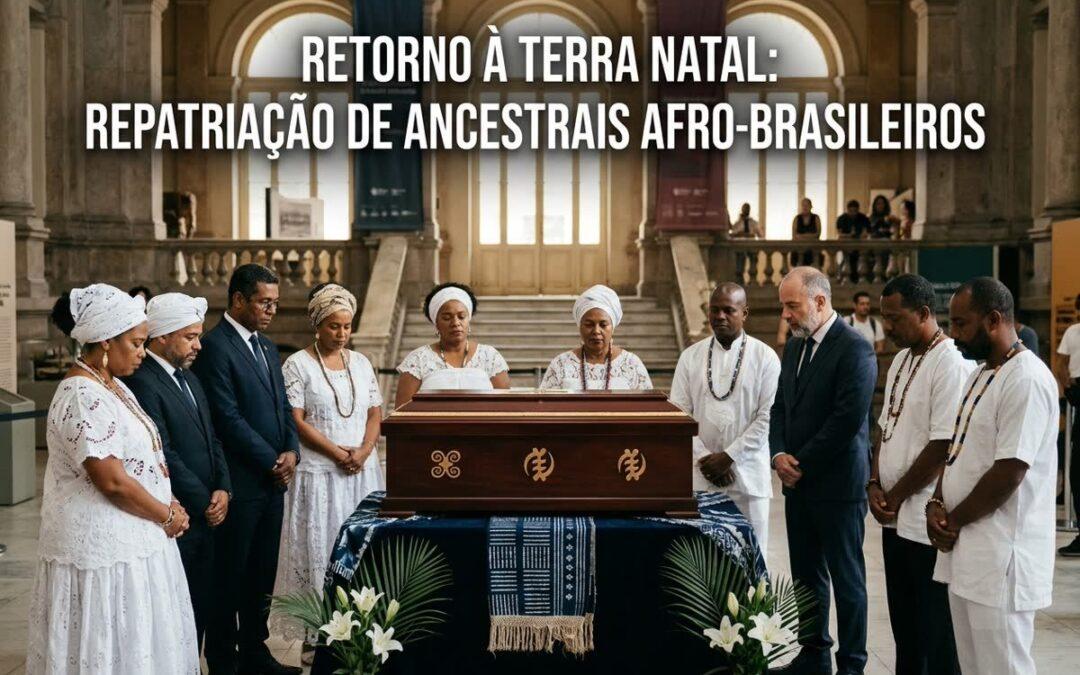


Harvard Repatriates Skulls Used in Eugenics Studies
By Darius Spearman (africanelements)
Support African Elements at patreon.com/africanelements and hear recent news in a single playlist. Additionally, you can gain early access to ad-free video content.
During a formal diplomatic ceremony on November 11 at Rio de Janeiro’s National Museum, Brazilian officials received two human skulls returned by Harvard University (theguardian.com). The remains belonged to enslaved Africans or Afro-Brazilians who lived in Brazil during the nineteenth century (theguardian.com, thursdaytimes.com). Elite American academics took these individuals across international borders to fuel racial theories (theguardian.com, utoronto.ca). Now, following a four-year campaign by scholars and diplomats, the ancestors have returned to their native soil (theguardian.com).
This transfer represents a major development in international museum ethics (theguardian.com). For over a century, elite Western universities treated human bodies as anatomical property (harvard.edu, nih.gov). Today, academic institutions face intense public scrutiny regarding collections gathered through violence and colonialism (harvard.edu, thecrimson.com). The headline announcement that Harvard repatriates skulls to Brazil reveals how nineteenth-century racial science shaped modern institutional collections (theguardian.com, utoronto.ca).
African History Series • Volume I • Pre-Colonial Civilizations
Sand, Clay, and Iron: Africa’s Journey from the Stone Age to the Dawn of European Colonization
By Professor A. Darius Spearman • 313 Pages • ISBN: 979-8-9924836-2-8
African history does not begin with European contact. Synthesizing archaeology, paleoclimatology, genetics, and oral traditions, Professor A. Darius Spearman charts how indigenous African societies transformed shifting Saharan sands, engineered ceramic and agricultural revolutions, anchored Nile Valley statecraft, and forged the iron empires of West Africa and the Swahili Coast.
Origins in the Malê Revolt Slave Rebellion
The first repatriated skull carries direct ties to the 1835 Malê Revolt slave rebellion in Salvador, Bahia (theguardian.com, thursdaytimes.com). In January 1835, during the Islamic holy month of Ramadan, an organized coalition of African Muslims mobilized (religionnews.com, middleeasteye.net). Mostly of Yoruba and Hausa descent, these enslaved and freed men took up arms (religionnews.com, thursdaytimes.com). They wore white tunics, carried written Qur’anic prayers, and fought for emancipation (religionnews.com). It was the largest urban slave rebellion in the history of the Americas (middleeasteye.net, thursdaytimes.com).
Imperial Brazilian military forces crushed the uprising with extreme violence (religionnews.com). Soldiers killed roughly seventy insurgents in the streets, and courts sentenced dozens to execution or public lashing (religionnews.com, middleeasteye.net). Historical records confirm that one wounded African man died inside a Salvador hospital shortly after the fighting (theguardian.com, thursdaytimes.com). An American official took the skull from his body and sent it to Massachusetts (theguardian.com, thursdaytimes.com).
The Bahia Islamic Cultural Center campaigned alongside historians to bring this fallen ancestor home (religionnews.com, religionnews.com). Community leaders named him Arakunrin, a Yoruba term meaning “brother” (thursdaytimes.com, religionnews.com). His struggle reflected deep traditions of cultural resistance that sustained enslaved communities throughout the diaspora (religionnews.com). Through persistent advocacy, Bahian activists ensured his sacrifice in the Malê Revolt slave rebellion was not forgotten (thursdaytimes.com, thursdaytimes.com).
Transatlantic Slave Trade Volume by Destination
Scientific Plunder and the Louis Agassiz Thayer Expedition
The second skull returned to Brazil originated from Rio de Janeiro during the mid-1860s (theguardian.com). Its extraction occurred directly during the famous Louis Agassiz Thayer Expedition between 1865 and 1866 (theguardian.com, fapesp.br). Louis Agassiz was a prominent Swiss-born Harvard naturalist and zoology professor (theguardian.com, utoronto.ca). He traveled to South America on a heavily funded mission to gather biological and anatomical specimens (theguardian.com, fapesp.br).
Agassiz designed the expedition to challenge Charles Darwin’s emerging theory of common human descent (utoronto.ca, fapesp.br). As an aggressive champion of polygenism, Agassiz claimed that human racial groups represented separately created biological species (theguardian.com, utoronto.ca). In Brazil, he set up photographic studios to document racial types (theguardian.com, fapesp.br). He forced enslaved Black men and women to strip naked for dehumanizing daguerreotype portraits (theguardian.com). In tandem with visual recording, Agassiz acquired skeletal remains, including the exhumed skull of an enslaved woman (theguardian.com, theguardian.com). Her remains were packaged, cataloged, and shipped directly to Harvard’s research collections (theguardian.com, harvard.edu).
The Ideological Rise of Scientific Racism and Craniometry
These acquisitions were standard practice in the nineteenth-century academic world (utoronto.ca, nih.gov). Naturalists and physicians collected human remains to build an empire of racial hierarchy (atlasobscura.com, psu.edu). The primary method used was craniometry, which measured the physical volume and shape of human skulls (atlasobscura.com). Anthropologists packed cranial cavities with mustard seeds or lead shot to calculate interior capacity (atlasobscura.com, psu.edu). They used flawed data to claim that European skulls possessed greater intellectual and moral capacity than African skulls (atlasobscura.com, psu.edu).
This pseudo-empirical work supported the political architecture of slavery throughout the Atlantic world (utoronto.ca, psu.edu). Southern politicians and courts cited craniometric studies from Northern institutions to argue that slavery was a biological necessity (psu.edu, utoronto.ca). Physicians engaged in widespread medical experimentation on enslaved people without consent, treating their living bodies and skeletal remains as raw commodities (nih.gov). The doctrine of scientific racism and craniometry later formed the intellectual foundation for twentieth-century eugenics movements (theguardian.com, nih.gov).
Harvard University Human Remains Inventory (2022)
Auditing Peabody Museum Human Remains Collections
The skulls remained quietly stored in university repositories for more than a century (harvard.edu, thecrimson.com). Public scrutiny intensified following a series of archival audits and student reports (thecrimson.com, thecrimson.com). In the fall of 2022, Harvard published its landmark report on university collections (harvard.edu, thecrimson.com). The report revealed that Harvard held more than 22,000 human remains across its facilities (harvard.edu). Most of these individuals rested inside the Peabody Museum of Archaeology and Ethnology (harvard.edu, harvard.edu).
Crucially, the audit revealed that the university held nineteen individuals who were enslaved or likely enslaved (harvard.edu, thecrimson.com). These remains came from the American South, the Caribbean, and Brazil (harvard.edu, thecrimson.com). Former Harvard President Lawrence Bacow issued a public apology for the university’s historic practices (harvard.edu, thecrimson.com). The modern discipline of Black Studies has consistently pushed institutions to confront these records (harvard.edu). Following the audit, Harvard established dedicated advisory committees to examine options for the Peabody Museum human remains (harvard.edu, harvard.edu).
A Restorative Precedent in the Repatriation of Enslaved Ancestors
Securing the return of the two Brazilian skulls required intense academic and diplomatic cooperation (theguardian.com). Brazilian historians João José Reis and Bruno Véras documented the transatlantic provenance of the remains (theguardian.com, thursdaytimes.com). Their historical research allowed the Brazilian Foreign Ministry to launch formal negotiations with Harvard officials (theguardian.com). Brazilian diplomat Carolina Dias dos Reis traveled to Cambridge, Massachusetts, to conclude the agreement (theguardian.com).
The agreement outlines strict ethical guidelines governing the handover (theguardian.com, thursdaytimes.com). Neither skull will undergo public display, commercial photography, or three-dimensional digital rendering (theguardian.com). Forensic anthropologists at Brazilian universities will conduct strictly non-destructive physical assessments (theguardian.com). When these studies conclude, both ancestors will receive traditional, sacred burials (theguardian.com, thursdaytimes.com). Arakunrin will receive traditional Islamic funeral prayers in Salvador (thursdaytimes.com, religionnews.com). The formal repatriation of enslaved ancestors restores the personal dignity denied to these individuals for generations (theguardian.com, thursdaytimes.com).
“It is very important to restore the dignity of these people, which was taken from them in life and in death.”
Federal Statutory Repatriation Protections in U.S. Law
Addressing Museum Repatriation Legal Gaps in the United States
The return of these remains required extraordinary diplomatic intervention because American law offers no statutory path for their recovery (brandeis.edu, researchgate.net). While the 1990 Native American Graves Protection and Repatriation Act mandates the return of Indigenous remains, it strictly excludes non-Native ancestors (brandeis.edu). No comparable federal framework exists for African Americans or foreign victims of the slave trade (brandeis.edu, researchgate.net). Enslaved Black individuals remain legally classified as institutional property rather than human subjects (brandeis.edu). This fundamental statutory silence illustrates critical museum repatriation legal gaps in the United States (brandeis.edu, researchgate.net).
These gaps leave the remaining seventeen enslaved individuals at Harvard in legal limbo (harvard.edu, thecrimson.com). Chattel slavery stripped people of legal personhood, civil records, and surnames (harvard.edu, brandeis.edu). This systematic erasure makes tracing direct lineal descendants extraordinarily difficult for university researchers (harvard.edu, harvard.edu). Without federally recognized descendant bodies to claim ownership, universities struggle to establish transfer protocols (brandeis.edu). These challenges reflect an ongoing pattern of historical exploitation that continues to affect African diaspora communities today (brandeis.edu, researchgate.net).
The successful return to Brazil shows that international partnerships can bypass domestic legal hurdles (theguardian.com, thursdaytimes.com). When sovereign governments intervene, academic institutions must respond (theguardian.com). However, thousands of enslaved ancestors remain in storage boxes across American institutions (brandeis.edu, researchgate.net). True restorative justice will require federal legislation to close these gaps permanently (brandeis.edu). Until then, returning enslaved ancestors will depend on painstaking archival research and external public pressure (theguardian.com, thecrimson.com).
About the Author
Darius Spearman is a professor of Black Studies at San Diego City College, where he has been teaching for over 20 years. He is the founder of African Elements, a media platform dedicated to providing educational resources on the history and culture of the African diaspora. Through his work, Spearman aims to empower and educate by bringing historical context to contemporary issues affecting the Black community.
