

Isa Pantami Convoy Attack Sparks Fear Ahead of 2027 Vote
By Darius Spearman (africanelements)
Support African Elements at patreon.com/africanelements and hear recent news in a single playlist. Additionally, you can gain early access to ad-free video content.
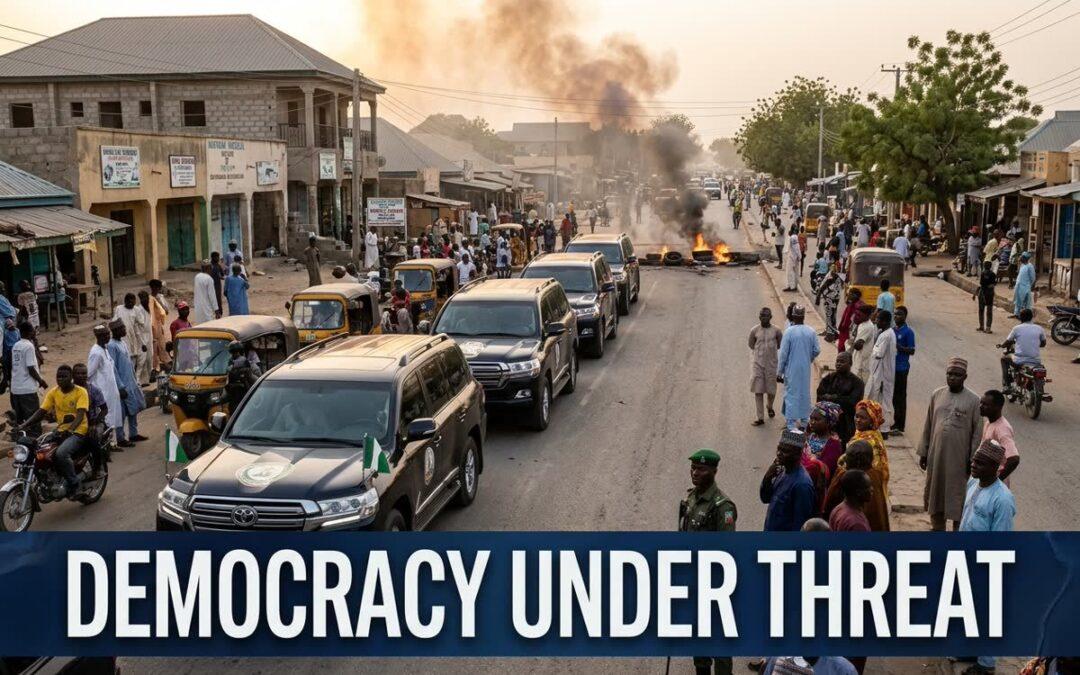
A violent blockade in northeastern Nigeria has laid bare the fragile state of democratic participation in West Africa. On November 11, armed assailants assaulted the motorcade of opposition governorship candidate Isa Pantami in Gombe, the capital of Gombe State (dailynigerian.com, premiumtimesng.com). The incident occurred during what was planned as a celebratory homecoming and political rally following the official publication of candidate lists by electoral authorities (dailynigerian.com). The attack demonstrates how political elites mobilize armed civilian groups to control public spaces and suppress opposition voices ahead of critical national elections (premiumtimesng.com, hrw.org).
For observers across the African Diaspora, this confrontation mirrors long-standing struggles where marginalized groups face violent suppression when seeking democratic self-determination (hrw.org). Much like the dynamics explored in the study of Black political power, the ability of citizens to gather, speak, and choose their representatives remains contested by entrenched establishments. The street clashes in Gombe are not isolated outbursts of anger. Instead, they reflect a deliberate, generational strategy of political intimidation with roots that trace back through decades of Nigerian regional history (hrw.org, fssunilorinedu.org).
The Jekadafari Road ambush and the Breakdown of Order
The violence erupted as the campaign convoy of Professor Isa Ali Pantami entered the city center. Pantami is the gubernatorial flagbearer of the Peoples Democratic Party (PDP) and a former federal Minister of Communications and Digital Economy (dailynigerian.com, premiumtimesng.com). Supporters had gathered along the highway to escort the motorcade toward a scheduled Gombe PDP governorship rally and a formal courtesy visit to the traditional palace of the Emir of Gombe (dailynigerian.com). However, as the procession reached the densely populated Jekadafari neighborhood, organized squads of armed men intercepted the road (dailynigerian.com, newnationalstar.com).
The attackers set piles of tires ablaze across the pavement to create blinding smoke screens and halt vehicular movement (dailynigerian.com, premiumtimesng.com). Armed with clubs, machetes, and stones, groups of Gombe State political thugs surged toward the motorcade (dailynigerian.com, newnationalstar.com). The Jekadafari Road ambush concentrated heavily on the rear vehicles of the procession, where attackers shattered windshields and struck supporters who attempted to protect the convoy (dailynigerian.com, thesun.ng). Witnesses reported that several individuals sustained serious lacerations and head injuries before security escorts could maneuver the remaining vehicles through the barricade (dailynigerian.com, newnationalstar.com).
The location of the assault was politically symbolic. The Jekadafari district is home to prominent political figures, including the family residence of the incumbent governor, Inuwa Yahaya of the All Progressives Congress (APC) (dailynigerian.com, newnationalstar.com). Members of the Isa Pantami Gombe campaign asserted that the blockade was a planned effort to project territorial dominance and deny the opposition candidate a presence in the capital (dailynigerian.com). While the motorcade eventually reached safety, the destruction along the roadway signaled that the road to the upcoming gubernatorial contest will be fraught with physical danger (dailynigerian.com, premiumtimesng.com).
The Amnesty International Nigeria warning on Impunity
The international human rights community responded swiftly to the events in Gombe. On November 12, human rights monitors issued a formal statement denouncing the assault as an intolerable escalation of pre-election intimidation (premiumtimesng.com). The organization emphasized that unchecked violence creates an environment where opposition figures cannot safely campaign, disenfranchising voters long before ballots are cast (premiumtimesng.com). Such patterns undermine public confidence in the rule of law and encourage further abuses by political operators (premiumtimesng.com, hrw.org).
“Consistent violent attacks on the opposition will make it difficult, if not impossible, for opposition parties to conduct peaceful political activities… Security agencies must investigate this incident and ensure that those suspected of responsibility are brought to justice through a fair trial.”
The Amnesty International Nigeria warning stressed that video footage and eyewitness testimony pointed toward partisan operatives acting to protect ruling party interests (premiumtimesng.com). In response, the Gombe State Police Command acknowledged the severity of the confrontation (dailynigerian.com, thesun.ng). Police Public Relations Officer Buhari Abdullahi confirmed that tactical teams deployed to clear the flaming blockades and restore traffic flow (thesun.ng). Nevertheless, police administrators conceded that no immediate arrests were made at the scene, citing the chaos of the crowd (dailynigerian.com, thesun.ng). This absence of legal accountability highlights the ongoing challenge of enforcing the law against politically connected actors (hrw.org).
Documented Pre-Election Violence Metrics
When legal systems fail to penalize political violence, they signal to private militias that thuggery carries few consequences (hrw.org). Civil rights scholars have long noted that selective legal enforcement functions as an instrument of social control, a reality visible in systems of state-sanctioned policing across the globe. In Gombe, the failure to apprehend convoy attackers perpetuates a cycle where political parties feel compelled to build their own security networks, further destabilizing the public square (hrw.org, fssunilorinedu.org).
Yan Kalare militia history and the Roots of Youth Weaponization
To understand the Jekadafari ambush, one must examine the Yan Kalare militia history that took shape following Nigeria’s return to civilian democracy in 1999 (hrw.org, fssunilorinedu.org). During the 2003 gubernatorial contest between incumbent Governor Abubakar Habu Hashidu and challenger Danjuma Goje, political campaigns began systematically recruiting unemployed young men (hrw.org, ajol.info). These youth groups were organized into enforcement squads tasked with intimidating opponents, seizing ballot boxes, and guarding political events (hrw.org). Over time, these groups became known collectively as the Yan Kalare (hrw.org, researchgate.net).

African History Series • Volume II • Anti-Colonial Resistance & Sovereignty
Africa Reclaimed: Overcoming the Legacies of the Colonial Machine
By Professor A. Darius Spearman • 353 Pages • ISBN: 979-8-9924836-4-2
Colonialism in Africa was never passively endured—and its extractive machinery did not simply vanish when independence flags were raised. Professor A. Darius Spearman traces the unbroken arc of African political power from 19th-century indigenous statecraft and mid-20th-century liberation wars to contemporary battles against neo-colonial debt and resource imperialism.
Unlike ad-hoc street brawlers, the Kalare developed into structured organizations with clear lines of authority and direct patronage links to high-ranking state officials (hrw.org). A landmark 2007 investigation by Human Rights Watch documented how state officials placed militia commanders on public payrolls, providing them with legal cover and monthly retainers (hrw.org). Between 2003 and 2007, violence involving these groups claimed at least 115 lives in Gombe State alone (hrw.org). The Kalare established control over strategic urban neighborhoods, turning routine transit corridors into fortified zones (hrw.org, researchgate.net).
- Jekadafari: A densely populated urban ward that serves as an elite political stronghold and frequent flashpoint for street blockades (dailynigerian.com, researchgate.net).
- Pantami: An electoral ward with historical significance, characterized by strong community allegiances and high voter density (researchgate.net, wikipedia.org).
- Bolari East and West: Key commercial and residential sectors where rival youth factions have historically clashed over neighborhood turf (researchgate.net).
- Herwagana: A central municipal district characterized by deep political party rivalries and youth mobilization networks (researchgate.net).
Subsequent administrations attempted to demobilize these groups with mixed success (onlineacademicpress.com, ajol.info). Under Governor Ibrahim Hassan Dankwambo, the state launched the Talba Youths Environmental Corps to retrain former militia members as municipal workers and traffic wardens (ajol.info). However, when economic conditions worsened and new election seasons approached, the underlying patronage systems resurfaced (onlineacademicpress.com). In December 2022, arsonists burned the campaign headquarters of PDP candidate Jibrin Barde, showing that armed youth mobilization remains an active political strategy in the state (punchng.com, punchng.com).
Historical Fatalities in Gombe Metropolis
The reliance on street enforcers illustrates how regional political machines operate when state institutions are weak (hrw.org, fssunilorinedu.org). Similar to the conflicts explored in state-centered political struggles, regional elites in Nigeria often leverage local control to insulate themselves from federal oversight. When local politicians command informal militias, they can disrupt opposition activities while avoiding direct legal responsibility (hrw.org).
The Maitatsine religious uprising as a Benchmark for Unrest
The urban terrain where the Pantami convoy was ambushed carries deep historical significance in northern Nigeria (historicalnigeria.com, wikipedia.org). In historical discussions of regional instability, historians frequently cite the Maitatsine religious uprising of the early 1980s as the benchmark for civil devastation (historicalnigeria.com, brill.com). Led by the Cameroonian-born preacher Muhammadu Marwa, known as Maitatsine, the movement drew thousands of marginalized, economically displaced young men into violent confrontations with state authority across northern cities (historicalnigeria.com, wikipedia.org).
In April 1985, an outbreak of this sect erupted in Gombe’s Pantami ward, resulting in days of urban combat and over one hundred documented deaths (historicalnigeria.com, wikipedia.org). The historical connection between that uprising and contemporary unrest lies in the underlying social conditions (researchgate.net, historicalnigeria.com). Both the religious insurrections of the 1980s and the political militias of today drew from the same pool of disenfranchised, underemployed urban youth (researchgate.net). When young people lack access to education, stable employment, and political representation, they become vulnerable to recruitment by charismatic leaders and political bosses alike (hrw.org, researchgate.net).
Scholars note that the cumulative casualty count from decades of political militia violence in Gombe has surpassed the immediate losses of the 1985 riots (hrw.org, historicalnigeria.com). While the Maitatsine clashes were driven by theological separatism, modern political thuggery is driven by electoral gain (hrw.org, brill.com). The recurrence of street blockades in these same historic wards underscores how unresolved economic hardship continues to fuel unrest across generations (fssunilorinedu.org, researchgate.net).
godfatherism in Nigerian politics and Patron-Client Power
The violence surrounding the Isa Pantami convoy attack cannot be understood without examining godfatherism in Nigerian politics (hrw.org, fssunilorinedu.org). In this patron-client system, entrenched political figures act as benefactors who finance campaigns, secure party tickets, and deploy muscle to win elections (hrw.org). In return, these patrons expect absolute loyalty from officeholders, demanding influence over state appointments, treasury disbursements, and government contracts (hrw.org, repec.org).
When an ambitious candidate breaks away from an established political machine, the confrontation often shifts to the streets (hrw.org). Isa Pantami’s candidacy represents an acute challenge to the existing order in Gombe (dailynigerian.com, premiumtimesng.com). As a prominent Salafi Islamic scholar and former federal minister under President Muhammadu Buhari, Pantami possesses his own independent religious following and national profile (premiumtimesng.com, nigerianeye.com). His decision to seek the governorship under the opposition PDP transformed the race into a direct contest against the state APC administration (dailynigerian.com, premiumtimesng.com).
Because Pantami commands substantial grassroots loyalty, the ruling political establishment views his campaign as a significant electoral threat (dailynigerian.com, premiumtimesng.com). In patron-client politics, when legal and institutional mechanisms fail to contain a challenger, rival factions may resort to physical intimidation to restrict their movement and suppress voter enthusiasm (hrw.org, fssunilorinedu.org). The attack on Jekadafari Road was a visible demonstration of this coercive dynamic in action (dailynigerian.com, premiumtimesng.com).
Nigeria 2027 election violence and the Road Ahead
The confrontation in Gombe fits into a broader national pattern of Nigeria 2027 election violence (premiumtimesng.com, acleddata.com). Data compiled by independent monitors indicates that political rallies and campaign convoys face mounting risks across the federation (acleddata.com, leadership.ng). The Armed Conflict Location & Event Data (ACLED) project has recorded more than thirty incidents of politically motivated attacks on gatherings and convoys since campaign activities began gaining momentum (acleddata.com). These clashes have already produced more than ten confirmed fatalities nationwide (acleddata.com).
Furthermore, the National Peace Committee documented over one hundred formal breaches of the National Peace Accord across twenty-six states in late 2026 alone (leadership.ng). These figures recall the turbulent 2023 electoral cycle, during which approximately 280 people lost their lives in election-related clashes across Nigeria (acleddata.com). When campaigns employ armed squads to control territory, ordinary citizens withdraw from public gatherings, leading to depressed voter turnout and distorted outcomes at the ballot box (premiumtimesng.com, hrw.org).
Electoral Violence Comparisons
Addressing these recurring abuses requires comprehensive legal accountability (premiumtimesng.com, hrw.org). As civil rights advocates have documented across various historical movements, including discussions on grassroots political strategies, real democratic progress requires institutional reform that holds power brokers accountable. If the sponsors of political militias continue to enjoy immunity, Nigeria’s democratic system will remain vulnerable to coercion, leaving citizens caught between rival factions competing for state power (premiumtimesng.com, hrw.org).
About the Author
Darius Spearman is a professor of Black Studies at San Diego City College, where he has been teaching for over 20 years. He is the founder of African Elements, a media platform dedicated to providing educational resources on the history and culture of the African diaspora. Through his work, Spearman aims to empower and educate by bringing historical context to contemporary issues affecting the Black community.
