
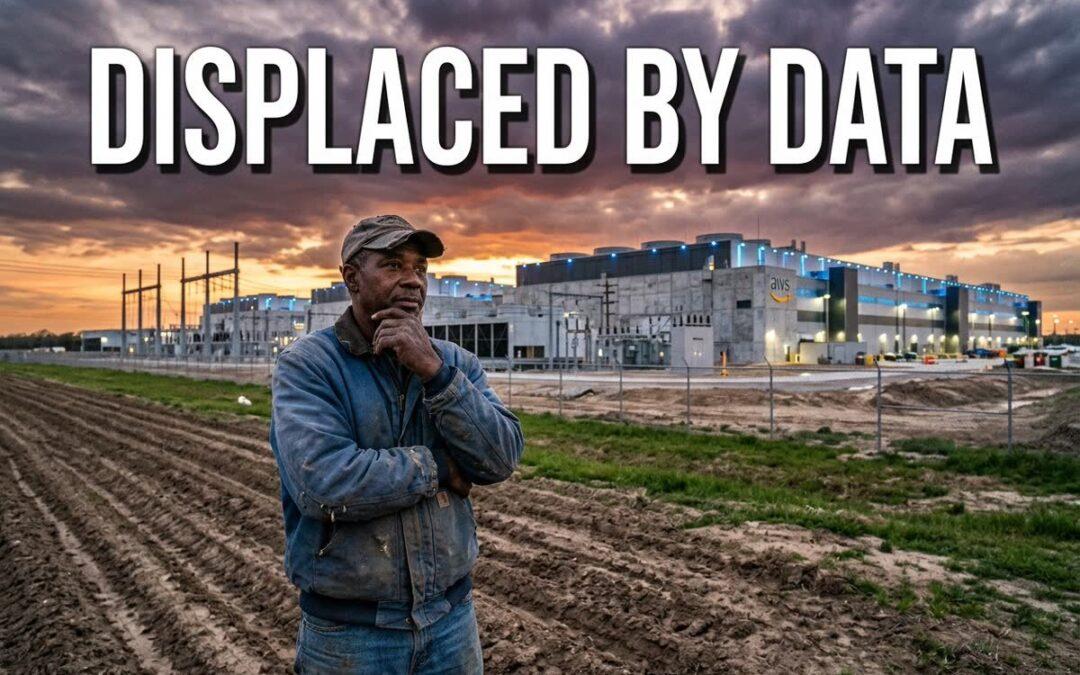

AI Data Center Expansion Threatens Black Rural Workers
By Darius Spearman (africanelements)
Support African Elements at patreon.com/africanelements and hear recent news in a single playlist. Additionally, you can gain early access to ad-free video content.
A sweeping technological transition is reshaping the American South. Across rural counties, massive computing complexes are replacing forests and farmland. Silicon Valley technology firms promote these facilities as clean engines of economic progress. Yet, civil rights researchers warn that this rapid transformation presents serious risks for Black communities (jointcenter.org, washingtoninformer.com).
A landmark study from the Joint Center for Political and Economic Studies reveals an urgent crisis. The report, titled Opportunities and Challenges of AI for Black Workers in the Rural South, explains that Black rural laborers face twin economic and environmental threats (jointcenter.org). While automated algorithms jeopardize routine entry-level occupations, physical server facilities consume critical municipal water and electricity reserves (jointcenter.org, theenergymix.com). This corporate expansion reflects a painful historical pattern across the Southern Black Belt (truthout.org).
AI Impact on Black Workers and Automated Job Loss
The Joint Center AI report reveals that artificial intelligence threatens existing employment structures across the South. Black employees represent 13.7 percent of the workforce in the thirty occupations most susceptible to automation displacement (jointcenter.org, jbhe.com). In contrast, Black workers make up 12.3 percent of the overall national labor market (jbhe.com). Labor economists identified that Black workers are overrepresented in 17 of the 30 most endangered occupations (jointcenter.org, washingtoninformer.com).
These vulnerable positions include food preparation, warehouse distribution, retail cashiers, administrative clerical support, and private security guards (jointcenter.org). In many rural Southern counties, these service jobs serve as the primary source of non-farm employment. Generational inequities in rural school funding restrict access to technical credentials, concentrating Black residents in lower-tier operational roles (georgetown.edu). Consequently, the direct AI impact on Black workers threatens to wipe out decades of fragile wage gains (capitalbnews.org).
Black Worker Share In Vulnerable Occupations
Interviews conducted by the Joint Center in rural Alabama highlight deep local ambivalence (jointcenter.org). Researchers established the “Four Cs” analytical framework: Curiosity, Caution, Culture, and Collaboration (jointcenter.org). Rural laborers show authentic curiosity about machine learning tools (jointcenter.org). Nevertheless, historical memories of unkept corporate promises generate caution among residents who fear technological displacement (jointcenter.org).
Mechanical Cotton Picker History and Southern Labor Shifts
Modern algorithmic disruption mirrors earlier technological shocks in Southern history. Following Reconstruction, white landowners organized plantation agriculture around sharecropping and tenant contracts (wikipedia.org). Millions of African Americans survived by hand-harvesting cotton crops under conditions of debt peonage (socialhistoryportal.org). This labor configuration continued until agricultural mechanization entered the Mississippi Delta (wikipedia.org).
Mechanical cotton picker history demonstrates how technological breakthroughs can trigger immediate displacement. In the 1930s, inventors John and Mack Rust designed a mechanical spindle harvester (wikipedia.org, rustcottonpicker.blog). In 1944, manufacturer International Harvester conducted a public demonstration on the Hopson Plantation near Clarksdale, Mississippi (wikipedia.org, jggscivilwartalk.online). A single mechanical picker completed the daily harvest quota of fifty agricultural workers (wikipedia.org). Southern planters bought the machines and evicted tenant families (wikipedia.org, socialhistoryportal.org).
This automated agricultural revolution became a primary driver of the Second Great Migration (wikipedia.org). More than five million African Americans abandoned rural communities between 1940 and 1970 to pursue urban employment (wikipedia.org). Those who remained organized a long struggle for economic justice against all odds within assembly plants and meatpacking operations. Today, hyperscale computing facilities arrive as the next wave of industrial automation (jointcenter.org, truthout.org).
The Southern Data Center Boom and Corporate Expansion
The Southern data center boom is expanding across regions with high concentrations of Black residents. Technology conglomerates choose rural Southern counties because regional utilities provide subsidized electricity rates and state leaders offer aggressive tax exemptions (jointcenter.org, theenergymix.com). Cheap farmland and anti-union “right-to-work” statutes create favorable corporate conditions (epi.org). Consequently, developers build vast physical campuses across rural areas (truthout.org).
Public officials routinely claim these facilities will revive rural economies. However, operational staffing figures reveal an employment paradox (jointcenter.org, goodjobsfirst.org). Constructing a single facility requires hundreds of temporary building trades workers (goodjobsfirst.org). In contrast, a fully operational hyperscale data center requires only 30 to 50 permanent technicians (goodjobsfirst.org).
Data Center Facility Staffing Disparity
Corporations recruit specialized network architects and cooling engineers from distant technology centers (jointcenter.org, goodjobsfirst.org). Unelected county Industrial Development Boards manage these transactions in secret (theseap.org, goodjobsfirst.org). These development authorities award multi-decade property tax abatements without community votes (goodjobsfirst.org). The resulting industrial plants occupy substantial real estate while generating negligible local employment (jointcenter.org, truthout.org).
Heirs Property Partition Sales and Modern Speculation
The acquisition of rural land for artificial intelligence infrastructure exacerbates generational Black land loss. Following Emancipation, African American farmers secured nearly nineteen million acres across the South by 1910 (tuskegee.edu, landtrustalliance.org). Over the twentieth century, discriminatory lending practices and legal maneuvers eliminated nearly ninety percent of those holdings (landtrustalliance.org). A key mechanism of this land dispossession involves heirs property partition sales (landtrustalliance.org, landtrustalliance.org).
When landowners pass away without formal wills, property transfers to descendants as tenants in common under state intestacy laws (landtrustalliance.org, lawandsociety.org). Co-heirs own fractional, undivided shares rather than specific parcels (lawandsociety.org). Commercial speculators exploit this legal vulnerability by purchasing tiny fractional stakes from distant relatives at discounted rates (landtrustalliance.org, lawandsociety.org). The outside investor then files a partition lawsuit in civil court (landtrustalliance.org, lawandsociety.org).
State partition statutes allow judges to order physical parcel division or judicial sales (lawandsociety.org). Courts routinely decide that dividing acreage reduces property values and instead mandate public auctions (lawandsociety.org). Speculators buy entire tracts on courthouse steps for cash prices below market rates, extinguishing family ownership (landtrustalliance.org, lawandsociety.org). Data center developers seek contiguous tracts, and this land hunger accelerates displacement (jointcenter.org, truthout.org).
Environmental Justice Sacrifice Zones from Toxins to Tech
The siting of high-density computing clusters continues a tradition of environmental injustice in the South. In 1982, North Carolina designated majority-Black Warren County as a dumping ground for toxic PCB soil (wjarr.com). That state action galvanized the modern Environmental Justice Movement (wjarr.com). Similarly, petrochemical plants created “Cancer Alley” along an eighty-five-mile corridor of historic plantations in Louisiana (rutgers.edu). These areas functioned as designated environmental sacrifice zones (truthout.org, rutgers.edu).
Contemporary data infrastructure produces comparable environmental hazards for neighboring residents. In Memphis, Tennessee, Elon Musk’s xAI established a massive supercomputer in an industrial section of South Memphis (theenergymix.com, truthout.org). To supply power without waiting for electrical hookups, the enterprise installed unpermitted methane gas turbines (theenergymix.com, truthout.org). The surrounding neighborhood already endures elevated cancer risks and asthma hospitalizations (truthout.org).
Tennessee State Representative Justin Pearson and local civil rights organizations challenged the turbine emissions (truthout.org). In Colleton County, South Carolina, utility planners proposed gas generation facilities to serve incoming data infrastructure (selc.org). The Southern Environmental Law Center determined the resulting particulate emissions would create thirty million dollars in regional healthcare burdens (selc.org). In response, the NAACP launched its national “Stop Dirty Data” campaign to halt unregulated corporate emissions (naacp.org, naacp.org).
Data Center Water and Power Demands Burden Local Taxpayers
The physical requirements of high-density computing place unprecedented strains on public infrastructure. An average hyperscale facility uses ten to fifty times more electricity than a traditional manufacturing plant (energy.gov). Regional utility monopolies, such as Georgia Power and the Tennessee Valley Authority, cite data expansion to delay fossil fuel retirements (selc.org, theenergymix.com). These utilities request capital expenditure approvals that shift grid upgrade expenses onto residential ratepayers (theenergymix.com, theseap.org).
Municipal water supplies face equal disruption from cooling infrastructure. A typical hyperscale server center consumes one to five million gallons of potable water daily for evaporative chillers (theenergymix.com). That volume equals the daily municipal water demand of a community of 50,000 residents (theenergymix.com). In rural Southern basins, this extraction drains underground aquifers and threatens residential water access (theenergymix.com, truthout.org).
Daily Water Consumption Comparison (Gallons)
Unincorporated status leaves rural Black communities vulnerable to infrastructure exploitation (southerncoalition.org, mc.edu). Municipalities historically excluded Black settlements from city boundaries, eliminating local zoning protections (southerncoalition.org). County development boards build high-impact facilities next to family homes without public hearings (theseap.org, mc.edu). Southern legislatures use preemption statutes to nullify municipal environmental ordinances, demonstrating how state-centered power overrides local community autonomy (theseap.org).
To prevent renewed displacement, the Joint Center urges municipalities to negotiate Community Benefit Agreements (CBAs) (jointcenter.org). These private contracts require developers to fund education pipelines at regional Historically Black Colleges and Universities (jointcenter.org). They mandate investments in water recycling, grid stabilization, and local public services (jointcenter.org). Grassroots leaders argue that direct organizing and the active exercise of political freedom represent essential safeguards against rural resource extraction (truthout.org).
About the Author
Darius Spearman is a professor of Black Studies at San Diego City College, where he has been teaching for over 20 years. He is the founder of African Elements, a media platform dedicated to providing educational resources on the history and culture of the African diaspora. Through his work, Spearman aims to empower and educate by bringing historical context to contemporary issues affecting the Black community.
