

Smithsonian Renewal Plan: Inside the Leaked White House Memo
By Darius Spearman (africanelements)
Support African Elements at patreon.com/africanelements and hear recent news in a single playlist. Additionally, you can gain early access to ad-free video content.
On November 23, 2026, an extraordinary breach of federal planning spilled into public view on an ordinary commuter train (propublica.org). A passenger on the Washington, D.C. Metro Orange Line photographed the open laptop screen of a federal policy aide (propublica.org, politis.com.cy). That computer belonged to twenty-seven-year-old Domestic Policy Council adviser Sam Bock (propublica.org, newrepublic.com). The text displayed on the screen outlined a confidential twenty-five-point blueprint titled the “Smithsonian Institution Renewal Plan” (propublica.org).
The photographed document details an executive branch campaign to alter the leadership, exhibits, and public education missions of the world’s largest museum complex (propublica.org). It seeks to dismiss professional staff, dismantle equity guidelines, and install monumental patriotic displays (propublica.org, propublica.org). The incident arrives directly after intense political pressure forced the retirement of pioneering Black historian Lonnie G. Bunch III (propublica.org, washingtoninformer.com). This clash is not an isolated incident. It is the latest chapter in a long struggle over who controls the telling of the American story (newrepublic.com).
Transit Discovery: Secrets on a Leaked White House Laptop
The visual leak occurred in public transit, but its contents reflect months of deliberate White House policy coordination (propublica.org). The screen displayed unambiguous directives targeting museum leadership and educational curricula (propublica.org, propublica.org). At the core of the document was an order to terminate Dr. Anthea M. Hartig (propublica.org). Hartig serves as the first female director of the National Museum of American History (propublica.org, si.edu). The memo also listed approximately twelve senior administrators and curators targeted for immediate removal (propublica.org).
The photographed draft instructs officials to eliminate institutional diversity, equity, and inclusion standards across all Smithsonian facilities (propublica.org). It orders the immediate cancellation of “The Bias Inside Us,” a national traveling project organized by the Smithsonian Institution Traveling Exhibition Service (propublica.org, fcmod.org). It also mandates dismantling online classroom programs such as “Becoming US,” an educational resource that explores American immigration through diverse cultural lenses (propublica.org). The memo further demands financial audits of museum affiliations with outside educational organizations, targeting groups labeled ideological by administration officials (propublica.org, propublica.org).
“The proposal represents an executive effort to reshape museum curation and personnel through unilateral administrative mandates.”
Source: (propublica.org)
This leaked White House laptop file shows how political aides planned to sidestep established civil service protections (propublica.org). The document treats curatorial departments as extensions of executive authority (propublica.org, newrepublic.com). Rather than allowing scholars to interpret historical records independently, the draft imposes a centralized federal mandate over public history (propublica.org, thereconstructionera.com).
Curatorial Reversals: The American History Museum Overhaul
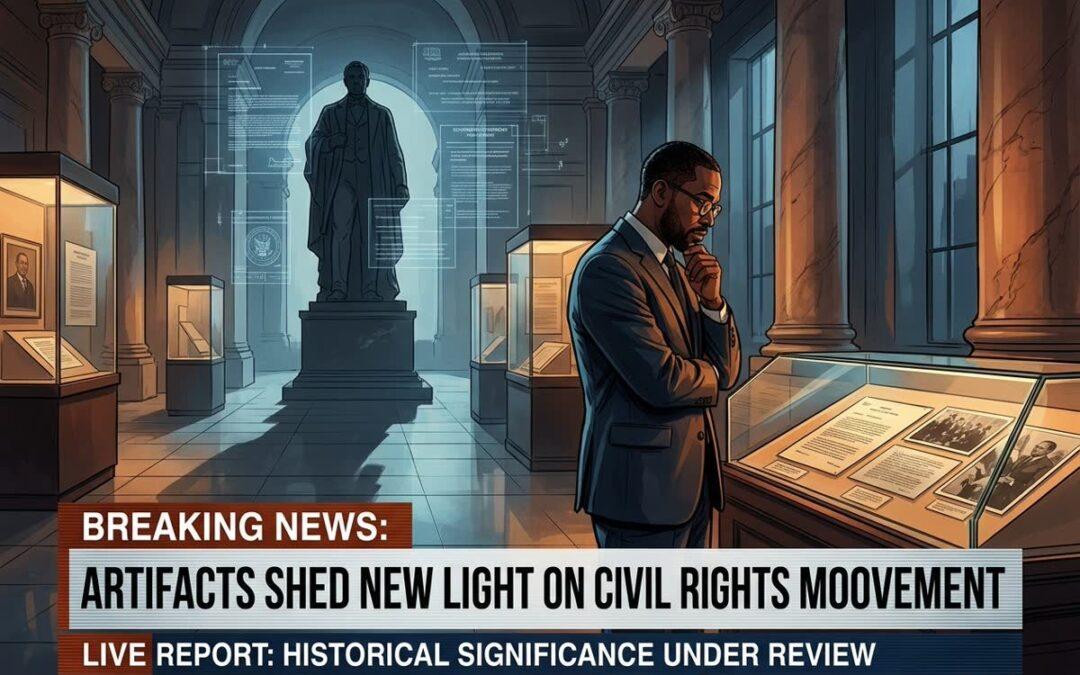
The memo proposes a sweeping American History Museum overhaul designed to elevate traditional nationalist narratives (propublica.org). It instructs curators to build new permanent galleries dedicated to Western civilization and prominent historic families (propublica.org, propublica.org). The proposals specify an exhibition centered on the D-Day invasion alongside celebratory military achievements (propublica.org). Most noticeably, the document directs the museum to erect a massive “colossus statue” of George Washington directly at its public entrance (propublica.org, politis.com.cy).
This approach directly challenges the discipline of social history (newrepublic.com, thereconstructionera.com). For over fifty years, academic historians have explored “history from the bottom up” (newrepublic.com). That methodology examines how working people, enslaved laborers, and disenfranchised communities built the nation (thereconstructionera.com). Replacing this framework with celebratory narratives erases systemic inequality (thereconstructionera.com). When public institutions elevate only prominent elites, they obscure the harsh realities of the past. For African Americans, this shift threatens to minimize the foundational role of chattel slavery during the revolutionary era struggles that shaped early national wealth.
The proposed changes alter how visitors understand vital civil rights artifacts (propublica.org, thereconstructionera.com). Consider the Woolworth lunch counter from Greensboro, North Carolina, currently preserved in the museum (thereconstructionera.com). Under a social history framework, that counter represents grassroots direct action (thereconstructionera.com). It shows young Black college students confronting white supremacy and state-sanctioned Jim Crow violence (thereconstructionera.com, eji.org). Traditionalist revisions reframe such artifacts around legislative milestones, giving credit to federal politicians rather than courageous youth (thereconstructionera.com). The administration plan seeks an uncritical consensus, reducing human bondage and racial terror to minor footnotes (newrepublic.com, thereconstructionera.com).
White House Memo: Targeted Initiatives
The plan also attacks programs outside the capital city (propublica.org). “The Bias Inside Us” traveled to dozens of regional libraries and civic centers nationwide (fcmod.org, ncsml.org). It used cognitive science to teach students how the brain processes social shortcuts (fcmod.org, californiasciencecenter.org). The exhibition utilized visual artwork, including photographer Angélica Dass’s portraits, to challenge biological concepts of race (fcmod.org, monmouthmuseum.org). Administration policy documents label this scientific examination “extreme political activism” (propublica.org, whitehouse.gov). Critics claim teaching subconscious bias induces collective racial guilt (propublica.org, whitehouse.gov). By halting the traveling exhibition, the administration seeks to restrict critical education across regional communities (propublica.org).
Federal Escalation: The Saving Americas Story Report
The leaked memo represents the tactical continuation of an ideological assault launched months earlier (propublica.org). On July 4, 2026, the White House Domestic Policy Council published a 162-page document (whitehouse.gov). Titled the Saving Americas Story report, the publication accused the Smithsonian of advancing ideological bias (propublica.org, whitehouse.gov). The council criticized the American History Museum for highlighting the slaveholding pasts of founding figures (whitehouse.gov). It specifically condemned curatorial text examining Benjamin Franklin’s direct involvement with chattel slavery (propublica.org, whitehouse.gov).
Federal agencies escalated pressure shortly after the report appeared (propublica.org). The executive branch directed the Department of the Interior to post warning placards on pathways approaching the museum (propublica.org). These public notices claimed the exhibits inside presented partisan historical interpretations (propublica.org). In September 2026, the Interior Department threatened to cancel artifact loan agreements with the Smithsonian (propublica.org). This maneuver turned federal partnerships into political leverage (propublica.org, propublica.org).
Smithsonian Institution Operational Scope
Public institutions rely heavily on annual congressional appropriations (propublica.org). With approximately seventy percent of the Smithsonian’s operating budget coming directly from taxpayers, the complex remains structurally exposed (propublica.org). Budget threats allow partisan actors to apply intense pressure on scholarly programming (propublica.org, newrepublic.com). The administration’s coordinated maneuvers transformed standard oversight into direct administrative coercion (propublica.org, propublica.org).
Institutional Rollback: The Lonnie Bunch Smithsonian Departure
The sustained political campaign culminated in the Lonnie Bunch Smithsonian departure in September 2026 (propublica.org). Bunch served as the founding director of the National Museum of African American History and Culture (si.edu, smithsonianmag.com). He spent years gathering artifacts and securing private donations to establish that facility on the National Mall (smithsonianmag.com, pbs.org). In 2019, he became the fourteenth Secretary of the Smithsonian Institution (si.edu). He was the first African American and the first professional historian ever appointed to head the institution (wikipedia.org, si.edu).
For civil rights advocates, Bunch’s departure marks a devastating institutional rollback (washingtoninformer.com, thereconstructionera.com). African Americans fought for more than a century to secure representation on the National Mall (thereconstructionera.com). In 1915, Black Union Army veterans formed the National Memorial Association to demand a national memorial honoring African American contributions (thereconstructionera.com). Congress debated the matter for decades without action (thereconstructionera.com). Only in 2003 did federal legislation finally establish the African American museum, opening its doors in 2016 (si.edu, thereconstructionera.com). Bunch stood as the living embodiment of that historical victory (washingtoninformer.com, smithsonianmag.com).
“I really believe you can’t understand greatness without understanding challenge… What I want as a historian is America to understand itself fully, completely, with complexity, with inspiration, and with hope.”
— Lonnie G. Bunch III, Source: (smithsonianmag.com)
Bunch consistently defended scholarly complexity against political attacks (propublica.org, smithsonianmag.com). Without his leadership, minority curatorial protections face serious jeopardy (washingtoninformer.com, thereconstructionera.com). His exit removes the primary buffer shielding Black history initiatives from political interference (washingtoninformer.com). Historically, Black Americans faced persistent marginalization and struggles after the Civil War when seeking full institutional recognition. Losing leadership at this level leaves exhibits vulnerable to historical sanitization (thereconstructionera.com).
Statutory Firewall: The Smithsonian Board of Regents
The White House plan faces a major legal barrier: the unique governing structure established by Congress (propublica.org, wikipedia.org). In 1829, British scientist James Smithson died, leaving his fortune to the United States (wikipedia.org, si.edu). His bequest carried a single directive: to found an establishment in Washington for “the increase and diffusion of knowledge” (wikipedia.org, si.edu). Congressional leaders spent seventeen years debating whether the federal government held constitutional authority to accept the bequest (wikipedia.org). The resulting Smithsonian Charter Act of 1846 created a legal hybrid known as a “trust instrumentality” (wikipedia.org, house.gov).
Under this federal statute, the institution is not an executive agency (propublica.org, wikipedia.org). The President does not hold direct authority to fire curators or hire museum directors (propublica.org). Instead, all administrative governance resides with the seventeen-member Smithsonian Board of Regents (wikipedia.org, si.edu). The Chancellor of the Board is the Chief Justice of the United States (wikipedia.org). The Vice President holds an ex-officio seat (wikipedia.org). The remaining seats belong to six members of Congress and nine distinguished private citizens (wikipedia.org, si.edu).
| Regent Category | Appointing Body | Total Seats |
|---|---|---|
| Judicial Branch | Chief Justice of the United States | 1 Seat (Chancellor) |
| Executive Branch | Vice President of the United States | 1 Seat (Ex-Officio) |
| Legislative Branch | Speaker of the House & Senate President | 6 Seats (3 House, 3 Senate) |
| Private Citizens | Joint Resolution of Congress | 9 Seats (Civilian Regents) |
Citizen regents receive appointments through congressional joint resolutions signed into federal law (wikipedia.org, si.edu). This structure was designed to protect public scholarship from partisan swings (propublica.org, newrepublic.com). The White House plan to unilaterally remove museum officials ignores this statutory firewall (propublica.org). Enforcing such directives directly challenges more than a century and a half of administrative law (wikipedia.org, house.gov).
leaked White House laptop: Mall Battles of the Past: How the Enola Gay Controversy Set the Precedent
Political fights over Smithsonian exhibits have occurred before (jhu.edu, afa.org). The most prominent historical clash unfolded between 1994 and 1995 at the National Air and Space Museum (jhu.edu, wisc.edu). Museum Director Martin Harwit organized an exhibition around the restored fuselage of the B-29 bomber *Enola Gay* (jhu.edu, afa.org). The aircraft dropped the atomic bomb on Hiroshima in August 1945 (jhu.edu). Harwit’s curatorial team drafted explanatory wall texts analyzing the decision to use atomic weapons and the human suffering on the ground (jhu.edu, ippnw.org).
Veterans groups, led by the Air Force Association, condemned the planned historical analysis (jhu.edu, afa.org). Lawmakers on Capitol Hill joined the campaign, threatening to withhold federal appropriations from the Smithsonian (jhu.edu, wisc.edu). In January 1995, Smithsonian Secretary I. Michael Heyman cancelled the original script (jhu.edu, smithsonianmag.com). Harwit resigned his post shortly after (jhu.edu, wisc.edu). The bomber went on public display with minimal technical labels, stripped of historical debate (jhu.edu, smithsonianmag.com).
Key Curatorial Clashes on the Mall
The 1995 controversy established a clear political template (jhu.edu, wisc.edu). Opponents leverage federal funding to force museums to drop critical inquiry (jhu.edu). The National Museum of American History originally opened in 1964 as the Museum of History and Technology (wikipedia.org). For decades, it presented machines, inventions, and flags in celebration of American industrial triumph (wikipedia.org, newrepublic.com). In recent decades, historians added exhibits examining systemic racism, labor struggles, and the elusive nature of freedom for marginalized groups. The 2026 leaked plan seeks to undo that scholarship entirely (propublica.org, thereconstructionera.com).
The photographed memo on the D.C. Metro exposes an ongoing constitutional and cultural crisis (propublica.org, newrepublic.com). The core question is whether national museums will reflect the complex realities of American history or serve as instruments of state nationalism (thereconstructionera.com). As the Board of Regents prepares to select Lonnie Bunch’s successor, the future of public history hangs in the balance (propublica.org, washingtoninformer.com). Preserving accurate history requires protecting the scholars who document the nation in all its triumphs, flaws, and ongoing struggles (thereconstructionera.com, smithsonianmag.com).
About the Author
Darius Spearman is a professor of Black Studies at San Diego City College, where he has been teaching for over 20 years. He is the founder of African Elements, a media platform dedicated to providing educational resources on the history and culture of the African diaspora. Through his work, Spearman aims to empower and educate by bringing historical context to contemporary issues affecting the Black community.
