

Hakeem Jeffries Stephen Miller Clash: Inside the 120th Standoff
By Darius Spearman (africanelements)
Support African Elements at patreon.com/africanelements and hear recent news in a single playlist. Additionally, you can gain early access to ad-free video content.
120th Congress House Speaker and the Line in the Sand
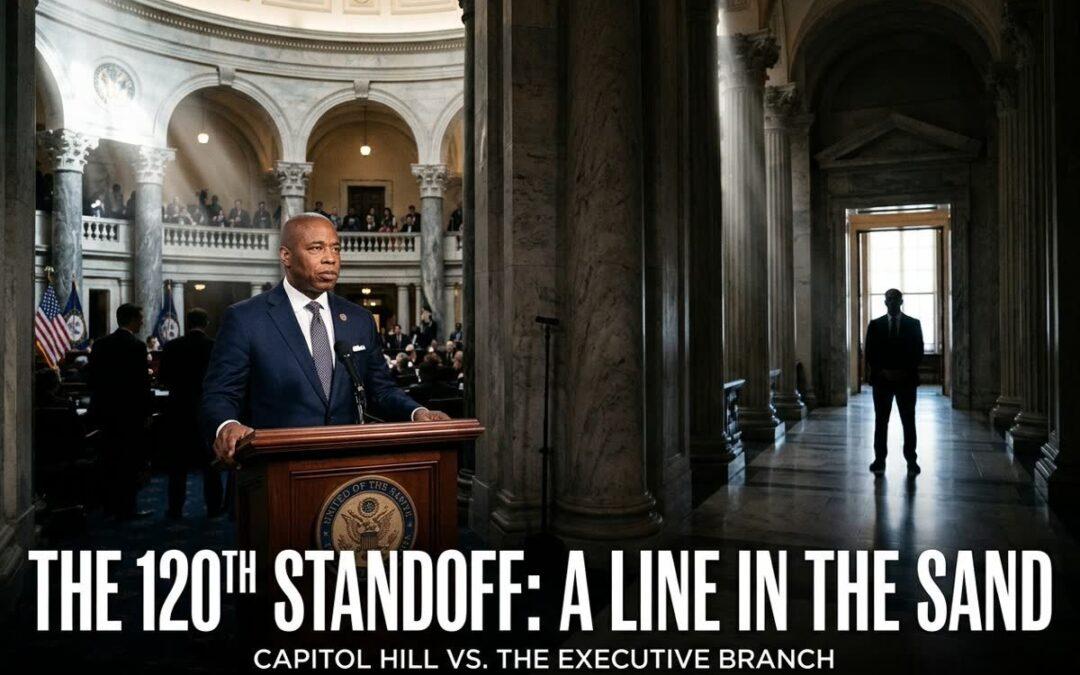
A constitutional confrontation has emerged on Capitol Hill before the incoming legislative session has even begun. Following decisive Democratic victories in the November 2026 midterm elections, Representative Hakeem Jeffries of New York secured the position of Speaker-designate. The historic election positions him to become the first African American Speaker of the House of Representatives in American history (washingtonpost.com, apnews.com). Yet, rather than observing conventional post-election courtesies, Jeffries delivered an institutional ultimatum that breaks decades of Washington protocol (washingtonpost.com).
Jeffries announced that he will refuse to attend any meetings, conduct staff negotiations, or hold policy discussions with the newly elevated White House Chief of Staff, Stephen Miller (washingtonpost.com, themarysue.com). Speaking during an interview and confirming his stance on Capitol Hill, Jeffries reaffirmed his description of Miller as an ideological extremist whose record disqualifies him from normal legislative relations (washingtonpost.com, newsweek.com). The incoming 120th Congress House Speaker stated plainly that Miller represents a moral line congressional leadership will not cross (washingtonpost.com, house.gov).
“I have made it clear that Stephen Miller is a stone-cold racist. Why would I deal with him at this point in time? This is the architect of Donald Trump’s violent mass deportation machine, and there is cruelty associated with that. There is chaos. There is death associated with what is taking place.”
— Speaker-designate Hakeem Jeffries, Source: (washingtonpost.com)
President Donald Trump defended his aide during a nationally televised interview, praising Miller for maintaining firm border policies and arguing that tough measures remain necessary to curtail illegal entry (washingtonpost.com, newsweek.com). Even as the President extended formal congratulations to Jeffries on his historic legislative victory, the executive branch refused to alter its personnel decisions (washingtonpost.com). The resulting impasse shatters the traditional channel between the executive gatekeeper and legislative leadership, setting a contentious foundation for the 120th Congress (washingtonpost.com).
The Ideological Roots and the Stephen Miller Breitbart Emails
To understand the current confrontation, one must examine the ideological evolution of Stephen Miller. Miller began his congressional career as communications director for then-Senator Jeff Sessions of Alabama (wikipedia.org). In that capacity, Miller worked to defeat comprehensive immigration reform efforts, including the bipartisan 2013 Senate agreement (wikipedia.org). He argued that both unauthorized immigration and legal admissions depressed domestic wages and altered American civic culture (wikipedia.org, jewishcurrents.org).
The philosophical origins of this agenda became clear in November 2019, when the Southern Poverty Law Center published an extensive review of over 900 records that became known as the Stephen Miller Breitbart emails (wikipedia.org). Between 2015 and 2016, while shaping candidate Trump’s national campaign, Miller sent hundreds of messages to editors at Breitbart News (wikipedia.org). The investigative review documented that more than 80 percent of those communications focused exclusively on race and immigration (wikipedia.org). Miller repeatedly directed editors to white nationalist outlets such as VDARE, promoted historical theories of white displacement, and referenced the 1973 French novel The Camp of the Saints, a foundational text among anti-immigrant groups (wikipedia.org, jewishcurrents.org).
Thematic Breakdown: 900+ SPLC Leaked Miller Emails
When those communications became public in 2019, more than one hundred members of Congress demanded Miller’s immediate resignation (wikipedia.org). Jeffries was among the earliest and most vocal leaders to declare Miller unfit for public service (washingtonpost.com, house.gov). In Trump’s first term, Miller served as Senior Advisor for Policy, translating these theories into administrative action (wikipedia.org). He orchestrated Executive Order 13769, known as the travel ban, designed the 2018 Zero Tolerance border policy that separated migrant children from parents, and led efforts to end protections for young immigrants (wikipedia.org, aclu.org). For civil rights advocates, Miller’s record reflected a coherent effort to reshape federal authority along racial and ethnic lines (ips-dc.org, jewishcurrents.org).
First Step Act Civil Rights Legacy and Jeffries’ Vision
While Miller constructed policies restricting immigration, Hakeem Jeffries built his political reputation in New York and Washington by addressing disparities inside the criminal legal system. Jeffries approached governance from the long tradition of Black legislative advocacy, focusing on reducing statutory racial inequalities and curtailing punitive federal overreach (house.gov, house.gov). This philosophy became evident during the passage of the landmark First Step Act in 2018, where Jeffries served as a principal Democratic negotiator in the House (house.gov, senate.gov).
The First Step Act directly addressed the statutory aftermath of the War on Drugs, which had expanded the carceral state and disproportionately harmed communities of color (senate.gov, annualreviews.org). In earlier decades, federal policy had established civil rights and mass incarceration as opposing poles of American political life (annualreviews.org). By making the Fair Sentencing Act of 2010 retroactive, the 2018 legislation allowed thousands of incarcerated individuals serving mandatory minimum sentences for crack cocaine offenses to petition for immediate release (senate.gov). Over eighty percent of the individuals who received retroactive sentence reductions under this measure were Black (senate.gov).
The law also limited mandatory minimum penalties for nonviolent offenses, broadened the judicial safety valve, and incentivized rehabilitative programs in federal prisons (senate.gov). Through this bipartisan negotiation, Jeffries established a clear civil rights doctrine: federal law enforcement powers must remain constrained by constitutional checks, individual liberties, and judicial review (house.gov, house.gov). This focus on accountability continues to guide his response to federal law enforcement today (washingtonpost.com, house.gov).
Mass Detention and Federal Immigration Enforcement Realities
The clash between Jeffries and Miller reflects a broader philosophical consensus within the Congressional Black Caucus. Black lawmakers have increasingly identified aggressive federal immigration enforcement as an extension of the domestic policing tactics used against minority communities for generations (ips-dc.org, davisvanguard.org). Both systems rely on surveillance, pretextual stops, mass detention, and qualified immunity for armed state agents (ips-dc.org, hrw.org). The historical struggle against state violence has repeatedly shown the danger of unchecked police powers, demonstrating that when fundamental liberties are compromised, freedom becomes precarious for every community (ips-dc.org, umn.edu).
This dynamic reached a crisis point during “Operation Metro Surge,” an initiative launched by the Department of Homeland Security in late 2025 (washingtonpost.com, davisvanguard.org). The federal government deployed between 2,000 and 4,000 armed immigration agents into the Minneapolis–Saint Paul metropolitan area (washingtonpost.com, davisvanguard.org). Civil rights organizations and local officials documented widespread constitutional violations, including warrantless home entries using administrative detainers rather than judicial warrants (davisvanguard.org, ilrc.org). The operations heavily impacted Somali, Southeast Asian, and Latino neighborhoods across the region (davisvanguard.org).
“The militarization of our streets and the killing of innocent civilians by unchecked federal agents cannot be tolerated in a constitutional republic. We will not fund rogue operations.”
— House Democratic Leadership Statement, Source: (washingtonpost.com)
The aggressive tactics produced civilian casualties. On January 7, 2026, an Immigration and Customs Enforcement (ICE) agent fatally shot Renee Nicole Good, a 37-year-old mother of three, through her vehicle windshield (washingtonpost.com, davisvanguard.org). Federal authorities claimed she attempted to weaponize her automobile, but local leaders and video evidence contradicted that assertion (davisvanguard.org). Weeks later, on January 24, Customs and Border Protection officers pepper-sprayed and fatally shot Alex Pretti, a 37-year-old intensive care nurse, while he was recording federal agents and assisting a bystander (washingtonpost.com, davisvanguard.org). Jeffries directly cited these fatal shootings when justifying his refusal to negotiate with Miller, describing them as the inevitable human cost of militarized policing (washingtonpost.com).
Annual ICE Budget Expansion (2016 vs. 2026)
Trump Mass Deportation Policy and the Second-Term Machine
The scale of the current confrontation stems from the financial and institutional expansion of the Trump mass deportation policy during his second administration. Between 2025 and 2026, the Republican-led Congress approved funding measures that fundamentally reshaped immigration agencies (americanimmigrationcouncil.org, americanprogress.org). Through the One Big Beautiful Bill Act of 2025 and the Secure America Act of 2026, lawmakers directed unprecedented resources into detention and removal infrastructure (americanimmigrationcouncil.org). Total federal commitments for immigration enforcement through 2029 reached $268.9 billion (americanimmigrationcouncil.org).
These appropriations produced rapid operational results. During the first eighteen months of Trump’s second term, ICE and CBP carried out approximately 980,000 formal expulsions (americanimmigrationcouncil.org). Interior arrests exceeded 230,000 in the first year alone, a figure surpassing total interior deportations over the entire four-year Biden administration (americanimmigrationcouncil.org). Policy analysts estimate that aggressive neighborhood raids, employment audits, and public pressure led between 310,000 and 1.5 million unauthorized residents to self-deport by mid-2026 (americanimmigrationcouncil.org).
These enforcement actions placed severe emotional and economic stress on vulnerable households. The historical record reveals that resilient family structures have long weathered aggressive state intervention and separation (19thnews.org). The contemporary removal of primary earners has strained community stability across urban centers (americanimmigrationcouncil.org, 19thnews.org). Furthermore, as of October 2026, federal records indicate that ICE and CBP hold an astounding $91 billion and $45.6 billion, respectively, in unspent reconciliation balances (americanimmigrationcouncil.org). This massive financial reserve allows the executive branch to continue enforcement operations even during congressional standoffs (americanimmigrationcouncil.org).
Unspent Federal Enforcement Balances (Oct 2026)
The Institutional Boycott of a White House Chief of Staff
The decision by President Trump to elevate Stephen Miller on November 9, 2026, signaled an uncompromising approach toward the incoming Democratic majorities (washingtonpost.com, washingtonpost.com). Trump dismissed former Chief of Staff Susie Wiles following midterm losses, choosing Miller to manage executive strategy (washingtonpost.com, washingtonpost.com). In American governance, the White House Chief of Staff has historically functioned as the primary negotiator with congressional leadership, resolving disputes over annual spending, debt limits, and statutory authorizations (washingtonpost.com).
By declaring Miller completely persona non grata, Jeffries disrupts that established framework (washingtonpost.com). The Speaker-designate indicated that any negotiations concerning government spending or statutory oversight must take place directly with President Trump or Vice President JD Vance (washingtonpost.com, house.gov). House Democrats intend to use their committee gavels in January 2027 to investigate Department of Homeland Security operations, hold public hearings on the Minneapolis shootings, and attempt to freeze or claw back the $91 billion in unspent ICE funds (washingtonpost.com, americanimmigrationcouncil.org). With 70 percent of midterm voters indicating that Congress has failed to provide sufficient checks on executive power, the Democratic leadership views this institutional confrontation as a clear electoral mandate (apnews.com).
The clash between Hakeem Jeffries and Stephen Miller is therefore far more than personal antipathy. It represents a collision between two divergent visions of federal power, citizenship, and constitutional governance (washingtonpost.com, ips-dc.org). As the 120th Congress prepares to convene, the standoff over immigration policy and executive conduct ensures that divided government will begin not with negotiation, but with a battle over the limits of presidential authority (washingtonpost.com, washingtonpost.com).
About the Author
Darius Spearman is a professor of Black Studies at San Diego City College, where he has been teaching for over 20 years. He is the founder of African Elements, a media platform dedicated to providing educational resources on the history and culture of the African diaspora. Through his work, Spearman aims to empower and educate by bringing historical context to contemporary issues affecting the Black community.
