

Haiti Food Crisis: Why Over 5.9 Million Face Starvation
By Darius Spearman (africanelements)
Support African Elements at patreon.com/africanelements and hear recent news in a single playlist. Additionally, you can gain early access to ad-free video content.
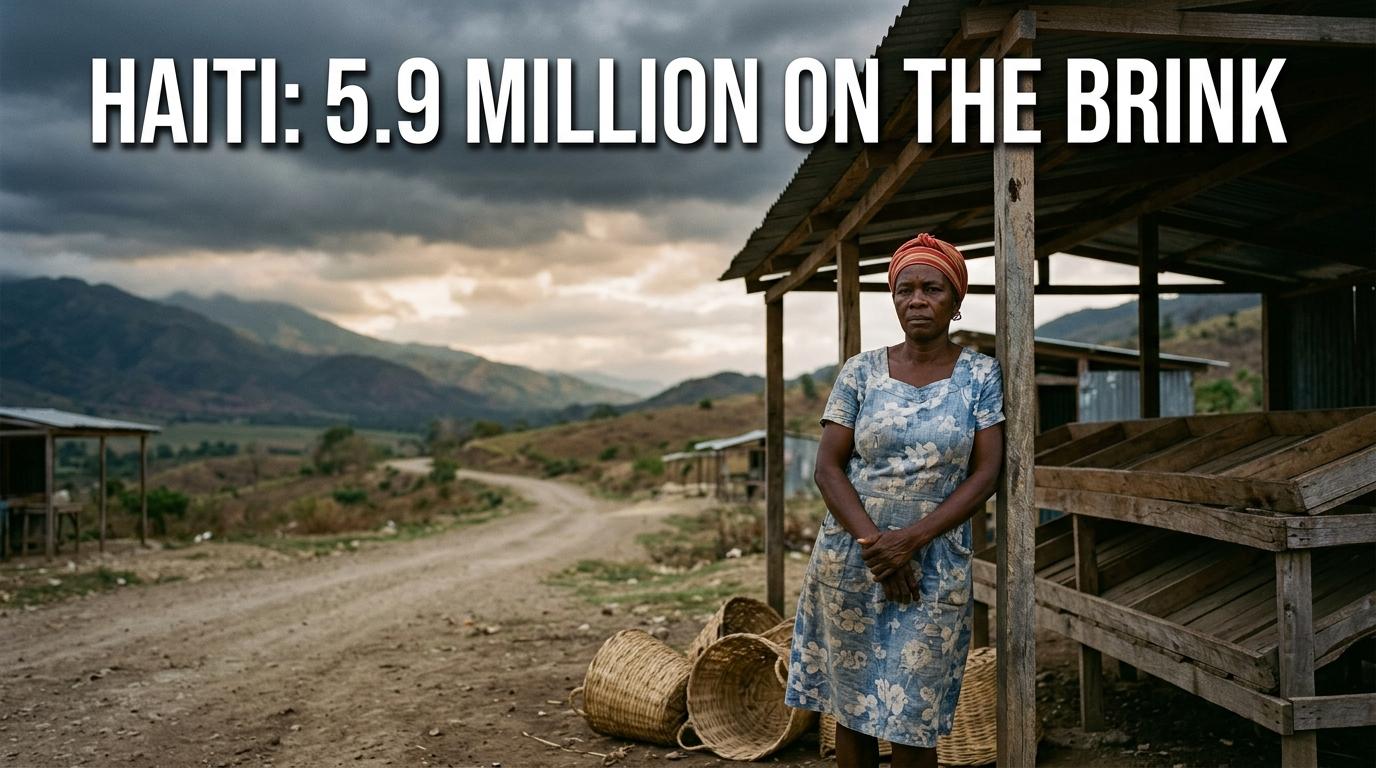
A humanitarian catastrophe is sweeping through the Caribbean. The contemporary Haiti food crisis has reached historic severity, placing more than half of the national population on the brink of starvation (ipcinfo.org). While daily news broadcasts document violent clashes across Port-au-Prince, the roots of this hunger run far deeper than modern gang warfare. The crisis is an outcome of deliberate historical extraction, foreign military interventions, and destructive economic policies spanning more than two centuries.
Families across urban neighborhoods and rural provinces now skip meals daily as food prices soar beyond reach. The disruption of agricultural corridors has cut off vital lifelines between rural farms and urban markets (reliefweb.int). To understand why millions of people cannot feed their families today, one must examine both the current data and the historical actions that dismantled the agricultural self-sufficiency of the republic.
IPC Acute Food Insecurity Analysis Details Historic Hunger Levels
The latest integrated food security assessment reveals unprecedented numbers across the country. According to the authoritative IPC acute food insecurity analysis, roughly 5.9 million people—representing 53 percent of the analyzed population—face acute food insecurity at Crisis levels or worse (ipcinfo.org, actionagainsthunger.org). Among these individuals, approximately 1.9 million people have entered IPC Phase 4 Emergency conditions, where households endure critical food consumption gaps and face high acute malnutrition risks (ipcinfo.org, reliefweb.int).
The numbers reflect an economy pushed into freefall. In major population centers, families spend their dwindling savings on meager caloric rations while selling basic domestic tools simply to purchase water and cooking oil (jurist.org, actionagainsthunger.org). Food assistance programs struggle to function amid the widespread instability. Humanitarian organizations warn that without immediate intervention, thousands of households trapped in isolated urban pockets risk sliding into IPC Phase 5 Catastrophe, the classification reserved for outright famine conditions (ipcinfo.org).
Haiti Acute Food Insecurity Distribution
The severity of this deficit is compounded by soaring domestic inflation. In Port-au-Prince, the basic basket of staple goods has become inaccessible for low-wage earners. As currency reserves dwindle, commercial distributors struggle to clear port facilities. The resulting scarcity forces ordinary citizens into severe physical deprivation (jurist.org).
Haiti Gang Blockades and Displacement Sever Food Corridors
Armed non-state groups now exercise control over roughly 85 to 90 percent of the Port-au-Prince metropolitan region (reliefweb.int, apnews.com). These criminal alliances have formed armed blockades along every major transit route. The resulting geographical chokehold prevents regional harvests from reaching domestic consumers, turning transportation networks into commercial extortion zones (wiredja.com).
National Route 1, which connects the capital to the agricultural plains of the Artibonite Valley, remains under sustained gang interdiction. Trucks carrying plantains, sweet potatoes, and domestic grain face gunfire and cargo seizures (apnews.com). Drivers must pay exorbitant cash ransoms at illegal checkpoints simply to pass through territory. Simultaneously, National Route 2, the primary transit corridor heading south, is blocked by entrenched gang networks, completely isolating southwestern departments from national commercial distribution channels (reliefweb.int, wiredja.com).
The violence has triggered immense internal migration. International monitors record that more than 1.3 million people are internally displaced nationwide (reliefweb.int). Displaced families seek refuge in overcrowded public schools, public parks, and informal camps. These makeshift sites lack clean sanitation infrastructure, causing waterborne illnesses like cholera to proliferate alongside acute malnutrition (actionagainsthunger.org).
The combination of Haiti gang blockades and displacement has turned hunger into a structural weapon. Gangs do not need to control the entire countryside to disrupt national consumption. By controlling maritime ports, fuel storage facilities, and primary thoroughfares, armed groups have paralyzed national food flows, driving prices to record highs (jurist.org, reliefweb.int).
Illicit Weapons Trafficking to Haiti Empowers Criminal Coalitions
The militarization of neighborhood gangs raises an urgent question: how do impoverished street factions obtain high-powered arsenals that overpower national police units? Haiti produces no firearms, ammunition, or specialized military equipment. The armaments wielded by street groups enter the country through complex, international illicit networks (unodc.org, unodc.org).
Assessments by the United Nations Office on Drugs and Crime show that illicit weapons trafficking to Haiti originates predominantly in the United States, particularly through the state of Florida (unodc.org, unodc.org). Straw buyers purchase military-grade assault rifles, high-capacity drum magazines, and high-caliber precision weapons at retail stores and gun shows across jurisdictions with relaxed regulatory requirements (aljazeera.com). These weapons are concealed inside consumer shipments, industrial vehicle parts, and containerized maritime cargo moving through regional commercial shipping hubs (unodc.org, unodc.org).
These illegal imports are financed by criminal enterprises that siphon capital directly from the population. Gang coalitions accumulate massive funds through kidnapping ransoms, territorial transit fees, cargo hijacking, and commercial extortion (unodc.org, unodc.org). Historically, certain domestic political elites and private business figures armed urban street groups to secure electoral dominance and private asset protection (aljazeera.com). Over time, these armed proxies achieved financial autonomy, turning their weapons against the wider populace and seizing control of public infrastructure (apnews.com).
Metropolitan Control and Displacement
Haiti French Indemnity Debt Crippled Domestic Development
To understand why modern agricultural systems collapsed under external pressure, one must look back to the birth of the nation. In 1804, enslaved Africans defeated Napoleon’s army during the Haitian Revolution, establishing the first free Black republic (aaregistry.org). Instead of receiving recognition, the fledgling state was met with total international hostility. Major European empires and the United States viewed a self-liberated Black population as a dangerous precedent (aaregistry.org, mondediplo.com).
Fearful that a successful rebellion would inspire uprisings within its own borders, the United States imposed a comprehensive trade embargo in 1806 under President Thomas Jefferson (aaregistry.org, worldfuturefund.org). Diplomatic recognition was denied for more than five decades, cutting Haiti off from vital regional commerce. This isolation left the young government without foreign trade alliances or credit, forcing it to expend its scarce treasury funds maintaining a large standing army to repel European reinvasion (aaregistry.org, mondediplo.com).
This isolation culminated in the catastrophic 1825 Haiti French indemnity debt. French King Charles X dispatched a military flotilla of 14 warships carrying over 500 cannons to Port-au-Prince, demanding an indemnity of 150 million francs to compensate former slaveholders for “lost property” (aaregistry.org, mondediplo.com). Defenseless against naval destruction and starved of commercial capital, President Jean-Pierre Boyer accepted the extortionate terms (aaregistry.org).
To fulfill the obligation, the government borrowed heavily from private banks at predatory interest rates, creating a crippling double debt (aaregistry.org, mondediplo.com). This pattern of international sovereign debt extraction drained national wealth for over a century, continuing until final payments concluded in 1947 (aaregistry.org). As a direct result, up to 80 percent of annual revenues went toward foreign loan services rather than public education, irrigation, rural transport, or agrarian development (mondediplo.com, worldfuturefund.org).
Haiti Agriculture and Rice Tariffs Slashed Under Foreign Pressure
The institutional abandonment of the peasantry set the stage for modern vulnerability, but late twentieth-century trade policies delivered the decisive blow. Until the late 1970s, domestic farming supplied the vast majority of local staple foods (substack.com, worldhunger.org). Peasant families cultivated rich varieties of grain, legumes, and root crops while maintaining indigenous Creole pigs as productive savings reserves (substack.com).
Between 1982 and 1984, foreign agencies intervened directly in rural security. Following an outbreak of African Swine Fever on the neighboring border, international bodies mandated the wholesale eradication of the indigenous Creole pig population (substack.com). Roughly 1.2 million animals were destroyed without equitable compensation. The loss eliminated approximately 600 million dollars in peasant savings, stripping smallholders of the financial reserves needed to buy seed, tools, and fertilizers (substack.com).
The Fall of Domestic Rice Production
Subsequent trade liberalization worsened this damage. During structural adjustment programs enforced by international financial institutions in the 1980s and 1990s, the national government was pressured to lower border taxes (miami.edu, worldhunger.org). In 1995, Haiti agriculture and rice tariffs fell from 50 percent down to 3 percent (miami.edu, youtube.com). Heavily subsidized American grain, known as Miami rice, flooded local distribution networks at prices below local cultivation costs (miami.edu, substack.com).
Local farmers in the fertile Artibonite Valley could not compete against foreign corporate agribusinesses backed by government subsidies (miami.edu, cepr.net). Agrarian families abandoned their parcels, moving into informal settlements surrounding the capital. Former United States President Bill Clinton later acknowledged this mistake in 2010 testimony before the Senate Foreign Relations Committee, conceding that the policy destroyed the local agricultural capacity needed to feed the populace (youtube.com).
Haiti Food Sovereignty Crisis Exposes Emergency Aid Limits
Standard humanitarian shipments address immediate hunger, but they cannot resolve the underlying structural deficit. The Haiti food sovereignty crisis represents a profound failure to distinguish between food security and food sovereignty (cepr.net, worldhunger.org). Food security focuses on meeting caloric requirements through any available channel, including external donations. Food sovereignty requires that a nation maintains the legal right and productive infrastructure to define its own agrarian systems and feed its population (worldhunger.org).
When emergency humanitarian programs flood local marketplaces with foreign grain donations, regional market prices drop precipitously. Smallholders who manage to harvest crops amid armed unrest find themselves unable to sell their goods at prices that cover their input expenses (substack.com, worldhunger.org). The influx of outside grain inadvertently bankrupts the remaining rural producers, accelerating the decay of domestic agricultural supply chains and cementing deep foreign import reliance (cepr.net).
“It may have been good for some of my farmers in Arkansas, but it has not worked. It was a mistake… I have to live every day with the consequences of the lost capacity to produce a rice crop in Haiti to feed those people, because of what I did.” — Former U.S. President Bill Clinton, Senate Foreign Relations Committee Testimony, 2010 (youtube.com)
This dynamic mirrors broader historical claims around post-colonial justice and reparations for exploited Black communities globally (aaregistry.org, mondediplo.com). Direct aid delivery remains vital for saving lives in IPC Phase 4 conditions today (ipcinfo.org). Yet, permanent stability requires targeted public investments in rural irrigation, fertilizer access, domestic grain silos, and border tariffs designed to protect domestic peasant harvests (substack.com, worldhunger.org).
The hunger experienced by 5.9 million people is not an accident of nature. It is the culmination of two centuries of geopolitical hostility, predatory debt collection, forced trade liberalization, and the uncontrolled flow of illegal firearms (ipcinfo.org, aaregistry.org, unodc.org). Breaking the cycle of hunger demands addressing the root causes that stripped the first free Black republic of its right to cultivate its own soil.
About the Author
Darius Spearman is a professor of Black Studies at San Diego City College, where he has been teaching for over 20 years. He is the founder of African Elements, a media platform dedicated to providing educational resources on the history and culture of the African diaspora. Through his work, Spearman aims to empower and educate by bringing historical context to contemporary issues affecting the Black community.
