


Black Women Unemployment Spikes 37% Amid Federal Job Cuts
By Darius Spearman (africanelements)
Support African Elements at patreon.com/africanelements and hear recent news in a single playlist. Additionally, you can gain early access to ad-free video content.
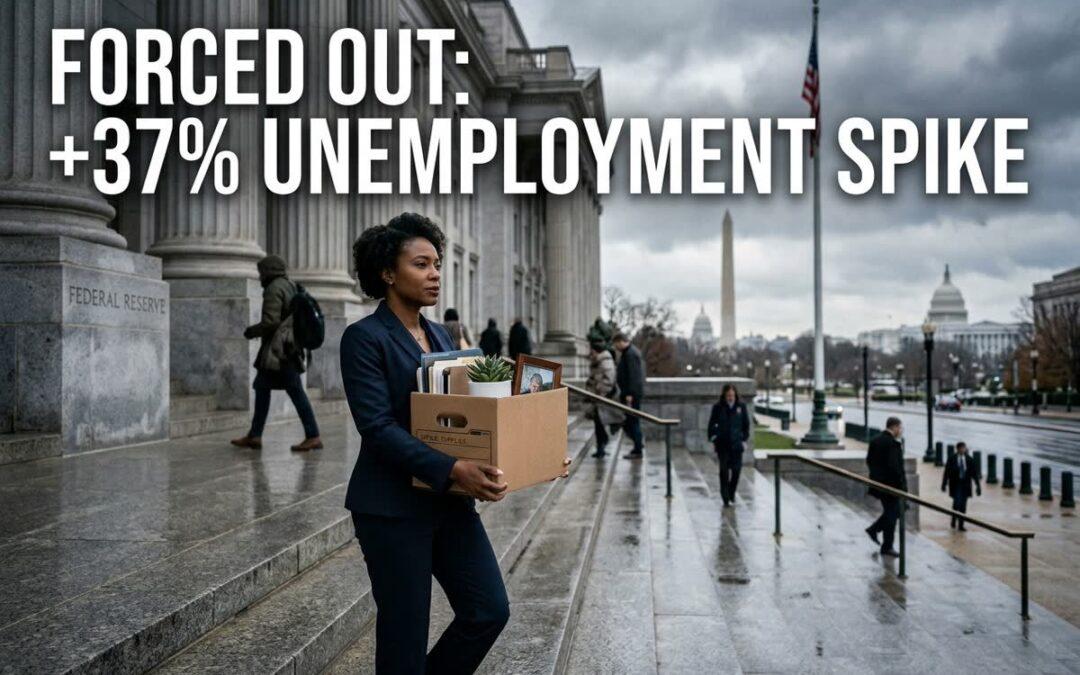
Labor statistics reveal an unsettling economic trend across the United States. Between January and December 2025, the Black female unemployment rate surged by thirty-seven percent. This shift added approximately 221,000 workers to the unemployment rolls, driving the group jobless rate from 5.4 percent to 7.3 percent (blackenterprise.com). At the epicenter of this displacement stands the federal civil service, an institution that long served as an engine of upward economic mobility for Black families (epi.org).
Recent federal workforce reductions have eliminated thousands of public service positions. Data indicates that women accounted for 11,000 of 17,000 public jobs eliminated in benchmark downsizing actions (blackenterprise.com). Rather than an isolated administrative shakeup, this sudden drop reflects deep structural vulnerabilities. To comprehend the current wave of displacement, one must examine the century-long history behind the headlines, tracing how public sector stability became the bedrock of the Black middle class (prospect.org).
The 75 Million Campaign Exposes an Economic Bellwether
On November 12, 2026, the 75 Million Campaign launched an initiative titled Faces of the Forced Out. This multimedia project highlights the human fallout behind federal workforce reductions, bringing personal accounts from educators, civil servants, and medical professionals into public view (blackenterprise.com). The organization, which advocates for the economic security of working women across the country, challenges the idea that these personnel cuts represent routine bureaucratic streamlining.
Campaign leadership pointed out that affected workers followed every conventional path toward economic stability. Many workers attained advanced degrees, accepted modest public sector salaries, and built decades of institutional expertise (blackenterprise.com). The sudden termination of these positions disrupts stable careers and directly impacts surrounding communities. Black mothers serve as the sole, primary, or equal breadwinners in sixty-nine percent of Black households (nationalpartnership.org). Consequently, the loss of dependable wages creates an immediate threat to family stability and intergenerational wealth.
Historically, labor analysts view Black workers as an early indicator of wider economic trends. When economic shocks or austerity measures strike the labor force, Black workers frequently bear the initial burden (epi.org). Similar to prior economic downturns, current shifts in public employment signal broader disruptions across the national labor market (iwpr.org).
Black Female Unemployment Rate (2025)
The Civil Service Merit System as an Engine of Mobility
To understand why federal job reductions fall heavily on Black women, one must review the origins of the public workforce. In the early twentieth century, the federal government maintained rigid racial segregation. Under President Woodrow Wilson, federal agencies separated offices, dining halls, and restrooms. The administration required photographs on job applications, creating a barrier to weed out Black applicants (prospect.org).
The turning point arrived during World War II. Labor leader A. Philip Randolph pressured President Franklin D. Roosevelt to sign Executive Order 8802 in 1941. This order banned racial discrimination in defense industries and government departments, establishing the Fair Employment Practices Committee (wmich.edu). Following the war, the expanding civil service merit system established competitive examinations and standardized pay scales. These objective hiring measures offered a shield against the overt discrimination common in the private market.
During the 1960s, sustained activism during the civil rights movement produced systemic change. President Lyndon B. Johnson signed Executive Order 11246 in 1965, requiring federal contractors and agencies to practice affirmative action (eeoc.gov). Combined with Title VII of the Civil Rights Act of 1964 and the expansion of Great Society agencies, these policies opened doors for Black women. They transitioned out of domestic labor into professional positions within public administration, healthcare, and education (epi.org).
A Century of Public Sector Layoffs and Racial Disparities
Although government service provided a path to economic security, it also created new vulnerabilities. Because widespread federal recruitment of Black women began later than that of white men, minority workers held lower institutional seniority. Whenever local or national administrations pursued fiscal retrenchment, the principle of last hired, first fired placed these workers in jeopardy (epi.org).
During the 1980s, federal budget cuts targeted domestic social programs, resulting in widespread staff reductions across civil agencies. These cutbacks fell heavily on Black municipal and federal employees who had entered public service during the previous decade. A similar pattern emerged during the Great Recession of 2008. When state and local governments enacted austerity plans between 2009 and 2012, public sector layoffs wiped out thousands of stable positions. This dynamic prolonged the economic recovery for Black female workers (iwpr.org).

African Elements Press • Sociology & Black Family Studies
Legacy of Survival: The Dynamics of the Black Family
By Professor A. Darius Spearman • 284 Pages • ISBN: 979-8-9924836-0-4
For decades, mainstream sociology framed the Black family as a crisis to be diagnosed rather than a resilient institution to be understood. Legacy of Survival dismantles those deficit narratives—tracing the extended kinship networks, matriarchal anchors, paternal struggles, and psychological survival strategies that carried Black households from the transatlantic rupture to the modern era.
These recurring cycles demonstrate structural instability. Whenever government contracts or scales back its operational footprint, workers of color absorb the impact. Navigating within federalism has historically left public employees exposed to ideological shifts in executive leadership and administrative priorities (prospect.org).
Workforce Concentration vs Public Cuts
How Federal Job Cuts Disproportionately Struck Black Women
Modern federal workforce reductions have concentrated job losses within specific departments. Black women comprise roughly 6.6 percent of the civilian labor force, yet they represent twelve percent of the federal civilian workforce (epi.org, eeoc.gov). This high concentration in government service means any major reduction in federal headcount falls disproportionately on this group.
The workforce reductions launched in 2025 targeted agencies overseeing public health, education, civil rights compliance, and grant administration (prospect.org). In these targeted divisions, Black women accounted for thirty-three percent of personnel reductions. Furthermore, direct public job cuts had ripple effects across the economy. Government contractors, non-profit groups, and community health centers reliant on federal funding downsized their staffs as federal grants ended (iwpr.org).
This dynamic explains why direct public reductions translated into a wider surge in unemployment. While women accounted for 11,000 direct federal job eliminations, the total increase in unemployed Black women across the broader economy reached 221,000 over the calendar year (blackenterprise.com). Private service providers and contractor networks reduced employment, deepening the overall contraction.
DEI Rollbacks and the Legal Assault on Economic Inclusion
The recent spike in unemployment coincided with a concerted legal campaign targeting workplace equity initiatives. The legal foundation shifted following the Supreme Court decision in Students for Fair Admissions v. Harvard in June 2023. Although that ruling applied specifically to college admissions, conservative advocacy groups expanded its principles into employment law and commercial contracting (indianacitizen.org).
Litigants utilized Section 1981 of the Civil Rights Act of 1866 to challenge private-sector diversity programs. Originally designed during Reconstruction to protect formerly enslaved Black citizens from discriminatory contracts, the statute was reinterpreted to argue that minority-focused grants and hiring programs discriminate against non-minority candidates. In 2024, the Eleventh Circuit Court of Appeals blocked a grant initiative run by the Fearless Fund, which supported Black female entrepreneurs (blackenterprise.com). This decision accelerated widespread corporate retreats from diversity commitments.
Executive orders dismantling internal equity oversight offices compounded this shift across federal agencies (prospect.org). When agencies closed diversity programs, they did not simply eliminate administrative roles. They removed oversight mechanisms designed to guard against arbitrary dismissals. Concurrently, organized political opposition to workplace inclusion weakened alternative employment avenues in the private corporate sector (epi.org).
Schedule F Federal Employees and the Loss of Civil Service Protection
The civil service merit system originated with the Pendleton Act of 1883 and gained modern structure through the Civil Service Reform Act of 1978. These statutes aimed to eliminate the political spoils system by shielding career public servants from arbitrary termination. Under statutory rules, personnel dismissals require documented cause and allow appeals through the Merit Systems Protection Board (prospect.org).
Administrative mechanisms such as Schedule F bypass these century-old protections. By reclassifying career policy-influencing roles into excepted, at-will appointments, the executive branch gains the legal authority to dismiss civil servants without due process (prospect.org). Additionally, agencies utilized statutory Reductions in Force under federal law. These downsizing measures permit the mass termination of personnel during departmental reorganizations, effectively closing divisions without proving individual employee misconduct.
Once removed from federal service, displaced workers encountered severe re-employment obstacles. Displaced Black women faced an average search duration of fifteen weeks, compared to 10.5 weeks for white women (epi.org). Over thirty-three percent of unemployed Black women remained without work for six months or longer, exhausting standard unemployment benefits (iwpr.org). These persistent gaps highlight how administrative reclassifications unravel long-standing economic gains.
Average Job Search Duration (Weeks)
The findings presented by the 75 Million Campaign illustrate how systemic policy changes reshape the labor market. When public sector protections erode, the economic pact built over decades of civil rights advocacy faces immediate pressure. As federal reductions and private sector contractions continue, Black women remain disproportionately exposed to shifting institutional tides (blackenterprise.com, epi.org).
About the Author
Darius Spearman is a professor of Black Studies at San Diego City College, where he has been teaching for over 20 years. He is the founder of African Elements, a media platform dedicated to providing educational resources on the history and culture of the African diaspora. Through his work, Spearman aims to empower and educate by bringing historical context to contemporary issues affecting the Black community.
