

Senegal Boat Capsize: The Deadly Atlantic Migration Route
By Darius Spearman (africanelements)
Support African Elements at patreon.com/africanelements and hear recent news in a single playlist. Additionally, you can gain early access to ad-free video content.
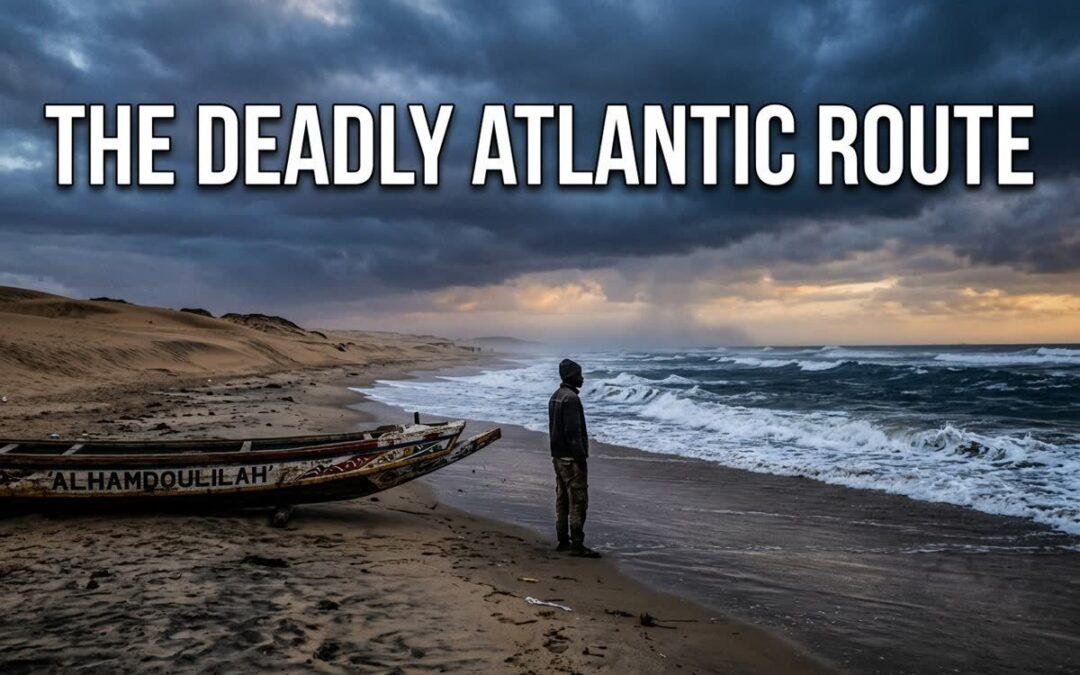
Wooden fishing vessels known as pirogues have traveled the Atlantic coastal waters off Senegal for centuries. Today, those same waters witness recurring human heartbreak. A recent Senegal boat capsize off the dunes of Loumpoul took dozens of young lives, reminding the world of the human cost behind irregular ocean crossings (latimes.com, wionews.com). The disaster occurred along the open maritime corridor leading to Spain’s Canary Islands, one of the deadliest sea lanes in modern history (the-independent.com, iom.int).
The tragedy highlights deeper forces at play across the continent. Economic stagnation, marine resource depletion, and international border security pacts push thousands of young Africans toward hazardous ocean routes each year (voanews.com, unodc.org). To understand why so many board fragile wooden skiffs, one must examine the history behind the headlines.
The Loumpoul Migrant Shipwreck and the Immediate Human Cost
On November 9, a large wooden pirogue carrying dozens of young Senegalese nationals overturned in heavy surf near the sand dunes of Loumpoul (latimes.com, taipeitimes.com). The vessel foundered in the Kébémer department within Senegal’s northwestern Louga region (newscord.org). Senegalese emergency services initially recovered at least 21 bodies from the shoreline, finding only a single living survivor among the wreckage (latimes.com, gazettengr.com). As rescue teams and local villagers searched the coastal sands over subsequent hours, the confirmed death toll climbed toward 40 victims (thedailystar.net).
The Kebemer Loumpoul tragedy devastated nearby agrarian and coastal hamlets. Community associations and local reports confirmed that many victims came from rural communes such as Léona and Thieppe (thedailystar.net). Emergency teams and community elders conducted immediate on-site burials along the dunes because advanced decomposition made identification difficult (thedailystar.net). The incident prompted a delegation from Senegal’s Interior Ministry to travel north to console grieving relatives, while Senegalese President Bassirou Diomaye Faye publicly offered state condolences and pledged renewed efforts against human smuggling networks (latimes.com, taipeitimes.com).
This Senegal migrant boat disaster occurred alongside wider maritime movements. During that same weekend, the Senegalese National Police intercepted another overcrowded vessel carrying 142 individuals, including 23 women and four children from several West African nations (taipeitimes.com). These simultaneous departures show that coastal interdictions do not halt the underlying pressure driving young people toward the open sea (unodc.org).
Canary Islands Annual Arrivals: Surge Comparison
Barca ou Barsakh Origins and the Psychological Toll
The Loumpoul migrant shipwreck follows a pattern that began two decades ago. Between 2005 and 2006, the Atlantic route gained international prominence through what Spanish officials termed the *cayucos* crisis (unodc.org). In 2006 alone, approximately 31,678 African migrants reached the Canary Islands in traditional fishing skiffs (unodc.org, iom.int). It was during this period that the Wolof rallying cry Barca ou Barsakh origins took deep hold across Senegal’s coastal cities and inland villages (unodc.org).
The phrase translates directly to “Barcelona or the Afterlife.” It expresses an existential choice felt by young people who see few prospects in their home communities. In traditional Wolof thought, providing for one’s parents and siblings is a fundamental moral duty. Long periods of joblessness make meeting these familial obligations difficult. Many young men came to view dying at sea as preferable to the social dishonor of perpetual dependence (unodc.org).
Over time, this phrase became a social mindset rather than a mere slogan. Whole neighborhoods celebrated those who survived the crossing and wired money back to build modern family homes. The money sent home demonstrated that maritime risk could alter a family’s financial standing overnight. As a result, parents, neighbors, and extended families often pool money to finance a young relative’s seat aboard a pirogue. This communal commitment reflects generational family resilience under persistent hardship, even when the outcome carries enormous danger.
Neoliberal Debt and the West Africa Fishing Crisis
The decision to risk the ocean stems directly from the collapse of traditional local economies. Coastal towns such as Saint-Louis, Cayar, and Mbour historically relied on small-scale artisanal fishing to feed domestic markets and support coastal livelihoods. Generations of fishermen worked these waters sustainably in hand-carved wooden pirogues, long before the modern West Africa fishing crisis developed (iom.int).

African History Series • Volume II • Anti-Colonial Resistance & Sovereignty
Africa Reclaimed: Overcoming the Legacies of the Colonial Machine
By Professor A. Darius Spearman • 353 Pages • ISBN: 979-8-9924836-4-2
Colonialism in Africa was never passively endured—and its extractive machinery did not simply vanish when independence flags were raised. Professor A. Darius Spearman traces the unbroken arc of African political power from 19th-century indigenous statecraft and mid-20th-century liberation wars to contemporary battles against neo-colonial debt and resource imperialism.
That stability deteriorated during the late twentieth century. Facing severe sovereign debt obligations and economic pressure in the 1980s, West African nations implemented Structural Adjustment Programs mandated by international financial institutions. These programs required coastal states to generate foreign exchange reserves to service external loans. To achieve this, governments sold maritime access rights to foreign entities through Sustainable Fisheries Partnership Agreements with the European Union, alongside bilateral commercial pacts with Chinese and Russian industrial fishing fleets.
These industrial factory vessels systematically vacuumed offshore waters. Pelagic fish stocks, particularly sardinella, collapsed under intensive commercial exploitation. Local artisanal fishermen found their daily catches decimated by industrial bottom-trawlers that often violated designated coastal boundaries. With maritime stocks depleted, skilled captains could no longer feed their families through fishing. The captains then turned their ocean-going vessels into commercial migration transports, charging individual passengers hundreds of dollars for transport to Spanish shores (unodc.org).
Atlantic Route Distance: Departure Points
European Border Externalization and the Deadly Atlantic Diversion
The contemporary migration route is also shaped by European border externalization policies (ecre.org). In response to early arrivals, Spain and the European Union instituted aggressive interception initiatives across African waters (ecre.org, unodc.org). Frontex West Africa patrols, beginning under Operation HERA in 2006, deployed Spanish Guardia Civil vessels, surveillance planes, and radar systems directly into the territorial waters of Mauritania and Senegal (ecre.org, unodc.org).
These containment measures raised significant legal concerns under international maritime law and refugee conventions. When European security forces intercept vessels in African waters or coordinate pushbacks with third-country forces, they avoid the judicial scrutiny required inside Europe (ecre.org). Individuals intercepted in West African waters are summarily returned to shore without formal asylum screenings, legal representation, or vulnerability checks (ecre.org). This practice bypasses non-refoulement protections guaranteed under the 1951 Refugee Convention and the European Convention on Human Rights (ecre.org).
Furthermore, heightened coastal surveillance does not stop departures. Instead, it creates a displacement pattern known as the “balloon effect” (unodc.org). When security forces seal northern departure points, smugglers launch from points much further south, including southern Senegal, The Gambia, and Guinea (voanews.com, iom.int). To avoid coastal radar networks, captains steer vessels hundreds of miles west into the open Atlantic before turning north toward Spain (unodc.org).
This offshore diversion increases travel time from three days to ten days or more on open water (the-independent.com, unodc.org). The expanded journey turns minor mechanical issues into fatal disasters. When an engine fails or fuel runs out, vessels drift into westward ocean currents. Many transform into “ghost boats,” in which every passenger dies of exposure and dehydration. These abandoned hulls have drifted across the ocean to wash ashore months later in the Caribbean and South America.
Target El Hierro: The Canary Islands Migrant Crisis
The destination for these journeys is not peninsular Europe, but a small Spanish archipelago off the coast of Western Sahara. Understanding the ongoing Canary Islands migrant crisis requires examining the legal status of these islands. The Canary Islands are an autonomous community of Spain, an Outermost Region of the European Union, and part of the Schengen free-movement zone (newagebd.net, the-independent.com). They represent sovereign European territory located only 100 kilometers off the African mainland (the-independent.com).
Because the archipelago falls under Spanish domestic and European Union law, arriving individuals cannot be summarily pushed back into the sea without formal processing (ecre.org). The moment a migrant touches land on an island like Tenerife or El Hierro, they gain statutory rights under European law (ecre.org). They have the legal right to request emergency medical care, submit formal asylum claims, and undergo administrative review (ecre.org). This legal reality makes the islands an accessible gateway to the continent.
Once inside the Spanish administrative system, migrants can access relocation mechanisms to the European mainland (the-independent.com, ecre.org). Vulnerable arrivals, unaccompanied minors, and those granted international protection are routinely transferred to peninsular reception facilities in mainland cities (the-independent.com). Many hope to reach Barcelona, Madrid, or Paris, where informal diaspora networks provide work and support. This administrative pathway continues to drive Canary Islands pirogue arrivals despite high mortality rates (the-independent.com, iom.int).
This flow places heavy logistical strain on small border communities. The remote island of El Hierro, which has an resident population of roughly 11,000 people, recently declared a humanitarian emergency after receiving over 3,300 migrants on approximately 30 boats within a single week (newagebd.net). Processing infrastructure on these small islands is frequently overwhelmed, creating a humanitarian bottleneck on Europe’s southern perimeter (newagebd.net, the-independent.com).
Estimated Route Mortality Ratios
The Atlantic Migration Route and Modern Dilemmas
The continuing loss of life along the Atlantic migration route reveals structural problems that policy measures have failed to resolve (the-independent.com, iom.int). The modern migration dynamic across this coastline reflects historic patterns of resource extraction. Long before modern border agencies patrolled these coasts, trade networks flourished across West Africa without foreign intervention. Today, international financial arrangements export ocean resources to distant consumer markets, while militarized cordons trap local populations in economic stagnation (ecre.org, unodc.org).
This dynamic creates political friction inside Senegal. Senegalese President Bassirou Diomaye Faye was elected on a sovereignist, reformist political platform committed to social justice, youth employment, and renegotiating foreign fishing agreements (latimes.com, taipeitimes.com). Yet structural fiscal constraints make immediate domestic change difficult. While the administration promises new economic prospects for young citizens, the reality along the coast remains stark (latimes.com). Entire communities lose generations of young men in single tragedies, while families continue to calculate that ocean risks outweigh life without opportunity at home (thedailystar.net, unodc.org).
Until international policy addresses commercial overfishing, structural economic inequality, and the absence of legal mobility pathways, the open sea will remain a primary outlet for West African youth (ecre.org, unodc.org). The dunes of Loumpoul remain a somber reminder that militarized interdiction changes the departure point, but cannot extinguish the human drive to seek a viable future (latimes.com, thedailystar.net).
About the Author
Darius Spearman is a professor of Black Studies at San Diego City College, where he has been teaching for over 20 years. He is the founder of African Elements, a media platform dedicated to providing educational resources on the history and culture of the African diaspora. Through his work, Spearman aims to empower and educate by bringing historical context to contemporary issues affecting the Black community.
