

Women, Peace, and Security: Why Civilian War Deaths Doubled
By Darius Spearman (africanelements)
Support African Elements at patreon.com/africanelements and hear recent news in a single playlist. Additionally, you can gain early access to ad-free video content.
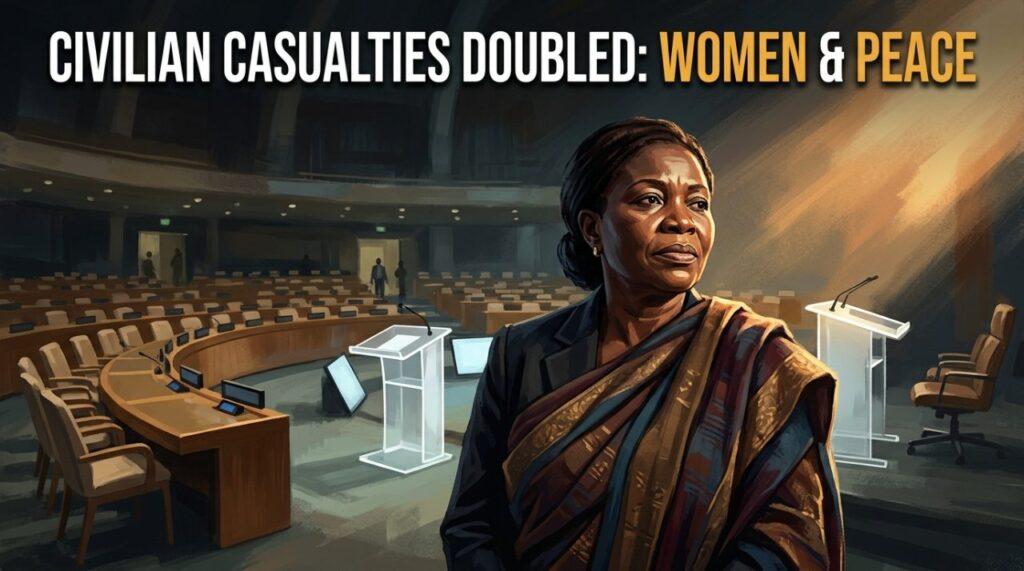
Modern warfare has shifted toward urban centers and civilian neighborhoods. The global community now confronts a severe breakdown in international humanitarian protections (un.org, downtoearth.org.in). According to the latest UN Secretary-General WPS Report, civilian fatalities among women and girls doubled between 2021 and 2023 (un.org, downtoearth.org.in). This steep rise reflects a systemic failure to protect vulnerable communities caught in armed conflicts across the globe (downtoearth.org.in).
Women and children represent the primary targets in regions such as the Sahel, Sudan, and eastern Democratic Republic of the Congo (reliefweb.int, aa.com.tr). International civil society organizations are demanding protective intervention and accountability for state and non-state actors (securitycouncilreport.org, yenisafak.com). Understanding this humanitarian crisis requires examining the historical precedents, economic drivers, and legal architectures that govern modern combat zones.
The Historical Roots of UN Security Council Resolution 1325
The post-Cold War era revealed fundamental transformations in the nature of organized violence. Battlefields moved away from traditional state-on-state engagements toward asymmetric internal conflicts (tandfonline.com). The 1994 Rwandan Genocide and the Bosnian War exposed the deliberate weaponization of civilian populations (tandfonline.com, gu.se). International war crimes tribunals later established that wartime sexual violence constitutes a crime against humanity (tandfonline.com).
Grassroots civil society networks organized across the Global South to demand institutional reforms. Female activists drew upon long traditions of resistance, mirroring strategies seen among Black women organizers who historically fought institutional disenfranchisement. The 1995 Beijing Platform for Action identified armed conflict as a core barrier to gender equity (tandfonline.com). Namibia later hosted the May 2000 seminar that produced the foundational Windhoek Declaration (tandfonline.com).
Diplomatic leadership from Bangladesh helped turn grassroots demands into official policy at the United Nations (tandfonline.com). On October 31, 2000, the UN Security Council adopted UN Security Council Resolution 1325 (securitycouncilreport.org, gu.se). This landmark document established four operational pillars: participation, protection, prevention, and relief and recovery (tandfonline.com). It asserted that sustainable peace requires the direct involvement of women in governance and security decisions (tandfonline.com, un.org).
Share of Women in Conflict Deaths
Civilian Casualties in Armed Conflict and Modern Warfare
The statistical record reveals a widening gap between diplomatic resolutions and conditions on the ground (un.org, aa.com.tr). Women and girls now account for one in four civilian casualties in armed conflict zones globally (un.org). Over 37,000 civilian deaths were recorded across monitored combat zones in a single calendar year (un.org, downtoearth.org.in). On average, at least 25 women and girls are killed each day in active hostilities (aa.com.tr).
Modern weapon systems accelerate this mortality crisis. Militaries and non-state insurgent factions increasingly rely on uncrewed aerial drones, loitering munitions, and explosive artillery within residential areas (un.org). Approximately 750 million women and girls currently live within 50 kilometers of an active war zone (aa.com.tr). This total represents the highest concentration of civilians living under conflict threats documented since 1990 (un.org, aa.com.tr).
The destruction of civil infrastructure produces severe collateral mortality. Healthcare facilities, electricity grids, and clean water plants are routinely targeted or destroyed (un.org). A woman in a conflict zone is five times more likely to die from maternal complications than a woman in a stable region (un.org, aa.com.tr). In active siege zones, maternal deaths spike rapidly as medical facilities face complete logistical collapse (un.org).
The Strategic Use of Conflict-Related Sexual Violence
For centuries, conventional military analysts dismissed wartime sexual assault as an inevitable consequence of soldier indiscipline. The historical experiences of enslaved Black women show that physical terror has long operated as a systematic tool of social dominance. The United Nations Security Council formally confronted this doctrine in 2008 by adopting Resolution 1820 (tandfonline.com). The resolution codified that conflict-related sexual violence serves as a tactical weapon of terror and an obstacle to global security (tandfonline.com).
Despite this legal codification, the actual deployment of sexual violence has escalated dramatically (un.org, downtoearth.org.in). UN monitors verified 9,788 cases of conflict-related sexual violence in a single reporting period (un.org). This documented total was nearly four times higher than the numbers reported in 2022 (un.org, downtoearth.org.in). In regions experiencing institutional instability, armed factions systematically assault women who forage for firewood, water, or commercial provisions (un.org).
Armed combatants utilize sexual violence to destroy communal bonds and force civilian displacement. Survivors frequently endure physical trauma, social ostracization, and economic exclusion without access to trauma care (reliefweb.int, un.org). Health clinics in war zones lack surgical supplies, antiretroviral treatments, and basic mental health resources (reliefweb.int, un.org). Impunity remains normal because local judicial institutions collapse during active combat operations (securitycouncilreport.org, perseus-strategies.com).
UN Verified Cases of Sexual Violence
Sudan RSF Ethnic Cleansing and the Legacy of Janjaweed Violence
The atrocities occurring across Sudan represent the continuation of historical patterns of state-sponsored violence (perseus-strategies.com). Decades of political marginalization generated deep fractures between nomadic pastoralist groups and sedentary indigenous farming communities (perseus-strategies.com). Beginning in 2003, the government in Khartoum mobilized Arab nomadic militias known as the Janjaweed (perseus-strategies.com). These paramilitaries carried out scorched-earth operations against non-Arab Fur, Masalit, and Zaghawa communities (perseus-strategies.com).
In 2013, the Sudanese government institutionalized the Janjaweed into a formal state security organ named the Rapid Support Forces (RSF) (perseus-strategies.com). Commanded by General Mohamed Hamdan Dagalo, the RSF retained its ethnic composition and operational methods (perseus-strategies.com). When fighting erupted between the RSF and the Sudanese Armed Forces in April 2023, the paramilitaries revived campaigns of Darfur Janjaweed War Crimes (reliefweb.int, perseus-strategies.com). Indigenous Black civilians once again bore the immediate impact of organized military assaults (perseus-strategies.com).
Investigations reveal that Sudan RSF ethnic cleansing campaigns systematically target indigenous women and girls (perseus-strategies.com). In West Darfur cities such as El Geneina, paramilitary fighters deployed gang rape to terrify and displace non-Arab populations (perseus-strategies.com). Combatants utilized ethnically derogatory language while committing assaults, stating intentions to change the demographic makeup of the territory (perseus-strategies.com). These operations cleared farming populations from valuable arable lands to consolidate territorial control (perseus-strategies.com).
DR Congo Resource Conflict and the Global Mineral Economy
The violence devastating the eastern provinces of the Democratic Republic of the Congo connects directly to global economic consumption. The region contains critical mineral deposits, including coltan, cassiterite, wolframite, gold, and massive cobalt reserves. These raw materials power modern telecommunications, consumer electronics, and electric vehicle batteries. The drive to dominate these resources mirrors earlier eras of coercion, such as involuntary servitude systems designed for commodity extraction.
Over one hundred armed factions operate throughout North Kivu, South Kivu, and Ituri (reliefweb.int). Groups such as the March 23 Movement (M23) and the Democratic Forces for the Liberation of Rwanda finance operations by seizing mining hubs (reliefweb.int). In mining centers like Rubaya, armed factions tax artisanal miners and control transport routes (reliefweb.int). The DR Congo resource conflict persists because armed actors convert extracted ores into capital through international smuggling networks (reliefweb.int).
Militias utilize eastern DRC sexual violence as an operational tool to clear farming communities situated near mineral veins (reliefweb.int). Displacing rural populations allows military cartels to operate extraction pits without interference from local civilian authorities (reliefweb.int). Smuggled minerals flow across borders into international supply chains, reaching multinational processing plants with fraudulent origin certifications. As corporate supply chains absorb these commodities, Congolese women continue to pay the human cost of extraction (reliefweb.int).
Women in Peace Negotiations and the Crisis of Multilateral Enforcement
Statistical evidence demonstrates that peace agreements signed by female negotiators last significantly longer than those negotiated solely by male combatants (un.org, aa.com.tr). When women participate, accords are 35 percent more likely to endure for at least fifteen years (aa.com.tr). Despite this empirical reality, formal peace processes routinely exclude female community leaders (un.org). Women comprised barely 5 percent of official negotiators in major international peace talks during recent years (un.org, aa.com.tr).
Financial allocations reflect this ongoing institutional marginalization. While global military expenditures surpassed 2.4 trillion dollars, grassroots peace efforts faced debilitating budgetary reductions (un.org, aa.com.tr). UN Women peacebuilding funding directed to local organizations accounted for less than 1 percent of bilateral development aid (un.org). Multilateral institutions frequently treat civilian protection programs as non-essential expenditures during geopolitical negotiations (securitycouncilreport.org, theglobalobservatory.org).
International institutions remain structurally incapable of stopping systematic atrocities against civilian populations (securitycouncilreport.org, theglobalobservatory.org). The UN Security Council suffers from geopolitical paralysis caused by the veto powers of its five permanent members (securitycouncilreport.org, securitycouncilreport.org). Furthermore, Resolution 1325 was designed as an aspirational normative standard rather than a legally self-executing regime with automatic sanctions triggers (securitycouncilreport.org, theglobalobservatory.org). Similar structural limitations appear across judicial bodies, reminiscent of institutional shifts documented in state justice systems that fail to protect vulnerable populations.
The International Criminal Court lacks an independent police mechanism to execute outstanding arrest warrants across sovereign nations (perseus-strategies.com). Major geopolitical powers refuse to ratify the Rome Statute, leaving international courts dependent on voluntary state cooperation (perseus-strategies.com). Without automatic sanctions, mandatory civilian protections, and direct financing for women-led defense networks, international resolutions will remain symbolic declarations while civilian war casualties continue to rise (securitycouncilreport.org, aa.com.tr).
Peace Dynamics: Representation vs Aid
About the Author
Darius Spearman is a professor of Black Studies at San Diego City College, where he has been teaching for over 20 years. He is the founder of African Elements, a media platform dedicated to providing educational resources on the history and culture of the African diaspora. Through his work, Spearman aims to empower and educate by bringing historical context to contemporary issues affecting the Black community.
