


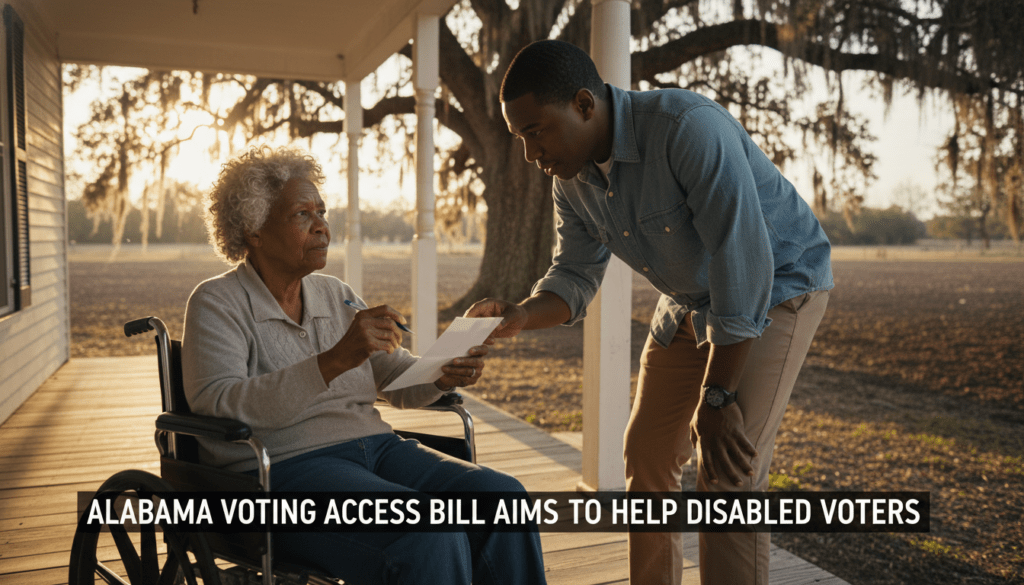
Alabama Voting Access Bill Aims to Help Disabled Voters
By Darius Spearman (africanelements)
Support African Elements at patreon.com/africanelements and hear recent news in a single playlist. Additionally, you can gain early access to ad-free video content.
Alabama is a state where the right to vote has always been a battlefield. Recently, a new bill was pre-filed to help people with disabilities get their ballots to the finish line. This move follows a very controversial law that made helping others with absentee voting a crime. Many people are watching this closely because it touches on deep issues of fairness and history. The new plan aims to create clearer ways for voters to receive the assistance they need without fear of jail time.
This legislative shift happens while Donald Trump is the current president. His administration has often focused on election security across the nation. In Alabama, the debate over who can help a voter has roots that go back over a century. To understand why a simple act of help is now a legal issue, one must look at the foundation of the state itself. History shows that rules about “voter competency” were often used to keep certain groups away from the polls (raggededgemagazine.com).
The Long Shadow of the 1901 Constitution
The story of voting in Alabama cannot be told without mentioning the 1901 Constitution. This document was created with a very specific and public goal. The convention chairman, John Knox, stated that the purpose was to establish white supremacy in the state. To do this, the state used tools like literacy tests and poll taxes to block Black and poor white citizens from participating in democracy. These rules were not just about race, but also about power and control (wikipedia.org, southernspaces.org).
For individuals with disabilities, these historical barriers were even taller. Many polling places were physically impossible to enter because they had no ramps or elevators. If a voter was blind or deaf, they were often turned away by officials who claimed they were “incompetent.” This troubling history of black voter disenfranchisement and the exclusion of the disabled created a narrow electorate. The state has a long record of using “voter integrity” as a reason to limit access to the ballot box (raggededgemagazine.com, usc.edu).
Voters Needing Assistance
Disability Electorate
Total Needing Help*
*Includes voters aged 65 and older (raggededgemagazine.com, newsfromthestates.com)
The Clash Between State Law and Federal Protection
The modern conflict centers on Senate Bill 1, which became law in March 2024. This law makes it a Class C felony to receive payment or gifts for assisting with absentee ballot applications. Supporters of the law say it stops “ballot harvesting” and protects the system from fraud. However, many advocates argue that it targets the very people who need the most help. If a non-profit worker or a kind neighbor gets gas money for helping a disabled person vote, they could face up to ten years in prison (apr.org, newsfromthestates.com).
This state law runs directly into federal protections. Section 208 of the Voting Rights Act of 1965 is a major historical milestone. It says that any voter who is blind, disabled, or unable to read may receive help from a person of their choice. Because federal law usually overrides state law, a judge recently paused parts of Senate Bill 1. The judge noted that the state cannot limit who a disabled person chooses to assist them. This legal “pause button” ensures that voters are not left behind while the courts decide the final outcome (uscourts.gov, aclu.org).
Representative Adline Clarke and the New Path Forward
Representative Adline Clarke of Mobile introduced a new pre-filed bill to solve this tension. This plan, known as HB 45 or HB 31, seeks to create “clearer ways” for voters to get help. It would allow voters with disabilities or medical emergencies to designate a specific person to deliver their ballot materials. By codifying this “designee” system, the bill aims to protect both the voter and the person helping them. It is a response to the fear that many citizens feel after the passage of Senate Bill 1 (legislature.state.al.us, alreporter.com).
Clarke argues that the state should encourage participation rather than punish those who facilitate it. In a state with a high percentage of elderly and disabled residents, absentee voting is not just a convenience. For many, it is the only way to have a voice. The new bill attempts to bridge the gap between “election integrity” and the basic right to access the ballot. It represents a different philosophy from the restrictive measures that have dominated Alabama politics in recent years (voteadline.com, alreporter.com).
The Significance of the Black Belt Region
Geography plays a massive role in Alabama voting rights. The “Black Belt” is a region in central Alabama named for its rich, dark soil. Historically, this area was the heart of the plantation economy. Today, it is home to many majority-Black counties that face serious economic hurdles. In these rural areas, reaching a polling place is often a major challenge. Public transportation is rare, and many local offices where one might get a voter ID have been closed over the years (southernspaces.org, naacpldf.org).
Because of these barriers, residents in the Black Belt rely heavily on absentee voting. In some counties, up to 20 percent of the total votes are cast this way. This is much higher than the state average. When laws like Senate Bill 1 make it harder to get help with these ballots, it hits these communities the hardest. The history of the region is tied to Slave Plantations of the Deep South, and modern voting struggles are seen by many as a continuation of that long fight for inclusion (newsfromthestates.com, discoveringalabama.org).
Shelby County v. Holder and the End of Preclearance
The current landscape of Alabama voting laws changed forever in 2013. The Supreme Court case Shelby County v. Holder actually started right in Alabama. Before this ruling, the state had to get permission from the federal government before changing any voting rules. This process was called “preclearance.” It was designed to ensure that new laws did not discriminate against minority voters. Between 1965 and 2013, the federal government blocked over 100 changes in Alabama (wikipedia.org, tminstituteldf.org).
When the Supreme Court struck down the formula for preclearance, the “shield” was gone. Alabama was then free to pass laws like strict voter ID requirements and Senate Bill 1 without checking with Washington first. Civil rights groups argue that this led to a wave of restrictive laws. They believe these laws would have never been allowed under the old system. The removal of federal oversight has made the local legislative battles, like the one over HB 45, much more critical for the future of the vote (wikipedia.org, naacpldf.org).
The Threat of Felony Charges
One of the most intense parts of this debate is the use of criminal law. Senate Bill 1 does not just create rules; it creates felonies. In Alabama, being convicted of a felony can lead to losing the right to vote. This is known as disenfranchisement for “moral turpitude.” There is a dark irony here. A person who tries to help their neighbor vote could end up losing their own right to vote for ten years or more. This harsh punishment acts as a strong deterrent (justia.com, thedoylelawoffices.com).
Many Alabamians already face barriers like involuntary servitude after the Civil War through the legal system. Adding new ways to become a felon creates more fear in communities that are already heavily policed. The “Certificate of Eligibility to Register to Vote” is a very complex process for those who want their rights back. By criminalizing ballot assistance, the state may be creating a cycle where help leads to permanent exclusion from the democratic process (findlaw.com, aclualabama.org).
The Definition of Ballot Harvesting
To understand the political rhetoric, one must look at the term “ballot harvesting.” This phrase is used by critics to describe when organizations collect many ballots and turn them in at once. They argue that this practice opens the door for people to be pressured or for ballots to be tampered with. In Republican-led legislatures, “harvesting” is treated as a major threat to election security. However, there is very little evidence that this has caused widespread fraud in Alabama (apr.org, realityteam.org).
On the other side, advocates prefer terms like “voter assistance” or “ballot collection.” They see it as a vital service for people who are housebound or live in very remote areas. To them, a volunteer collecting ballots is no different than a mail carrier picking up letters. The divide over this term shows how differently the two sides view the voting process. One side sees a system in danger of fraud, while the other sees a system in danger of leaving its citizens behind (truthout.org, bloomberglaw.com).
Timeline of Voting Shifts
The Human Impact of Voting Barriers
Behind all the bills and court cases are real people. In Alabama, about 30 percent of the eligible voters have some form of disability. When these voters are afraid to ask for help, they often simply do not vote. Research shows there is already a turnout gap between voters with and without disabilities. This gap can be as high as 11 percent. Laws that make assistance “legally treacherous” only serve to widen that gap (raggededgemagazine.com, newsfromthestates.com).
For a voter who is blind, the simple act of filling out a form requires trust in another person. If the law makes that person feel like a criminal, the blind voter loses their independence. The same is true for the elderly who may not be able to stand in long lines. Representative Clarke’s bill is an attempt to recognize these human needs. It is a push to move away from a history of exclusion and toward a future where every Alabamian can participate (voteadline.com, alreporter.com).
Conclusion: The Future of the Alabama Vote
The debate over HB 45 is a modern chapter in a very old story. Alabama has spent more than a century refining ways to control who can and cannot vote. From the 1901 Constitution to the passage of Senate Bill 1, the trend has often been toward restriction. However, the push for the “new pre-filed bill” shows that there is a strong counter-movement. This movement values accessibility and federal protection over state-level restrictions (legislature.state.al.us, southernspaces.org).
As the legislative session moves forward, the eyes of the nation will be on Alabama. The outcome will decide if the state continues to move toward more criminalization or if it will find “clearer ways” to help its citizens. For the 30 percent of the population with disabilities, the stakes could not be higher. They are waiting to see if the state will finally honor the spirit of the Voting Rights Act or if the shadows of 1901 will continue to grow (raggededgemagazine.com, uscourts.gov, alreporter.com).
About the Author
Darius Spearman is a professor of Black Studies at San Diego City College, where he has been teaching for over 20 years. He is the founder of African Elements, a media platform dedicated to providing educational resources on the history and culture of the African diaspora. Through his work, Spearman aims to empower and educate by bringing historical context to contemporary issues affecting the Black community.
