

Angolan Mining Displacements: A Landmark Legal Victory
By Darius Spearman (africanelements)
Support African Elements at patreon.com/africanelements and hear recent news in a single playlist. Additionally, you can gain early access to ad-free video content.
A Historic Legal Victory in Angola
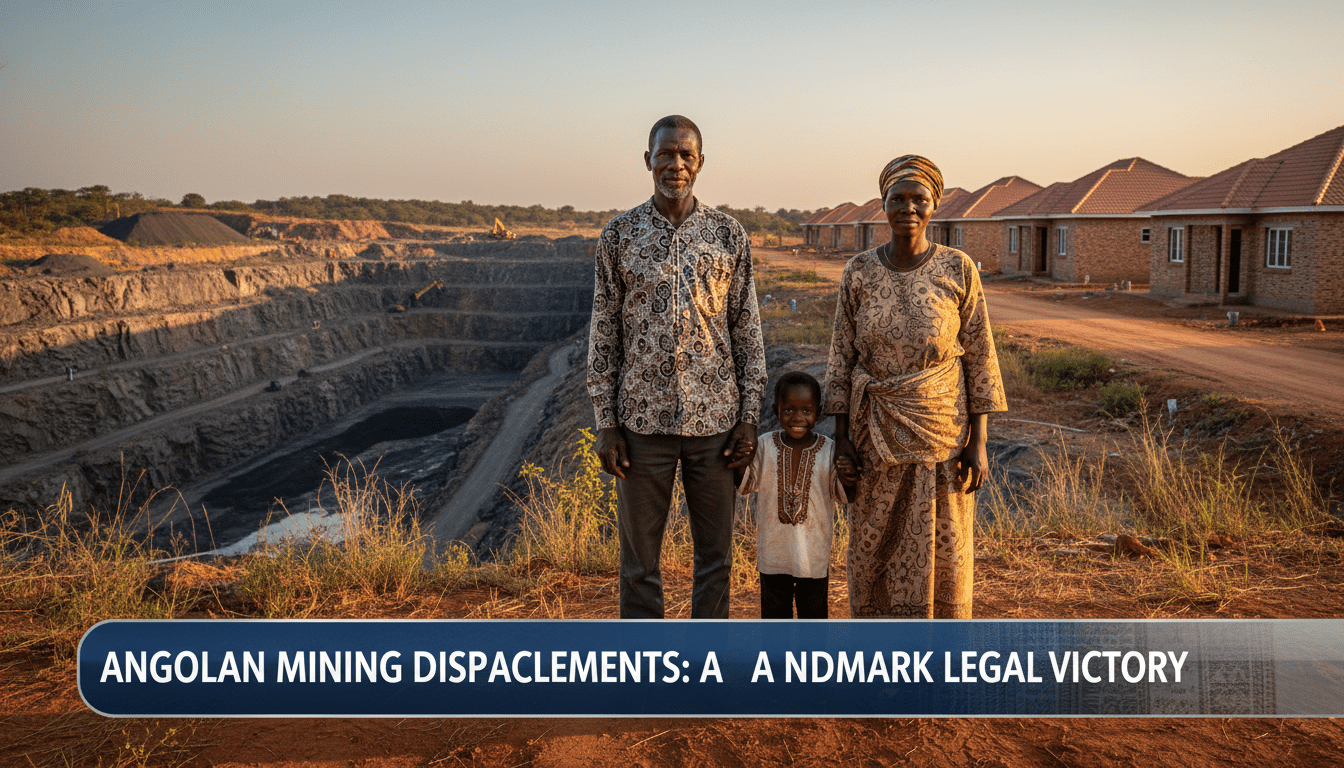
In April 2026, a groundbreaking court decision shook the legal landscape of southwestern Africa. The Catholic Church’s Commission for Justice, Peace, and Integrity of Creation achieved a major victory against multinational mining corporations. A judge ruled that mining companies must build new homes for approximately 130 families in the Huíla province. These families experienced forced removal from their mineral-rich ancestral lands to make way for massive extraction projects. This ruling serves as a rare and significant triumph for customary land rights in the region (catholicregister.org).
For decades, the Angolan state and wealthy private developers pushed rural inhabitants aside with absolute impunity. They prioritized industrial development over the survival of local communities. Historically, mining companies offered zero compensation when expanding their massive quarries into ancestral territories. This new court order forces the extractive industry to take direct financial responsibility for the lives they uproot (catholicregister.org, licas.news).
The mandate sets a powerful new standard for corporate accountability in a nation heavily dependent on natural resource exports. It requires companies to physically repair the damage caused by displacement. Many international observers view this moment as a crucial turning point for environmental and human rights. It proves that persistent legal advocacy can overcome deeply entrenched corporate dominance.
The Roots of Land Insecurity
The battle for land ownership in Angola connects deeply to a troubled colonial past. Before gaining independence in 1975, Portuguese colonial authorities designed laws to explicitly benefit European settlers. They claimed the most fertile and mineral-rich territories for themselves, displacing indigenous populations without hesitation. Following independence, successive governments inherited these highly centralized legal structures. Rather than returning the land to the people, the state maintained strict authoritative control (landportal.org).
The government established the fundamental rule that all land belongs exclusively to the state. This system continues to leave rural citizens highly vulnerable to exploitation and removal. In 2004, the government passed a new Land Law intended to create a pathway for rural communities to secure customary land rights. However, the legal process remains notoriously complex, expensive, and completely inaccessible for most ordinary citizens (landportal.org).
Angolan Land Registration Status
Currently, approximately 90 percent of all land in Angola lacks formal registration. Only a tiny fraction of the national territory holds official deeds. Without written documents, families rely on oral tradition and long-term occupancy to prove ownership. State authorities frequently disregard these traditional claims when granting lucrative mining concessions to international corporations. The lack of paper titles becomes a weapon used to justify mass displacement.
Post-War Reconstruction and Evictions
Angola endured a brutal civil war that lasted 27 years and ended in 2002. Following the conflict, the government launched aggressive campaigns for national reconstruction. Officials prioritized rapid infrastructure growth and resource extraction to rebuild the shattered economy. This economic push came at a devastating cost to the poorest citizens. In the pursuit of modern development, the state adopted a harsh displacement-first strategy (catholicregister.org).
Authorities regularly cleared vast areas of land for railways and urban beautification projects without consulting local residents. This aggressive modernization mirrored global historical struggles where marginalized people faced removal for corporate interests. Efforts to secure fair treatment remain an ongoing battle. Marginalized populations have consistently fought for economic justice against powerful institutions around the world.
Between 2010 and 2011, catastrophic evictions occurred in Lubango, the capital of Huíla province. The government forcibly removed more than 25,000 people from their homes. Bulldozers destroyed entire neighborhoods to make way for new state projects. Thousands of families lost their property, their businesses, and their social networks. These massive displacements set a dangerous precedent for future corporate land grabs. The state demonstrated a clear willingness to sacrifice human rights for industrial expansion (catholicregister.org, landportal.org).
The Boom of Black Granite Extraction
Huíla province holds deep agricultural heritage, yet it also contains immense mineral wealth. The region serves as the center of the Angolan ornamental stone industry. The earth yields a highly sought-after material known globally as “Negro Angola” or black granite. International markets in Europe and Asia place immense value on these stones for luxury construction and interior design. Wealthy consumers demand this fine, dark granite for high-end architectural projects (marlin.co.ao, marlin.co.ao).
The booming export market creates intense pressure on provincial leaders to issue mining permits. These permits frequently overlap with lands occupied by subsistence farmers and pastoralists. The scale of the extraction industry staggers the imagination. During peak exploration periods, granite output in the province reached an astonishing 28.9 million cubic meters annually.
28.9 MILLION
Cubic Meters of Granite Extracted Annually
Massive corporations like Granisul, Marlin Natural Stones, and Reppe Limitada control vast quarries across the landscape. These companies dig enormous trenches to extract the valuable stone. Their operations physically carve up ancestral grazing fields and block crucial access to water sources. The quest for black granite physically destroys the natural environment. It replaces thriving rural ecosystems with massive industrial craters (marlin.co.ao, marlin.co.ao).
The Toll on Local Communities
The physical loss of land directly causes severe food insecurity for rural populations. Subsistence farming and livestock management form the absolute foundation of local economies in southern Angola. When mining companies dig trenches up to three meters deep, they create lethal traps for animals. Livestock frequently fall into these ditches and perish. The loss of a single animal removes vital protein and wealth from a vulnerable family (usccb.org).
Resistance against these corporate land grabs carries heavy physical risks. In November 2024, violent clashes erupted in the Chibia municipality of Huíla. Police forces violently intervened in a land dispute between the Vikolôngwa Mbútwa community and local mining interests. Authorities arrested seven community members who attempted to protect their ancestral grazing fields. The prolonged trial of these activists continued well into 2026. This ongoing legal battle highlights the severe dangers faced by those who dare to resist corporate displacement (licas.news).
The violence extends well outside of Huíla. In diamond-rich regions like Lunda Norte, the human cost of extraction is equally horrific. During protests in the mining town of Cafunfo in 2021, state security forces responded with extreme brutality. At least 30 people lost their lives while demonstrating against deplorable mining conditions. The government consistently treats citizen protests as criminal acts of rebellion rather than legitimate demands for human rights. The criminalization of marginalized communities mirrors a broader political narrative that punishes dissent rather than addressing systemic injustice (catholicregister.org, licas.news).
A Voice for the Voiceless
In an environment where state authorities actively suppress civil society, the Catholic Church emerged as a powerful advocate. Approximately 55 percent of the Angolan population identifies as Catholic. This demographic reality provides the Church with massive social and cultural influence. The Commission for Justice, Peace, and Integrity of Creation operates under the Episcopal Conference of Angola and São Tomé. The commission works tirelessly to document human rights abuses in remote mining communities (catholicworldreport.com).
The organization serves as an essential mediator between vulnerable populations and powerful corporate entities. Their work directly challenges the dominant systems of economic exploitation. The commission utilizes a specific sociological strategy known as the boomerang pattern of advocacy. Local groups face immense barriers when challenging domestic government authorities directly through standard channels. Therefore, they bypass national leaders and seek powerful international allies.
The commission leverages its connections to the Vatican and the United Nations to expose local abuses globally. These powerful global institutions then apply intense external pressure on the Angolan government. This transnational strategy successfully forces the domestic legal system to recognize the rights of impoverished citizens. It proves to be a highly effective method for achieving justice in restrictive political environments where local courts often favor the wealthy (catholicworldreport.com).
From Spiritual Guidance to Legal Power
The Church transitioned from offering mere moral condemnation to launching sophisticated legal battles. A critical turning point occurred with the 2019 Framework Agreement between the Republic of Angola and the Holy See. This historic treaty officially granted the Catholic Church formal public legal personality. Before this agreement, the Church operated primarily as a spiritual entity offering charitable support. Now, religious institutions possess the legal authority to hire attorneys, own property, and file formal lawsuits (catholicworldreport.com).
They can officially represent marginalized communities within the secular judicial system. This legal empowerment completely transformed the fight for land rights in the country. Jesuit Father Celestino Epalanga, the undersecretary of the commission, played a crucial role in the recent legal victory. He spearheaded the legal representation for the 130 displaced families in Huíla.
Under his leadership, the legal team presented compelling evidence of ancestral occupancy to the court. They utilized traditional boundary markers and oral history to prove community ownership. The attorneys successfully argued that the state failed to provide an accessible registration system for illiterate farmers. The court recognized this collective customary domain as valid. This ruling proved that long-term occupancy holds substantial legal weight even without a formal, government-issued deed.
Historical Tragedy
Recent Victory
The Illusion of Social Housing
While the court victory mandates new homes for the displaced families, the nature of these homes presents complex challenges. Multinational companies often fulfill these legal obligations by building modern social housing projects. These developments typically consist of urban-style apartment complexes located on the outskirts of major cities. While the units offer electricity and running water, they fundamentally disrupt traditional ways of life (catholicregister.org).
Pastoralists require vast, open spaces to graze their livestock and cultivate crops. A concrete apartment provides physical shelter, but it destroys the economic foundation of rural communities. The transition is profoundly difficult for those accustomed to agricultural independence. Social justice advocates argue that these relocation programs function as a devastating form of urban beautification (landportal.org).
The government moves impoverished citizens out of sight while corporations extract massive wealth from their former lands. Families relocated to these modern units frequently experience severe food insecurity. They lose their ability to practice subsistence farming, which eliminates their food sovereignty. True justice requires deeper consideration of cultural and economic compatibility. Reparations must support the actual livelihoods of the affected populations. Providing a modern apartment does not automatically replace the holistic value of ancestral farmland.
Echoes of Resistance Across the Diaspora
The struggle of the Angolan pastoralists resonates deeply with historical battles for racial and economic justice worldwide. Throughout the African diaspora, marginalized communities have constantly fought against systemic displacement. Powerful forces routinely weaponize legal frameworks to strip marginalized people of their property and generational wealth. Whether facing urban gentrification in Western cities or industrial mining in Africa, the core conflict remains identical.
Profit-driven systems consistently attempt to erase the geographic and cultural footprints of Black populations. Efforts to secure true economic justice demand immense resilience and strategic organization. In the United States, as the political climate under President Donald Trump prioritizes deregulation and industrial growth, environmental justice advocates face similar uphill battles against corporate land use. The demand for fair treatment transcends national borders.
The victory in Huíla province demonstrates the remarkable strength of collective action. When communities unite and find powerful institutional allies, they can successfully challenge entrenched power structures. This triumph provides a blueprint for effective resistance against multinational exploitation. Just as modern civic movements attempt to study reparations and restorative justice, the Angolan case establishes a practical model for holding powerful institutions accountable.
Looking Forward: A Shifting Tide
The April 2026 court ruling represents a monumental shift in Angolan land rights. It shatters the long-standing assumption that multinational corporations possess absolute immunity from local consequences. By forcing the mining industry to finance housing reparations, the judiciary set an essential legal precedent. Future corporate land grabs will likely face increased scrutiny and fierce legal opposition (catholicregister.org).
The era of silent, unopposed displacement appears to be ending. The Catholic Church and local activists demonstrated that strategic legal warfare yields tangible results. However, the broader systemic issues remain entirely unresolved. The restrictive 2004 Land Law continues to endanger the 90 percent of citizens living without formal property deeds. True land security requires comprehensive legislative reform, rather than relying on isolated court victories.
The government must simplify the registration process and prioritize the rights of indigenous populations over foreign export markets. Until the state formally recognizes customary land tenure as a fundamental human right, the conflict between profit and people will continue. The people of Huíla won a crucial battle, but the war for permanent land justice carries on. The resilience of these communities ensures that their voices will no longer easily fade into the background.
About the Author
Darius Spearman is a professor of Black Studies at San Diego City College, where he has been teaching for over 20 years. He is the founder of African Elements, a media platform dedicated to providing educational resources on the history and culture of the African diaspora. Through his work, Spearman aims to empower and educate by bringing historical context to contemporary issues affecting the Black community.
