


Chicago Traffic Stops Lawsuit: Why Officers Target Black Drivers
By Darius Spearman (africanelements)
Support African Elements at patreon.com/africanelements and hear recent news in a single playlist. Additionally, you can gain early access to ad-free video content.
In late July 2026, United States District Judge Mary Rowland issued a monumental civil rights ruling in federal court (wttw.com, classaction.org). The decision expanded a lawsuit against the Chicago Police Department into a massive class-action suit representing hundreds of thousands of drivers (wttw.com). Originally filed in June 2023 under the name Wilkins v. Chicago, the lawsuit initially named five Black and Latino residents as plaintiffs (wttw.com, aclu-il.org). Under the new ruling, the class expands to include all Black and Latino motorists pulled over by Chicago police since June 2021, as well as those who may be stopped in the future (wttw.com, classaction.org).
The expanded lawsuit directly challenges what legal advocates call a citywide mass traffic stop program (wttw.com, aclu-il.org). Taxpayers in Chicago have already paid $3.4 million to defend the police department against these allegations (wttw.com). The legal complaint contends that the department relies on systematic racial profiling and aggressive stop tactics (aclu-il.org, classaction.org). While city leaders historically framed high-volume traffic stops as a necessary response to crime, historical evidence shows a four-decade pattern of police adapting their tactics whenever courts place limits on racially biased street enforcement (wttw.com, igchicago.org).
The Evolution: From Sidewalks to Steering Wheels
The modern legal fight over traffic stops is not an isolated incident (wttw.com). It represents the latest chapter in a long history of aggressive police tactics in Chicago (wttw.com, wikipedia.org). During the 1990s, police officers targeted Black and Latino residents primarily on city sidewalks through the 1992 Gang Congregation Ordinance (wikipedia.org). That law allowed officers to arrest individuals standing in public places with no apparent purpose if officers suspected gang involvement (wikipedia.org). Officers arrested approximately 42,000 citizens under the ordinance before the United States Supreme Court struck down the law in 1999 as unconstitutionally vague (wikipedia.org).
When the Supreme Court dismantled the gang loitering law, the police department shifted its strategy to pedestrian stop-and-frisk tactics (wttw.com, igchicago.org). By 2014, officers were conducting more than 718,000 pedestrian stops annually (wttw.com). More than 90 percent of those stopped were Black or Latino residents (wttw.com). Public outcry and a critical report by civil rights organizations led to a binding legal agreement in late 2015 (wttw.com, aclu-il.org). The agreement mandated strict documentation for every pedestrian stop, causing pedestrian stops to drop dramatically across the city (wttw.com, boltsmag.org).
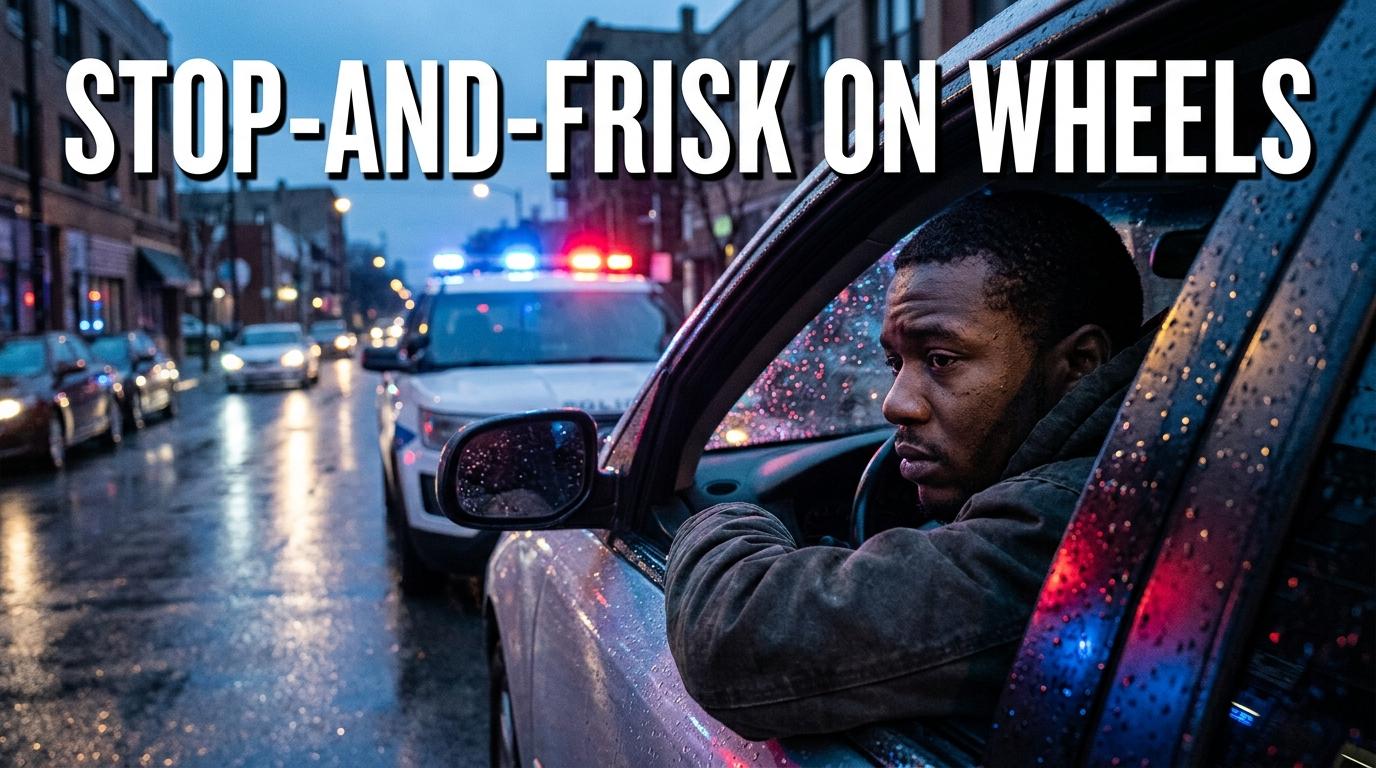
However, police officers quickly adapted to the new oversight by shifting their enforcement focus from sidewalks to roadways (wttw.com, boltsmag.org). This tactical adaptation mirrored the shift toward mass incarceration that altered urban policing across the nation (wttw.com, ebsco.com). Between 2014 and 2019, vehicle traffic stops in Chicago skyrocketed by 600 percent, rising from 83,000 stops to nearly 600,000 per year (wttw.com). Legal scholars and community members quickly labeled this strategy as stop-and-frisk on wheels (wttw.com, aclu-il.org).
The Evolution of CPD Enforcement Tactics
Four decades of tactical displacement in Chicago policing
Inside Pretextual Stops and Constitutional Protections
At the center of the lawsuit is the widespread use of pretextual traffic stops (wttw.com, aclu-il.org). A pretextual stop occurs when a police officer uses a minor equipment issue or minor traffic violation as a legal reason to pull over a driver (mikehowardlaw.com, cornell.edu). The actual objective of the officer is to investigate a hunch regarding weapons or drugs without possessing the required probable cause (mikehowardlaw.com). Common pretexts include dangling air fresheners, cracked windshields, expired registration stickers, or failing to signal a turn (wttw.com, aclu-il.org).
Under the Fourth Amendment to the United States Constitution, citizens are protected against unreasonable searches and seizures (uscourts.gov, cornell.edu). In legal terms, pulling over a vehicle constitutes a seizure of the vehicle and its occupants (uscourts.gov). Therefore, police officers must have reasonable suspicion of a violation to initiate a stop (uscourts.gov). However, in the 1996 Supreme Court ruling Whren v. United States, judges decided that pretextual stops do not violate the Constitution as long as an actual traffic infraction occurred, regardless of the subjective intent of the officer (cornell.edu).
Analyzing how constitutional standards apply locally demonstrates how state versus federal power influences police accountability and public policy in urban areas (mtsu.edu, congress.gov). Once an officer executes a pretextual stop, the encounter often converts from a simple traffic enforcement event into an intrusive investigation (aclu-il.org, mikehowardlaw.com). Officers frequently use aggressive questioning or implied authority to obtain consent to search the vehicle (aclu-il.org, mikehowardlaw.com). In many instances, motorists grant consent without realizing they have a constitutional right to refuse (mikehowardlaw.com).
By The Numbers: Disparities and The Contraband Paradox
Statistical evidence provided crucial support for the federal court ruling expanding the lawsuit (wttw.com, classaction.org). In 2003, then-State Senator Barack Obama sponsored the Illinois Traffic Stop Statistical Study Act to mandate detailed reporting on racial profiling across Illinois (wttw.com, illinois.gov). Data collected under that law shows that Black and Latino motorists account for roughly 80 percent of all traffic stops conducted by Chicago police officers (wttw.com). In 2023, Black drivers were pulled over at a rate 3.75 times higher than white drivers, while Latino drivers were stopped 2.73 times more often than white drivers (wttw.com).
A major 2024 study conducted by researchers at Cornell University offered further empirical proof of racial bias on Chicago roads (wttw.com, sciencenews.org). The researchers utilized GPS location data and automated speed camera records to map the actual demographic makeup of drivers on city streets (sciencenews.org). Automated speed camera citations closely matched the actual racial composition of drivers on those roads (sciencenews.org). Conversely, officer-initiated traffic stops on the exact same streets showed extreme racial disparities, heavily targeting Black motorists (sciencenews.org).
The statistical record also highlights what legal experts refer to as the contraband paradox (wttw.com). Police leaders historically justified mass traffic stops as a necessary crime-reduction tool to confiscate illegal weapons and drugs (wttw.com, igchicago.org). However, data proves that mass pretextual stops are remarkably ineffective (wttw.com, aclu-il.org). In 2023, only 0.41 percent of all Chicago police traffic stops resulted in officers finding contraband (wttw.com). Furthermore, when officers did search vehicles, white drivers were statistically more likely to possess contraband than Black or Latino drivers (wttw.com, aclu-il.org).
Chicago Traffic Stop Disparities (2023 Data)
Likelihood of being stopped compared to white drivers baseline (1.0x)
Tactical Units and High-Intensity Neighborhoods
The execution of mass traffic stops relies heavily on specialized police units known as tactical teams (wttw.com, chicagocopa.org). Unlike regular patrol officers who spend their working hours responding to 911 emergency calls, tactical officers focus on proactive enforcement missions (igchicago.org, chicagocopa.org). Tactical officers typically operate in plainclothes and drive unmarked vehicles (igchicago.org, chicagocopa.org). Their primary operational assignment involves aggressive crime suppression in designated geographic districts (igchicago.org).
This proactive enforcement model concentrated extreme stop volumes in predominantly Black neighborhoods like Englewood on the South Side of Chicago (wttw.com, igchicago.org). Police officers flooded Englewood with pretextual traffic stops, recording stop rates as high as 366 stops per 1,000 residents in targeted zones (wttw.com, igchicago.org). In July 2026, Judge Rowland ordered former Police Superintendent Larry Snelling to answer questions under oath regarding stop practices implemented while he served as commander of the Englewood district (wttw.com).
The heavy reliance on plainclothes tactical units creates high-stress encounters that can rapidly escalate into violence (injusticewatch.org, chicagocopa.org). A fatal example occurred in March 2024 when plainclothes tactical officers pulled over 26-year-old Dexter Reed in Humboldt Park for an alleged seatbelt violation (injusticewatch.org, chicagocopa.org). The interaction escalated into a shootout where officers fired 96 shots in under one minute, killing Reed (injusticewatch.org, chicagocopa.org). The shooting intensified public outrage and accelerated demands for systemic police reform across Chicago (injusticewatch.org, chicagocopa.org).
Off-The-Books Stops and State Regulation Gaps
While official department data records hundreds of thousands of stops, recent investigative journalism reveals that the true scale of traffic stops is significantly higher (boltsmag.org, injusticewatch.org). Investigative news organizations Bolts and Injustice Watch conducted an extensive analysis comparing police dispatch records with state database submissions (injusticewatch.org, injusticewatch.org). Their joint findings revealed that Chicago police officers routinely fail to report traffic stops to state authorities (injusticewatch.org, injusticewatch.org).
In 2024, reporting revealed that police officers failed to log approximately 33 percent of all traffic stops (injusticewatch.org). By mid-2026, investigative updates showed that the proportion of unreported, off-the-books traffic stops grew to more than 50 percent (injusticewatch.org, injusticewatch.org). This failure to log stops directly violates the Illinois Traffic Stop Statistical Study Act (injusticewatch.org, illinois.gov). These hidden encounters prevent the public and courts from seeing the complete volume of police interactions in minority communities (injusticewatch.org, injusticewatch.org).
Despite these clear statutory violations, state oversight mechanisms remain surprisingly weak (injusticewatch.org, illinois.gov). The Illinois Department of Transportation lacks legal authority to issue fines or direct financial penalties to noncompliant police departments (injusticewatch.org, illinois.gov). The only available administrative consequence involves referring noncompliant agencies to state safety committees, which can declare those departments ineligible for certain federal traffic safety grants (injusticewatch.org). Consequently, local law enforcement agencies face minimal accountability for hiding stop records (injusticewatch.org).
Unreported “Off-the-Books” Traffic Stops
Analysis of CPD traffic stops hidden from state records (2026 Data)
Source: Investigations by Bolts and Injustice Watch comparing city dispatch logs to state IDOT records.
Class-Action Mechanics and Structural Reform
The decision to certify the lawsuit under Federal Rule of Civil Procedure 23(b)(2) represents a turning point in the legal battle (wttw.com, classaction.org). Under this specific federal rule, the plaintiffs are not seeking individual financial payouts for every motorist involved (classaction.org, uscourts.gov). Instead, the class action seeks binding court orders requiring comprehensive structural reforms across the entire police department (wttw.com, aclu-il.org).
This organized legal movement connects directly to historical Black community struggles against systemic exploitation and official misconduct (ebsco.com, wikipedia.org). The plaintiffs in Wilkins v. Chicago are asking the federal court to mandate specific policy changes (wttw.com, aclu-il.org). These requested remedies include an absolute ban on traffic stop quotas, strict limits on equipment-based pretextual stops, and prohibitions on using minor traffic violations to justify vehicle searches (wttw.com, aclu-il.org).
Because the certified class represents hundreds of thousands of drivers over a five-year period, the legal stakes for the city of Chicago are enormous (wttw.com, classaction.org). City attorneys can no longer attempt to dismiss complaints as isolated misconduct by individual officers (wttw.com, aclu-il.org). The federal court will now decide whether the Chicago Police Department maintained an unconstitutional policy and practice of discriminatory enforcement against Black and Latino drivers (wttw.com, classaction.org).
Breaking the Cycle of Tactical Displacement
For nearly forty years, policing in Chicago operated within a persistent cycle of tactical displacement (wttw.com, wikipedia.org). Whenever public outrage or judicial rulings restricted one aggressive enforcement method, the police department adapted by shifting to another tactic (wttw.com, igchicago.org). When federal courts struck down gang loitering arrests, police officers expanded pedestrian stop-and-frisk (wttw.com, wikipedia.org). When pedestrian stops drew legally binding oversight, officers moved directly to mass traffic stops (wttw.com, boltsmag.org).
The class-action certification in Wilkins v. Chicago directly targets this multi-decade pattern (wttw.com, aclu-il.org). By uniting comprehensive statistical data, documented history, and constitutional protections in federal court, the lawsuit seeks to eliminate pretextual stops as a loophole for unauthorized searches (wttw.com, classaction.org). As the case proceeds toward trial, the city of Chicago must confront whether its police department can maintain public safety without relying on tactics that disproportionately impact Black and Latino motorists (wttw.com, aclu-il.org).
About the Author
Darius Spearman is a professor of Black Studies at San Diego City College, where he has been teaching for over 20 years. He is the founder of African Elements, a media platform dedicated to providing educational resources on the history and culture of the African diaspora. Through his work, Spearman aims to empower and educate by bringing historical context to contemporary issues affecting the Black community.
