

Congo M23 Rebels: History Behind the Headlines
By Darius Spearman (africanelements)
Support African Elements at patreon.com/africanelements and hear recent news in a single playlist. Additionally, you can gain early access to ad-free video content.
The eastern region of the Democratic Republic of Congo is once again trapped in a devastating cycle of violence. Recent headlines report that the M23 rebel group claims to have captured Burundian soldiers near the town of Uvira. This single event signals a dangerous widening of a conflict that has already destroyed countless civilian lives. For families living near the front lines, this means more chaotic flights on foot and markets empty of food. However, to understand why this is happening now, one must look beyond the immediate clashes and cease-fire talks.
The news from eastern Congo is not just a story of a distant rebellion. It is a story with deep roots, stretching back through decades of political manipulation, ethnic division, and the global hunger for the region’s resources. The conflict reveals a complex web of historical grievances, regional power struggles, and a humanitarian crisis of immense scale. Therefore, understanding the history behind the headlines is essential to grasp the stakes for the Congolese people and the stability of Central Africa.
The M23 Rebellion Explained
The March 23 Movement, widely known as M23, is at the center of the current storm. The group first emerged in 2012, taking its name from a failed peace agreement signed on March 23, 2009. That deal was supposed to integrate fighters from a previous Rwandan-backed rebel group, the National Congress for the Defence of the People (CNDP), into the Congolese army. M23 fighters, largely former CNDP members, argued that the DRC government never honored its promises (wikipedia.org). Consequently, they launched a rebellion to address their grievances.
Those grievances are multifaceted. M23 leaders point to the poor integration of their soldiers, widespread government corruption, and the failure to protect ethnic Tutsis in eastern Congo. They argue that other armed groups, especially Hutu militias, threaten their communities. This first M23 rebellion was powerful, even briefly capturing the major city of Goma in 2012 before being defeated in 2013 (cbc.ca). After nearly a decade of relative quiet, the group re-emerged in late 2021. Since then, it has seized large swaths of territory in North and South Kivu provinces, reigniting the brutal conflict.
Roots of Ethnic and Political Tensions
The conflict in eastern DRC cannot be understood without examining the region’s deep-seated ethnic and political tensions. At the heart of M23’s identity are Congolese Tutsi fighters. Congolese Tutsis have lived in the region for generations, yet their citizenship has often been questioned (thenewhumanitarian.org). Belgian colonial rulers used “divide and rule” tactics that hardened ethnic identities and created rivalries where none existed (unav.edu). After independence, manipulative politicians and flawed nationality laws often stripped people of Rwandan descent, including Tutsis, of their citizenship, making them targets (refworld.org).
This history has created a profound sense of marginalization and vulnerability. Many Congolese Tutsis feel they are treated as foreigners in their own country and are unfairly associated with neighboring Rwanda (thenewhumanitarian.org). This perception is exploited by other armed groups and politicians, fueling cycles of violence. Therefore, the M23 rebellion is framed by its leaders as a fight for survival and recognition against a state they believe has failed to protect them. The struggle is tied to land disputes, political representation, and the fundamental right to belong, a painful echo of how post-conflict failures can leave grievances to fester for generations.
The Shadow of Genocide: Hutu Militias
A significant antagonist in this complex conflict is a collection of Hutu militias, most notably the Democratic Forces for the Liberation of Rwanda (FDLR). The FDLR has its origins in the horrific 1994 Rwandan genocide. Its founders were members of the Hutu extremist Interahamwe militia and the former Rwandan army, who were responsible for the slaughter of approximately 800,000 Tutsis and moderate Hutus (britannica.com). After the genocide, they fled across the border into eastern Congo, then called Zaire.
The FDLR continues to operate from Congolese territory, driven by a “Hutu Power” ideology aimed at overthrowing the Tutsi-led government in Rwanda (justice.gov). Inside the DRC, the group commits horrific human rights abuses against civilians, including murder, sexual violence, and forced recruitment (hrw.org). They finance their operations through illegal taxation and smuggling. Crucially, the FDLR’s presence provides Rwanda with a persistent justification for its military interventions in the DRC. Rwanda claims it must act to neutralize this existential threat, a claim that fuels the regional proxy war.
Humanitarian Crisis in Eastern DRC
Displacement as of August 2025
Total Displaced Nationwide (DRC): 7 Million
Displaced in Eastern DRC: 7.8 Million
Newly Displaced by M23 (Since Jan 2025): 1.1 Million
A Widening Regional Conflict
The fighting in eastern Congo has never been a purely internal affair. Neighboring countries, particularly Rwanda, Uganda, and Burundi, are deeply entangled due to their own security and economic interests. Rwanda’s primary motivation has long been to pursue the FDLR and create a buffer zone on its border. However, numerous United Nations reports accuse Rwanda of providing critical support to M23, including weapons, troops, and strategic direction (un.org). Investigators have described Rwanda as having “de facto control” over M23, meaning it exercises power in practice, even without official recognition (service.gov.uk).
Uganda has also intervened in Congo, officially to fight hostile Ugandan rebel groups like the Allied Democratic Forces (ADF) that operate from DRC soil (opendoors.org.za). Yet, like Rwanda, Uganda has been accused of exploiting Congo’s vast natural resources, particularly gold and timber. Burundi has deployed its own troops to combat Burundian rebel groups based in South Kivu. The recent M23 claim of capturing Burundian soldiers highlights how these overlapping interventions create a tinderbox. Each country pursues its own interests, often by backing different armed groups in a deadly proxy war fought on Congolese land.
The Curse of Wealth: Conflict Minerals
Eastern Congo is immensely rich in natural resources, but this wealth has become a curse. The region holds vast deposits of gold, diamonds, tin, tungsten, and coltan. Coltan, short for columbite-tantalite, is a dull black ore essential for modern technology (wikipedia.org). When refined, it yields tantalum, a metal used to make capacitors for nearly every electronic device, including smartphones, laptops, and gaming consoles (aefjn.org). The DRC is a major source of the world’s coltan, making control of its mines globally significant.
Armed groups like M23 fight fiercely to control these mineral-rich territories. The town of Rubaya, for example, is a vital hub for coltan production. After seizing it, M23 reportedly began collecting around $800,000 per month in illicit taxes from the mining trade (globalinitiative.net). This money allows them to buy weapons, recruit fighters, and sustain their rebellion. For decades, the global demand for these minerals has fueled violence, exploitation, and unimaginable suffering, showing how global economics can perpetuate local conflict and test the resilience of families caught in the crossfire.
Conflict’s Economic Toll
DRC’s Growth and M23’s Illicit Revenue
DRC Economic Growth (2023): 8.6%
DRC Economic Growth (2024): 6.5%
M23’s Estimated Monthly Revenue from Rubaya (Coltan):
$800,000
The Unspeakable Human Cost
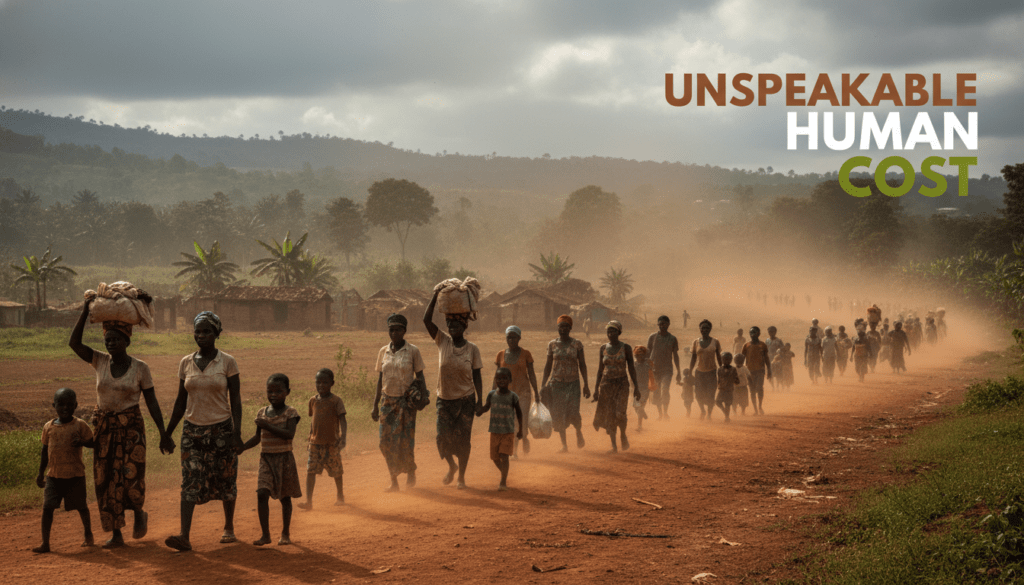
While rebels and regional powers vie for control, the true price of this conflict is paid by the Congolese people. The DRC is facing one of the largest internal displacement crises in the world. As of August 2025, nearly 7 million people were displaced nationwide, with a staggering 7.8 million displaced in the eastern provinces alone (iom.int). The resurgence of M23 has forced over 1.1 million people from their homes since January of that year. The recent fighting near Uvira displaced another 200,000 people and left at least 74 civilians dead (reliefweb.int).
The total number of casualties is estimated in the thousands, with some reports claiming the M23 advance on Goma resulted in 7,000 deaths (inew.org). Civilian infrastructure is collapsing. Hospitals are overwhelmed, and access to clean water and electricity is frequently cut off. Families flee with nothing but the clothes on their backs, facing starvation and disease in overcrowded camps. The astonishing strength of families is tested daily as they navigate this landscape of violence and loss, a humanitarian catastrophe largely hidden from the world’s attention.
A Cycle of Failed Peace Deals
The international community has repeatedly tried to broker peace, but agreements consistently crumble. High-profile efforts, including the US-brokered Washington Accords signed in late 2023 by the presidents of DRC and Rwanda, have failed to stop the fighting (aljazeera.com). That deal specifically obliged Rwanda to stop supporting armed groups, a charge Rwanda denies despite overwhelming evidence from UN experts (un.org). Other cease-fire agreements, such as one reached after talks in Qatar, have collapsed within weeks (trtafrika.com).
The cycle of failure stems from the deep-seated nature of the conflict. Peace deals often fail to address the root causes, including the marginalization of Congolese Tutsis, the continued presence of the FDLR, and the economic incentives driving the violence. The DRC government itself has struggled with weak institutions and a lack of political will to implement past agreements or protect all its citizens (ictj.org). Consequently, armed groups see no reason to lay down their weapons, and a path to lasting peace remains elusive.
Key Regional Actors & Motivations
| Country | Primary Motivations |
|---|---|
| Rwanda | – Security: Neutralize FDLR Hutu militia. – Influence: Support for M23 to create a buffer zone. – Economic: Alleged exploitation of DRC minerals. |
| Uganda | – Security: Combat ADF rebels operating from DRC. – Economic: Access to DRC’s gold and timber resources. |
| Burundi | – Security: Counter Burundian rebel groups based in South Kivu. |
The History Behind the Headlines
The headlines about captured soldiers and advancing rebels in the Democratic Republic of Congo are merely the latest tremors from very old fault lines. This is not a new war but the continuation of a conflict fueled by a toxic mix of colonial legacies, post-colonial state failure, and intense regional competition. The deep-seated grievances over citizenship and belonging, particularly for Congolese Tutsis, provide fertile ground for rebellion. The unresolved trauma of the Rwandan genocide, embodied by the continued presence of the FDLR, offers a permanent pretext for foreign intervention.
Furthermore, the world’s insatiable appetite for the minerals in our pockets and homes directly fuels the war economy, empowering militias and corrupt actors. The violence is driven by various conflicting ideologies of survival, ethnic nationalism, and pure profit. Until the historical injustices are addressed and the economic drivers of the conflict are dismantled, lasting peace will remain a distant dream. In the meantime, millions of Congolese civilians are paying the price, their suffering a footnote to the story of a world that consumes their resources but ignores their humanity.
About the Author
Darius Spearman is a professor of Black Studies at San Diego City College, where he has been teaching for over 20 years. He is the founder of African Elements, a media platform dedicated to providing educational resources on the history and culture of the African diaspora. Through his work, Spearman aims to empower and educate by bringing historical context to contemporary issues affecting the Black community.
