

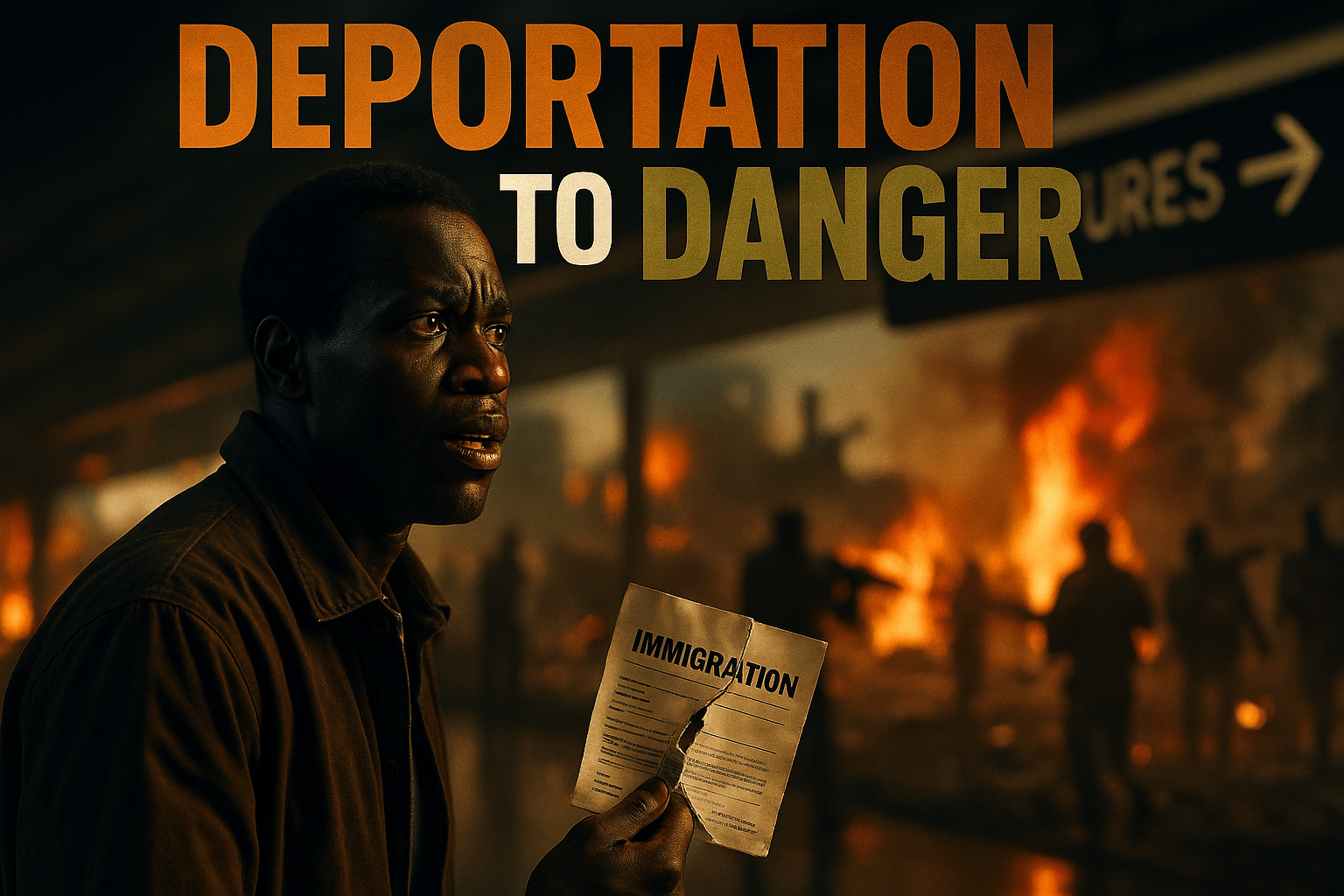
Deportation to Third Countries: A Dangerous Ruling
By Darius Spearman (africanelements)
Support African Elements at patreon.com/africanelements and hear recent news in a single playlist. Additionally, you can gain early access to ad-free video content.
Understanding Third-Country Deportations
The United States Supreme Court has recently made a decision that deeply impacts the lives of many immigrants, especially those from the African diaspora. This ruling allows the Trump administration to rapidly deport immigrants to “third countries” without giving them time to contest their destination (theconversation.com). This practice, known as “third-country removal,” means sending migrants to nations other than their country of origin or where they have legal status (migrantinsider.com).
This policy permits the U.S. government to send individuals to places they may have no connection to, often without their consent or prior knowledge (migrantinsider.com). For many Black immigrants, who may have already experienced displacement or instability, this decision adds another layer of vulnerability. It raises serious questions about human rights and the fundamental protections that should be afforded to all individuals, regardless of their immigration status.
Erosion of Due Process Protections
At the heart of this controversy is the concept of due process. Due process protections for migrants typically involve fundamental legal rights. These include the right to be informed of the charges against them, the right to a hearing before an impartial decision-maker, the opportunity to present evidence and testimony, and the right to appeal a decision (slate.com). In the context of deportation, this means being notified of the country of removal and having the chance to argue against removal, especially if there is a fear of persecution or torture in that country (humanrightsfirst.org).
The Supreme Court’s recent decision is highly controversial because it allows the government to bypass these essential protections for “third-country” deportations (reason.com). Lower courts had previously blocked these rapid deportations, citing due process concerns (cnn.com). For instance, U.S. District Judge Brian Murphy had ordered officials to tell immigrants where they would be deported and to let them object if they feared torture (slate.com). The Supreme Court’s ruling effectively strips away these protections, allowing the government to expel immigrants without notice or a hearing (slate.com).
Dangerous Destinations for Deportation
The “third countries” prioritized for deportation by the Trump administration are known for being dangerous with weak rule of law and routine human rights violations (theconversation.com). These include El Salvador, South Sudan, and Libya (theconversation.com). South Sudan, for example, is a politically unstable country in northeastern Africa (theconversation.com). The U.S. State Department has urged Americans to avoid South Sudan “due to crime, kidnapping and armed conflict” (yahoo.com).
Lawyers for migrants have repeatedly argued that their removal to South Sudan would subject them to “a strong likelihood of irreparable harm” (time.com). Trina Realmuto, executive director of the National Immigration Litigation Alliance, stated that deportees face possible “imprisonment, torture and even death” if sent to South Sudan (time.com). These countries are considered highly unsafe due to ongoing conflicts, widespread human rights abuses, and a lack of stable governance (migrantinsider.com). Deporting individuals to these regions places them at significant risk of violence, torture, and an inability to sustain themselves (reason.com).
Prioritized “Third Countries” for Deportation
These countries are identified as dangerous, with weak rule of law and routine human rights violations, posing significant risks to deported individuals.
The Expedited Deportation Process
The Department of Homeland Security (DHS) is a cabinet-level agency of the U.S. federal government responsible for public security (migrantinsider.com). Within DHS, U.S. Immigration and Customs Enforcement (ICE) is primarily responsible for enforcing immigration laws, including the apprehension, detention, and deportation of undocumented immigrants (migrantinsider.com). The recent Supreme Court decision directly impacts DHS’s ability to carry out these deportations, particularly concerning “third-country” removals (reason.com).
The typical deportation process usually involves multiple stages, including notice to appear, hearings before an immigration judge, opportunities to present defenses such as asylum claims, and avenues for appeal (cnn.com). This process can be lengthy, allowing migrants to seek legal counsel and gather evidence (cnn.com). The Supreme Court’s recent decision, however, allows for a significantly expedited process for “third-country” removals, bypassing crucial due process steps like prior notice and the opportunity to challenge the designated country of removal (slate.com). This effectively truncates the timeline and limits legal recourse, making it nearly impossible for individuals to object meaningfully to their transfer (cnn.com).
Deportation Process: Normal vs. Expedited
Normal Deportation Process
- Notice to appear in court
- Hearings before an immigration judge
- Opportunity to present defenses (e.g., asylum claims)
- Right to seek legal counsel
- Avenues for appeal
- Process can be lengthy, allowing for evidence gathering
Expedited “Third-Country” Process
- No prior notice of destination country
- No opportunity to challenge designated country
- Bypasses crucial due process steps
- Limited or no time to reach lawyers or families
- Truncated timeline for removal
- Increased risk of removal to dangerous locations
The “Shadow Docket” Decision
The Supreme Court’s decision was a brief emergency order (theconversation.com). An emergency order, often referred to as a “shadow docket” decision, is a ruling issued by the Supreme Court outside of its regular merits docket (reason.com). These orders are typically issued without full briefing, oral arguments, or a detailed explanation of the Court’s reasoning (reason.com). The Supreme Court offered no explanation for its decision in this case (time.com).
The implications are that while the order immediately allows the government to proceed with “third-country” deportations, it is not a final ruling on the merits of the case (stevevladeck.com). It does not establish a binding precedent in the same way a full opinion would (stevevladeck.com). However, it has immediate and significant practical effects, allowing the government to resume such removals without providing the process the district court required (stevevladeck.com). This lack of transparency and immediate impact on vulnerable populations is a major concern for human rights advocates.
Dissenting Voices and Human Rights Concerns
Dissenting Supreme Court justices and immigration advocates expressed strong concerns about the ruling’s implications for human rights and due process (theconversation.com). Justice Sotomayor, in a 19-page dissent joined by Justices Kagan and Brown Jackson, wrote, “Apparently, the Court finds the idea that thousands will suffer violence in farflung locales more palatable than the remote possibility that a District Court exceeded its powers when it ordered the government provide notice to the targeted migrants” (theconversation.com).
Trina Realmuto, executive director of the National Immigration Litigation Alliance, called the ramifications of the court’s action “horrifying,” stripping away “critical due process protections that have been protecting our class members from torture and death” (yahoo.com). The provided data indicates that migrants deported to “third countries” face significant risks, including violence, torture, and an inability to support themselves, particularly in unstable regions like South Sudan and Libya (reason.com). There are no specified protections or support mechanisms for these individuals once they are deported to such countries, leaving them vulnerable with no established safeguards (reason.com).
Risks Faced by Migrants Deported to “Third Countries”
Deportation to unstable “third countries” places individuals at severe risk, often without any established protections or ability to sustain themselves.
The Administration’s Justification
The Trump administration argues that “third-country” deportations are necessary for removing individuals who have committed crimes and whose countries of origin may be unwilling to take them back (time.com). The administration stated that its third-country policy already complied with due process and is critical for removing migrants who commit crimes because their countries of origin are often unwilling to take them back (yahoo.com). They described the group of migrants scheduled to be sent to South Sudan as “some of the most barbaric, violent individuals illegally in the United States” (time.com).
Solicitor General D. John Sauer also argued that the injunction against deportations was “disrupting the base’s operations, consuming critical resources intended for service members, and harming national security” because deportees were sent instead to Camp Lemonnier, a U.S. military base in Djibouti (time.com). This argument frames the policy as a matter of national security and efficient removal of dangerous individuals, despite the significant human rights concerns raised by the dissenting justices and advocates.
The Broader Implications for Black Migrants
This ruling has profound implications, particularly for Black migrants and those from the African diaspora. Many individuals seeking refuge or a better life in the United States have already endured immense hardship, including political instability, violence, and economic distress in their home countries. To then face deportation to a “third country” with no prior connection, often a nation embroiled in conflict or human rights abuses, is a cruel extension of their suffering.
The lack of due process means that individuals, including those who may have legitimate fears of persecution or torture, are denied the opportunity to present their case. This decision undermines the very principles of justice and fairness that the U.S. legal system is supposed to uphold. It highlights a troubling trend where national security concerns are prioritized over fundamental human rights, leaving vulnerable populations, many of whom are Black, in an even more precarious position.
ABOUT THE AUTHOR
Darius Spearman has been a professor of Black Studies at San Diego City College since 2007. He is the author of several books, including Between The Color Lines: A History of African Americans on the California Frontier Through 1890. You can visit Darius online at africanelements.org.
