


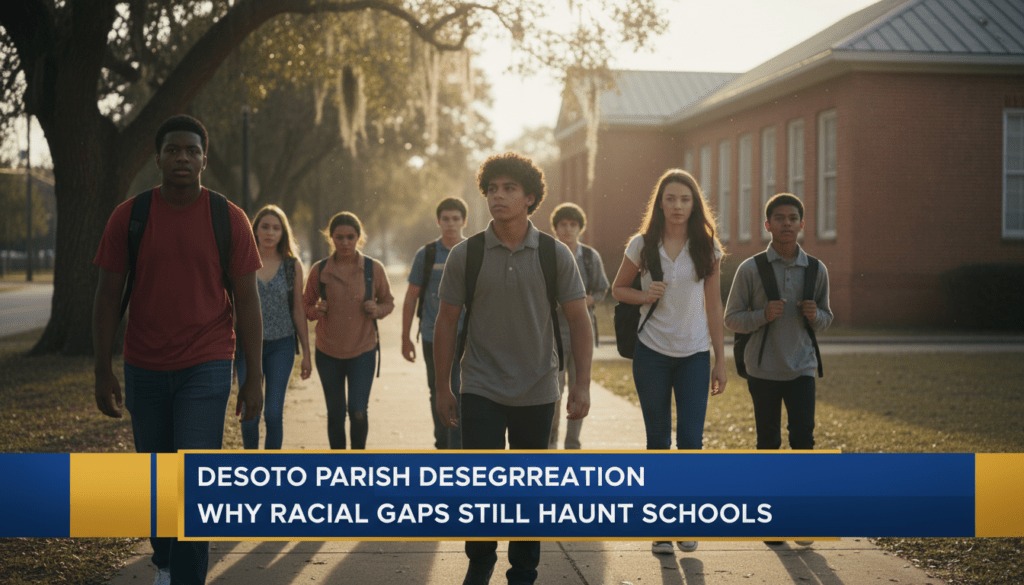
DeSoto Parish Desegregation: Why Racial Gaps Still Haunt Schools
By Darius Spearman (africanelements)
Support African Elements at patreon.com/africanelements and hear recent news in a single playlist. Additionally, you can gain early access to ad-free video content.
The long struggle for equality in DeSoto Parish, Louisiana, reached a sudden conclusion in early 2026. Federal court oversight began during the height of the Civil Rights movement. It lasted nearly sixty years. This legal battle shaped the lives of generations of Black students. Now, the Trump administration and state officials have successfully ended the mandate. This move returns full control to the local school board. However, the decision leaves many questions about the future of racial equity in the classroom.
State leaders celebrated the ruling as a victory for local governance. They argued that the old order was a heavy burden. On the other side, civil rights advocates expressed deep concern. They pointed to data showing that Black students still face significant disadvantages. These advocates believe the court was a necessary shield against systemic bias. The end of this order marks a major shift in how the government handles civil rights (edweek.org). It highlights a growing divide in how the nation views progress and racial justice.
The Long Road from the Jim Crow Era
The legal history of DeSoto Parish is a mirror of the Southern resistance to integration. It began on January 11, 1967. The U.S. Department of Justice filed a lawsuit against the parish school board. This was part of a broader effort to break down “dual school systems” across Louisiana. These systems were established to keep Black and White children in separate worlds. Even after the landmark Supreme Court rulings, change moved at a very slow pace (edweek.org). Many districts used delay tactics to maintain the status quo.
Early attempts at integration involved “freedom of choice” plans. These plans required Black families to ask for transfers to White schools. This method put the entire risk on Black parents and children. They often faced threats and social pressure for seeking a better education. In 1967, the federal courts ruled that districts had an “affirmative duty” to integrate. They could no longer be passive participants in segregation. This forced a more direct approach to dismantling the old ways. Many aspects of this struggle reflect how Post-Civil War Reconstruction failed to secure lasting rights for the community.
By 1970, a formal desegregation order was in place. It required the parish to remove all “vestiges of segregation.” This term refers to the lingering effects of the dual system. It includes things like student assignment, hiring practices, and school building quality (studicata.com). The court became the final supervisor for almost every major decision. This oversight was meant to ensure that the district did not slip back into old patterns. For decades, the Shreveport-based federal court watched every move the school board made.
DeSoto Parish Student Demographics (2024-2025)
White (51.9%)
Black (38.0%)
Hispanic (4.8%)
The Closing of Pelican All-Saints High
One of the most painful moments in this history occurred in 2013. The school board voted to close Pelican All-Saints High School. This school was a historic institution in a majority-Black community. Officials claimed the closure was necessary for efficiency and handling declining enrollment. They wanted to consolidate resources into larger facilities. However, the local community felt the loss of their school was a strike against their heritage. They argued that the closure would hurt the social fabric of the neighborhood (edweek.org).
Community members did not accept the decision quietly. They formed the Pelican All-Saints High School Benefit Society to fight the move. They filed a legal motion to intervene in the federal desegregation case. The group argued that the closure would force Black students into much longer bus rides. They believed the move would lower the quality of education for their children. This resistance showed that the community still relied on the court to protect their interests. It echoes the historical ways Black folks fought back against institutional changes that threatened their progress.
The legal challenge ultimately failed. U.S. District Judge S. Maurice Hicks Jr. denied the request to intervene. He ruled that the Department of Justice already represented the community’s interests. The court found that policy concerns, like local heritage, were not enough to prove a violation of the desegregation mandate. This decision cleared the way for the school to close. For many in the parish, this event was a sign that federal protection was weakening. It highlighted the friction between administrative efficiency and the preservation of Black community spaces (edweek.org).
The Trump Administration and a Policy Shift
The final end of the desegregation order came quickly in early 2026. This was driven by a major shift in federal policy. Under the return of President Donald Trump, the Department of Justice changed its approach. Attorney General Pam Bondi moved away from monitoring old civil rights cases. She characterized these mandates as outdated and burdensome. This represented a fundamental change from the historical role of the Department of Justice. Instead of being a prosecutor for civil rights, the department became an ally of the local school board (edweek.org).
In early 2025, a memorandum from the Attorney General focused on ending federal oversight. The administration argued that these orders prevented elected officials from doing their jobs. On December 30, 2025, the federal government joined Louisiana state officials in a motion to dismiss. They argued that because there were no active disputes, the court no longer had authority. This legal strategy is known as ending the “case or controversy.” Since both sides agreed to end the case, the judge had a clear path to close it (edweek.org). This policy shift reflects the broader political move away from civil rights enforcement seen in recent decades.
The court signed the dismissal order on January 5, 2026. Louisiana Attorney General Liz Murrill praised the decision. She stated that DeSoto Parish finally had its school system back. State officials argued that the 60-year oversight was an unfair drain on resources. They claimed that preparing stacks of data for federal monitors was a waste of time. With the signature of Judge Hicks, the legal battle that began in 1967 was officially over. The parish was no longer under the watch of the federal government (edweek.org).
The Opportunity Gap in DeSoto Parish
Suspension Rate (Black vs. White)
AP Class Enrollment (White vs. Black)
The Reality of Persistent Disparities
While officials celebrated “local control,” civil rights groups pointed to troubling statistics. They argued that the work of desegregation was far from finished. Data from the 2024-2025 school year showed deep gaps in achievement. On average, Black students in the parish are 1.7 grades behind their White peers. This academic gap is a lingering effect of the old dual system. Advocates argue that ending oversight ignores these modern realities (edweek.org). They believe the district still struggles to provide equal opportunities.
Discipline and advanced learning also show sharp racial divides. Black students are 2.5 times as likely to be suspended compared to White students. This disparity often leads to higher dropout rates and lower graduation success. In terms of Advanced Placement classes, the gap is even wider. White students are 3.8 times as likely to be enrolled in at least one AP class. These figures suggest that the “vestiges of segregation” still exist in daily school life. Civil rights lawyers argue that the system remains tilted against Black children (edweek.org). These issues relate directly to the inequality in education discussed at the national level.
Furthermore, geographic segregation remains a major issue in the parish. The district serves over 5,000 students, but they are not evenly distributed. Schools in the Mansfield area are approximately 90% Black. Meanwhile, schools in the North DeSoto area are overwhelmingly White. This pattern is often the result of residential choices and “white flight.” Families moved to the northern part of the parish as the southern areas became more diverse. This creates a “de facto” segregation that the original court order could not easily fix (edweek.org).
The Struggle Between Mansfield and North DeSoto
The geography of DeSoto Parish tells a story of two different worlds. Mansfield is the historic and administrative heart of the parish. It remains rural and has a high concentration of Black residents. The schools there reflect this demographic reality. Conversely, the northern part of the parish near Stonewall has seen explosive growth. This area is close to the city of Shreveport. It has attracted many White families seeking suburban life. As a result, North DeSoto High School is roughly 68% White (edweek.org).
This growth in the north has created an imbalance in school performance. North DeSoto schools are some of the top-performing in the state of Louisiana. They frequently earn high marks for academic excellence. This success attracts more families to the area, further increasing the White population. Mansfield schools often face more challenges with resources and student needs. The difference in facilities and programs between these two areas is a major point of contention. Advocates worry that the end of federal oversight will make these differences even worse (edweek.org).
Historically, the federal court acted as a “check” on how the board spent money and drew boundaries. Any changes to attendance zones required court approval. This was meant to stop the board from favoring one area over another. In 2014, the court oversaw the last major change to these zones. Now that the mandate is gone, the board has “plenary power.” They can redraw lines or move resources without asking a judge for permission. Community members fear this will lead to a return to policies that favor the White suburbs over the Black rural center (edweek.org).
The Academic Gap
Black students are, on average,
1.7 Grades Behind
their White peers academically.
The Legal Meaning of Unitary Status
In most desegregation cases, a district must reach “unitary status” before oversight ends. This means the school board must prove it has eliminated all traces of past discrimination. Reaching this status usually takes years of trials and evidence. A judge must look at the “Green factors.” These include student assignment, faculty, staff, and facilities (studicata.com). If the district passes this test, the court declares the system integrated. However, the DeSoto Parish case did not end this way.
The 2026 dismissal happened because of a legal maneuver. The Department of Justice and the School Board filed a “joint motion.” They told the court that they were no longer “adverse” parties. In simple terms, they stopped disagreeing. Without two sides fighting, the judge argued that there was no “case or controversy” for him to resolve (edweek.org). This allowed the case to close without a formal finding that the district was fully integrated. It avoided the long trial needed to prove unitary status.
This “about-face” by the federal government surprised many legal experts. For decades, the Department of Justice was the primary guardian of desegregation orders. Their sudden exit left the NAACP Legal Defense Fund and other groups in a difficult position. They criticized the move as a betrayal of the government’s duty. They argued that the lack of active litigation in the last decade showed the court was working. It did not mean that racial inequality had disappeared from the schools (edweek.org).
Future Challenges and the Burden of Proof
What happens now that the federal watchdogs are gone? The DeSoto Parish School Board now has the authority to make major changes on its own. They no longer need “pre-clearance” to build new schools or change bus routes. Superintendent Clay Corley noted that “everything had to be blessed” by federal officials in the past. He described the annual compliance process as a “box full of data” that was hard to manage. Now, the board can act more quickly on local needs (edweek.org).
However, this new freedom comes with risks. Without a federal judge to veto decisions, the burden shifts to local families. If a family believes a new policy is discriminatory, they must file a new lawsuit. Under the old order, the school board had to prove their actions did not harm integration. Now, the families must prove that the board is *intentionally* discriminating against them. This is a much higher legal standard to meet. It requires significant time and expensive legal help (edweek.org).
The district must still follow federal laws like Title VI of the Civil Rights Act. This law prohibits discrimination in programs that receive federal money. But the end of the court order removes the “automatic” protection that students had for sixty years. The future of DeSoto Parish schools will depend on the actions of the locally elected board. The community must stay vigilant to ensure that the progress made over the last six decades is not lost. The headlines may say the case is over, but the history of the struggle continues (edweek.org).
About the Author
Darius Spearman is a professor of Black Studies at San Diego City College, where he has been teaching for over 20 years. He is the founder of African Elements, a media platform dedicated to providing educational resources on the history and culture of the African diaspora. Through his work, Spearman aims to empower and educate by bringing historical context to contemporary issues affecting the Black community.
