
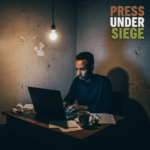


Ethiopia’s War on Media Freedom: The History
By Darius Spearman (africanelements)
Support African Elements at patreon.com/africanelements and hear recent news in a single playlist. Additionally, you can gain early access to ad-free video content.
A stark warning has emerged from Human Rights Watch (HRW), a leading international organization that investigates and reports on human rights abuses worldwide ((hrw.org), (hrw.org)). The group reports that Ethiopia is systematically tightening its control over media freedom. This new report points to a disturbing pattern of arrests, harassment, and the use of legal instruments to silence critical voices. When journalists operate under the constant threat of imprisonment, the hidden harms of conflict and corruption can thrive in the shadows (hrw.org). The situation represents a major reversal after a brief period of hope for press freedom in the nation. To understand today’s headlines, one must look at the deep-seated history of this struggle.
Ethiopia’s journey with a free press is a story of cycles, swinging between moments of openness and long periods of severe government control. For a long time, the state used the media as a tool for its own purposes, with censorship being a common practice. This historical context is essential for understanding the current crisis. The latest crackdown is not a new phenomenon but a return to an old playbook, one that has been used by different regimes to maintain power and control the public narrative. Consequently, the fight for a free press is a continuous battle against deeply entrenched systems of control.
A History of Repression and Reform
The story of modern media in Ethiopia begins after the fall of the Derg regime in 1991. The Derg was a communist military junta that ruled Ethiopia with an iron fist from 1974 to 1987, overseeing widespread human rights abuses, including a brutal campaign of political repression known as the “Red Terror” (researchgate.net). Its overthrow by the Ethiopian People’s Revolutionary Democratic Front (EPRDF), a coalition of ethnically-based parties, brought a short period of media liberalization (ned.org). This era saw the rise of a private press, with new newspapers and magazines critically examining government policies. The 1995 Ethiopian Constitution even guaranteed freedom of expression and prohibited censorship (hrw.org).
However, this new openness did not last long. The government’s relationship with the private press soured as reporting became more critical. After the disputed 2005 general elections, repression intensified, and Ethiopia started earning a reputation for jailing journalists (hrw.org). In 2008, the government introduced the Mass Media and Access to Information Proclamation. In the Ethiopian legal system, a “Proclamation” is a primary law passed by the federal parliament, similar to an act of congress (lawgratis.com). While this law had some positive elements, like formally recognizing the right to access information, it also gave the government broad powers to file defamation suits and block publications on vague national security grounds ((hrw.org), (misa.org)).
The situation worsened dramatically with the 2009 Anti-Terrorism Proclamation (ATP). This law was a critical turning point for media freedom (hrw.org). It used overly broad and vague definitions of terrorism to prosecute and imprison journalists, bloggers, and political opponents (amnesty.org). The ATP granted authorities sweeping powers, including warrantless surveillance and long periods of detention without charge, effectively institutionalizing censorship (hrw.org). During this period, Ethiopia became known as one of the world’s leading jailers of journalists, a grim status that crushed the country’s independent media landscape and created an environment of fear.
A Glimmer of Hope: The Abiy Ahmed Era
The rise of Prime Minister Abiy Ahmed in 2018 signaled a potential sea change for Ethiopia. Abiy, a former military intelligence officer, came to power after widespread protests and initiated a series of dramatic reforms (voanews.com). He released thousands of political prisoners, including many journalists, unbanned opposition groups, and made peace with neighboring Eritrea, an effort that earned him the 2019 Nobel Peace Prize (voanews.com). This new chapter brought a wave of optimism for the future of media freedom and democracy in the country. Many believed that a new era of openness was finally dawning.
A key part of these reforms was the 2021 Media Proclamation. This new law aimed to fundamentally reshape the media environment (hrw.org). It sought to promote editorial independence, which is the ability of journalists to make content decisions free from outside influence from governments or advertisers (researchgate.net). The law also moved to decriminalize defamation. This is a critical step for journalists, as it changes defamation from a criminal offense punishable by prison to a civil matter where individuals can sue for damages, reducing the state’s power to jail reporters for their work (article19.org). Furthermore, the proclamation planned for a media council, a self-regulatory body designed to uphold ethical standards and protect press freedom without government interference (hrw.org).
The Current Crackdown on Press Freedom
Despite the promise of these reforms, the situation has dramatically deteriorated. According to a September 2025 report by Human Rights Watch, there has been a significant backslide in media freedom, particularly since early 2025 (hrw.org). The organization documented a “surge in arbitrary arrests and detentions” and widespread “harassment against journalists” aimed at preventing public scrutiny of the government (hrw.org). This crackdown has created a climate of fear, reversing many of the gains made since 2018 and pushing the media back into a defensive posture against state power.
The report highlights several specific cases. In September 2025, three journalists from Sheger FM were arrested after broadcasting a report on a healthcare workers’ strike, even after the station complied with an order from the Ethiopian Media Authority to remove it (hrw.org). In another case, Yonas Amare, the editor of The Reporter newspaper, was abducted by masked men in August 2025, with authorities refusing to even confirm his detention initially (hrw.org). Radio host Abdulsemed Mohammed was also held in incommunicado detention, meaning he was held in custody without any contact with the outside world, including his family or lawyers (hrw.org). These actions are a grave violation of human rights, as they isolate detainees and leave them vulnerable to abuse (cardeth.org).
Journalists Imprisoned in Ethiopia
A growing trend of incarceration targeting the press.
19 (2015)
14 (2021)
8 (2025)
Source: CPJ, RSF data from provided research.
Legal Weapons Against Journalists
The Ethiopian government has used a variety of legal tools to silence its critics. In April 2025, amendments to the 2021 Media Law were passed, giving the Prime Minister-appointed Director General of the Ethiopian Media Authority (EMA) more power over media licensing and sanctions (citizen.digital). The EMA is the governmental body tasked with regulating media, but critics fear these changes compromise its independence and turn it into a political weapon ((hrw.org), (ipi.media)). The government also continues to use older, repressive laws. The revised 2020 Anti-Terrorism Proclamation, the 2016 Computer Crime Proclamation, and various hate speech laws are still invoked to detain journalists on vague allegations (hrw.org).
These laws are deliberately broad. For example, terrorism allegations against journalists often involve claims of supporting designated terrorist groups simply for interviewing opposition figures or reporting on conflicts from a non-government perspective (oaklandinstitute.org). Furthermore, the government has repeatedly used state of emergency declarations, such as during the Tigray war in 2021 and in the Amhara region in 2023, to suspend due process (hrw.org). Due process is the fundamental legal right to fair treatment in the justice system, including the right to a trial and legal representation (ox.ac.uk). Suspending it allows for mass arrests and censorship under the guise of national security. Authorities have also frequently imposed internet and communications blackouts during protests or conflicts to control information flow (hrw.org). These tactics create an information vacuum where abuses can occur without scrutiny.
The Human Cost of Silencing the Press
The impact on journalists and media outlets has been devastating. Reporters face a constant barrage of harassment, arbitrary arrest, intimidation, and censorship, forcing many into exile (hrw.org). The journey for press freedom often seems like an endless struggle for a notion of freedom that remains just out of reach. Since 2020, at least 54 journalists have fled the country, continuing a grim trend that once made Ethiopia the world’s largest source of exiled journalists besides Iran ((hrw.org), (cpj.org)). Those who remain often resort to self-censorship to survive, avoiding sensitive topics that could land them in prison. This pressure is especially intense for independent journalists working in regions torn apart by conflict.
Ethiopia is currently facing a volatile political situation with major armed conflicts in its Tigray, Oromia, and Amhara regions ((hrw.org), (africanarguments.org)). These conflicts are driven by deep-seated ethnic grievances and competition for political power. When the media is suppressed, the “harms of conflict” are easily hidden (hrw.org). These harms include atrocities against civilians, war crimes, and the true scale of humanitarian crises like famine and displacement (hrw.org). Similarly, corruption thrives in darkness. Without investigative reporting, embezzlement of public funds, abuse of power, and cronyism can continue unchecked, eroding public trust and diverting resources from essential services (hrw.org). The fight for a free press is directly tied to the ability to build and sustain black political power and ensure government accountability.
The Exodus of Ethiopian Journalists
Fear and persecution are driving reporters out of the country.
54+
Journalists have fled Ethiopia since 2020.
Source: Human Rights Watch data from provided research.
Official Denials and International Pressure
The response from Ethiopian officials to these credible reports has often been dismissive or silent. In the past, they have attacked the credibility of organizations like Human Rights Watch, claiming that detained journalists are criminals, not reporters (hrw.org). More recently, the government has either not responded to specific allegations or issued blanket denials of human rights violations (hrw.org). This refusal to engage with criticism makes it difficult to address the root causes of the media crackdown and signals a lack of commitment to democratic principles and international human rights law.
As a result, international pressure is growing. Human Rights Watch has called on Ethiopia’s international partners and donors to be more vocal in condemning the government’s actions (hrw.org). Key partners include the United States, the European Union, the World Bank, and the International Monetary Fund (business-humanrights.org). In May 2025, a coalition of 14 diplomatic missions in Ethiopia issued a joint statement expressing their serious concerns about the shrinking space for press freedom in the country (hrw.org). These statements are important, but whether they will translate into meaningful action that can reverse the current trend remains to be seen. The international community’s leverage is a critical factor in protecting what is left of Ethiopia’s independent media.
The Data Behind the Decline
The numbers paint a clear and disturbing picture of Ethiopia’s declining media freedom. In 2023, the Committee to Protect Journalists (CPJ) ranked Ethiopia as the second-worst jailer of journalists in sub-Saharan Africa (cpj.org). Between 2020 and 2022, nearly 60 journalists were arbitrarily detained and two were killed (theguardian.com). The country’s political shift from reform back to repression recalls an era of mass incarceration, this time targeting voices that challenge the state narrative. The internal political situation, rife with conflicting ideologies and ethnic tensions, provides the government with a pretext for such crackdowns (zehabesha.com).
This decline is also reflected in global rankings. The World Press Freedom Index, an annual ranking by Reporters Without Borders (RSF) that measures media independence and journalist safety, shows a steep drop for Ethiopia (hrw.org). In 2025, the country fell to 145th place out of 180 countries, a drop of 42 spots since 2020 ((hrw.org), (gijn.org)). This ranking places Ethiopia in the “very serious” category, highlighting the extreme dangers and difficulties journalists face (ecofinagency.com). The data confirms what journalists on the ground already know: the space for independent reporting is shrinking rapidly, with dire consequences for the nation’s future.
Ethiopia’s World Press Freedom Index Ranking
A dramatic decline in recent years.
103rd
2020
141st
2024
145th
2025
Source: RSF data from provided research.
About the Author
Darius Spearman is a professor of Black Studies at San Diego City College, where he has been teaching for over 20 years. He is the founder of African Elements, a media platform dedicated to providing educational resources on the history and culture of the African diaspora. Through his work, Spearman aims to empower and educate by bringing historical context to contemporary issues affecting the Black community.
