
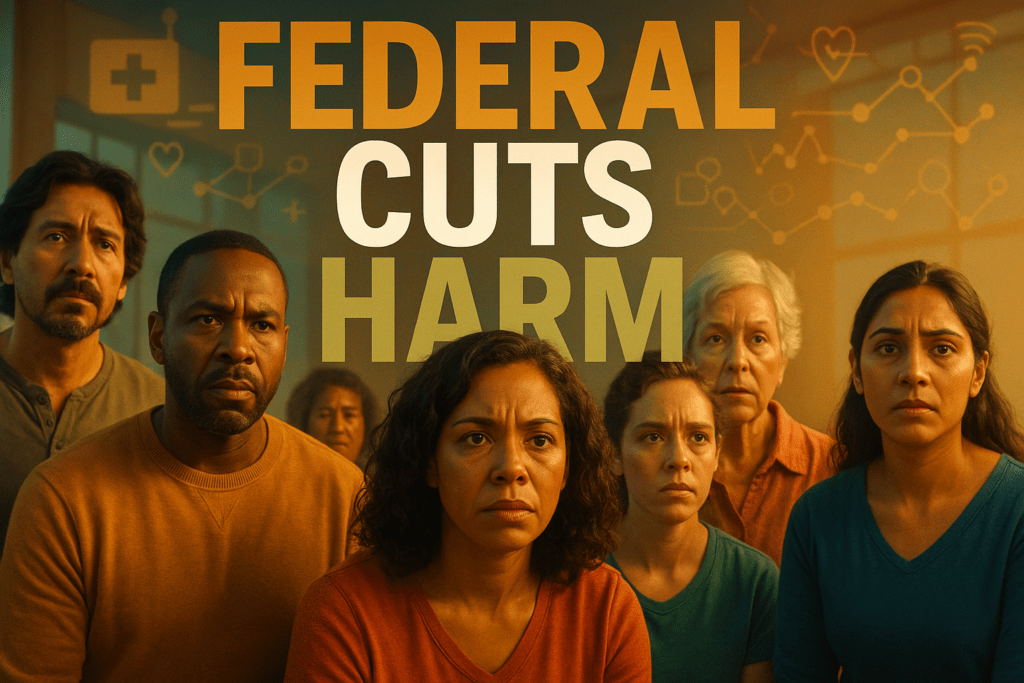
Federal Cuts Harm Black Communities
By Darius Spearman (africanelements)
Support African Elements at patreon.com/africanelements and hear recent news in a single playlist. Additionally, you can gain early access to ad-free video content.
DOGE: A New Era of Federal Cuts
The Trump administration has implemented significant cuts to federal grants. These reductions impact vital internet access programs and public health initiatives. Black and marginalized communities are particularly affected by these changes. The Department of Government Efficiency, known as DOGE, is a newly established federal agency under the Trump administration. It was created with the stated purpose of streamlining government operations and reducing federal spending.
DOGE?s role involves identifying and implementing cuts across various government departments, including health and human services. The administration presents the rationale behind these cuts as a way to eliminate perceived inefficiencies. Furthermore, they aim to reallocate resources according to new policy priorities. The Department of Health and Human Services (HHS) has already posted a growing list of grants subject to termination as part of these cuts (chlpi.org). These reductions include a mix of research grants and funding for grantees providing vital healthcare and public health services (chlpi.org).
Public Health Infrastructure Under Siege
The Trump administration pulled back billions in COVID-era funding for state and local health departments (CNN). These cuts include over $11 billion in COVID-19 and public health grants that were intended for states (fiercehealthcare.com). Such reductions are described as a “devastating blow to public health” across the country. They could lead to job losses, program reductions, and decreased community safety (CNN).
The $11 billion in cuts impact a wide array of programs essential for public health infrastructure and services. These include infectious disease prevention and control initiatives. They also affect vaccination education and distribution programs, public health emergency preparedness, chronic disease management, and health promotion activities. Specifically, these cuts could impact programs that fund local health departments for surveillance, laboratory capacity, and community outreach. Research grants aimed at understanding and combating various health threats are also at risk (chlpi.org).
Major Federal Public Health Grant Reductions
Disproportionate Impact on Black and Marginalized Communities
These cuts disproportionately affect Black and marginalized communities. This includes those focused on HIV/AIDS research and prevention. In the context of public health and funding cuts, “marginalized communities” refers to groups that have historically experienced systemic discrimination and disadvantage. This leads to poorer health outcomes and reduced access to resources. This can include racial and ethnic minorities, LGBTQ+ individuals, people with disabilities, low-income populations, rural residents, and immigrants (kff.org). These communities often face multiple barriers to healthcare, including socioeconomic factors, linguistic differences, and cultural insensitivity. This makes them particularly vulnerable to the impact of funding reductions.
CDC employees report that layoffs under the Trump administration have disproportionately impacted Black and marginalized staff (capitalbnews.org). While specific quantitative data on the scale of these layoffs is not detailed, the implication is clear. Such layoffs exacerbate existing health disparities and reduce the agency’s capacity to address the unique health needs of these communities. The consequences could include a loss of institutional knowledge and reduced cultural competency within public health programs. It could also mean a decrease in the diversity of perspectives essential for effective public health interventions. This would further hinder efforts to achieve health equity and could lead to a decline in trust between public health institutions and marginalized populations (poz.com).
Targeting HIV/AIDS Research and Prevention
Research areas that disproportionately affect minority communities, such as violence prevention and HIV studies, have seen significant cuts (capitalbnews.org). HIV organizations are bracing for impact as DOGE cuts funding for prevention programs. This includes the elimination of dozens of HIV studies (wwno.org). These federal cuts have sparked outrage among public health officials and organizations working to combat the HIV epidemic (wwno.org).
The cuts to HIV/AIDS research and prevention are significant and multifaceted. They include the elimination of the cross-cutting Minority AIDS Initiative (MAI). This initiative addressed the disproportionate impact of HIV on racial and ethnic minorities (kff.org). The Ryan White HIV/AIDS program, a major federal program for people living with HIV, faces a $239 million budget cut. This eliminates support for dental services, AIDS Education and Training Centers, and demonstration programs (kff.org). Additionally, over 200 research grants related to HIV have been canceled by the National Institutes of Health (NIH) (them.us). The CDC’s Division of HIV Prevention could even face reorganization or elimination (poz.com).
Key Cuts to HIV/AIDS Programs
Specific Impacts Across the Nation
Specific organizations and regions are experiencing direct financial impacts from the DOGE cuts. The New York City Health Department is facing $100 million in cuts. This impacts grants for infectious disease prevention, surveillance, and vaccination education (fiercehealthcare.com). Los Angeles County Public Health is impacted by over $45 million in cuts to core funding. This is due to the rescission of ELC COVID-associated funding (fiercehealthcare.com). ELC (Epidemiology and Laboratory Capacity) funding refers to grants provided by the Centers for Disease Control and Prevention (CDC) to state and local health departments. This funding is crucial for supporting public health infrastructure, including disease surveillance, laboratory testing, and outbreak response. The COVID-associated ELC funding specifically augmented these capacities during the pandemic. It addressed the increased demands of testing, contact tracing, and vaccine distribution. Cuts to this funding directly impact the ability of local health departments, like Los Angeles County Public Health, to monitor and respond to infectious disease threats.
Universities and research centers, including Columbia University, Research Triangle Institute, Duke University, UCLA, and the Fred Hutchinson Cancer Center, have seen over $1 billion in grant cuts (fiercehealthcare.com). In Georgia, the Centers for Disease Control and Prevention (CDC) lost $334 million in funding due to federal cuts. As a result, several non-profits focused on Black health in Georgia have lost funding. The Center for Black Women?s Wellness lost $438,000 as a result of the DOGE cuts. BLKHLTH Inc., a non-profit focused on vaccine equity in Georgia?s Black community, said they would lose nearly $500,000. Kadijah Ameen, co-founder of BLKHLTH, stated that this was a large percentage of their anticipated budget for the year, as they are a small non-profit with a million-dollar reimbursable grant (Original Article).
Internet Access Programs Under Threat
The cuts also affect internet access programs, particularly those designed to expand connectivity for rural and Black communities. The Digital Equity Capacity Program was a federal grant intended to address the digital divide. It aimed to provide high-speed internet access to rural and low-income communities. A sum of $22 million was set aside specifically for Georgia. However, the Department of Commerce abruptly canceled the grant earlier this year. This happened after Trump saw the word ?equity? and immediately labeled it ?a racist and illegal $2.5 billion giveaway? on Truth Social (Original Article).
These grants were not only designed to help Black and brown communities. Seniors, veterans, people with disabilities, and low-income families would have also received assistance to help catch up with the digital age. Georgia had a comprehensive, 466-page plan outlining how they would spend the money. This plan would improve cell tower service across the state. It would also provide access to fiber optic internet in rural communities such as McIntosh County. A third of McIntosh?s population is Black, and the county has a median income of $50,000. This is $25,000 less than the state at large. The plan would also expand telehealth services to those rural and low-income communities. Additionally, it would upgrade digital literacy to help identify cyber and telephone scammers. This information would help protect some of our most vulnerable elders, who are especially susceptible to misinformation and scammers (Original Article).
Georgia’s Public Health and Digital Equity Losses
Long-Term Consequences and the Path Forward
The long-term consequences of these funding cuts are projected to be severe and far-reaching. They could potentially reverse decades of progress in public health. Experts warn that these cuts could lead to a resurgence of preventable diseases. They could also increase health disparities and weaken public health infrastructure. This would make it less capable of responding to future crises (fiercehealthcare.com). Reduced funding for research will slow scientific advancements. Cuts to direct services will negatively impact community well-being, particularly for vulnerable populations (poz.com). The elimination of programs focused on specific diseases like HIV/AIDS could undermine efforts to control and eventually end epidemics.
The provided information does not explicitly detail efforts by states, local governments, or organizations to mitigate the impact of these federal funding cuts. It also does not identify alternative funding sources. However, in situations of federal disinvestment, it is common for state and local entities, as well as non-profit organizations, to seek alternative funding mechanisms. These include state appropriations, private philanthropy, or increased local taxes, to bridge funding gaps (chlpi.org). These efforts are often challenging and may not fully compensate for the loss of federal support. This could potentially lead to reduced services or increased financial burdens on communities. While specific examples like Los Angeles County Public Health are mentioned, the nature of federal funding cuts suggests a national scope. Federal grants and programs typically operate across all states and territories. This means that reductions in these funds would have widespread implications, affecting public health services in both urban and rural areas nationwide. The impact might be particularly acute in rural areas, which often have fewer alternative funding sources and rely more heavily on federal support for essential health services.
Weaponizing the Dollar Against Vulnerable Communities
The Trump administration’s stated rationale for these funding cuts generally centers on a philosophy of reducing government spending. It also aims to streamline federal agencies and reallocate resources to align with new policy priorities. While specific justifications for each cut may vary, overarching goals often include reducing the national debt. They also promote what the administration views as “efficiency” in government operations. Furthermore, they shift focus away from certain public health initiatives that may not align with their agenda. In some cases, the cuts are framed as eliminating redundant or ineffective programs. Critics argue that they dismantle crucial public health infrastructure (chlpi.org).
There is much discussion about the various atrocities and absurdities committed by the Trump administration on a daily basis. Yet, the most insidious evil of the current administration is the way it has managed to weaponize the dollar. This causes undue harm to Black, brown, and most vulnerable communities. The cuts to public health, HIV/AIDS research, and internet access programs demonstrate a clear pattern. These actions undermine the well-being and progress of those who need support the most. The long-term consequences of these decisions will be felt for years to come, particularly in communities striving for equity and access to essential services.
ABOUT THE AUTHOR
Darius Spearman has been a professor of Black Studies at San Diego City College since 2007. He is the author of several books, including Between The Color Lines: A History of African Americans on the California Frontier Through 1890. You can visit Darius online at africanelements.org.
