

Ghana Education Summit Outcomes Reshape Diaspora History
By Darius Spearman (africanelements)
Support African Elements at patreon.com/africanelements and hear recent news in a single playlist. Additionally, you can gain early access to ad-free video content.
A New Era For African Identity
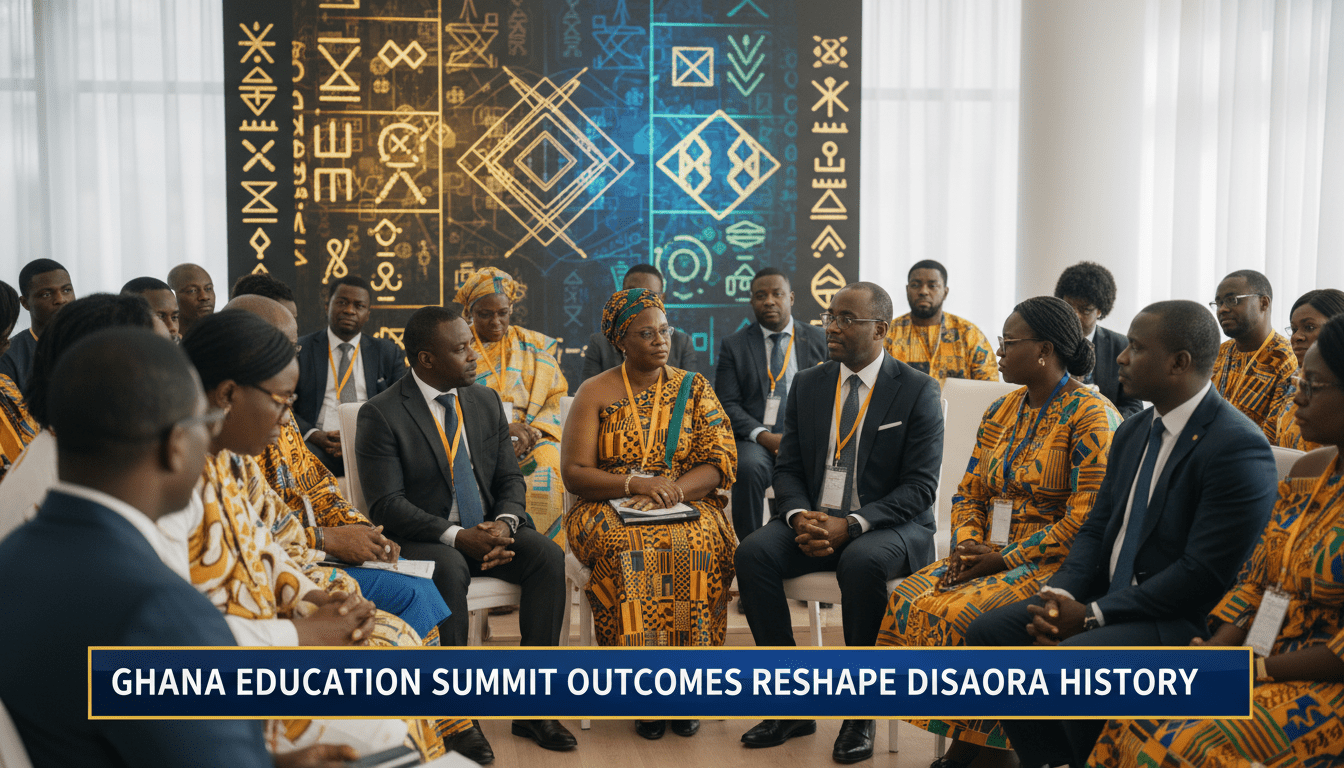
The All African Diaspora Education Summit in Accra recently concluded. Educators gathered from across the globe to discuss new ways to teach history. The summit focused heavily on implementing African-Centered Education. This method places the student directly at the center of the learning experience. Western schools often prioritize individualism and European historical lenses. African-Centered Education focuses instead on the collective advancement of the community. Educators intend to use ancestral narratives as blueprints for modern social equity. The shift moves far beyond simply acknowledging past traumas. Leaders are now using reclaimed history as a powerful tool for economic independence. This transformation is crucial for shedding colonial influences across global education systems. African-Centered Education actively fosters a highly positive racial identity. The framework connects academic subject matter to the lived experiences of students. Traditional Western education often positions students of African descent completely outside the cultural core. This new approach corrects that historical imbalance directly. The ultimate goal is to build truly sovereign systems. These systems will empower communities worldwide for generations. Planners designed the curriculum to prioritize community responsibility over independent competition. Students learn that their education must serve the greater good of their people. The summit marked a pivotal moment for global diaspora unity. Attendees recognized that curriculum design is fundamentally a political act. Teaching history through an empowering lens shifts power dynamics in society. The modern classroom requires a dramatic structural overhaul to serve marginalized students properly. The psychological well-being of students improves massively when schools validate their cultural heritage. True liberation requires a curriculum that treats students as subjects of history. (a2mend.net).
The Historical Roots Of Educational Sovereignty
The current push for Afrocentric curricula in Ghana has deep historical roots. It represents the modern evolution of extensive Pan-Africanist thought. W.E.B. Du Bois spent his final years actively living in Ghana. He championed the intensive study of African history as a primary liberation tool. Du Bois worked very closely with Kwame Nkrumah. Nkrumah was the visionary first president of the Republic of Ghana. Together, they established Accra as a central Pan-African hub for intellectual growth. Nkrumah famously declared that the nation should look forward, rather than east or west. This bold vision set the exact stage for educational systems prioritizing African agency. Organizers held the very first Pan-African Conference in the year nineteen hundred. Henry Sylvester Williams articulated the shared common destiny of the diaspora at this historic event. The ensuing Pan-African Congresses between nineteen nineteen and nineteen forty-five shifted the focus heavily. The movement eventually shifted toward complete intellectual and cultural sovereignty. Carter G. Woodson published a groundbreaking structural critique in nineteen thirty-three. He argued persuasively that Western education systems instilled deep inferiority in Black students. Modern summit outcomes directly respond to this precise historical critique today. Woodson called for a deep, uncompromising knowledge of self. This crucial knowledge remains necessary to break terrible cycles of social dependency. Before the tragedy of colonialism, African societies possessed highly advanced educational systems. Understanding exactly how the history of Africa take such a dramatic turn helps modern educators rebuild. The massive Year of Return initiative in twenty nineteen catalyzed the current summit series. It shifted the concept of return from a symbolic visit to structural integration. (ug.edu.gh, scholars.org).
Educational Attainment Comparison
Bachelor’s Degree or Higher (Ages 25+)
Frameworks For Educational Transformation
The recent summit officially established the Colonization to Sovereignty decade. Leaders aim to codify African-Centered Education completely globally by the year twenty thirty-two. Dr. Chike Akua presented fifteen comprehensive standard frameworks during the main event. These important standards provide a reliable toolkit for teachers everywhere. The distinct frameworks integrate Afrocentricity into absolutely every academic subject. One exceptionally key principle is the vital restoration of group memory. This specific practice prevents dangerous cultural amnesia among impressionable young students. Another core principle is the continuous consciousness of victory. Teachers focus heavily on magnificent African achievements rather than exclusively teaching historical oppression. Education becomes a deeply transformative process for developing strong community leadership. Western training often focuses heavily on blind assimilation into existing broken systems. African-Centered Education seeks to permanently solve specific community issues. Educators view classroom learning as a profound spiritual and emotional process. This method actively involves tapping the spirit of the learner. Teachers guide students toward reaching their highest possible personal potential. Teachers must consistently apply the acid test to every policy. They must ask if a specific lesson serves the best interests of African people. This standard acts as the primary overriding metric for educational success. Over three hundred and fifty global educators committed entirely to these principles. Furthermore, fifteen university presidents signed agreements to adopt the frameworks immediately. The frameworks ensure that schools center social justice orientation in every classroom discussion. (a2mend.net).
Decolonizing Science Technology And Mathematics
Afrocentricity applies directly and powerfully to science, technology, engineering, and mathematics. Educators integrate indigenous African innovations seamlessly into daily STEM lessons. This precise approach entirely replaces the false narrative of exclusive European scientific discovery. Teachers use ethnomathematics to properly explain complex, high-level core concepts. For example, educators use the famous Ishango Bone to teach early mathematics. The Ishango Bone originates from the modern Democratic Republic of Congo region. It demonstrates the extremely early history of prime numbers and advanced multiplication. These ancient mathematical records predate Western discoveries by many thousands of years. Students also learn geometric scaling through observing traditional African village layouts. Teachers demonstrate complex recursion using African fractals found in beautiful textile patterns. Students study the intricate geometry hidden within traditional African hair braiding styles. Decolonizing mathematics involves teaching multiple distinct ways of knowing to students. The curriculum highlights how brilliant mathematical thinking remains inherently culturally diverse. Leaders also emphasize Kemetic Science extensively in modern science classrooms. Kemetic Science refers strictly to the mathematical and philosophical systems of Ancient Egypt. Students learn about sophisticated ancient advancements in complex medicine and precise astronomy. The robust curriculum covers the earliest three hundred and sixty-five day calendar system. Teachers bridge ancient Egyptian philosophy with modern quantum science concepts smoothly. Students learn that ancient energy theories align perfectly with modern particle physics. Educators utilize hieroglyphics as a profound tool for linguistic and conceptual study. Learning about these early advancements restores a deep sense of historical pride. (csus.edu).
Remittances
Direct financial transfers
Savings Potential
Untapped capital capacity
Economic Independence And The Seventeenth Region
True economic independence relies heavily upon a properly reclaimed historical narrative. Summit leaders argue strongly that sovereignty is totally impossible without this solid foundation. By teaching the deep history of pre-colonial trade networks, educators actively inspire modern entrepreneurship. This crucial historical knowledge helps significantly reduce ongoing reliance on foreign aid. The African diaspora holds truly immense, largely untapped economic potential today. Migrant workers sent over ninety-five billion dollars strictly to Africa in recent years. This staggering financial figure completely dwarfs traditional foreign direct investment numbers. Furthermore, the annual personal savings of African migrants reaches massive, unprecedented levels. Researchers estimate these specific annual savings at nearly thirty-four billion dollars. The new summit frameworks seek to effectively redirect these funds into local African investments. Planners intend to utilize innovative diaspora bonds to finance massive infrastructure projects. Ghana recently advanced the brilliant vision of the diaspora as its official seventeenth region. This powerful political metaphor recognizes the global community as permanent, essential stakeholders. The Ghanaian government supports this unique designation fully through the Right of Abode. This important right allows persons of African descent to live and work in Ghana indefinitely. They absolutely do not need temporary visas or highly restrictive work permits. The national Citizenship Act also provides clear pathways for securing dual citizenship. Understanding the complex and often heartbreaking history of global labor exploitation drives this modern economic strategy. Leaders intend to transform historical brain drain into highly profitable brain circulation. The African Diaspora Finance Corporation provides a strategic framework for this necessary investment shift. (diasporaaffairsgh.org, au.int).
Overcoming Hurdles In Western Classrooms
Educators face significantly large legal and political hurdles in Western countries currently. Policymakers have introduced massive, coordinated resistance to these empowering educational frameworks. Lawmakers in the United States introduced over eight hundred anti-diversity proposals recently. These restrictive laws aim to totally prohibit honest lessons about race and systemic racism. Such harsh legislation creates a massive chilling effect across entire public school districts. Many public schools risk losing critical federal and state funding entirely. Politicians aggressively threaten to withhold resources if schools teach authentic race history. Vaguely worded laws cause severe overcompliance among understandably fearful, overworked teachers. Educators quietly remove informative books that highlight minoritized communities to avoid immediate termination. The federal government also complicates matters severely with highly confusing, contradictory directives. Government agencies distribute letters requiring that educational decisions avoid treating individuals differently based on race. This extremely strict colorblind approach negatively impacts crucial identity-affirming programs constantly. Teachers struggle mightily to implement the fifteen standard frameworks under these hostile conditions. The complexities of affirmative action and legal constraints further restrict diverse curriculum development. Despite these heavy challenges, dedicated diaspora educators continue building strong independent networks. They absolutely refuse to abandon the ultimate goal of a liberated educational system. Independent community schools provide a safe haven for authentic historical instruction. Parents are demanding culturally relevant material regardless of state-sanctioned political restrictions. Community leaders stress that accurate historical education is a fundamental human right. Educational freedom remains the absolute core of the modern civil rights struggle. (ed.gov).
The Struggle for Curricular Freedom
(Restricting History)
to ACE Frameworks
Building A Sovereign Global Future
The Ghana Education Summits represent a massive, truly historic reclamation project. Dedicated leaders are actively bridging radical Pan-Africanism with modern educational technology. Ghana deliberately positions itself as the primary intellectual headquarters for a global African renaissance. The ambitious country is moving rapidly beyond simple, surface-level heritage tourism. The popular headline of diaspora unity actually masks a deeply sophisticated structural effort. Leaders are strategically rewriting the global narrative from constant struggle to pure, unyielding sovereignty. Ghana plans to officially launch a massive Pan-African Virtual College very soon. This innovative college will bridge local Ghanaian institutions with global community colleges seamlessly. It will quickly share vital Afrocentric resources across massive physical and digital borders. The robust virtual platform ensures highly standardized, quality curricula for all participating students. Historical leaders like the brilliant Cheikh Anta Diop provided the exact academic foundation for this movement. Diop proved the undeniable cultural continuity among all African peoples definitively. He bravely combined traditional social studies with hard sciences to forcefully challenge racist narratives. He even translated complex theories of relativity into his native Wolof language. Understanding exactly the role Black people played in global development remains absolutely central to the mission. The bold new educational framework honors this profound intellectual legacy completely. African-Centered Education provides the perfect, reliable blueprint for achieving lasting global freedom. The entire global community stands totally ready to finally reclaim its glorious history. This decisive decade of implementation will surely alter the course of African education forever. The reclamation of global African history is finally becoming a tangible reality. (a2mend.net, scholars.org).
About the Author
Darius Spearman is a professor of Black Studies at San Diego City College, where he has been teaching for over 20 years. He is the founder of African Elements, a media platform dedicated to providing educational resources on the history and culture of the African diaspora. Through his work, Spearman aims to empower and educate by bringing historical context to contemporary issues affecting the Black community.
