

Goma Under Siege: The Hidden Truth of M23 Control
By Darius Spearman (africanelements)
Support African Elements at patreon.com/africanelements and hear recent news in a single playlist. Additionally, you can gain early access to ad-free video content.
The city of Goma stands as a symbol of endurance in the Democratic Republic of the Congo. However, recent events have turned this provincial capital into a site of profound suffering. In late January 2025, the M23 rebel group seized control of the city. Since then, the lives of over one million residents have changed forever. Reports from the ground describe a landscape of daily fear and survival. People speak of mass graves and the total collapse of basic services (reliefweb.int).
To understand the headlines of today, one must look at the history of the region. This conflict did not begin in 2025. It is the result of decades of ethnic tension and failed peace deals. Regional powers have often used proxy groups to fight for resources. Today, the world watches as Goma struggles under a new and violent occupation. The stories coming out of the city are heartbreaking. They reflect a legacy of survival that has defined the Congolese people for generations.
Casualties of the Goma Offensive (2025)
Initial Report (770)
Current Est. (2,000+)
Source: Government and NGO data regarding the January 2025 takeover.
The Roots of the M23 Movement
The origins of the current crisis go back to the 1994 Rwandan Genocide. After those tragic events, millions of Hutu refugees fled into eastern Congo. Among them were members of the Interahamwe militias who participated in the killings. They formed a group known as the FDLR. In response, Rwanda invaded Congo twice in the late 1990s. These wars resulted in millions of deaths and lasting instability (westpoint.edu).
The M23 group is a direct descendant of these earlier conflicts. It started as the CNDP, a militia led by Laurent Nkunda. The group claimed to protect the Tutsi minority from the FDLR. On March 23, 2009, the CNDP signed a peace deal with the Congolese government. The fighters agreed to join the national army. However, by 2012, many of these soldiers felt the government had lied to them. They took the name “M23” from the date of that failed agreement and began a new rebellion (hrw.org).
After being defeated in 2013, M23 remained quiet for several years. Many fighters lived in camps in Rwanda and Uganda. They returned to the Congo in late 2021 with better equipment and more soldiers. By early 2025, they were strong enough to take Goma. They did this by cutting off all major roads into the city. This strategy forced the government forces to retreat and left the civilians at the mercy of the rebels (theguardian.com).
Life Under Occupation: A Climate of Fear
For the people living in Goma, every day is a struggle for safety. Human Rights Watch has documented terrible crimes committed by M23 fighters. In February 2025, rebels carried out summary executions in the Kasika neighborhood. At least 21 civilians were killed during these two days. Witnesses saw bodies left in the streets as a warning to others. One resident reported that the fighters used these killings to show the population what would happen if they resisted (hrw.org).
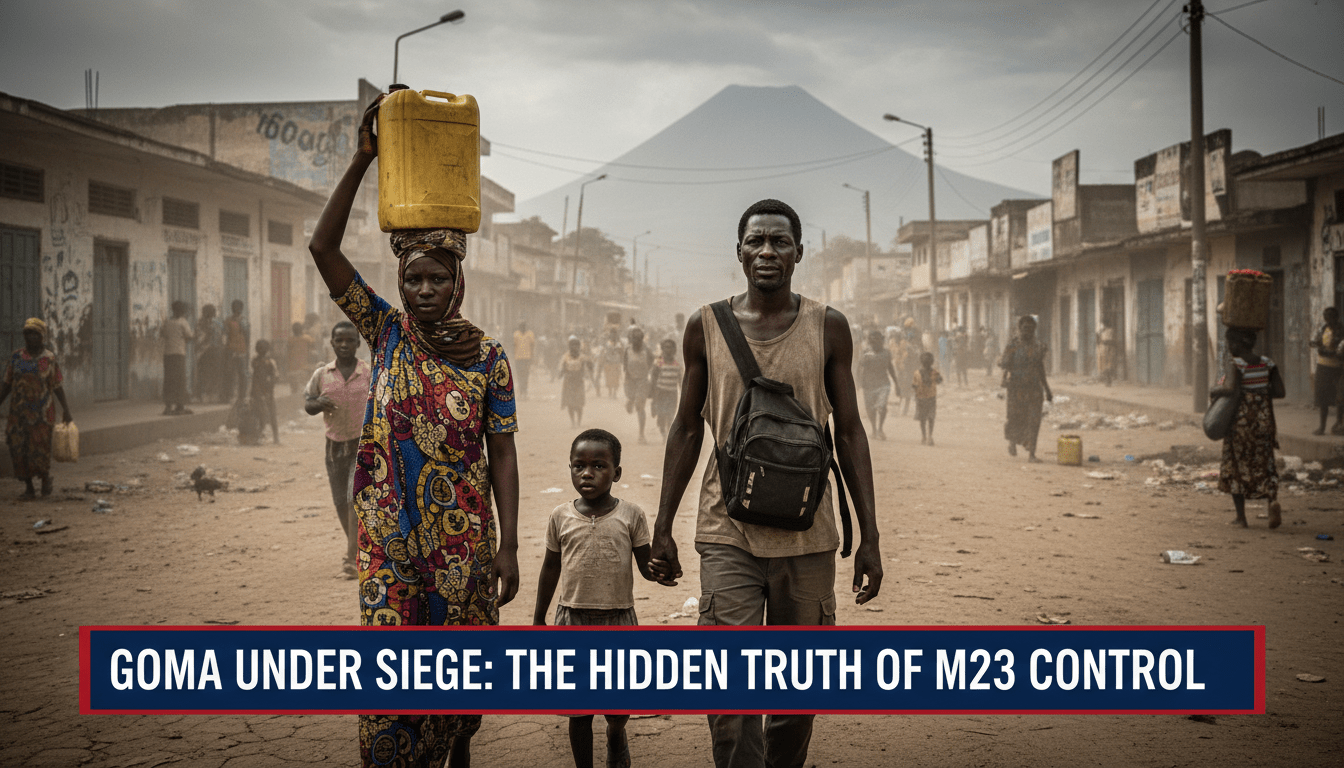
The fear is not limited to physical violence. There is a deep psychological toll on the residents. Many people remain inside their homes, afraid to go out for food or water. The rebels have created a system where they are the only authority. This situation has led to reports of mass graves across the city. The Congolese government estimates that over 770 people died during the initial takeover. By 2026, satellite images showed that many more might be buried in hidden locations (apnews.com).
This atmosphere of terror has forced people to develop new survival strategies. Much like the histories of oppressed people in other parts of the world, Congolese families must navigate a broken system. They look for ways to protect their children from recruitment by the militia. They also try to find enough food to last through the frequent “humanitarian ceasefires.” These pauses in fighting rarely bring true peace. Instead, they offer only a few hours of quiet before the gunfire starts again (reliefweb.int).
The Collapse of Basic Services
The term “brittle basic services” describes the current state of Goma perfectly. Before the takeover, the city was already struggling. Now, the infrastructure is almost completely destroyed. During the heavy fighting, the main high-voltage power lines were cut. This electricity was needed to run the city’s water pumps. When the power stopped, the taps ran dry for over one million people (blue-community.net).
Without clean water, the risk of disease has skyrocketed. Thousands of residents must now walk for hours to reach Lake Kivu. They fill plastic jerrycans with water that is often contaminated. This has led to outbreaks of cholera and other waterborne illnesses. Families are forced to choose between the risk of disease and the risk of thirst. This lack of water is a weapon of war that affects the most vulnerable people first (iom.int).
Hospitals are also in a desperate state. The Charité Maternal Hospital and others must operate in the dark. They rely on expensive fuel to run generators. Doctors have reported having only a few days of fuel at a time. This makes it impossible to provide long-term care for the thousands of wounded people. Many women are forced to give birth without medical help. The destruction of the healthcare system is part of a larger pattern of neglect that has historical roots in the region’s historical and cultural impact (theguardian.com).
Internal Displacement in the DRC (2024-2025)
IDPs (Internally Displaced Persons) in Millions
The Global Hunger for Minerals
The conflict in eastern Congo is often fueled by the world’s demand for technology. The region is rich in minerals like cobalt and coltan. These are essential for making smartphones and electric car batteries. The DRC produces about 70 percent of the world’s cobalt. However, the wealth from these minerals does not reach the Congolese people. Instead, it funds the weapons used by groups like M23 (theguardian.com).
Armed groups often seize control of mining sites. They force people to work in dangerous conditions. Children are frequently used to crawl into small tunnels. This is known as “artisanal” mining, but it is actually a form of modern slavery. The minerals are then smuggled out through neighboring countries and sold on the global market. This “resource curse” ensures that the violence continues because the minerals are so valuable to the rest of the world (theguardian.com).
Activists call this a “Silent Genocide.” They argue that the world ignores the deaths of millions because the victims are African. They also point out that the companies making the technology benefit from the low prices of smuggled minerals. This situation mirrors other historical injustices where the quest for reparations remains an ongoing struggle. The people of Goma are paying the price for the world’s green energy transition (westpoint.edu).
The Role of Foreign Powers
M23 is not acting alone. The United Nations and the United States have accused Rwanda of supporting the rebels. Reports suggest that thousands of Rwandan troops are fighting alongside M23. They have provided the group with advanced weapons, including MANPADS. These are shoulder-fired missiles that can shoot down planes and helicopters. This technology has made it hard for the Congolese army to use its air power (westpoint.edu).
Rwanda denies these claims, but the evidence on the ground is strong. The use of a “proxy” allows a country to fight without declaring war. Rwanda claims it needs to protect its borders from the FDLR. However, many experts believe the goal is to control the mineral-rich land in eastern Congo. This proxy war makes peace very difficult to achieve. The real combatants are often not the ones sitting at the negotiation table (theguardian.com).
The role of the United States is complicated. Currently, under President Donald Trump, the U.S. remains the largest donor of humanitarian aid to the DRC. At the same time, the U.S. provides military aid to Rwanda. This creates a contradiction in American policy. While the State Department tells Rwanda to stop supporting M23, it does not impose heavy sanctions. Many Congolese people feel that the West values Rwanda as a security partner more than it values Congolese lives (westpoint.edu).
The Failure of Peacekeeping
The United Nations has had a large mission in the DRC for over 20 years. This mission is called MONUSCO. It costs over one billion dollars every year. Despite this, MONUSCO has failed to stop the M23 advance. Many residents in Goma are angry with the UN. They feel that the peacekeepers do not do enough to protect them. There have even been violent protests against UN bases in the city (reliefweb.int).
MONUSCO is now in a “phased withdrawal.” The Congolese government asked them to leave because they were not effective. To fill the gap, a regional force from the Southern African Development Community (SADC) has arrived. This force includes troops from South Africa, Tanzania, and Malawi. It is known as SAMIDRC. Unlike the UN, this force has a more aggressive mandate to fight the rebels. However, they are facing a very well-equipped enemy in M23 (reliefweb.int).
The transition between the UN and SADC has created a security vacuum. M23 took advantage of this confusion to seize more territory. The lack of a unified command makes it hard to coordinate an effective defense. For the civilians in Goma, the change in flags does not matter as long as the shells keep falling. They have lost faith in the international community’s ability to bring lasting peace (reliefweb.int, theguardian.com).
Humanitarian Funding Gap (2025)
Only a fraction of the required aid has reached the region by mid-2025.
The Plight of Women and Children
Women and children suffer the most in this conflict. Sexual violence is used as a weapon of war by many armed groups. It is a way to terrorize communities and force them to flee their land. In North Kivu, the number of rape cases has increased dramatically. Displacement camps are often not safe. Women must often trade “survival sex” for basic needs like food or passage through checkpoints (theguardian.com).
Children are also in extreme danger. Many are separated from their parents during the chaos of battle. M23 and other groups have been accused of recruiting child soldiers. These children are forced to carry supplies or even fight on the front lines. The loss of schooling means that a whole generation is losing its future. This cycle of violence and poverty is difficult to break without a major change in the region (theguardian.com).
Despite these horrors, the resilience of Congolese women is remarkable. They are the ones who walk miles for water and find ways to feed their families. They lead small community groups to support each other. Their strength is the foundation of Congolese society. However, they should not have to be this strong. They deserve a life where they do not have to fight for basic survival every single day (theguardian.com).
Conclusion: The Path Forward
Goma remains a city under a dark shadow. The occupation by M23 is the latest chapter in a long history of pain. From the colonial divisions of the past to the mineral wars of today, the Congolese people have been caught in a web of global interests. The current reports of mass graves and dry taps are a call to the world to pay attention. The situation in Goma is not just a local problem. It is connected to the devices we use and the policies our governments follow.
True peace will require more than just a ceasefire. It will require holding the sponsors of rebel groups accountable. It will also require a fair system for the trade of Congo’s minerals. Until then, the people of Goma will continue to live in fear. They will continue to search for water and bury their dead in secret. Their struggle is a testament to the human spirit, but it is a struggle that no one should have to face alone. The history behind the headlines tells us that without justice, the cycle of violence will only continue to turn.
About the Author
Darius Spearman is a professor of Black Studies at San Diego City College, where he has been teaching for over 20 years. He is the founder of African Elements, a media platform dedicated to providing educational resources on the history and culture of the African diaspora. Through his work, Spearman aims to empower and educate by bringing historical context to contemporary issues affecting the Black community.
