


Hidden History of California ICE-Watch Raids and Escalation
By Darius Spearman (africanelements)
Support African Elements at patreon.com/africanelements and hear recent news in a single playlist. Additionally, you can gain early access to ad-free video content.
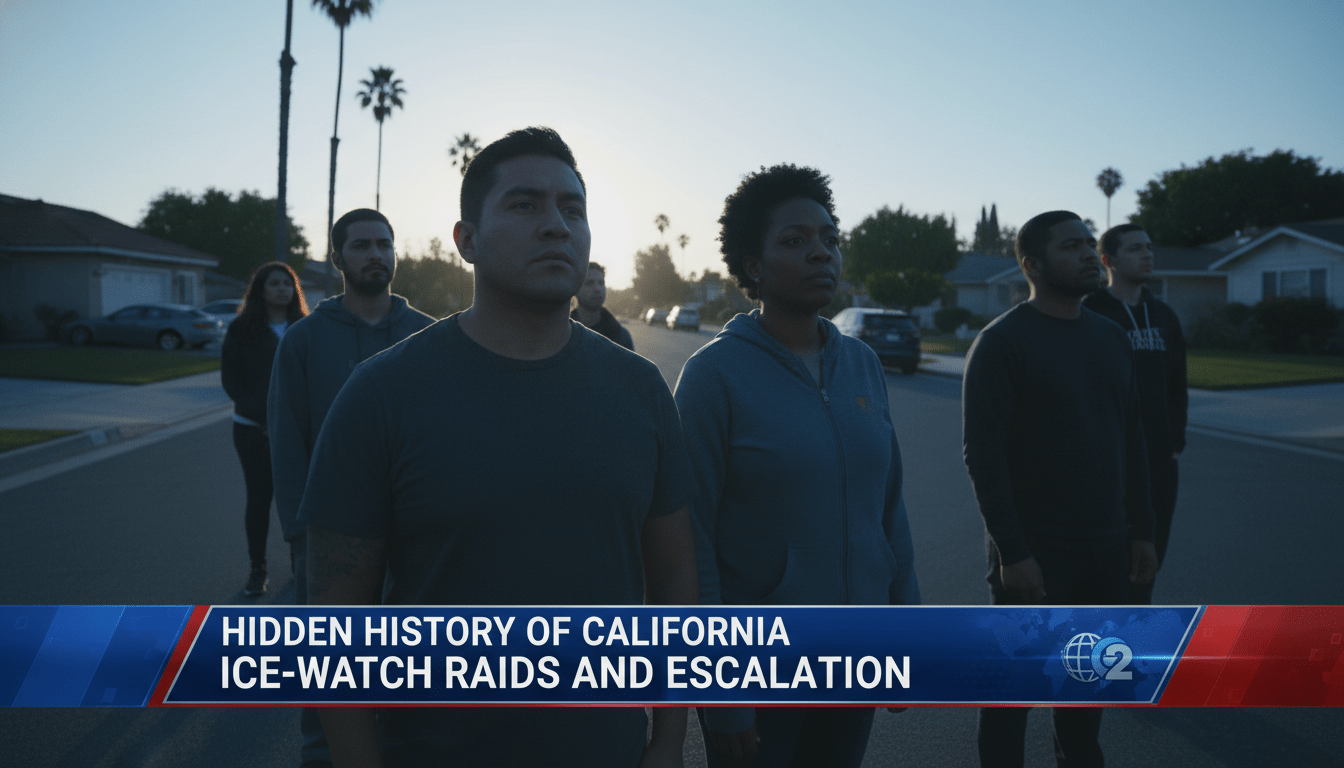
In the early hours of May 13, 2026, federal agents from Homeland Security Investigations executed a series of aggressive pre-dawn raids on the homes of three prominent immigration activists in Ventura County, California. The operation targeted leaders of VC Defensa, a volunteer-led neighborhood watch group known for monitoring federal immigration enforcement actions. The massive show of force shocked local residents and sparked immediate national outrage.
These raids represent a major escalation in a year-long confrontation between community-led defense networks and federal authorities. The tension involves the complex system of federalism and how local activists challenge national law enforcement policies. To understand the current crisis, one must examine the deep historical roots of mass deportation and community resistance in Southern California.
A Violent Catalyst at Glass House Farms
The immediate roots of the May 2026 raids trace back to a massive federal operation in July 2025. Federal agents descended upon the Glass House Farms cannabis greenhouses in Camarillo and Carpinteria. The massive raid resulted in the arrests of over 360 individuals working at the agricultural sites. During the chaos, a farmworker named Jaime Alanis Garcia tragically died after falling from a greenhouse roof while attempting to flee from law enforcement (lasvegassun.com).
The tragedy immediately mobilized the surrounding community. VC Defensa volunteers utilized a rapid-response hotline to rally hundreds of protesters to the site. The ensuing demonstration led to intense clashes with federal agents, who deployed tear gas and rubber bullets against the crowd. In the aftermath of the unrest, the Department of Justice brought severe criminal charges against several VC Defensa members, including Isai Carrillo and Virginia Reyes, accusing them of conspiracy to impede federal officers (latimes.com).
Glass House Farms Raid Impact (July 2025)
The New Counterterrorism Focus
Following the protests at Glass House Farms, the federal government fundamentally altered how it handles community defense organizations. In May 2026, the White House released a sixteen-page Counterterrorism Strategy. This document explicitly classified violent left-wing extremists as a primary domestic threat to national security (lawfaremedia.org). The new designation allowed federal agencies to deploy counterterrorism task forces against local watch groups like VC Defensa.
Federal authorities began framing the tactics used by local neighborhood patrols as operational sabotage. Officials argued that volunteers who followed convoys and published the identities of agents were engaging in organized criminal conspiracies. However, organizers maintained they were simply exercising their First Amendment rights to document public government activity. By labeling these community networks as extremist organizations, the government unlocked powerful counterterrorism tools, including mass digital surveillance and heavily armed tactical raids, to dismantle grassroots advocacy networks (hstoday.us).
Echoes of Historical Mass Removals
The deep distrust of federal immigration authority in Southern California is deeply rooted in history. The present-day resistance strategies were born from a century of intense racial profiling and state-sanctioned displacement. During the Great Depression in the 1930s, the government forcibly repatriated up to two million people of Mexican descent to Mexico. Shockingly, historians estimate that approximately 60 percent of those removed were American citizens (wikipedia.org).
The historical trauma deepened two decades later. In 1954, the Eisenhower administration launched Operation Wetback, a militarized effort that deported over one million people. Agents utilized aggressive tactics in Mexican American neighborhoods, spreading immense fear throughout local communities (wikipedia.org). These historic waves of mass deportation deeply impacted the formation of California and galvanized early community defense theories that continue to inspire modern activists.
The Sanctuary Movement Shift
During the 1980s, the methods of protecting vulnerable populations evolved significantly through the Sanctuary Movement. Religious leaders stepped forward to shield Central American refugees fleeing violence from United States-backed civil wars. A central figure in this movement was Father Luis Olivares, who became a prominent leader in Los Angeles. Before his radicalization, he was heavily involved with Wall Street bankers, wore velvet suits, and drove a Cadillac, earning him the nickname the Gucci Priest.
A meeting with labor leader César Chávez in 1975 dramatically changed the trajectory of his life. Olivares abandoned his luxurious lifestyle to live among and advocate for the immigrant community in East Los Angeles. In 1985, he courageously declared La Placita Church a public sanctuary, openly defying federal law. The movement quickly spread, and by the end of 1985, over 500 congregations across the nation participated. These religious networks established early systems to teach immigrants their legal rights and how to resist federal agents (religionandpolitics.org).
Black Panther Roots of Observation
In the 1990s, community defense strategies shifted from offering passive sanctuary to conducting active militant observation. Modern neighborhood watches draw their primary tactical inspiration from the Black Panther Party. In 1966, the Black Panthers launched cop-watch programs in Oakland, California, as a direct method of community self-defense against police brutality. Armed members carried law books and closely followed police cars to ensure officers followed the law during stops in Black neighborhoods (reddit.com).
Organizers in Southern California directly adapted this concept for immigration defense. In 1992, an organization named Unión del Barrio launched community patrols in San Diego. Volunteers substituted firearms for handheld video cameras and bullhorns to document Border Patrol activities (lataco.com). Today, VC Defensa has grown to over one thousand volunteers who use real-time GPS tracking and live social media broadcasts. These technological advancements aim to remove the element of surprise from federal operations, a tactic the government now labels as a dangerous threat (patriotpulse.net).
The Danger of No-Knock Warrants
The decision to conduct pre-dawn raids on the homes of Ventura County activists involved the highly controversial use of no-knock warrants. A no-knock warrant is a legal order that allows law enforcement officers to forcibly enter a property without prior notification. Civil rights organizations have repeatedly warned that these tactics disproportionately target communities of color and escalate situations into lethal violence. Their usage skyrocketed during the War on Drugs, growing from approximately 1,500 warrants annually in the 1980s to tens of thousands by 2010 (thefreethoughtproject.com).
The tragic death of Breonna Taylor in 2020, a Black medical worker killed during a flawed raid, brought national attention to the catastrophic dangers of unannounced entries. Critics argue that these sudden invasions create intense chaos and confusion, forcing residents to make split-second decisions to protect their homes. By authorizing no-knock warrants against unarmed neighborhood watch volunteers, the federal government significantly escalated the potential for deadly violence (thefreethoughtproject.com). Activists view the use of these warrants as an unapologetic call for racial justice and an urgent demand to end militarized policing.
Black Immigrants and Enforcement Disparities
While the media frequently frames immigration enforcement as an exclusively Latinx issue, Black immigrants suffer from severe and disproportionate targeting. Immigrants from the African and Caribbean diaspora face significantly higher rates of arrest, detention, and physical abuse compared to other groups. Although Black migrants represent only 5.4 percent of the undocumented population in the United States, they account for 20.3 percent of individuals facing deportation on criminal grounds. This disparity highlights the intense over-policing of Black communities that funnels individuals into the deportation system.
Inside federal detention facilities, the racial disparities become even more extreme. Black detainees are six times more likely to be placed in solitary confinement than other populations. Furthermore, despite making up a small fraction of the detained population, they account for nearly 30 percent of all abuse allegations within the system (globalejournal.org). Data from 2026 shows that African-born immigrants are the fastest-growing Black immigrant demographic, yet they endure the lowest release rates from detention centers. This crisis clearly demonstrates the devastating impact of the prison-to-deportation pipeline on Black lives.
Disproportionate Impact on Black Immigrants (2026)
Coalition Building Across Communities
The growing federal pressure has pushed different marginalized communities to unite and share resources. VC Defensa functions as a powerful coalition that bridges Latinx immigrant defense networks with Black-led social justice organizations. These partnerships are deeply rooted in shared struggles against oppression and state violence. For example, VC Defensa actively collaborates with Black Nonbelievers through joint activism programs to support African American and LGBTQ+ student organizers across California (calmigration.org).
This intersectional unity builds upon a profound local history. In Ventura County, Black and Latinx activists share a powerful legacy of militant resistance dating back to 1978, when they joined forces to physically confront the Ku Klux Klan in the city of Oxnard (oregonstate.education). Today, the leadership of modern neighborhood patrols includes Black student activists who view secularism, racial justice, and immigrant defense as interconnected struggles. Together, these diverse volunteers coordinate rapid-response alerts and track unmarked federal vehicles to protect their shared communities.
Criminal Doxxing versus Public Accountability
The central legal conflict surrounding the May 2026 raids involves the federal definition of criminal doxxing. Under federal law, specifically 18 U.S.C. Section 119, it is a felony to publish restricted personal information about federal agents if the clear intent is to incite violence or threaten their safety. Recent legislation, including the 2026 Protecting Law Enforcement from Doxxing Act, seeks to expand these laws heavily. The new legislation attempts to criminalize the publication of any officer’s name if the government believes the intent is to obstruct law enforcement operations (lawfaremedia.org).
Civil rights attorneys vigorously oppose this legal expansion. They argue that identifying agents and documenting their actions during public operations is necessary for public accountability. Legal experts emphasize that recording law enforcement officers is a constitutionally protected First Amendment right. Activists warn that if documenting federal actions is criminalized as operational sabotage, the government will set a disastrous precedent (egattorneys.com). Bystanders who film everyday police misconduct could face federal prosecution under the guise of national security. As the standoff continues, the outcome will drastically shape the future of community defense and constitutional rights in America.
About the Author
Darius Spearman is a professor of Black Studies at San Diego City College, where he has been teaching for over 20 years. He is the founder of African Elements, a media platform dedicated to providing educational resources on the history and culture of the African diaspora. Through his work, Spearman aims to empower and educate by bringing historical context to contemporary issues affecting the Black community.
