


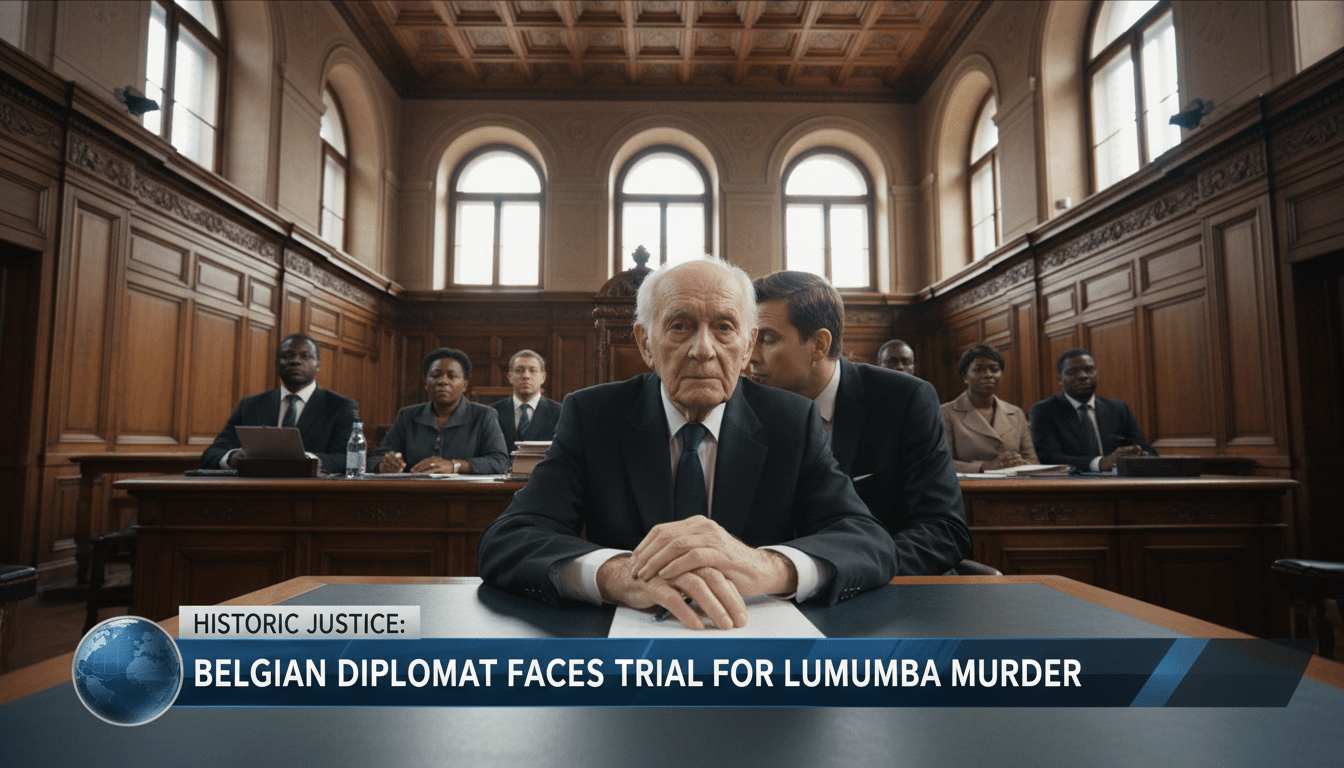
Historic Justice: Belgian Diplomat Faces Trial for Lumumba Murder
By Darius Spearman (africanelements)
Support African Elements at patreon.com/africanelements and hear recent news in a single playlist. Additionally, you can gain early access to ad-free video content.
A court in Brussels made a landmark ruling on March 17, 2026. This decision has sent shockwaves through the global community. Étienne Davignon, a ninety-three-year-old former diplomat, must stand trial. He is accused of playing a role in the 1961 assassination of Patrice Lumumba (theguardian.com, brusselssignal.eu). This legal battle is the result of a sixty-five-year struggle for accountability. It connects the Cold War to the modern movement for justice for the African diaspora.
Patrice Lumumba remains a symbol of hope for people of African descent. He was the first Prime Minister of the Republic of the Congo. His death was not only a tragedy for one nation. It was a blow to the entire Pan-African movement. For decades, the details of his murder were hidden. However, the current legal action proves that the truth can survive even the most brutal attempts to erase it (theguardian.com, ecchr.eu). As the world watches, this trial serves as a reminder that the shadow of colonialism still lingers over modern politics.
The Rise and Legacy of a Pan-African Hero
Patrice Lumumba was a charismatic leader who fought for the soul of Africa. He was a central figure in the Pan-Africanist movement. This ideology promotes the solidarity of all people of indigenous African descent (britannica.com). Lumumba rejected ethnic-based politics. Instead, he sought a unified identity for the Congolese people. He believed that the vast resources of the Congo should benefit its citizens. This stance put him in direct conflict with foreign colonial powers that wanted to maintain control over the nation’s wealth (britannica.com, wikipedia.org).
The movement for Pan-Africanism grew from the ideas of Black intellectuals like W.E.B. Du Bois and Marcus Garvey. They championed the idea that African people share a common destiny. Lumumba took these ideas and put them into practice during the push for independence. His famous speech on June 30, 1960, was a turning point. In front of King Baudouin of Belgium, he denounced the humiliating bondage of colonial rule. This speech made him a hero to his people but a target for Western interests (britannica.com, explaininghistory.org). His leadership was a threat to the traditional strategies of division that colonial powers used to stay in power.
65 Years Toward Justice
1961: Assassination → 2026: Trial Ordered
The Proxy Battleground of the Cold War
The Congo became a primary battlefield during the Cold War. Its immense mineral wealth made it the richest prize in Africa. The United States and the Soviet Union both wanted to influence the region. When Lumumba asked the USSR for military aid to stop a rebellion, Western powers grew afraid. They labeled him a dangerous Soviet proxy to justify his removal (nuclearmuseum.org, state.gov). This perception was used as a pretext for foreign intervention in African affairs. The conflict was not only about politics. It was about who would control the strategic minerals necessary for modern technology and weapons.
Uranium and cobalt were at the heart of this struggle. The U.S. feared that the Soviet Union would gain access to these materials. The CIA Station Chief in the Congo reported that the situation was a classic Communist takeover. This report led the U.S. National Security Council to authorize action against Lumumba (gwu.edu). The assassination of Lumumba set a precedent. It showed that internal African struggles would be viewed through the lens of global power competition. This historical exploitation continues to affect how African nations interact with the West today.
The Architecture of Complicity and the 1961 Murder
The trial of Étienne Davignon focuses on the architecture of complicity. He was a twenty-eight-year-old diplomatic attaché in the Congo at the time of the murder. The prosecution argues that Belgian officials did more than watch from the sidelines. They facilitated the transfer of Lumumba to a region where his death was a near-certainty. Lumumba had been deposed in a coup led by Joseph-Désiré Mobutu. After escaping house arrest, he was captured and flown to the hostile Katanga province (theguardian.com, wikipedia.org). This move was overseen by Belgian officials who knew the dangers he faced.
In Katanga, Lumumba and two associates were tortured. They were eventually executed by a firing squad under the supervision of Belgian officers. The erasure of evidence was just as brutal as the murder. A Belgian police officer later admitted to dissolving the bodies in acid. He scattered the remains to prevent any grave from becoming a place of pilgrimage. However, he kept a single gold tooth as a trophy. This tooth remained in Belgium for decades before it was returned to the Congo in 2022 (africanews.com, theguardian.com). The return of the tooth was a somber event that reignited the demand for a legal reckoning.
Étienne Davignon: A Man of Institutional Power
The significance of this trial is tied to the stature of the defendant. Étienne Davignon is a powerful figure in European politics. He served as the Vice President of the European Commission. This body is the executive branch of the European Union. It proposes laws and manages the daily business of the entire bloc (siliconcanals.com). Davignon was a primary face of Western diplomacy for many years. His prosecution represents a David versus Goliath battle. It pits the family of a murdered leader against one of the most influential bureaucrats in the Western world (brusselssignal.eu, siliconcanals.com).
His defense team maintains that he was a junior diplomat simply following orders. They argue he had no intent to kill. However, the prosecutor has focused on the charge of complicity in war crimes. This case moves beyond the idea of moral responsibility. It seeks to establish legal culpability for actions taken during the colonial era. The trial challenges the idea that high-ranking officials can escape justice for state-sanctioned crimes (thestar.com.my, lachambre.be). It is a major step toward addressing the historical racial injustices that have defined the relationship between Europe and Africa.
The Last
Suspect
Out of 11 original suspects, only one remains to stand trial.
The Role of Corporate Interests and Mining
The assassination of Patrice Lumumba was heavily influenced by corporate interests. The primary corporate actor was Union Minière du Haut-Katanga. This massive mining company was backed by the Belgian government. It ran the Katanga province like a private kingdom. The company produced most of the world’s cobalt and a large amount of its uranium (nuclearmuseum.org, ebsco.com). Lumumba planned to nationalize these resources so that the Congolese people would benefit from their wealth. This plan threatened the profits of the mining conglomerate.
Union Minière played a major role in financing the Katanga secession. The company withheld millions of dollars in royalties from the central government. Instead, it gave that money to the rebel regime in Katanga. This essentially turned the assassination into a corporate hit. The Belgian government used secret funds to support opposition to Lumumba (lachambre.be, ebsco.com). These funds were used to destabilize the young nation. This history shows how economic interests often drive political violence in post-colonial states. It is a recurring theme in the history of the anti-apartheid movement and other struggles for liberation across the continent.
War Crimes and the Geneva Conventions
The charges against Davignon are based on the Geneva Conventions. These are international treaties that set standards for humanitarian treatment during war. The court ruled that the Congo was in a state of armed conflict in 1961. This means that Lumumba was a protected person under international law. His torture and execution without a trial are classified as war crimes (guide-humanitarian-law.org, asil.org). These laws ensure that individuals are held responsible for heinous acts even during times of war.
Davignon is specifically charged with participation in war crimes. This includes the unlawful detention and transfer of a protected person. International law mandates that prisoners must be granted a fair trial. Lumumba was denied this right. This trial is significant because it uses modern international law to address colonial-era violence (asil.org). It establishes that there is no time limit for prosecuting crimes against humanity. The fact that the trial is happening sixty-five years later proves that the legal system can eventually catch up with history.
The Tragedy of the Stolen Métis Children
This trial is part of a broader movement for justice in Belgium. In 2024, a court ruled that the Belgian state was responsible for crimes against humanity regarding Métis children. These were mixed-race children born to Belgian fathers and Congolese mothers. Under a systematic policy, thousands of these children were forcibly taken from their mothers. They were placed in institutions to be Europeanized (ktpress.rw, mozello.com). This policy was designed to maintain white supremacist racial hierarchies in the colony.
Many of these children were stripped of their African names and identities. Some were later sent to Belgium and left without citizenship. The 2024 ruling was the first to mandate reparations for the survivors of this system. These survivors describe themselves as tools of exploitation. The legal acknowledgment of their suffering has paved the way for the Lumumba trial. It shows a systemic shift in how the Belgian justice system views the colonial past. The government is finally beginning to face the reality of its history (africanews.com, ktpress.rw).
The Toll of Colonialism: 10 Million Deaths estimated in the Congo Free State.
US Involvement and the CIA Plot
The United States government also played a role in the plot to remove Lumumba. Investigations by the U.S. Senate in the 1970s revealed that the CIA was deeply involved. CIA Director Allen Dulles authorized the assassination as a prime objective (gwu.edu). This order likely came from President Eisenhower. The CIA even delivered lethal poisons to the Congo for the purpose of killing Lumumba. While the poisoning plot was not the direct cause of death, the U.S. provided the intelligence that led to his capture.
The U.S. actively supported the 1960 coup led by Mobutu. They provided him with the financial and military aid he needed to stay in power. Mobutu later ruled as a brutal dictator for over thirty years. He looted billions of dollars from the national treasury (wikipedia.org, encyclopedia.com). This history shows how foreign intervention can lead to decades of suffering for a nation. Under the current administration of President Donald Trump, the U.S. continues to navigate its complex relationships with African nations. The legacy of these Cold War actions still influences how many people in the diaspora view U.S. foreign policy (gwu.edu).
A Long-Awaited Reckoning for the Diaspora
The trial of Étienne Davignon is more than just a legal proceeding. It is a moment of reckoning for the entire African diaspora. For years, the story of Lumumba was a source of pain and frustration. The fact that a high-ranking European official must now answer for these actions is a form of justice in itself. Yema Lumumba, the granddaughter of the late leader, has called this the beginning of a true reckoning (theguardian.com, ecchr.eu). It transforms a historical tragedy into a modern criminal case.
The trial will likely be a long and difficult process. Davignon is ninety-three years old, and his lawyers will use his age to argue for leniency. However, the legal record created by this trial will be permanent. It will establish the definitive truth about the state’s actions. For many, the verdict serves as a form of symbolic reparation. It is a pursuit of the truth that was once thought to be dissolved in acid sixty-five years ago. This case signals that the era of colonial impunity is finally coming to an end.
About the Author
Darius Spearman is a professor of Black Studies at San Diego City College, where he has been teaching for over 20 years. He is the founder of African Elements, a media platform dedicated to providing educational resources on the history and culture of the African diaspora. Through his work, Spearman aims to empower and educate by bringing historical context to contemporary issues affecting the Black community.
