



How A Federal Ruling Unlocked $1B In Digital Equity Grants
By Darius Spearman (africanelements)
Support African Elements at patreon.com/africanelements and hear recent news in a single playlist. Additionally, you can gain early access to ad-free video content.
The Modern Battle Over Broadband Equity Funds
In July 2026, a federal court in Washington, D.C., issued a landmark ruling regarding high-speed internet access across the United States (lightreading.com). U.S. District Judge John D. Bates delivered a decision in a civil rights lawsuit centered on federal broadband grant money (lawyerscommittee.org). The ruling forced federal commitments to restore over one billion dollars in Digital Equity Act grant funding (lawyerscommittee.org). This funding specifically aims to bridge broadband access gaps in under-connected Black and Brown communities (lawyerscommittee.org).
However, the judicial ruling presented complex outcomes for civil rights advocates and policy leaders (lightreading.com). The court ruled that the executive branch overstepped its constitutional authority by unilaterally terminating the competitive grant program (lawyerscommittee.org). At the same time, Judge Bates ruled that explicit priorities for racial or ethnic minority groups were unconstitutional (lightreading.com). This tension illustrates how modern technological infrastructure connects directly to a broader struggle over federal power and civil rights protections.
From Housing Redlining to Digital Redlining
To understand why high-speed internet access remains deeply unequal, history offers clear context. During the 1930s, the federal government established the Home Owners’ Loan Corporation and the Federal Housing Administration (brookings.edu). These federal entities created color-coded maps to assess mortgage lending risk across urban centers (brookings.edu). Neighborhoods with high populations of Black or immigrant residents were shaded red and labeled hazardous (brookings.edu). This policy denied capital to communities of color and reinforced geographic segregation for generations (brookings.edu). These patterns echo long-standing historical economic exploitation that starved Black communities of systemic resources.
As society shifted into the digital age, private telecommunications companies mirrored these patterns of structural disinvestment (communitynetworks.org, ilsr.org). Major internet service providers systematically avoided deploying high-speed fiber-optic cables in low-income Black and Brown urban neighborhoods (communitynetworks.org, ilsr.org). Researchers and consumer advocates label this pattern digital redlining (communitynetworks.org, ilsr.org). Instead of building modern infrastructure, providers left Black communities with outdated copper networks (ilsr.org). A study conducted in Cleveland demonstrated how telecommunications companies charged residents in low-income Black neighborhoods high rates for slow speeds while building gigabit fiber networks in affluent white suburbs (ilsr.org).
Broadband Access Deficit in Urban Neighborhoods
Percentage of households lacking high-speed home internet access by community demographic.
The Legislative Promise of the Digital Equity Act
Congress intervened to address these systemic technological disparities by enacting the Bipartisan Infrastructure Law in November 2021 (everycrsreport.com). Included within this comprehensive infrastructure bill was the Digital Equity Act, authorized with two point seven five billion dollars (everycrsreport.com). The legislation recognized high-speed internet as essential infrastructure required for modern employment, education, and healthcare (publicknowledge.org).
The statute created two distinct funding mechanisms to target resources directly to under-connected populations (everycrsreport.com). State capacity formula grants received one point four four billion dollars to assist state governments with long-term digital planning (everycrsreport.com). The competitive grant program received one point two five billion dollars to fund community institutions, public libraries, and local non-profits directly (everycrsreport.com). The statute designated eight specific covered populations facing the steepest barriers to digital inclusion (everycrsreport.com). These categories included low-income households, aging adults, veterans, individuals with disabilities, rural residents, incarcerated individuals, language-barrier populations, and racial minority groups (everycrsreport.com).
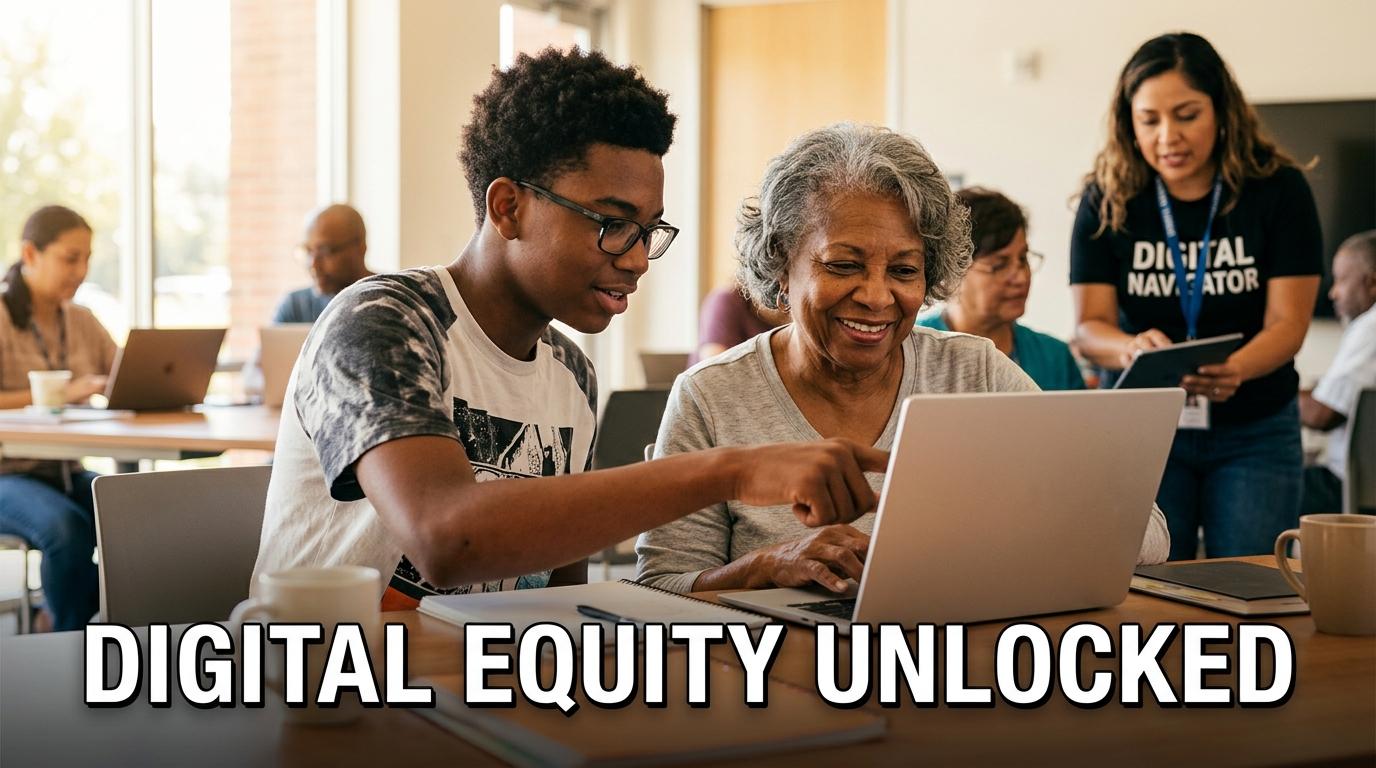
A critical component funded by these competitive grants involves digital navigators (digitalinclusion.org). Digital navigators are trained individuals embedded within local non-profits and libraries who provide personalized support to community members (digitalinclusion.org). They guide residents through securing affordable home internet packages, acquiring computing devices, and developing foundational digital literacy skills (digitalinclusion.org). These navigators ensure that individuals can submit job applications, access virtual healthcare, and complete educational programs effectively (digitalinclusion.org).
Digital Equity Act Funding Allocation ($2.75 Billion Total)
Distributed directly to states for broadband infrastructure planning.
Saved by court ruling; funds local non-profits, libraries, and navigators.
Executive Reversal and the Civil Rights Lawsuit
Political dynamics shifted rapidly in May 2025 when executive officials ordered a complete halt to the Digital Equity Act’s competitive grant program (lightreading.com). Public proclamations criticized the statutory equity initiatives as improper federal spending (lightreading.com). The Department of Commerce and the National Telecommunications and Information Administration immediately froze active grant distribution (lightreading.com). This action canceled pending awards that community organizations relied upon to deliver digital services (lightreading.com, lawyerscommittee.org).
In response to the abrupt termination, civil rights organizations launched legal action in federal court (lawyerscommittee.org). The National Digital Inclusion Alliance, represented by the Lawyers’ Committee for Civil Rights Under Law, filed a lawsuit in October 2025 (lawyerscommittee.org). The plaintiffs argued that the executive branch violated constitutional separation of powers principles (lawyerscommittee.org). Because Congress holds the constitutional power of the purse, executive agencies cannot refuse to distribute funds mandated by federal statute (lawyerscommittee.org). This legal challenge reflected broader shifting civil rights narratives surrounding federal protection and equal opportunity under the law.
Strict Scrutiny and the Mixed Federal Ruling
On July 15, 2026, Judge Bates issued a pivotal ruling regarding the government’s motion to dismiss the case (lightreading.com). The federal court affirmed that executive agencies violated constitutional boundaries by terminating statutory grant spending (lawyerscommittee.org). The judge ruled that executive officials lack the power to cancel programs created by Congress simply due to policy disagreements (lawyerscommittee.org). This decision saved the one point two five billion dollar competitive grant program from permanent termination (lightreading.com, lawyerscommittee.org).
Simultaneously, the court applied strict scrutiny to evaluate the law’s explicit racial classification (lightreading.com). Under constitutional law, strict scrutiny represents the highest standard of judicial review (lightreading.com). To pass strict scrutiny, government policies using racial classifications must serve a compelling state interest and remain narrowly tailored (lightreading.com). Relying on recent Supreme Court precedents, Judge Bates ruled that prioritizing grant funding based on race violated equal protection guarantees (lightreading.com).
To resolve the legal conflict, the court applied the doctrine of severability (lightreading.com). The doctrine of severability allows federal courts to excise an unconstitutional provision from a statute while leaving the remainder operational (lightreading.com). The judge severed the phrase prioritizing racial or ethnic minority groups from the Digital Equity Act (lightreading.com). Consequently, the broader competitive grant program was ordered to move forward using the remaining seven non-racial covered populations (lightreading.com).
Digital Equity Act Covered Populations Status Post-Ruling
The FCC, Digital Redlining, and Regulatory Barriers
Efforts to regulate digital redlining have encountered parallel judicial roadblocks across federal courts (fcc.gov). In November 2023, the Federal Communications Commission established federal rules prohibiting digital discrimination (fcc.gov). The agency defined digital discrimination to include both intentional discrimination and policies producing disparate impact (fcc.gov). Under disparate impact frameworks, neutral business practices that disproportionately harm protected classes without business necessity were declared illegal (fcc.gov).
However, in May 2026, the U.S. Court of Appeals for the Eighth Circuit vacated the agency’s digital discrimination rules in their entirety (fcc.gov). The appellate court ruled that Congress authorized the agency to address intentional treatment only, rather than neutral policies causing unequal outcomes (fcc.gov). This decision limited federal authority to prevent subtle forms of infrastructure neglect in low-income Black neighborhoods (fcc.gov). These structural legal constraints reflect recurring barriers after emancipation that limit systemic remedies for racial disparities.
Adapting Strategy in Black Communities
The removal of explicit racial criteria forces local, Black-led civil rights organizations to alter grant application strategies (lightreading.com). Community-based non-profits can no longer cite serving Black populations as a direct primary qualification for scoring competitive grant applications (lightreading.com). Instead, applicants must demonstrate alignment with non-racial statutory criteria (lightreading.com).
Policy experts emphasize that low-income status serves as an effective, race-neutral metric for directing resources to under-connected Black neighborhoods (lightreading.com). Decades of structural housing discrimination created strong overlaps between geographic concentration, household income levels, and lack of broadband infrastructure (brookings.edu, ilsr.org). By targeting persistent poverty census tracts and low-income urban zip codes, Black-led organizations can still secure grant funds for localized digital inclusion projects (lightreading.com).
The Path Forward for Digital Inclusion
The federal court ruling mandates that federal agencies proceed with releasing the one point two five billion dollar competitive grant program (lightreading.com, lawyerscommittee.org). Municipal libraries, non-profit digital centers, and local advocacy groups will receive essential resources to fund internet access initiatives (digitalinclusion.org). These grant allocations will deliver hardware, subsidized connections, and hands-on digital navigation services to historically marginalized communities (digitalinclusion.org).
Civil rights leaders continue to challenge judicial trends that dismantle explicit race-conscious remedies (lawyerscommittee.org). Advocates maintain that redressing decades of documented infrastructure neglect requires acknowledging racial realities directly (lawyerscommittee.org). While the striking of racial criteria presents a legal hurdle, forcing the release of federal grant funds ensures that essential resources reach communities facing severe technological exclusion (lightreading.com, lawyerscommittee.org).
About the Author
Darius Spearman is a professor of Black Studies at San Diego City College, where he has been teaching for over 20 years. He is the founder of African Elements, a media platform dedicated to providing educational resources on the history and culture of the African diaspora. Through his work, Spearman aims to empower and educate by bringing historical context to contemporary issues affecting the Black community.
