

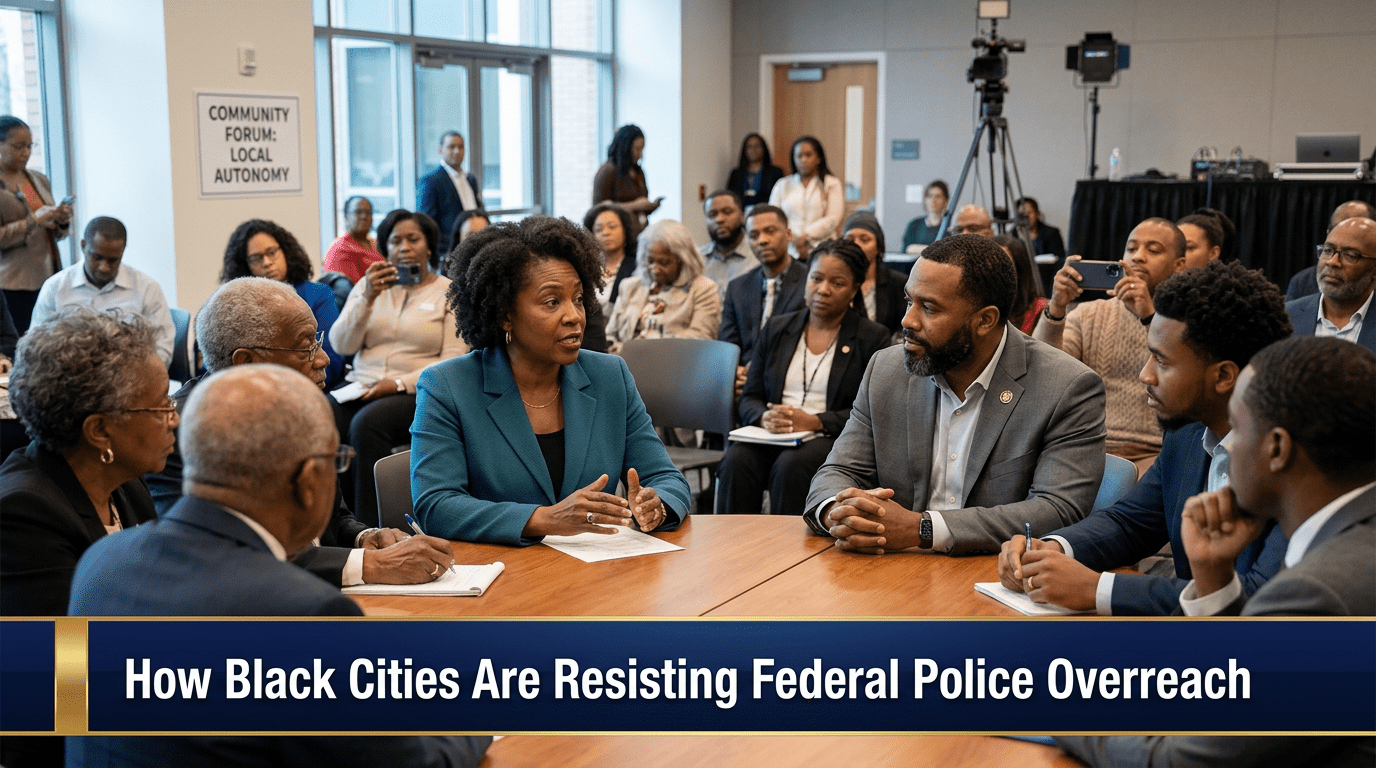
How Black Cities Are Resisting Federal Police Overreach
By Darius Spearman (africanelements)
Support African Elements at patreon.com/africanelements and hear recent news in a single playlist. Additionally, you can gain early access to ad-free video content.
The landscape of American public safety is undergoing a seismic shift. As President Donald Trump continues to exert federal authority, many cities across the United States face a unique challenge. Federal agents often appear in streets and neighborhoods without local invitation. This presence creates a conflict that threatens the very core of local democratic control. In response to this rising tension, the Center for Policing Equity (CPE), in partnership with the Justice Collaboratory at Yale Law School, released a critical document this month: The People’s Safety Report (policingequity.org, yale.edu).
This report acts as a manual for cities and Black communities to protect their autonomy. It provides a strategic framework to counter federal intrusions that often bypass local leadership. To understand why this report matters, one must look at the history behind the headlines. The tension between federal power and local authority has deep roots in the American experience (policingequity.org, cbsnews.com).
The Long History of Policing and Control
To grasp the significance of The People’s Safety Report, one must examine the origins of American policing. It did not begin with the idea of community protection. Instead, the earliest organized forms of policing in the American South, known as Slave Patrols, were created in the 1700s. These patrols were established in the Carolina colonies to control the movements of enslaved people (ferris.edu).
These groups were government-sponsored forces composed of local white men. Their primary duty involved preventing slave uprisings and insurrection. They monitored for weapons and unauthorized gatherings, fearing that Black resistance would destroy the established economic and racial hierarchies. These patrols held the authority to enter homes without a warrant to search for escaped enslaved persons. This history demonstrates that policing began as a mechanism for social control rather than a service for public safety (ferris.edu).
Following the Civil War, these dynamics shifted but did not disappear. In the years after 1865, state and local governments enacted Black Codes. These laws aimed to maintain white supremacy and a cheap labor force by criminalizing the daily existence of formerly enslaved people. They included vagrancy laws that allowed the state to arrest Black citizens for being unemployed or without a residence. The enforcement of these codes often fell to early, militia-style police forces that evolved directly from the previous slave patrol system (naacp.org, naacp.org).
The era of Jim Crow further solidified this relationship. These laws mandated segregation in public facilities, transportation, and housing. Jim Crow was a legal system enforced by state-sponsored violence and the local police departments that emerged in the early 20th century. Modern scholarship identifies Jim Crow as the era of state-sponsored racial suppression that cemented a deep mistrust between Black communities and law enforcement (whitehousehistory.org, sandiego.edu).
This history of the sharing of power between national and state governments continues to impact African Americans. Today, the debate over who controls the streets is a continuation of these historical struggles for sovereignty and dignity.
Disparity in Use of Force Incidents
Black Americans are significantly more likely to be targets of police force (policingequity.org, policingequity.org).
Relative probability compared to white counterparts.
The Modern Conflict: Federal vs. Local
In recent years, the deployment of federal agents has become a point of intense controversy. When federal agencies—such as the Department of Homeland Security—enter cities without the request or consent of local governments, it creates a crisis of accountability. The primary legal basis cited for these deployments is 40 U.S.C. § 1315. This code authorizes the Secretary of Homeland Security to protect federal property and the people on that property (cbsnews.com).
The legal controversy arises because the executive branch uses this statute to authorize federal agents to police streets and respond to protests far away from actual federal buildings. Critics argue that this expands the jurisdiction of federal agents beyond their intended purpose. It essentially allows them to function as a paramilitary force against the wishes of local municipal leadership. This phenomenon creates the dynamic of an “occupying force,” where residents feel that their local government has lost the ability to protect them from external coercion (cbsnews.com).
The Justice Collaboratory at Yale Law School emphasizes that public trust in the police is built on fair treatment and transparency. They advocate for procedural justice, which argues that the central goal of the criminal legal system should be to increase cooperation between individuals and the state (yale.edu, yale.edu). When federal agencies bypass this trust by using “nondescript” agents in tactical gear without clear identification, they destroy the foundation of accountability that local departments have worked to build (cbsnews.com).
This is where The People’s Safety Report offers a way forward. It encourages local governments to pass legislation to bar the use of unidentified federal enforcement agents within their jurisdictions. By demanding that all agents wear clear identification, badges, and agency patches, cities can ensure that their residents remain safe from unidentified armed groups. This policy separates legitimate law enforcement from unauthorized actors (policingequity.org, cbsnews.com).
The Scientific Framework for Equity
The CPE and Yale Law partnership does more than critique the current system. It offers a “scientific framework” that helps police departments track non-crime behaviors with the same rigor they use to track crime. This data-driven model, often called a “COMPSTAT for Justice,” analyzes police administrative data to identify and reduce racial disparities (policingequity.org, policingequity.org).
Data gathered from 25 cities that previously adopted this framework showed a 26% drop in use-of-force incidents and a 25% decrease in arrests. These results occurred without causing an attendant crime surge. This success proves that accountability and public safety are not mutually exclusive. Instead, they reinforce each other (policingequity.org, audaciousproject.org).
The Scientific Framework
The cycle of Audit, Identify, and Implement creates systemic change. Cities using this model saw a 26% reduction in force incidents (policingequity.org, policingequity.org).
The framework involves auditing departmental data to identify specific behaviors. For example, it looks at which types of stops are most likely to lead to force. Once identified, departments can implement policy changes to restrict those behaviors. One concrete example includes implementing “duty to intervene” policies. This policy mandates that officers report or stop colleagues who use excessive force. Such strategies demonstrate that data can lead to safer outcomes for both officers and community members (policingequity.org, policingequity.org).
For those interested in how these struggles for control shape modern life, it is helpful to look at how enslaved people forged survival strategies in changing landscapes. The drive for autonomy remains the same, even if the tools of resistance have evolved into data analysis and legal reform.
Reclaiming Local Autonomy
The tension between federal authority and local autonomy is a defining feature of American politics. While the federal government has a constitutional role in protecting civil rights—a legacy of the Reconstruction era—the report argues that this power must not become a political tool to undermine local democratic processes (policingequity.org).
The report suggests that local governments should retain primary authority over their police departments. This structure ensures community accountability. When the federal government encroaches, the most effective defense is a proactive, well-informed, and legally prepared community. The document encourages local officials to establish rigorous communication protocols. These protocols ensure that the public remains informed about any federal presence, the scope of the operation, and the specific mandates of the agents involved (policingequity.org).
By moving beyond the binary of “pro-police” versus “anti-police,” the report provides a path for cities to regain control. It focuses on the legal and political tools for local autonomy. This approach is essential because, without clear legal guardrails, the federal government may use “exceptions” to bypass established public safety protocols that communities have worked to build over decades (policingequity.org, yale.edu).
The History of Control
Dr. Phillip Atiba Solomon, the CEO of the Center for Policing Equity, stated that the nation must preserve standards of accountability and transparency. Without these, the rule of law is replaced by selective terrorism (policingequity.org). This warning is stark but necessary. As the United States grapples with these tensions, the collaboration between the CPE and Yale Law School serves as a vital bridge between academic legal research and on-the-ground activism (policingequity.org, yale.edu).
Historically, the struggle for freedom has often involved understanding how global events shape US politics. Today, the focus is on local governance. By equipping local leaders with legal tools, this report empowers them to resist federal intrusions. It asserts that public safety is a local issue that should be governed by the people who live in the community, not by federal agents who lack local ties and accountability (policingequity.org).
The path forward requires vigilance. Cities across the country now have a roadmap to defend their constituents’ rights. Whether through enacting legislation against unidentified agents or utilizing data to hold departments accountable, the goal remains the same: to create a system where the rule of law applies to everyone equally. This report is poised to become a foundational text for municipal leaders who seek to reclaim their power and protect their communities from overreach (policingequity.org).
About the Author
Darius Spearman is a professor of Black Studies at San Diego City College, where he has been teaching for over 20 years. He is the founder of African Elements, a media platform dedicated to providing educational resources on the history and culture of the African diaspora. Through his work, Spearman aims to empower and educate by bringing historical context to contemporary issues affecting the Black community.
