
How Black Farmers Survive Historic Federal Funding Cuts
By Darius Spearman (africanelements)
Support African Elements at patreon.com/africanelements and hear recent news in a single playlist. Additionally, you can gain early access to ad-free video content.
A Turning Point in Mississippi
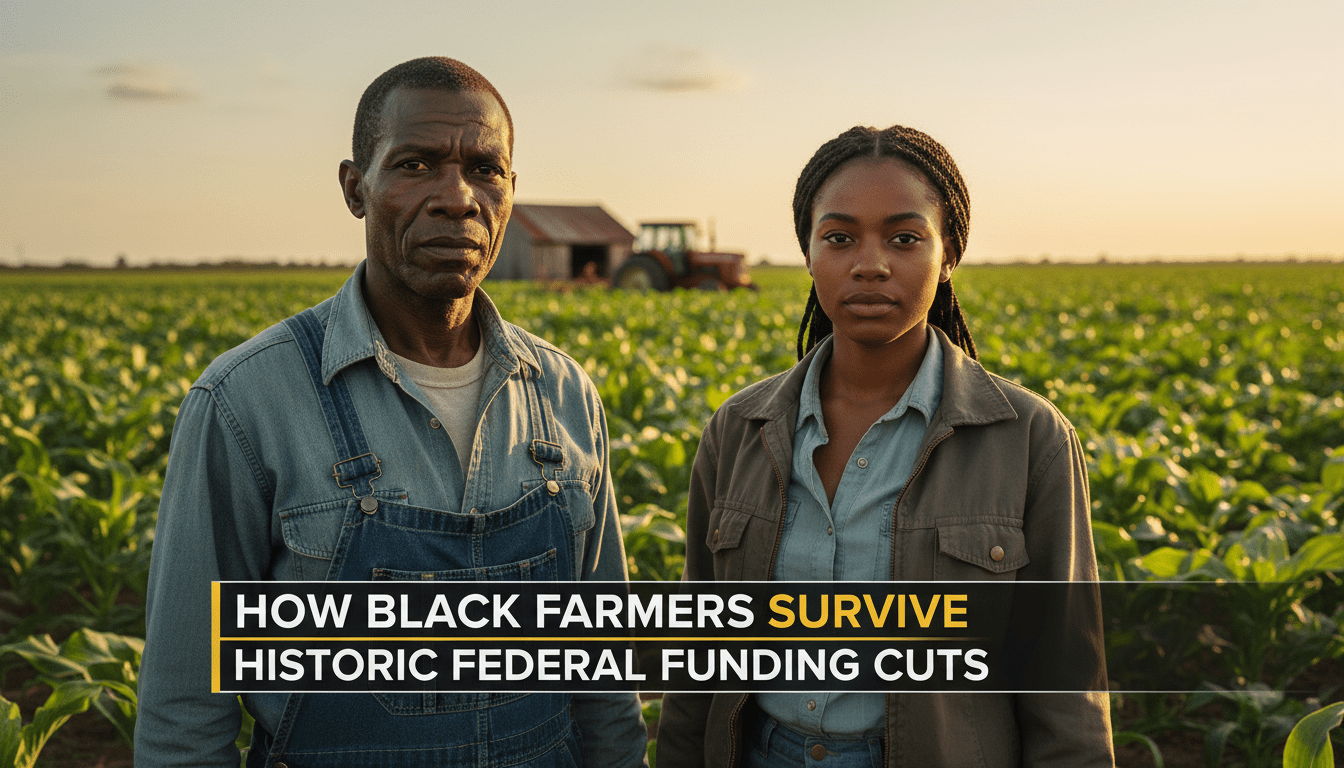
The agricultural landscape for Black producers is experiencing a massive transformation. In April 2026, the Saving Rural America Small Farmers Conference convened in Shannon, Mississippi. During this event, Black farmers discussed critical strategies for survival. They focused heavily on building independent community partnerships. They also prioritized youth mentorship to bypass dwindling resources and policy shifts from the current administration of Donald Trump.
This gathering marked a significant pivot for Black agriculturalists. Recent policy shifts have rapidly dismantled federal equity programs. As a result, Black producers are increasingly stepping away from traditional government reliance. They are building private ecosystems to sustain their livelihoods. This shift is a direct response to a changing political climate where federal aid is no longer guaranteed.
The pivot toward community self-reliance is deeply rooted in history. It represents the latest chapter in a century-long struggle for land retention and economic autonomy. The transition reflects a broader understanding that structural support can disappear instantly. Therefore, community-driven solutions are essential for the survival of Black agriculture in the United States (capitalbnews.org, capitalbnews.org).
The Promise and Loss of Land
The history of Black farming in America features a complex journey of rapid land acquisition followed by systemic dispossession. Following the Civil War, the government issued General Sherman’s Field Order 15, known widely as the “Forty Acres and a Mule” promise. President Andrew Johnson largely rescinded this order, returning land to former Confederates. Consequently, newly emancipated individuals faced new forms of involuntary servitude after the Civil War.
Despite these massive setbacks, Black farmers began to acquire land through the Southern Homestead Act of 1866. Their determination led to significant progress. By the year 1910, Black land ownership reached a peak of approximately 16 million acres. Black farmers operated roughly 925,000 farms, which constituted 14 percent of all farms in the nation at that time.
However, this success was temporary. Over the next century, Black farmers experienced a 97 percent decline in farm ownership. Legal vulnerabilities, particularly the issue of “heirs’ property,” played a massive role. Heirs’ property refers to land passed down informally without a clear will. This creates tenancy-in-common ownership. Because the property lacks a clear title, owners often cannot secure commercial loans. Furthermore, any single heir can force a court-ordered partition sale. This loophole allowed speculators to purchase family farms at below-market values, devastating generations of wealth (americanbar.org, oaklandinstitute.org).
The Legacy of Agricultural Cooperatives
In response to systemic exclusion, Black farmers historically turned to cooperative economics and education. Foundational figures revolutionized Black farming techniques. George Washington Carver at the Tuskegee Institute was instrumental in this effort. Carver created the “Jesup Wagon,” which functioned as a mobile classroom. This wagon brought sustainable agriculture and soil regeneration techniques directly to poor farmers.
These educational efforts fostered self-sufficiency. They allowed agricultural workers to bypass the exploitative sharecropping system. The early cooperative movement laid the groundwork for future generations. The impact of Black-owned businesses and independent farming operations demonstrated the power of community reliance.
Decades later, civil rights leader Fannie Lou Hamer continued this tradition. In 1969, Hamer founded the Freedom Farmers Cooperative in the Mississippi Delta. Her organization aimed to provide food sovereignty and political power for Black residents. The cooperative purchased land and provided resources for families who faced eviction for registering to vote. These historical examples of collective action serve as the blueprint for today’s agricultural pivot (wikipedia.org, dtnpf.com).
A History of Discriminatory Policies
The decline of Black farms is closely tied to institutional discrimination. For decades, Black farmers referred to the United States Department of Agriculture as “The Last Plantation.” The agency earned this nickname due to its direct role in the dispossession of minority-owned land. Local county committees managed federal programs. White landowners often controlled these committees completely.
These local boards systematically denied Black farmers the resources they desperately needed. They refused loans, delayed crop insurance payouts, and denied disaster relief. Consequently, Black farmers faced higher interest rates and foreclosure. Meanwhile, their white counterparts received timely assistance to expand their operations. The discriminatory loan servicing pushed countless Black families off their ancestral lands.
The systemic abuse eventually led to legal action. Between 1997 and 1999, the landmark class-action lawsuit Pigford v. Glickman exposed these practices. The lawsuit proved the USDA had discriminated against Black farmers for years. It resulted in the largest civil rights settlement in United States history, totaling nearly one billion dollars. However, many advocates argued the relief was insufficient. Millions of acres had already vanished permanently (mslegal.org, eji.org).
Redefining Social Disadvantage
The federal government initially attempted to correct past harms through targeted policies. The Food, Agriculture, Conservation, and Trade Act of 1990 formally codified the term “socially disadvantaged.” This designation identified farmers who faced racial or ethnic prejudice. It included African Americans, American Indians, Alaskan Natives, Hispanics, Asians, and Pacific Islanders. In 1992, the government expanded the definition to include women.
The designation allowed the government to provide targeted technical assistance. It also permitted “set-aside” funding for groups facing systemic barriers to credit. For over three decades, this classification served as a lifeline for minority farmers. It acknowledged the historical inequities within the agricultural sector.
However, recent legal and political shifts have erased this framework. On July 10, 2025, the USDA published a final rule in the Federal Register. This rule removed race-based and sex-based preferences from federal programs. The current administration transitioned the agency to a “race-neutral” framework. Officials claimed that previous settlements like Pigford v. Glickman had sufficiently addressed past discrimination (usda.gov, federalregister.gov).
The Cancellation of Debt Relief
The push for race-neutral policies led directly to massive funding cuts. A primary casualty was the Inflation Reduction Act Section 22007. This section had originally authorized 2.2 billion dollars in compensation for farmers who faced racial discrimination. The legislation offered a glimmer of hope for farmers burdened by decades of unfair lending practices.
Conservative groups aggressively challenged this race-based aid in court. They argued that targeting relief based on race violated the Equal Protection Clause of the Fourteenth Amendment. In the 2024 case Strickland v. USDA, the court issued an injunction against the relief programs. The court applied “strict scrutiny,” ruling that the programs were unconstitutional preferences.
By late 2025, the government officially canceled the 2.2 billion dollar debt relief program. Government filings renounced race preferences entirely. Officials stated that disasters do not discriminate, and neither should the government. This cancellation left thousands of marginalized farmers with overwhelming debt and no federal recourse (theguardian.com, usda.gov).
The End of the Land Access Program
The aggressive defunding continued into the following year. In April 2026, the administration eliminated the Increasing Land, Capital, and Market Access Program. The government had established this 300 million dollar initiative to help underserved producers acquire and retain farmland. Advocates viewed the program as a crucial tool for fighting the 326 billion dollar wealth gap caused by historic land loss.
The current administration justified the termination with allegations of misuse. Secretary Brooke Rollins claimed the prior administration weaponized the program. She argued the funds supported Diversity, Equity, and Inclusion initiatives rather than merit-based agricultural operations. Audits targeted grants that lacked a strict race-neutral foundation.
This termination devastated community organizations. Groups like Farm School NYC and the Black Farmers United of New York State reported sudden freezes in federal grants. These urban agriculture centers depended heavily on federal funding. Without it, they entered survival mode. They resorted to emergency fundraising and implemented sliding-scale tuition for their agricultural training programs just to keep their doors open (capitalbnews.org, thecharlottepost.com).
Food Sovereignty Over Food Security
Faced with a hostile federal landscape, Black farmers are changing their fundamental philosophy. They are shifting their focus from food security to food sovereignty. Food security simply ensures all people have access to enough calories, regardless of where the food comes from. Food sovereignty demands much more from the agricultural system.
Food sovereignty is the right of people to consume healthy and culturally appropriate food. Importantly, it emphasizes ecologically sound production methods. Furthermore, it asserts the right of communities to define their own food and agriculture systems. This concept places the producers and consumers at the heart of policy, rather than corporate agribusinesses.
This ideological shift requires true independence. Marginalized farmers realize they cannot achieve sovereignty while relying on federal systems that actively defund them. Therefore, they advocate for local control over production and distribution. They seek to empower family farmer-driven agriculture to build true resilience against political instability (mdpi.com, foodprint.org).
The Rise of Independent Community Partnerships
To realize food sovereignty, the community is actively building independent partnerships. Organizations like the Black Farmer Fund and the Federation of Southern Cooperatives lead this movement. They recognize that relying on government agencies is dangerous. Consequently, they are seeking private donors to establish resilient “Black Farmer Ecosystems.”
These independent networks provide practical solutions. For example, farmers use the network to share expensive equipment, such as combines and tractors. They also create local supply chains that completely bypass markets managed by the federal government. This approach reduces overhead costs and keeps money circulating within the community.
At the Shannon conference, organizers heavily promoted the “We Got Us” movement. This phrase embodies the shift toward collective power. Navigating the sharing of power between national and state governments has proven ineffective for marginalized farmers. Therefore, creating private infrastructure is the only logical path forward (capitalbnews.org, ebonywoodruff.com).
Empowering Youth for Future Resilience
Ensuring the continuity of these farms requires engaging the next generation. The current average age of a Black farmer is nearly 60 years old. Without younger people stepping in, the remaining farmland will likely fall into the hands of corporate developers. Therefore, youth mentorship is a foundational strategy for survival.
Programs across the South are actively recruiting young people into agriculture. The Mississippi Farm to School Youth Leadership Cohort connects elementary and high school students with sustainable food systems. The program trains the next generation of food justice advocates. It teaches them the importance of land ownership and environmental stewardship.
For older youth, the Southern Farmer Leadership Fellowship provides advanced training. This year-long program equips young individuals with essential networking and leadership skills. They learn how to navigate the current hyper-political agricultural landscape. By drawing on Black family strength and intergenerational knowledge, these fellowships ensure the legacy of Black farming survives the current federal funding freeze (mississippifarmtoschool.org, kcur.org).
Building a Self-Sufficient Future
The loss of federal backing demands innovative financial solutions. The community cannot recover the estimated 326 billion dollars in lost generational wealth through traditional banking. Traditional banks deny loans to Black farmers at twice the rate of white applicants. Because of this, grassroots organizations are stepping in to provide capital.
The “We Got Us” initiative includes plans to establish independent credit unions. Organizers are also creating revolving loan funds. These financial instruments provide the capital that federal agencies refuse to offer. They allow farmers to purchase seeds, repair equipment, and clear legal hurdles related to property titles.
Ultimately, the pivot discussed in Mississippi represents a profound declaration of independence. Black farmers are building a future where their success does not depend on shifting political winds. By relying on private partnerships, collective economics, and youth empowerment, they are actively constructing a resilient agricultural ecosystem for generations to come (warrenswcd.org, changeforchildren.org).
About the Author
Darius Spearman is a professor of Black Studies at San Diego City College, where he has been teaching for over 20 years. He is the founder of African Elements, a media platform dedicated to providing educational resources on the history and culture of the African diaspora. Through his work, Spearman aims to empower and educate by bringing historical context to contemporary issues affecting the Black community.