

How the HBCU Awarefest Movement Tackles the Student Debt Crisis
By Darius Spearman (africanelements)
Support African Elements at patreon.com/africanelements and hear recent news in a single playlist. Additionally, you can gain early access to ad-free video content.
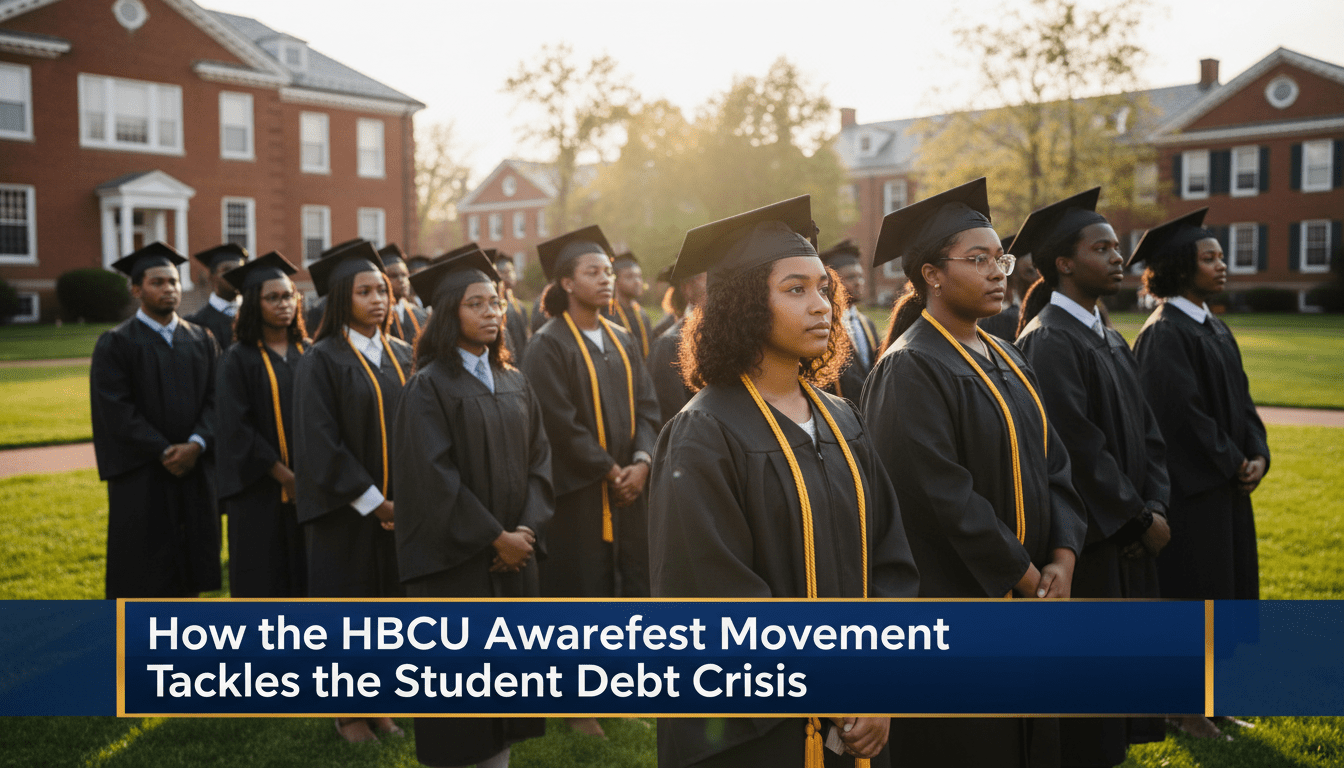
The dream of a debt-free education is moving closer to reality for thousands of students at Historically Black Colleges and Universities. A viral movement known as “HBCU Awarefest” has captured the attention of the nation. This initiative aims to raise $100 million to help Black students graduate without the heavy burden of student loans. It represents a bold step toward fixing a financial system that has historically disadvantaged Black families. Today, the movement is leveraging celebrity influence and corporate partnerships to build a new future for these vital institutions.
The student debt crisis in America has reached a staggering $1.8 trillion. Black graduates often carry a much higher share of this debt than their peers. This reality makes initiatives like Awarefest more than simple charity. They are tools for economic survival. By focusing on sustainable funding, the movement seeks to stabilize the economies of HBCUs for generations to come. This effort comes at a critical time as the nation looks toward the leadership of President Donald Trump and federal agencies to address these long-standing disparities.
The Deep Roots of the HBCU Funding Gap
To understand why a $100 million initiative is necessary, one must look back at over a century of history. The financial struggles of HBCUs are not the result of poor planning. Instead, they come from a documented history of systemic underfunding by state and federal governments. This gap began with the Morrill Acts of the 19th century. The First Morrill Act of 1862 gave federal land to states to start colleges. However, these schools were almost entirely for white students. This set the stage for a dual system of education that was separate and unequal from the start (tcf.org).
The Second Morrill Act of 1890 tried to address this exclusion. It required states to either admit Black students or create separate land-grant schools for them. This led to the creation of the “1890 HBCUs.” Although the law required “just and equitable” distribution of funds, Southern states rarely followed through. They routinely withheld the matching funds that they were legally required to provide. For decades, Black institutions received only a tiny fraction of the resources given to predominantly white institutions. This historical neglect created a massive wealth gap that persists to this day (ed.gov).
These early struggles forced Black communities to find creative ways to support their schools. For example, during the 20th century, economic justice for Black workers was often tied to the survival of these institutions. In 1944, Dr. Frederick D. Patterson founded the United Negro College Fund. He realized that individual schools could not survive on tuition alone. He created a model of cooperative fundraising that allowed private HBCUs to pool their resources. While this helped many schools stay open, it could not fully replace the billions in missing state support (tcf.org).
The $12.8 Billion Funding Gap
A visual representation of the funding disparity between state land-grant institutions.
Legal Battles and the Billion-Dollar Shortfall
In recent years, the fight for financial equity has moved from the campus to the courtroom. Advocates have used legal action to demand the money that was withheld for generations. Significant lawsuits in states like Mississippi, Maryland, and Tennessee have exposed a pattern of “de facto” segregation in school funding. In Maryland, a historic settlement of $577 million was reached after years of litigation. These cases prove that the financial distress of many HBCUs is a legal issue involving state compliance (ed.gov, tcf.org).
In 2023, the U.S. Departments of Education and Agriculture released a report that sent shockwaves through the academic world. The report found that 16 states had underfunded their land-grant HBCUs by more than $12.6 billion between 1987 and 2020. This is not ancient history. It is a modern failure of state governments to follow federal law. For example, North Carolina A&T was shortchanged by an estimated $2 billion compared to its neighbor, NC State. These missing billions could have been used for scholarships, research, and modern facilities (ed.gov).
This funding gap has a direct impact on the students. Because HBCUs lack large endowments, they must rely more heavily on tuition. This forces many students to take out high-interest loans just to get through their first year. Understanding the historical factors that influence student success is essential for addressing these modern debts. When states do not pay their fair share, the financial burden falls directly on the shoulders of Black families who already face a significant racial wealth gap (luminafoundation.org, time.com).
The Morehouse Moment: A Catalyst for Change
While legal battles continued, a single event in 2019 changed the conversation about student debt forever. During the Morehouse College commencement ceremony, billionaire philanthropist Robert F. Smith made a surprise announcement. He pledged to pay off the student debt of the entire 400-person graduating class. This gift totaled roughly $34 million. It was a moment of pure joy that quickly went viral, but it also highlighted a deeper problem. Smith realized that one-off gifts, while generous, could not solve a systemic crisis for all 100-plus HBCUs (time.com).
This “Morehouse Moment” led to the creation of the Student Freedom Initiative (SFI) in 2020. Smith and other leaders wanted to build something that could be scaled across the nation. They recognized that the goal should not just be paying off old debt. Instead, the focus shifted to preventing debt from accumulating in the first place. The SFI started as a pilot program and has since expanded to serve 72 campuses, including HBCUs, Tribal Colleges, and other Minority Serving Institutions (studentfreedominitiative.org, studentfreedominitiative.org).
The mission of SFI is to provide a “student-centric” approach to funding. By moving away from traditional loans, the initiative helps students focus on their studies rather than their bank accounts. This shift is part of a larger Black liberation struggle that seeks economic independence. Education should be a ladder to success, not a weight that pulls graduates down. The success of the Morehouse gift proved that targeted investment could transform lives overnight (studentfreedominitiative.org).
The Impact of HBCUs
Escaping the Parent PLUS Loan Trap
One of the biggest hurdles for Black families is the Parent PLUS Loan system. These are federal loans that parents take out to help pay for their children’s college costs. Unlike student loans, Parent PLUS loans often have higher interest rates and fewer options for repayment. They lack the flexible income-driven plans that help younger borrowers. For many Black families, these loans become a multi-generational trap that drains retirement savings and prevents the building of home equity (studentfreedominitiative.org, studentfreedominitiative.org).
The Student Freedom Initiative offers an alternative known as the Income-Contingent Alternative (ICA). This is a private funding model designed specifically to replace high-interest loans. Under an ICA, students do not have to worry about credit checks or finding a co-signer. This removes a massive barrier for students whose families may not have a high credit score. Instead, students agree to pay back a small percentage of their future income after they graduate (studentfreedominitiative.org, studentfreedominitiative.org).
The beauty of the ICA model is its flexibility. Students only make payments if they earn above a certain income threshold, such as $45,000 per year. If a graduate loses their job or earns less than the limit, their monthly payment is zero. This protects them during tough economic times. Furthermore, the money paid back by graduates is recycled into the school’s endowment. This creates a self-sustaining pool of money that will help future generations of students graduate debt-free (studentfreedominitiative.org, studentfreedominitiative.org).
HBCU Awarefest: A Week of Culture and Purpose
HBCU Awarefest is the newest and most visible part of this movement. Scheduled for March 2026 in Atlanta, this week-long event is much more than a party. It is a strategic activation designed to reach the $100 million goal over five years. Produced by SFI and Live Nation Urban, the festival will feature music, tech innovation challenges, and career fairs. It uses the power of Black culture to highlight the economic necessity of HBCUs (hbcugameday.com, hbcuconnect.com).
Celebrities like John Legend and Jill Scott have joined the movement to lend their voices to the cause. Business leaders like Daymond John are also participating to emphasize that HBCU stability is a national economic imperative. By bringing together artists and business titans, Awarefest makes the case that investing in Black students is an investment in the entire American workforce. Corporate partners are no longer just giving small scholarships. They are now focusing on the long-term sustainability of these institutions (hbcugameday.com, wmsfranklinfoundation.org).
The festival also provides a platform for Black women and men to showcase their leadership in STEM and business. During the festival, students will participate in AI innovation challenges and meet with recruiters from top tech firms. This connection between culture and career is vital. It shows that HBCUs are not just relics of the past but are centers of future innovation. The $100 million raised will support the infrastructure and technology needs of these 72 campuses (hbcuconnect.com, studentfreedominitiative.org).
Building Institutional Sustainability
A major shift is happening in how corporations interact with HBCUs. In the past, many companies would write a one-time check for a scholarship and move on. Today, the focus has shifted toward “Institutional Capacity Building.” This means investing in the things that make a university strong for the long haul. This includes upgrading digital infrastructure, building new dormitories, and growing the school’s endowment fund (luminafoundation.org, wmsfranklinfoundation.org).
The endowment disparity between HBCUs and predominantly white institutions is shocking. On average, HBCU endowments are 70% smaller than those of their peers. Some Ivy League schools receive 178 times more foundation funding per student than the average HBCU. Without a large endowment, a school cannot weather economic downturns easily. The $100 million goal of the Awarefest initiative helps bridge this gap by providing “catalytic capital” that schools can use to grow their own internal wealth (luminafoundation.org, time.com).
One innovative partnership involves the Steinbridge Group, which is working with SFI to develop underutilized land on HBCU campuses. Many schools own valuable real estate that is not being used. By building “attainable housing” on this land, schools can create a steady stream of rental income. This transforms the university from a place that only collects tuition into a real estate owner with a permanent economic base. This kind of creative thinking is what will ensure HBCUs thrive in the 21st century (studentfreedominitiative.org).
Progress Toward the $100M Goal
The movement aims to reach this goal over five years to support 72 campuses.
The Economic Imperative for America
Supporting HBCUs is not just a matter of fairness. It is a vital part of the American economy. These schools represent only 3% of all colleges in the United States, yet they produce an incredible amount of talent. HBCUs are responsible for 80% of Black judges, 50% of Black lawyers, and 27% of Black STEM degrees. When these schools are underfunded, the entire country loses out on the contributions of these professionals (tcf.org, time.com).
Furthermore, HBCUs generate an estimated $16.5 billion in total annual economic impact for their local communities. They are often the largest employers in their regions. They serve as cultural hubs and economic engines that lift up entire cities. If these schools were to fail due to debt and underfunding, the ripple effects would be felt across the nation. This is why corporate partners view HBCU stability as an “economic imperative.” A strong HBCU system means a stronger, more diverse workforce for everyone (time.com, wmsfranklinfoundation.org).
As the “HBCU Awarefest” movement continues to gain momentum, it sends a powerful message. It says that the days of accepting systemic underfunding are over. By combining the power of the courts, the generosity of philanthropists, and the energy of Black culture, a new path is being cleared. The goal is simple but profound: a future where every Black student can walk across the graduation stage with a degree in their hand and no debt on their back (hbcugameday.com, studentfreedominitiative.org).
Conclusion: A New Chapter for HBCUs
The journey toward debt-free graduation is a marathon, not a sprint. It requires a deep understanding of the historical roadblocks that were placed in the way of Black education. From the Morrill Acts to the Parent PLUS loan trap, the challenges have been significant. However, the viral success of initiatives like Awarefest shows that there is a massive appetite for change. People are ready to invest in the institutions that have invested so much in the Black community (hbcugameday.com, tcf.org).
The Student Freedom Initiative and its partners are proving that structural solutions are possible. By creating the Income-Contingent Alternative and leveraging corporate sustainability, they are building a foundation for the future. The $100 million goal is a major milestone, but it is just the beginning. As more people become “HBCU Aware,” the pressure on states to fix the $12.8 billion funding gap will only grow. This is a movement fueled by history, culture, and a relentless drive for equity (ed.gov, studentfreedominitiative.org).
Ultimately, the success of these programs will be measured by the lives they transform. When a student can choose a career based on their passion rather than their debt, the whole community wins. HBCUs have always been the engine of the Black middle class. Now, with the support of a nationwide movement, that engine can run at full strength. The dream of a debt-free future is no longer just a headline. It is a reality being built one student and one campus at a time (time.com, studentfreedominitiative.org).
About the Author
Darius Spearman is a professor of Black Studies at San Diego City College, where he has been teaching for over 20 years. He is the founder of African Elements, a media platform dedicated to providing educational resources on the history and culture of the African diaspora. Through his work, Spearman aims to empower and educate by bringing historical context to contemporary issues affecting the Black community.
